
How to Freeze Dry Potatoes for Commercial Production
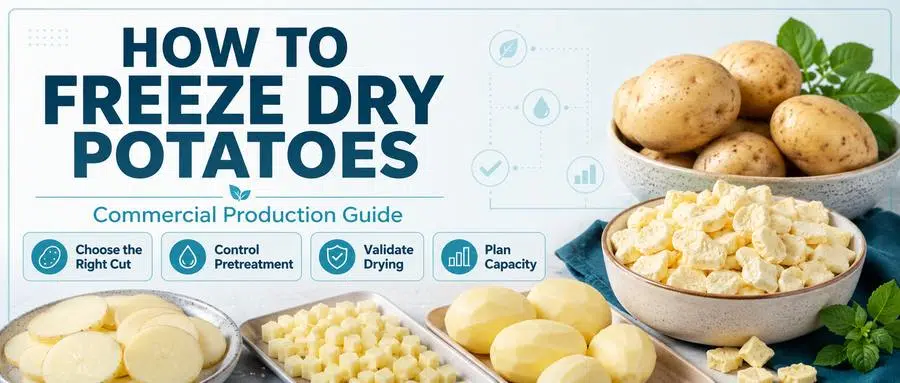
How to freeze dry potatoes at commercial scale depends on the potato format, raw-material condition, pretreatment, loading, drying profile and release specification. A repeatable process is not a single home recipe. It is a product and equipment test that can be converted into a defensible batch capacity and quotation basis.
Potatoes can be processed as slices, cubes, shreds, cooked pieces or mashed products. Each format changes cutting, freezing, heat and mass transfer, handling and rehydration. The production route should therefore follow the target SKU instead of using one universal potato recipe.
Can Potatoes Be Freeze Dried?
Yes. Potatoes can be freeze dried, but the factory should define the intended product before process development. A snack slice, soup cube, hash-brown shred, instant mashed potato and ingredient powder do not require the same preparation or finished texture.
For commercial production, the main product forms are:
- Slices: useful when shape retention and visible piece identity matter.
- Cubes or dices: suitable for soups, meal components and ingredient applications.
- Shreds: relevant to hash-brown and quick-cooking applications.
- Cooked pieces: useful when rapid rehydration and ready-meal performance matter.
- Mashed potato: suitable for instant puree, meal systems and powder-style applications after further size reduction.
The choice changes the moisture path through the product, tray loading, drying behavior and rehydration. For a food manufacturer asking how to freeze dry potatoes, the first decision is therefore the target SKU. The factory should lock the product form before comparing cycle time or equipment capacity.
For the wider vegetable framework, see the site’s commercial vegetable freeze-drying guide. That page remains the general vegetable hub; this page owns the potato-specific process and buyer decisions.
Raw vs Blanched vs Cooked Potatoes
Raw potato minimizes thermal preparation, while blanching or cooking may help control enzyme activity, color, texture and rehydration. Heat treatment also changes starch structure and can change the final bite. The development team should select the route through a controlled comparison against the finished SKU.
| Route | Main advantage | Main process risk | Development focus |
|---|---|---|---|
| Raw | Simple preparation and less thermal exposure | Browning, uneven texture or weaker rehydration depending on product form | Color control, cut size and final cooking application |
| Blanched | Can support enzyme and color control | Over-treatment can soften pieces or change texture | Blanch severity, cooling and surface-water removal |
| Cooked | Can improve convenience and shorten end-user preparation | Structure may become fragile during drying and handling | Cooking endpoint, piece integrity and rehydration |
| Mashed | Fast reconstitution and flexible portioning | Layer depth and formulation strongly affect drying behavior | Solids content, layer thickness, seasoning and reconstitution target |
How to Freeze Dry Potatoes: Commercial Process
The following sequence shows how to freeze dry potatoes in a commercial development workflow. Each step should be documented so the trial can later support batch-capacity and equipment decisions.
1. Receive and Sort the Potatoes
A consistent batch starts with consistent raw material. The factory should define variety, maturity, defect tolerance, storage condition and intended solids profile. Mixed raw material can create differences in color, texture, water removal and final yield.
2. Wash and Peel
Washing should remove soil and foreign material before clean cutting and preparation steps. Peeling depth should remain consistent because excessive trimming changes yield, while incomplete peeling may affect appearance and product specification.
3. Control Cut Size
Uniform geometry matters because the center of a thick piece has a longer moisture-removal path than the surface. The factory should specify slice thickness, cube dimensions or shred size and keep that geometry consistent during testing and production.
Cut size also affects tray loading. Small pieces may pack more densely, while large pieces create a lower bulk density but a longer internal drying path. Capacity should not be estimated from tray count alone.
4. Evaluate Anti-Browning and Blanching
Freshly cut potato surfaces can discolor during handling. Enzyme activity and pretreatment influence final color and texture, so a commercial process should compare untreated, blanched and other permitted routes under controlled conditions.
The factory should not copy additive concentrations from another plant without checking local food regulations, product labeling and the destination market. The development trial should record the exact treatment, contact time, temperature and sensory result.
5. Cool and Remove Excess Surface Water
If potatoes are blanched or cooked, controlled cooling helps stop further heat treatment. Operators should then remove excess surface water before loading. Otherwise, the freeze dryer must remove water that does not contribute to the product, which can increase condenser load and extend the cycle.
6. Pre-Freeze and Load the Trays Consistently
Complete and repeatable freezing establishes a consistent starting condition. During loading, the plant should record prepared wet mass, usable shelf area, product thickness and wet loading density in kg/m².
A single-layer presentation may improve uniformity for larger slices, while smaller dices or shreds may allow a different practical load. The correct value should come from product testing, not from the maximum physical tray depth.
Freezing history matters: A study of 30% coffee granules found that freezing parameters changed internal pore structure and freeze-drying kinetics.[5] The material was not potato, so its temperatures and rates should not be copied. The useful commercial lesson is to record freezing method, product thickness and edge-to-center temperature during potato trials instead of treating “fully frozen” as the only relevant starting condition.
7. Control Primary and Secondary Drying
During primary drying, frozen water leaves the product mainly by sublimation. Secondary drying removes more strongly bound residual moisture. Product temperature, shelf heat, absolute pressure, vapor resistance and condenser performance all affect the drying path.[4]
8. Verify the Drying Endpoint
A machine timer does not prove that every potato piece is dry. The factory should sample representative tray positions and check the written product specification. Depending on the product, release checks may include final moisture, water activity, center dryness, color, texture, bulk density and rehydration.
For a documented acceptance protocol covering production equipment and validation stages, see the site’s food freeze-dryer validation guide.
9. Package the Product Quickly
After drying, the porous product can pick up moisture from surrounding air. The plant should package the product after the validated release step without unnecessary exposure. Barrier performance, seal integrity, pack size, oxygen management and shelf-life targets should match the final product specification.
The site’s freeze-dried food packaging guide explains barrier, sealing and storage decisions in more detail.
What Controls Potato Freeze-Drying Time?
There is no reliable universal answer to “how long do potatoes take to freeze dry?” for commercial production. A practical cycle depends on the product and the machine working together. Food freeze-drying reviews describe the same dependency: freezing, primary drying and secondary drying respond to material composition, geometry, heat transfer, mass transfer and the product quality limit.[4]
The main variables include:
- potato variety and solids content;
- raw, blanched, cooked or mashed condition;
- slice thickness, dice size or layer depth;
- wet loading density per square meter;
- initial freezing condition and ice structure;
- product temperature during drying;
- shelf heat transfer;
- absolute chamber pressure;
- vapor resistance inside the product;
- condenser loading and refrigeration performance; and
- the required final moisture and quality endpoint.
Household cycle times should not be copied into a factory capacity proposal. A commercial processor should use comparable historical data to establish a test range and then verify the potato cycle under the intended cut size and loading condition.
For the difference between drying-stage time and full production turnaround, see the commercial freeze-drying time chart. That page is the site’s general time reference; this page keeps the explanation potato-specific.
How to Calculate Potato Yield and Production Capacity
Capacity planning should begin with measured material balance, not chamber volume. The first useful number is prepared wet potato per batch. The second is how much water that batch requires the system to remove.
Usable shelf area × validated wet loading density = prepared wet potato per batch
Step 2 – Dry solids
Wet mass × (1 - initial moisture fraction) = dry solids
Step 3 – Estimated final product mass
Dry solids ÷ (1 - target final moisture fraction) = final product mass
Step 4 – Approximate water removal
Wet mass - final product mass = water removed
Illustrative example only: Assume a validated test loads 240 kg of prepared potato at 80% initial moisture and the product specification targets 2% final moisture. The batch contains 48 kg of dry solids. The estimated final product mass is about 49.0 kg, while the system must remove about 191.0 kg of water.
This example is a mass-balance demonstration, not a guaranteed potato yield or a customer case result. Real yield changes with potato solids, peeling loss, trimming, cooking, pretreatment and the final moisture specification. The factory should replace every assumed value with measured production data before equipment purchase.
Therefore, daily throughput depends on verified batch capacity and full turnaround, including loading, vacuum establishment, drying, unloading, defrosting and preparation for the next batch.
Prepared wet kg per batch × validated batches per day = daily wet processing capacity
Quality Control for Freeze-Dried Potatoes
A production batch should pass a written acceptance specification instead of relying on appearance alone. The exact limits depend on the SKU, but a commercial QC plan can include:
- Final moisture: confirms that the product reaches the defined release condition.
- Water activity: supports product stability and shelf-life evaluation.
- Center dryness: catches thick or uneven pieces that remain wet internally.
- Color: monitors browning and pretreatment consistency.
- Piece integrity: shows whether the product is cracking or breaking during processing.
- Bulk density: supports packaging and shipping calculations.
- Rehydration time and ratio: measure performance in the final application.
- Tray-position consistency: reveals uneven heat transfer or loading.
- Seal integrity: protects the dry product after release.
For a new SKU, the team should finalize acceptance limits during pilot development and carry them into routine batch records. Cultivar, lot, dry matter and pretreatment should be recorded with the batch because potato quality is not independent of raw material.
Common Potato Freeze-Drying Problems
| Problem | Possible cause | What the plant should check |
|---|---|---|
| Browning | Long exposure after cutting, unsuitable pretreatment or raw-material variation | Cut-to-treatment time, pretreatment method, temperature and potato variety |
| Wet center | Pieces are too thick or the cycle ends before the center reaches specification | Geometry, product temperature, endpoint method and representative sampling |
| Uneven drying | Inconsistent loading or tray distribution | kg/m², layer depth, tray position and vapor path around the load |
| Excessive breakage | Over-softening before drying or fragile dried structure | Blanch or cook severity, handling and packaging process |
| Poor rehydration | Product structure or pretreatment does not match the intended application | Raw vs cooked route, piece size, drying endpoint and rehydration method |
| Cycle is too long | High water load, dense loading, difficult geometry or limited system performance | Wet load, water removal, cut size, condenser condition, vacuum stability and heat transfer |
| Moisture pickup after drying | Long open exposure or inadequate packaging barrier or seal | Unload-to-pack time, packaging material, sealing and storage conditions |
From Pilot Test to Commercial Production
A potato sample that looks acceptable after one batch is not enough to size a factory line. Scale-up requires a repeatable process record. The engineering team should know which inputs remain fixed and which values change when shelf area increases.
Lab or Pilot Stage
The development stage should define the potato format, cut size, pretreatment, loading range, product quality target and initial cycle. It should also record pressure, shelf conditions, product temperature, condenser behavior, drying time, final moisture and rehydration.
Commercial Stage
Once the product is repeatable, the plant can connect validated kg/m² loading with batch turnaround, labor, defrosting and packaging speed. This is the point where realistic daily output becomes easier to calculate.
Industrial Stage
Larger projects must also account for refrigeration capacity, water removal, vacuum-system configuration, utilities, material handling, cleanable production flow, service access and production scheduling. At this scale, a small change in batch turnaround can materially change annual output.
Projects that still lack repeatable product data should start with the food R&D and pilot freeze-dryer guide before final commercial sizing.
How to Size a Freeze Dryer for a Potato Project
The equipment decision should follow the product definition. A useful supplier inquiry should provide enough information to calculate shelf area, water-removal load and realistic batch demand.
The buyer should prepare:
- potato product form: slices, cubes, shreds, cooked pieces or mash;
- cut size or wet layer depth;
- raw, blanched or cooked process route;
- prepared wet kg per batch or required wet kg per day;
- measured initial moisture or solids if available;
- required final product condition;
- planned operating hours and shifts per day;
- pack size and packaging method;
- available electricity, cooling water, steam or other utilities; and
- destination country and installation constraints.
With these inputs, the supplier can compare the project against lab or pilot, commercial and industrial machine classes. Buyers who already have confirmed product data can use the commercial food freeze-dryer capacity and water-load guide and the freeze-dryer condenser guide for the wider equipment decision.
Planning a Commercial Freeze-Dried Potato Product?
The engineering team can review the product form, prepared wet load, cut size, target daily output, packaging plan, destination country and available utilities. The resulting discussion can be tied to shelf area, water removal, batch turnaround and a suitable machine class instead of an assumed chamber size.
When Does Freeze Drying Potatoes Make Commercial Sense?
Freeze drying is most attractive when the final product can justify the process through quality, low shipping weight, rapid rehydration, premium positioning or a specific functional use. Potential applications include premium instant meals, lightweight outdoor foods, emergency foods, high-value meal components and specialty ingredients.
However, not every potato product needs freeze drying. If the market only requires a low-cost commodity dried ingredient, another drying method may offer a lower processing cost. A responsible equipment decision should compare product value, required quality, energy use, packaging, labor and expected sales volume before investment.
Frequently Asked Questions
Can raw potatoes be freeze dried?
Yes, raw potatoes can be freeze dried. However, the factory should test color, texture, final cooking performance and rehydration before choosing the raw route. Blanching or cooking may produce a better result for some SKUs.
Do potatoes need to be blanched before freeze drying?
Not every potato product needs the same pretreatment. Blanching is commonly evaluated because it can help control enzyme activity, color and texture. The correct treatment should be confirmed against the target product and local regulations rather than copied from another recipe.
How long does it take to freeze dry potatoes?
There is no universal commercial potato cycle time. Cut size, pretreatment, loading density, freezing condition, product temperature, pressure, heat transfer, condenser load and the required endpoint all affect the result. A factory should establish the actual time through pilot or production testing.
Why do cut potatoes turn dark?
Cut surfaces can discolor during handling because damaged tissue reacts with oxygen and because potato variety and pretreatment affect color stability. Fast handling and a validated anti-browning or blanching strategy can help control the final appearance.
Can mashed potatoes be freeze dried?
Yes. Mashed potato can be developed as a freeze-dried product, but layer depth, solids content, seasoning, fat and the required reconstitution behavior should remain consistent during testing.
How much weight do potatoes lose during freeze drying?
The weight loss depends mainly on initial water content, preparation losses and the final moisture specification. The most reliable answer comes from mass balance using the measured solids of the actual prepared potato product.
How should freeze-dried potatoes be packaged?
The plant should package the product soon after release in a validated moisture-barrier system. The final package should match the required shelf life, oxygen exposure, pack size, transport conditions and product specification.
What size freeze dryer is needed for commercial potato production?
The required size depends on validated wet kg/m² loading, prepared wet kg per batch, water-removal load, full batch turnaround and target daily throughput. Product testing should come before final equipment sizing.
Conclusion
A reliable answer to how to freeze dry potatoes starts with the product, not the machine. The processor should define potato form, cut size, pretreatment, loading and final quality; verify the drying endpoint; then convert the tested batch into water load and daily capacity. This approach gives commercial buyers a clearer basis for investment and gives the supplier better information for a responsible equipment recommendation.
References
- Répás, Z.; Nagy, R.; Polgár, Z. G.; Győri, Z. Study to Determine the Nutritional Characteristics of Potato Varieties that Are Suitable for the Application of the Freeze-Drying Process. Potato Research. 2025;68:2237-2259. DOI: 10.1007/s11540-024-09827-9
- Dankar, I.; Haddarah, A.; Pujolà, M.; Sepulcre, F. Hydrogen Bond Integration in Potato Microstructure: Effects of Water Removal, Thermal Treatment, and Cooking Techniques. Polysaccharides. 2024;5:609-629. DOI: 10.3390/polysaccharides5040039
- Oikonomopoulou, V. P.; Krokida, M. K. Structural Properties of Dried Potatoes, Mushrooms, and Strawberries as a Function of Freeze-Drying Pressure. Drying Technology: An International Journal. 2012;30(4):351-361. DOI: 10.1080/07373937.2011.639475
- Nowak, D.; Jakubczyk, E. The Freeze-Drying of Foods-The Characteristic of the Process Course and the Effect of Its Parameters on the Physical Properties of Food Materials. Foods. 2020;9(10):1488. DOI: 10.3390/foods9101488
- Levin, P.; Meunier, V.; Kessler, U.; Heinrich, S. Influence of Freezing Parameters on the Formation of Internal Porous Structure and Its Impact on Freeze-Drying Kinetics. Processes. 2021;9(8):1273. DOI: 10.3390/pr9081273
- Food and Agriculture Organization of the United Nations (FAO). Fruit and Vegetable Processing – Processing Flow-Sheet for Dried/Dehydration Potatoes. FAO processing reference.
- U.S. Food and Drug Administration. FSMA Final Rule for Preventive Controls for Human Food. FDA official guidance.

Technical author and reviewer
Zheng Wei is a freeze-drying engineer with experience in commercial and industrial food freeze-dryer selection, product-trial evaluation, process development, capacity planning, scale-up and project configuration.
Equipment specifications, commercial proposals and final project documents are issued by Fuzhou Xing Shun Da Refrigeration Facility Project Co., Ltd. according to the confirmed product, utilities, selected configuration, test basis and contractual scope.