
Freeze Dryer Thailand: Commercial & Industrial Food Equipment Buying Guide
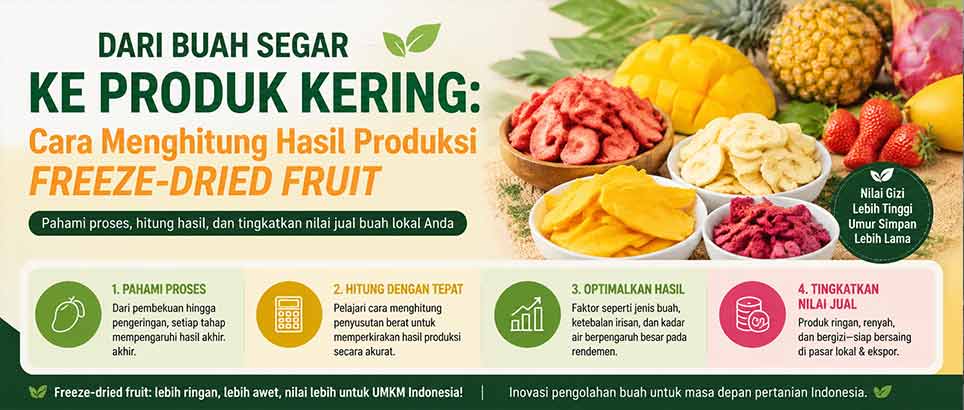
Choosing a freeze dryer in Thailand should begin with the product, wet-material throughput, water removal, cycle basis, factory utilities and installation plan—not tray count or a single quoted “kg per batch” figure. This guide is for Thai food manufacturers, agricultural processors, seafood companies, pet-food producers and project teams evaluating commercial or industrial freeze-drying capacity.
What Type of Freeze Dryer Does a Thailand Food Business Need?
A freeze drying machine in Thailand may support laboratory development, early commercial production or a factory-scale line. A pilot unit used to validate a durian recipe should not be assessed with the same criteria as an industrial system expected to process several tons of seafood or pet-food ingredients per day.
| Project stage | Typical requirement | Equipment direction | Main decision |
|---|---|---|---|
| R&D / product validation | Small controlled batches | Pilot freeze dryer | Validate recipe, thickness, loading, endpoint and final quality |
| Early commercial production | Repeatable batches for market sales | Commercial freeze dryer | Match wet-material throughput to sales demand and utilities |
| Established food factory | Stable daily production | Commercial or industrial | Balance capacity, water load, utilities, labor and batch turnover |
| Large export / ingredient project | Multi-ton daily wet-material load | Industrial freeze dryer | Plan steam, power, floor load, logistics and expansion |
Buyers comparing a commercial freeze dryer in Thailand can start with the commercial range. Projects above commercial scale should review the industrial range. The broader freeze-dryer machine buyer guide covers general equipment-selection logic; this page adds Thailand-specific procurement, installation and regulatory context rather than duplicating a product catalogue.
Which Thai Food Products Should Be Tested?
Equipment selection is similar across food categories, but process load is not. Product structure, sugar, fat, solids, initial moisture, piece size and target texture influence heat transfer, water removal, cycle time and packaging requirements.
Tropical fruit
Durian, mango, pineapple and dragon fruit are logical candidates for premium freeze-dried products. Soft or high-sugar fruit may need product-specific pretreatment and cycle development because stickiness, deformation and collapse risk can change as solids concentrate.
Seafood, meat and pet food
Shrimp, fish, meat and pet-food products can vary significantly in fat level, shape, thickness and microbial-control requirements. Useful capacity evidence should come from actual loading trials rather than a generic tray count.
Vegetables, herbs and ingredients
Vegetable pieces, herbs, soups and food ingredients should be checked against target final moisture, rehydration, bulk density, breakage and packaging performance before production capacity is finalized.
Food freeze-drying is a sequence of freezing, primary drying and secondary drying. The product’s composition, layer thickness, freezing history and critical temperature affect structure, drying resistance and quality, so a general time or pressure cannot be transferred safely to every food.[1]
Freezing is not just a pre-step. In a study of high-solid coffee and gum-arabic systems, freezing history changed ice-crystal structure, pore pathways and rehydration behavior; the authors also found that the response depended on formulation.[2] For a Thai fruit, seafood or pet-food project, the practical action is to test the actual product and loading pattern before promising cycle time or texture.
How to Calculate Freeze-Dryer Capacity and Water Removal
A reliable food freeze dryer Thailand project should be sized from production demand backward. Start with daily wet raw material, then translate moisture into water load and check whether the proposed system can handle both total ice and peak vapor generation.
- Define wet material per day. Record the product form, kg/day, expected batches and operating days.
- Define the practical batch window. Commercial product pages list 8–15 hours as a planning reference for many food products, but actual time depends on product and process conditions.
- Confirm loading geometry. Tray area is meaningful only after slice thickness, fill depth and loading density are validated.
- Calculate water removed. Initial moisture and target final moisture determine the total water that must ultimately be captured.
- Check peak vapor load. A condenser can hold the batch water and still restrict a cycle if capture rate, refrigeration duty or vapor path is inadequate at the highest-load stage.
- Check batch turnover. Loading, unloading, freezing, defrost and sanitation time determine how many practical batches fit into a day.
- Add operating margin. The sales plan should not depend on perfect loading and zero downtime every day.
Water Balance Example
Final product mass = dry solids ÷ (1 − target final moisture fraction)
Water removed = wet mass − final product mass
Illustrative calculation: 500 kg of wet material at 80% initial moisture contains 100 kg of dry solids. At 3% final moisture, the final product mass is about 103.1 kg and the batch removes about 396.9 kg of water. This is a water-balance input, not a machine-capacity guarantee. The freeze dryer condenser guide explains why usable ice capacity and peak condensing rate must be checked separately.
Why Peak Vapor Load Matters
Process-design research shows that dryer performance can be limited by vapor-flow restrictions or condenser capacity and that maximum sublimation rate is equipment-specific.[3] For buyers, the practical question is therefore: what product, water load, pressure, heat input, test duration and safety margin support the supplier’s condenser claim?
For broader planning, compare the batch freeze-dryer capacity guide and the freeze-drying time guide. A machine advertised as “500 kg” should not be purchased until the buyer confirms whether that means wet feed per batch, wet feed per 24 hours, water capture or a theoretical maximum.
Need a Capacity Check Before Comparing Prices?
Send the product, wet-material target, thickness, moisture range, expected loading, factory location and utilities. The engineering review can then screen water balance, condenser load, pilot versus commercial scale and quotation assumptions.
Send Project Data for ReviewReal Thailand Project: 390 kg of Durian per Batch in Rayong
First-hand project data is more useful than an unqualified capacity claim. In a documented project in Rayong Province, Thailand, an SDG1100 system with 30 m² of drying area processed approximately 390 kg of frozen-and-cut fresh durian per batch.
The project page also reports a 30–90 Pa working vacuum range, condenser capture of 2 kg water/m²/hour, approximately 60 kg water/hour total condenser capacity, 1.73 kWh/kg fresh material and five customized units ordered in separate batches. These are case-specific results, not guaranteed values for every product or site.
The useful lesson is not that every 30 m² machine will process 390 kg of every food. It is that capacity becomes meaningful when product, pretreatment, loading density, drying area, cycle time, water removal and final moisture are reported together. In this project, durian was frozen before cutting to improve handling of soft, sticky pulp.
Review the full Thailand freeze-dried durian case study for the original project context. The case is development and commercial evidence, not a universal operating recipe.
Planning a durian, mango, seafood or pet-food project in Thailand? Project teams can submit the product and daily wet-material target for an initial capacity review.
Commercial vs. Industrial Freeze Dryer for Thailand Projects
Current product specifications list approximately 340 kg–1.36 tons of wet material per 24 hours for the commercial range and approximately 1.2–8 tons per 24 hours for the industrial range. Actual throughput remains product-dependent, so the table below is a planning comparison rather than a universal capacity guarantee.
| Selection factor | Commercial system | Industrial system |
|---|---|---|
| Typical wet-material scale | About 340 kg–1.36 t / 24 h | About 1.2–8 t / 24 h |
| Best fit | Food brands, agricultural processors and medium batch production | Large food factories, seafood, pet food, meat and ingredient plants |
| Heating / utility planning | Primarily electric commercial production | Electric power plus steam-supported industrial planning |
| Installation planning | Equipment space, power, water, drainage and maintenance access | Factory-level steam, power, drainage, lifting, logistics, floor load and civil coordination |
| Expansion question | Can future demand still fit batch production? | Does the factory need multi-ton stable daily throughput? |
Choose the production category first and the exact model second. Check complete model data on the freeze dryer specifications guide; do not turn a country page into a duplicate product catalogue.
Freeze Dryer Price in Thailand: Evaluate Total Project Cost
A useful freeze dryer price Thailand comparison includes the entire delivered and installed project. A low equipment price can be misleading when utilities, shipping, commissioning or site work are omitted.
- Equipment, options and documented capacity basis
- Export packing, freight and cargo insurance
- Destination handling and inland transport
- Import-related charges and taxes, where applicable
- Electrical, cooling, steam, drainage and civil preparation
- Installation, commissioning and operator training
- Recommended spare parts and maintenance documentation
- Travel, accommodation and local lifting when site service is required
Freight, customs treatment, taxes and local service costs can change. A Thailand buyer should confirm them with the relevant logistics provider, customs adviser and local authorities at quotation stage. Each supplier should state what is included, excluded and assumed, using the same delivery basis for comparison. For the generic cost framework, see the freeze dryer price and total-cost guide; this country page keeps the focus on Thailand delivery and site conditions.
Factory, Utilities and Thai Regulatory Planning
A commercial or industrial freeze dryer affects factory layout long before the machine arrives. Thai project teams should review equipment access, floor space, clear height, power distribution, cooling, water, drainage, ventilation, maintenance access and product flow during model selection.
Factory layout and utilities
- Confirm unloading route, door dimensions, clear height, rigging and lifting access.
- Reserve service clearance for refrigeration, vacuum, condenser and control systems.
- Verify site voltage, frequency and available electrical capacity before final electrical design.
- Plan cooling water, defrost water and drainage for the proposed operating schedule.
- For industrial systems, confirm steam availability, pressure and boiler capacity where required.
- Separate raw-material preparation, freezing, drying, unloading and packaging flows as the food-safety plan requires.
The freeze dryer installation and setup guide provides model-level planning references. Final civil, electrical and utility work should use approved project drawings.
Thai food-premises requirements
The Thai Food and Drug Administration guidance for food production states that food production for sale in Thailand requires the applicable license and that production premises must meet GMP criteria. The Thai FDA’s GMP guidance describes basic requirements intended to prevent food-safety risks.
Requirements can depend on the business, food category and premises. The project team should confirm the latest approvals with the Thai FDA or the relevant Provincial Public Health Office before finalizing the factory plan. Equipment selection does not replace the site’s HACCP, sanitation, traceability or product-specific validation work.
How to Compare Freeze-Dryer Suppliers for a Thailand Project
The strongest supplier review focuses on evidence and definitions. Buyers should be able to trace every important capacity or performance statement to a product basis, test condition, specification or project reference.
1. Ask for product-specific evidence
The proposal should identify the food, product dimensions, pretreatment, wet load, loading density, target final moisture, cycle basis and endpoint method. Product-specific evidence is stronger than a generic “suitable for all foods” statement.
2. Treat cycle time as a tested result, not a timer setting
Food freeze-drying research has adapted process-monitoring methods to tray-loaded liquids and foods, reinforcing the need to confirm drying progress with process evidence rather than relying on a programmed timer alone.[4] Ask for the complete batch timeline, including freezing, loading, primary drying, secondary drying, endpoint confirmation, unloading and defrost. A listed 8–15-hour drying reference is not a guarantee for an untested Thai product.
3. Check usable drying area, not tray count alone
Tray count is easy to market but incomplete for scale-up. Usable drying area, loading density, product thickness and water balance are better production-planning inputs.
4. Check condenser water-removal capacity
Ask for total usable ice capacity, peak condensing rate, loaded condenser temperature, vapor-path design and defrost-to-ready time. A pump name or no-load cold temperature does not describe the complete chamber, condenser and piping behavior.
5. Check vacuum, refrigeration and heating under load
The supplier should identify the vacuum-pump configuration, absolute-pressure measurement method, heating design, product-temperature strategy and maintenance requirements. A low ultimate-vacuum figure alone does not prove stable loaded production.
6. Define FAT, installation, commissioning and SAT
The quotation should state which empty-machine checks and loaded-product tests are performed before shipment or acceptance, what the customer must prepare on site, who completes installation and commissioning, and what operator training is included.
7. Confirm spare parts and long-term support
Commercial food production needs planned maintenance. The supplier should provide critical-spares recommendations, manuals, troubleshooting routes, warranty terms and a clear technical-support responsibility matrix.
A broader due-diligence checklist is available in the freeze dryer manufacturer selection guide.
Final Moisture, Packaging and Food-Safety Controls
Final moisture is important, but it is not the only release criterion. Product structure, water activity, glassy-state stability, oxygen and moisture ingress, packaging seal quality, handling breakage and storage conditions can all affect commercial quality.
Food freeze-drying literature links the porous structure created during sublimation with rehydration performance, while excessive heat or unsuitable process conditions can cause shrinkage, color change or collapse. It also notes that final moisture alone does not describe storage stability; packaging and moisture uptake must be controlled.[1]
- Define the product quality target: appearance, texture, rehydration and final moisture.
- Define product-specific final-moisture, rehydration, packaging and shelf-life verification where required.
- Use moisture-barrier packaging and verify sealing, headspace and storage conditions.
- For meat, seafood and pet food, integrate the dryer into HACCP and microbial-control procedures.
- Do not present freeze drying itself as a universal pathogen-kill step.
- Link release criteria to a documented product test, not to a programmed timer alone.
For post-drying planning, review the freeze-dried food packaging guide and freeze-dried food shelf-life guide.
Buying Locally vs. Direct Manufacturer Supply in Thailand
There is no universally better procurement route. The correct choice depends on project scale, engineering support, customization, local coordination and the buyer’s ability to manage international logistics.
| Factor | Local supplier / distributor | Direct manufacturer supply |
|---|---|---|
| Communication and local coordination | May simplify routine local service and site coordination | Requires clear cross-border project coordination |
| Equipment range | Depends on locally represented models | May provide broader commercial and industrial customization |
| Engineering customization | Depends on distributor capability and responsibility boundaries | Can be coordinated directly with the design and manufacturing team |
| Shipping and import work | May be handled locally | Must be assigned clearly between buyer, forwarder and supplier |
| Best comparison method | Compare total delivered scope, validated capacity, installation responsibility and after-sales support—not country of origin alone. | |
Information to Prepare Before Requesting a Freeze-Dryer Quotation in Thailand
A high-quality quotation can only be as accurate as the project information supplied. Prepare the following before requesting a commercial or industrial freeze-dryer proposal:
- Product name, photos and intended market
- Fresh raw material, kg/day and expected batch pattern
- Piece size, slice thickness or layer depth
- Initial moisture or solids, if known
- Target final moisture, texture and rehydration result
- Expected hours, batches per day and production schedule
- Factory location in Thailand and installation route
- Available floor area, clear height and floor loading
- Power, cooling water, drainage and steam conditions
- Target production start date, FAT/SAT and training expectations
Request a Thailand Freeze-Drying Project Review
Send the product, wet-material target, thickness, moisture range, factory location and available utilities. The engineering response can then focus on product-fit, water balance, condenser and vacuum requirements, commercial versus industrial scale, installation scope and quotation assumptions.
Request a Project ReviewFAQ About Freeze Dryers in Thailand
How much does a freeze dryer cost in Thailand?
There is no reliable single price for a commercial or industrial system. Cost depends on drying area, wet-material capacity, water load, condenser and vacuum configuration, utilities, controls, shipping, installation, commissioning and service scope. Compare total project cost rather than machine price alone.
What size freeze dryer is needed for 100–500 kg of food per day?
The daily wet-material target is only the first input. Product moisture, thickness, loading density, cycle time, water removal and practical batches per day must also be confirmed. Pilot testing is appropriate when the product process has not yet been validated.
Can a commercial freeze dryer process durian and mango?
Yes, these fruits can be evaluated for freeze drying, but the process should be developed for the specific product form, sugar level, thickness, loading density and target texture. The documented Rayong project provides real durian production data rather than a generic fruit claim.
Can an industrial freeze dryer be shipped to Thailand?
Industrial equipment can be supplied internationally, but the project should define packing, freight, destination handling, inland transport, unloading, installation responsibilities and local import procedures before shipment.
How long does commercial food freeze drying take?
Current commercial and industrial product specifications list 8–15 hours as a planning reference for many food products. Actual time depends on product structure, initial moisture, thickness, loading density, freezing condition, heating profile, vacuum condition, endpoint method and target final moisture.
Should a Thailand food factory choose a commercial or industrial freeze dryer?
Commercial systems generally fit stable batch production below factory-scale multi-ton output. Industrial systems become more appropriate when the project requires multi-ton daily throughput, steam-supported operation and full factory utility planning. Confirm the choice after product trials and a site review.
Technical Author
Zheng Wei — Freeze-Drying Systems Engineer
This article is based on food freeze-drying equipment engineering, product-scale planning and documented project data. Technical claims are separated from product-specific case results and regulatory guidance.
Company: Fuzhou Xing Shun Da Refrigeration Facility Project Co., Ltd. · About the manufacturer and engineering team
Technical, Regulatory and Literature References
- Thailand Durian Case Study — Rayong Province, 30 m² SDG1100. First-party project data; case-specific.
- Commercial Freeze Dryer Specifications — SDG350 / SDG700 / SDG1100. First-party planning data; product-dependent.
- Industrial Freeze Dryer Specifications — SDG1600 / SDG3000 / SDG6000. First-party planning data; product-dependent.
- Thai FDA — Production of Food for Sale.
- Thai FDA — Good Manufacturing Practice (GMP).
Academic references
- Nowak D, Jakubczyk E. The Freeze-Drying of Foods—The Characteristic of the Process Course and the Effect of Its Parameters on the Physical Properties of Food Materials. Foods. 2020;9(10):1488. https://doi.org/10.3390/foods9101488
- Malik N, Gouseti O, Bakalis S. Effect of freezing on microstructure and reconstitution of freeze-dried high solid hydrocolloid-based systems. Food Hydrocolloids. 2018;83:473–484. https://doi.org/10.1016/j.foodhyd.2018.05.008
- Tchessalov S, Maglio V, Kazarin P, Alexeenko A, Bhatnagar B, Sahni E, Shalaev E. Practical Advice on Scientific Design of Freeze-Drying Process: 2023 Update. Pharmaceutical Research. 2023;40:2433–2455. https://doi.org/10.1007/s11095-023-03607-9
- Pisano R, Barresi AA, Fissore D. Innovation in Monitoring Food Freeze Drying. Drying Technology. 2011;29(16):1920–1931. https://doi.org/10.1080/07373937.2011.596299