
Freeze Drying Beef Liver for Commercial Pet Treat Production
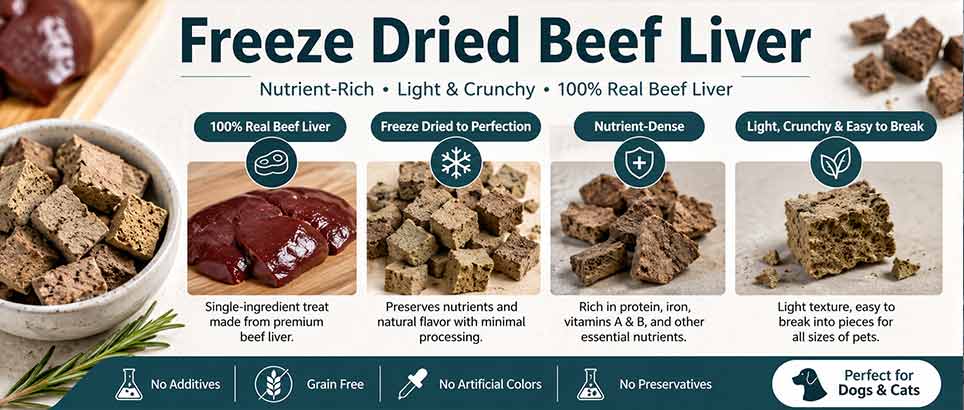
Freeze drying beef liver commercially requires more than placing sliced liver into a freeze dryer. A repeatable process connects raw-material control, slice or cube dimensions, raw or cooked status, pre-freezing, tray loading, drying endpoint, packaging, food safety and realistic wet-material capacity.
This guide is written for pet-treat manufacturers, meat processors, food factories and product-development teams that need to move from a beef-liver concept to a controlled pilot and then to commercial production. It is not a household freeze-dryer recipe.
Why Beef Liver Is a Strong Freeze-Dried Pet-Treat Product
Beef liver is attractive for single-ingredient pet treats because a small portion has a strong aroma and a distinct organ-meat identity. Freeze drying can create a light, dry product without the high air temperatures used by conventional hot-air dehydration. For a manufacturer, that creates an opportunity to convert a perishable raw material into a higher-value shelf-stable format when the process and package are properly validated.
However, liver should not be treated like lean muscle meat. Its structure, surface behavior, composition and oxidation sensitivity can change cutting, drying and storage performance. For commercial freeze drying beef liver, the correct development question is not simply “Can beef liver be freeze dried?” but “What product specification can be repeated batch after batch?”
Raw vs Cooked Beef Liver: Which Should Be Freeze Dried?
The answer depends on the intended product, regulatory market and validated food-safety plan. Raw liver can be developed for products that are intentionally marketed and controlled as raw animal food. Cooked liver can provide a more defined pretreatment before drying, but cooking alone does not eliminate the need for post-cook hygiene, environmental control, packaging protection and verification.
| Decision factor | Raw beef liver | Cooked beef liver |
|---|---|---|
| Product positioning | Raw-style animal food or treat where legally and commercially appropriate | Cooked single-ingredient treat or further-processed product |
| Safety emphasis | Incoming-material hazards, raw-zone sanitation and validated controls are critical | Validated cooking where applicable, then strong post-cook contamination control |
| Process repeatability | Raw-lot variability may influence handling and cycle behavior | Pretreatment can be standardized more easily if cooking conditions are fixed |
| Scale-up rule | Validate the exact raw product | Validate the exact cooked product and dimensions |
USDA consumer guidance lists 160°F (71.1°C) for organ and variety meats such as liver. A commercial pet-treat manufacturer should not treat that household recommendation as a substitute for its own validated process, regulatory requirements and food-safety plan. [10]
How to Prepare Beef Liver Before Freeze Drying
Preparation determines whether the later cycle is comparable from batch to batch. Before pilot testing, the processor should freeze the product specification on paper: source, chilled or frozen receiving condition, raw or cooked status, trimming rule, final shape, maximum dimension, tray-loading method and intended package.
For commercial work, “thin slices” is not an adequate specification. A process sheet should state the maximum thickness in millimetres and the acceptable size range. That single change makes pilot results much more useful for scale-up.
A 2025 study of raw beef liver found that repeated freeze-thaw cycles were associated with poorer sensory and water-holding results and higher TBARS and total viable counts. The study did not evaluate freeze drying, so its practical use here is limited to receiving, thawing and lot-control decisions rather than a freeze-drying recipe. [3]
How Thick Should Beef Liver Be for Freeze Drying?
For commercial freeze drying beef liver, there is no universal thickness that guarantees a successful cycle. Thicker pieces create a longer vapor path and increase the risk that the outside feels dry while the centre still contains too much moisture. Very thin pieces may dry faster but can become fragile, curl, break during handling or create excessive fines.
Freeze-drying studies on meat show why thickness and product condition must be tested together. A chicken-breast study identified sample thickness as critical to process conditions, while a separate meat freeze-drying study evaluated how product thickness and process parameters affected drying behavior within its tested ham and tenderloin products. Neither study establishes a beef-liver setting. [1][4]
The site’s published meat case used approximately 10 mm pieces; that is a project reference, not a promised beef-liver setting.
Should Beef Liver Be Pre-Frozen Before Freeze Drying?
Yes, the product must be fully frozen before the main sublimation stage. Commercial processors may pre-freeze loaded trays in a separate freezer or use an in-chamber freezing sequence, depending on the equipment and production layout.
Pre-freezing is also a throughput decision. If a separate freezer prepares the next batch while the freeze dryer is running, production scheduling can improve. However, the freezer must have enough capacity to freeze the thickest product centre consistently, and trays should move to the dryer without unnecessary warming or condensation.
The important specification is not “freeze for 24 hours.” It is a reproducible product condition before vacuum drying begins.
Freeze Drying Beef Liver: Commercial Process Steps
A commercial cycle should be built as a controlled sequence rather than a single temperature or vacuum number. For teams researching how to freeze dry beef liver, the sequence below is more useful than copying a home-machine preset.
1. Load a defined batch
Record product dimensions, total wet kilograms, kg/m2, tray count and distribution. Avoid overlapping pieces unless the loading pattern itself has been validated.
2. Freeze the product completely
Confirm the thickest representative pieces are frozen through before the main drying stage. Inconsistent freezing creates inconsistent drying behavior.
3. Establish vacuum and begin primary drying
Under vacuum, ice sublimes as controlled shelf heat supplies the energy required for vapor removal. Shelf temperature, product temperature, chamber pressure, dry-layer resistance and condenser performance must be considered together. Pressure alone cannot prove that the product is dry.
4. Continue through the late drying stage
As free ice decreases, the process must remove remaining bound or less-mobile water without overheating the product. The exact endpoint depends on the product specification and quality target.
5. Verify the endpoint before release
Check representative centres of the thickest pieces and compare moisture, texture, mass stability where appropriate and tray-to-tray variation. Then transfer the product to packaging quickly enough to limit moisture and oxygen exposure.
For a broader explanation of pressure, product temperature and batch records, use the freeze-dryer monitoring guide.
How Long Does It Take to Freeze Dry Beef Liver?
There is no responsible universal cycle time. When freeze drying beef liver, duration depends on thickness, shape, raw or cooked status, initial water, tray loading, pre-freezing, shelf-temperature program, vacuum performance, condenser load, final-moisture target and the actual endpoint test.
A published first-party meat case on this site reports approximately 12 hours for one specific 10 m2 meat project using approximately 10 mm pieces and 12.1 kg/m2 loading. That figure is useful as a scale reference, but it should not be advertised as a guaranteed beef-liver cycle. See the commercial time-planning guide for the distinction between drying-stage time and total machine cycle time.
How to Know When Freeze-Dried Beef Liver Is Completely Dry
A crisp surface is not enough. The processor should evaluate the location most likely to remain wet: the centre of the thickest representative piece and the trays that historically dry slowest.
- Representative centre inspection
- Final-moisture test
- Texture and breakage
- Color and odor
- Mass stability where useful
- Product-temperature history
- Pressure behavior
- Tray-to-tray consistency
- Condenser performance
- Batch-record completeness
If water activity is part of the company’s product-release or shelf-life program, it should be measured and interpreted within that validated specification. It should not be replaced by a generic internet target that has not been demonstrated for the product and package.
A precooked-beef study also evaluated texture after different plate-temperature and rehydration conditions, reinforcing that texture and rehydration are qualification outcomes rather than automatic consequences of low moisture. It was not a raw-liver or pet-treat study, so no treatment setting is transferred here. [2]
A 2024 pork study compared raw, frozen-thawed and freeze-dried-rehydrated meat using water activity, water-holding capacity, color, myoglobin, shear force and histology. The useful commercial lesson is that release should include a product-specific quality panel rather than crispness alone; the pork values are not beef-liver targets. [5]
For a formal loaded-run framework, see the food freeze-dryer validation guide.
Food Safety for Commercial Freeze-Dried Beef Liver Pet Treats
Food safety must be designed around the full process. Incoming raw liver can carry biological hazards, while a cooked product can be recontaminated after the heat step if zoning, sanitation, handling and packaging controls are weak.
For U.S. animal-food facilities that are required to register, FDA explains that the Preventive Controls for Animal Food framework in 21 CFR Part 507 includes current good manufacturing practice and, where applicable, hazard analysis and risk-based preventive controls. Manufacturers should determine their exact obligations from their facility, product and activities. [9]
- Control supplier approval, receiving temperature and lot traceability.
- Separate raw handling from post-treatment product where the process requires it.
- Validate any cooking or other kill step used as a preventive control.
- Control sanitation, employee practices, equipment surfaces and post-process exposure.
- Use appropriate verification, corrective-action and recordkeeping procedures.
- Protect finished product through validated packaging and storage.
For additional background, see why freeze drying should not be treated as sterilization.
Oxidation, Odor and Quality Problems in Freeze-Dried Beef Liver
Beef liver is not only a moisture-removal problem. Strong organ aroma, surface lipids, oxygen exposure and fragile dry structure can determine whether the finished treat remains acceptable after weeks or months in storage.
Research on freeze-dried beef and pork found that the porous dried structure and storage temperature were relevant to myoglobin degradation and lipid oxidation. The study used beef and pork rather than liver, so it supports the need for oxygen, package and storage testing, not a guaranteed liver shelf life. [6]
| Observed issue | What to investigate first |
|---|---|
| Rancid or stale odor develops | Raw-material freshness, oxygen exposure, package barrier, residual oxygen and storage temperature |
| Dark or uneven color | Pretreatment, oxidation before freezing, product temperature history and tray variation |
| Surface feels oily | Product composition, trimming specification, temperature history and package/storage conditions |
| Too much powder or breakage | Slice thickness, drying severity, unloading, conveying and package-fill method |
| Strong batch-to-batch odor variation | Supplier/raw-material variation, age of raw liver and pretreatment consistency |
Packaging Freeze-Dried Beef Liver
Once dry, beef liver can reabsorb moisture and can also be affected by oxygen. Packaging should therefore be developed together with the process, not selected after equipment purchase.
A commercial packaging plan should consider water-vapor barrier, oxygen barrier, sealing method, package headspace, residual oxygen where monitored, light exposure, storage temperature, distribution conditions and shelf-life testing. Nitrogen flushing or oxygen absorbers may be evaluated when appropriate to the product and packaging system, but they are not a substitute for good raw-material and process control.
The broader freeze-dried food packaging guide covers barrier selection, moisture pickup and packaging-line considerations in more detail.
From Pilot Testing to Commercial Beef Liver Production
A pilot has value only when the data can be used later. The engineering team should be able to reconstruct exactly what was tested and why the batch was accepted.
- Raw or cooked status
- Maximum thickness
- Wet weight per tray
- kg/m2 loading
- Initial moisture if available
- Pre-freezing condition
- Total cycle time
- Final moisture
- Dry yield
- Texture/breakage
- Color and odor
- Packaging result
When moving from pilot to commercial scale, the processor should preserve the important relationships rather than simply multiplying tray area. Product geometry, kg/m2 loading, heat input, pressure behavior, water removal, condenser capacity and endpoint logic all affect scale-up.
Before production acceptance, the processor should define loaded-run evidence for the product, process window and agreed project scope.
How to Calculate Freeze-Dryer Capacity for Beef Liver
Equipment should be sized from a validated process basis. Daily wet kilograms alone do not show how much usable shelf area or condenser capacity the project needs.
A simple screening example
If a beef-liver pilot eventually validates 10 kg/m2 and the project needs 100 kg wet input per batch, the first shelf-area estimate is about 10 m2. That calculation is only a starting point. The supplier must still confirm water load, cycle time, practical tray utilization, condenser performance, defrost and plant schedule. The freeze-dryer condenser guide explains why vapor load and condenser margin must be checked with shelf area.
The same 100 kg/day sales target can require very different equipment if the plant runs one long validated cycle per day versus two shorter cycles with reliable changeover. Therefore, a quotation should state its process assumptions instead of only listing a nominal “kg/day” capacity.
Commercial Meat Project Reference
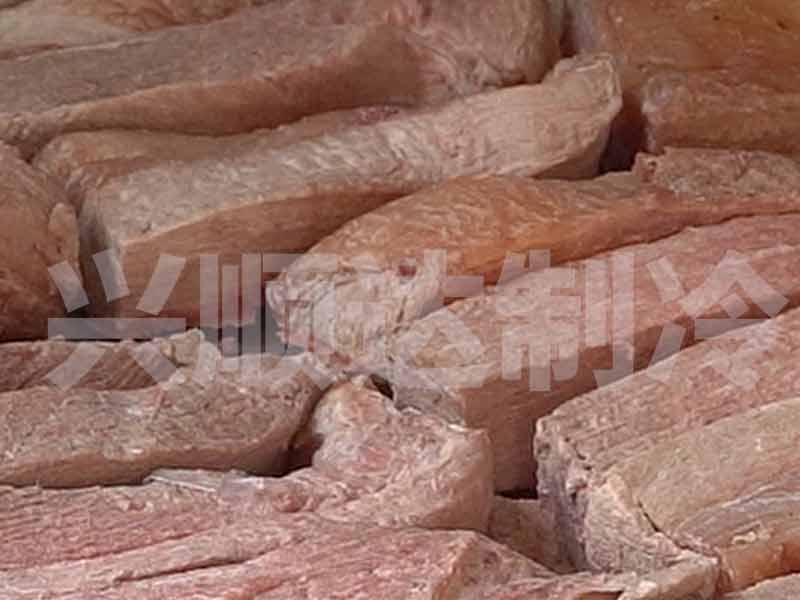
Because a dedicated first-party beef-liver production case is not being claimed here, the most relevant internal evidence is the published commercial meat case below. It demonstrates how geometry, loading, cycle time and endpoint data can be documented for scale-up.
The case reports approximately 121 kg wet material per batch, around 12 hours drying time and a chamber-pressure range of approximately 26–103 Pa for that specific meat project. These values should not be transferred automatically to beef liver.
Which Freeze-Dryer Size Fits Beef Liver Production?
Machine selection comes after product definition and pilot evidence. A lab or pilot unit is appropriate when thickness, raw/cooked status, loading, cycle and package are still being developed. Commercial equipment is appropriate when the process window is stable and the buyer can define realistic wet kg/batch and batches/day. Industrial systems require factory-level integration of freezing, loading, utilities, condenser management, defrost, unloading, packaging, cleaning and maintenance access.
- Lab / pilot: compare product trials before production scale.
- Commercial pet treats: use the pet-food and treat production guide for the equipment-level decision.
- Broader meat processing: the site’s commercial meat guide remains the owner of generic meat-process intent.
This page intentionally does not duplicate the full commercial-model comparison so that the beef-liver process keyword remains separate from the site’s equipment-buying pages.
Common Beef Liver Freeze-Drying Problems and Likely Checks
| Problem | Likely checks |
|---|---|
| Outside dry, centre soft | Maximum thickness, centre sampling, kg/m2, pre-freezing and cycle endpoint |
| Cycle takes much longer than expected | Thickness, wet loading, initial water, shelf program, vacuum performance and condenser load |
| Uneven trays | Cutting tolerance, tray loading pattern, product probes and shelf-to-shelf heat transfer |
| Oily or unstable product | Raw-material composition, trimming, temperature history, oxygen exposure and packaging |
| Product breaks into fines | Thickness, endpoint, handling, unloading and package-fill method |
| Rancid odor during storage | Raw-material freshness, oxygen barrier, residual oxygen, storage temperature and shelf-life validation |
| Vacuum is unstable | Door/gasket condition, product vapor load, vacuum system, condenser performance and leaks |
| Condenser overload | Wet kg/batch, actual water removal, loading density, cycle scheduling and defrost capacity |
Turn Beef Liver Trial Data Into a Capacity Basis
A preliminary engineering review can begin before a formal quotation. The useful inputs are the product itself and the production target, not a preferred machine model.
Send these six items
- Wet beef liver kg/day
- Raw or cooked product
- Slice/cube dimensions
- Target final moisture or release specification
- Package format and target shelf life
- Country, power supply and available utilities
The result is a preliminary model range, shelf-area basis, condenser/water-load review, utility checklist and pilot-data request. It is not a guaranteed production cycle until the product and process are validated.
FAQ: Freeze Drying Beef Liver
Can beef liver be freeze dried?
Yes. Beef liver can be developed as a freeze-dried pet-treat or ingredient product, but commercial success depends on consistent raw material, geometry, loading, endpoint verification, food-safety controls and packaging.
How do you freeze dry beef liver?
Standardize the liver, cut it to a controlled maximum thickness, load a recorded kg/m2, freeze it completely, run a validated vacuum-drying cycle, verify the thickest centres and package promptly in a qualified barrier system.
How to freeze dry liver for dog treats?
For beef liver, the commercial sequence is to define raw or cooked status, control thickness and loading, validate the drying endpoint, establish food-safety controls and qualify the package for the intended market and shelf life.
How thick should beef liver be for freeze drying?
There is no universal validated thickness. The pilot should compare a small number of controlled geometries and qualify the thickest-centre endpoint. Existing meat project data can guide trial design but should not be copied as a beef-liver standard.
Should beef liver be frozen before freeze drying?
Yes. The product should be frozen through before the main sublimation stage. Commercial operations may use separate pre-freezing or an in-chamber freezing sequence depending on the line design.
How long does it take to freeze dry beef liver?
Cycle time depends on thickness, loading, raw or cooked status, initial water, pre-freezing, shelf program, vacuum performance, condenser load and final-moisture endpoint. A specific meat case cannot be treated as a guaranteed beef-liver time.
Does freeze drying kill Salmonella in beef liver?
It should not be assumed to do so. Freeze drying is primarily a water-removal process. A manufacturer should use validated hazard controls appropriate to the product, facility and market rather than treating dryness as proof of pathogen elimination.
How should freeze-dried beef liver be packaged?
Use a package system qualified for moisture and oxygen protection, seal integrity, distribution conditions and target shelf life. Oxygen-management methods can be evaluated when appropriate, but they do not replace process control.
What size freeze dryer is needed for beef liver production?
Size it from validated wet kg/batch, kg/m2, water removal, cycle time, practical batches/day and utilities. Daily sales volume alone is not enough to select shelf area or condenser capacity.
Conclusion
Freeze drying beef liver becomes commercially useful when the process is defined well enough to repeat and scale. The key controls are product geometry, raw or cooked status, kg/m2 loading, complete freezing, endpoint verification, food safety, oxidation control and packaging. Once a pilot establishes those relationships, the same data can be converted into shelf area, condenser load, utilities and a realistic production schedule.
For buyers, that sequence also reduces equipment risk: first prove the beef-liver product, then size the freeze dryer around evidence rather than a nominal capacity claim.
References
- Ma, Y., Wu, X., Zhang, Q., Vigna, G., & Meng, X. (2018). Key composition optimization of meat processed protein source by vacuum freeze-drying technology. Saudi Journal of Biological Sciences. DOI: 10.1016/j.sjbs.2017.09.013.
- Ayrosa, A. M. E. B., & Pitombo, R. N. M. (2003). Influence of plate temperature and mode of rehydration on textural parameters of precooked freeze-dried beef. Journal of Food Processing and Preservation, 27, 173–180. DOI: 10.1111/j.1745-4549.2003.tb00510.x.
- Salam, M. A., Khatun, H., Akter, H., Ahmed, M. T., Hashem, M. A., & Khan, M. (2025). Effect of repeated freezing and thawing on the quality of beef liver. Meat Research, 5(03). DOI: 10.55002/mr.5.3.119.
- Babic, J., Cantalejo, M. J., & Arroqui, C. (2009). The effects of freeze-drying process parameters on broiler chicken breast meat. LWT – Food Science and Technology, 42, 1325–1334. DOI: 10.1016/j.lwt.2009.03.020.
- Coria-Hernández, J., & Meléndez-Pérez, R. (2024). Effect of the Freeze-Drying Preservation Process on Some Quality Attributes of Pork Meat (Longissimus thoracis). Food Science & Nutrition, 12, 10424–10432. DOI: 10.1002/fsn3.4598.
- King, V. A.-E., & Chen, J.-F. (1998). Oxidation of controlled low-temperature vacuum dehydrated and freeze-dried beef and pork. Meat Science, 48(1–2), 11–19. DOI: 10.1016/S0309-1740(97)00070-3.
- U.S. Food and Drug Administration. Get the Facts: Raw Pet Food Diets Can Be Dangerous to You and Your Pet.
- U.S. Food and Drug Administration. Get the Facts About Salmonella.
- U.S. Food and Drug Administration. How do I Start an Animal Food Business? Includes FDA guidance on the Preventive Controls for Animal Food framework in 21 CFR Part 507.
- USDA Food Safety and Inspection Service. Beef From Farm to Table. Includes consumer safe-cooking guidance for organ and variety meats such as liver.
- U.S. Food and Drug Administration. Foodynamics recall of certain freeze-dried pet treats because of potential Salmonella contamination. FDA publication date: October 9, 2025.
Technical author and reviewer
Zheng Wei is a freeze-drying engineer with experience in commercial and industrial food freeze-dryer selection, product-trial evaluation, process development, capacity planning and project configuration.
Equipment specifications, commercial proposals and final project documents are issued by Fuzhou Xing Shun Da Refrigeration Facility Project Co., Ltd. according to the confirmed product, utilities, selected configuration, test basis and contractual scope.