
Freeze Drying of Mushroom Products: Commercial Process, Yield and Equipment Sizing
Technically reviewed on
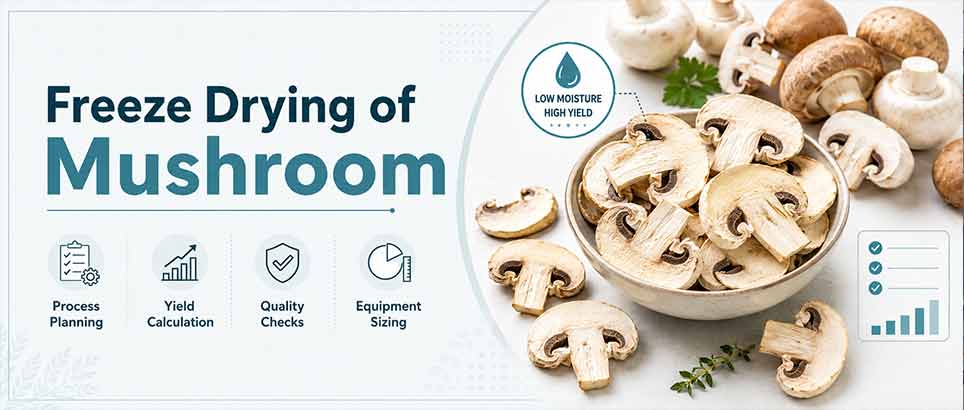
Commercial freeze drying of mushroom products should begin with the sale format and acceptance criteria—not a copied time-and-temperature recipe. For slices, dice, soup ingredients or powder, the practical sequence is to define the finished product, measure the prepared raw material, complete a representative pilot trial and then size the system around water removal, validated loading and batch turnaround.
This guide is for mushroom growers, ingredient processors, soup and ready-meal manufacturers, seasoning producers and project teams evaluating a higher-value dried product. It supports pilot planning and preliminary equipment sizing; however, it does not replace product-specific food-safety, packaging, shelf-life or commercial validation.
When is freeze drying of mushroom commercially justified?
Freeze drying is usually worth evaluating when colour, porous structure, rehydration, piece integrity or a premium ingredient position matters to the buyer. In contrast, it may not be commercially justified for a low-price conventional dried ingredient where hot-air drying already meets the required specification.
Therefore, the project should define the end use before comparing equipment. A visually intact retail slice, a soup ingredient and a powder do not have the same quality target or downstream process.
| Final format | What to validate first | Commercial question |
|---|---|---|
| Whole pieces or slices | Cut consistency, centre dryness, breakage, colour and rehydration | Does the appearance and recovery justify the additional processing cost? |
| Dice for soup or ready meals | Largest-piece dryness, batch uniformity and performance in the final recipe | Can the ingredient perform consistently after distribution and cooking? |
| Powder | Final moisture, milling behaviour, flow, moisture pickup and package protection | Can downstream handling preserve a stable, free-flowing ingredient? |
Commercial mushroom freeze-drying process
- Receive and grade. Separate species, maturity, size and damaged material. Record the lot condition after washing and trimming because this is the actual material entering the process.
- Standardize geometry. Use a defined slice thickness or piece-size range. Mixed geometry creates different freezing and vapour paths, so an apparently complete cycle may still leave moisture in the largest pieces.
- Test pretreatment rather than assuming it. Untreated and treated samples should be compared for colour, flavour, structure, rehydration and target-market requirements. Blanching or anti-browning treatment should not be adopted without product evidence.
- Freeze through the product centre. Surface hardness does not prove that the largest piece is fully frozen. Representative centre conditions should be confirmed during process development.
- Dry a documented load. Record wet mass per tray or square metre, product geometry, batch start and finish, product temperatures and the complete process record. These data are more valuable than an isolated chamber setpoint.
- Unload and package promptly. Porous dried mushrooms can regain moisture during unloading, milling and packing. Exposure time should be controlled, followed by a suitable barrier and seal. The wider packaging decision is covered in the freeze-dried food packaging guide.
Calculate yield and water-removal load before sizing equipment
Tray area alone is not capacity. A commercial discussion needs three separate values: prepared wet input, expected dry output and the water that must be removed.
Expected dry-product mass = wet material mass × initial solids fraction ÷ final solids fraction
Water to remove = wet material mass − expected dry-product mass
Illustrative calculation: 100 kg of prepared mushrooms at 10% solids, with a 2% final-moisture specification, gives a theoretical dry-product mass of approximately 10.2 kg and a theoretical water-removal load of approximately 89.8 kg.
This is a calculation example, not a yield promise. Solids should be measured after grading, trimming and any treatment before the plant commits to production capacity.
The preliminary equipment brief should then account for validated loading density, complete batch turnaround, condenser duty and downstream packaging capacity. The broader engineering logic is explained in the food freeze-dryer design guide.
First-party commercial mushroom project reference
Documented white-mushroom-slice project: A commercial project using an SDG3000 configuration with 100 m² of drying area processed approximately 1,200 kg per batch at a tested loading of 12 kg/m². The recorded drying cycle was approximately 11.5 hours, and final moisture reached 2.09%.
These figures belong to that white-mushroom product, preparation method, loading and equipment configuration. They are not a universal recipe for shiitake, oyster mushroom, whole mushrooms, thicker cuts or powders.
Project context and supporting images are available in the freeze-dried mushroom soup ingredient case study.
This project reference strengthens preliminary planning because it connects shelf area, loading, batch input, drying time and final moisture. Nevertheless, a new project still requires a representative trial before production guarantees are established.
What should a mushroom pilot trial prove?
| Record | Why it matters |
|---|---|
| Species, photos, cut size and largest-piece dimensions | Defines material variation and the hardest location to dry. |
| Prepared wet mass, initial moisture or solids and tray loading | Turns a product concept into a water-removal and shelf-area model. |
| Product temperatures, absolute pressure and batch record | Allows an acceptable result to be repeated without treating one setpoint as a universal recipe. |
| Final moisture, centre dryness, mass stability, appearance, breakage and rehydration | Creates a practical release specification connected to the intended use. |
| Packaging and storage test plan | Checks whether the packed product remains within its agreed condition during distribution. |
A single chamber reading is not a release decision. The largest pieces and different tray locations should be sampled. Projects still in development can begin with a pilot freeze-drying trial and then convert the accepted result into a food freeze-dryer validation plan.
How should a mushroom freeze dryer be sized?
Equipment selection should start with the required prepared wet input per day and the expected water-removal load. The engineering team should then confirm shelf area, batch duration, condenser capacity, defrost time and the number of practical production batches.
For example, two projects that both process 1,000 kg of fresh mushrooms may require different configurations when their cut size, solids, loading density, acceptable cycle time or packaging schedule differs. Therefore, a quotation based only on “kilograms per batch” is incomplete.
Once the product trial is accepted, buyers can compare the available commercial food freeze-dryer configurations. Larger daily requirements may instead need the capacity and utility analysis covered by the industrial freeze-dryer range.
How should a commercial batch be released?
The primary batch checks should include final moisture, dryness at the product centre, mass stability after additional drying, appearance, structure, rehydration and consistency across tray locations. The final criteria should match the product form and customer specification.
No universal endpoint should be published. The correct release specification depends on species, geometry, package, distribution conditions, target market and shelf-life evidence. The broader storage programme belongs on the dedicated freeze-dried food shelf-life guide.
Likewise, pressure values should be stated as absolute pressure and interpreted together with product temperature, heat transfer, dry-layer resistance, vapour load and condenser behaviour. The site’s freeze-drying temperature and pressure guide explains this relationship in more detail.
Common mushroom freeze-drying failures
| Observed problem | Likely cause | Corrective direction |
|---|---|---|
| Wet or soft centres | Pieces are too thick, the load is excessive or the cycle ends before the largest pieces are dry. | Standardize geometry, reduce loading or extend the validated drying stage. |
| Darkened colour | Raw-material delay, unsuitable pretreatment or excessive product temperature. | Shorten pre-processing time and compare pretreatment conditions in a controlled trial. |
| Uneven batch results | Mixed sizes, inconsistent loading or insufficient sampling across the chamber. | Grade the material, weigh tray loads and inspect multiple tray positions. |
| Powder caking after milling | Residual moisture or excessive exposure before sealing. | Confirm the endpoint and shorten the transfer from unloading to protected packaging. |
| Unexpectedly long cycle | Water load, vapour resistance or condenser duty exceeds the validated basis. | Recalculate water removal and review loading, product temperature and condenser behaviour. |
Freeze drying vs cabinet drying for mushrooms
The choice is a trade-off rather than a universal claim. In one button-mushroom powder study, the freeze-dried sample had 5.09% moisture compared with 7.60% for the cabinet-dried sample. The freeze-dried powder also recorded a higher lightness value under the study conditions.[1] These are comparative research results, not production specifications for every species, cut or dryer.
A second study comparing conventional freeze drying, microwave freeze drying and atmospheric freeze drying reported that conventional freeze drying produced the best overall product quality, but required longer drying time and the highest energy consumption among the tested methods.[2]
For a commercial buyer, the implication is straightforward: freeze drying should be selected when the validated product outcome and selling position support the additional capital and operating cost. A low-value powder that does not benefit from improved structure or appearance may not justify the process.
Request a mushroom pilot and sizing brief
Processors can submit the mushroom species, product photos, final format, slice thickness or largest-piece dimensions, daily prepared wet input, measured solids or initial moisture, target package and destination utilities.
The engineering team at Fuzhou Xing Shun Da Refrigeration Facility Project Co., Ltd. can use these inputs to prepare a preliminary dry-yield and water-removal estimate, identify the trial data still required and recommend an appropriate pilot, commercial or industrial configuration.
Request mushroom project sizing Review commercial configurationsFrequently asked questions
Can whole mushrooms be freeze dried?
Yes. However, whole mushrooms create a longer centre-drying path than slices. Centre freezing, final dryness, breakage and acceptable batch time should be validated before scale-up.
Do mushrooms need blanching before freeze drying?
Not automatically. Treated and untreated samples should be compared against the finished-product criteria, including colour, flavour, structure, rehydration and market requirements.
How long does commercial freeze drying of mushroom products take?
There is no responsible universal time. Species, geometry, initial solids, loading, freezing, endpoint and equipment response should be established through a representative trial. The site’s freeze-drying time guide explains why published cycle times must be treated as planning references rather than guarantees.
What information is required for an equipment quotation?
The quotation brief should include species, product form, prepared daily input, initial moisture or solids, cut dimensions, target final moisture, expected batches, packaging form and local utilities. Wet kilograms or tray area alone cannot reliably define dry yield, vapour load or daily output.
References
- Shams, R., Singh, J., Dash, K. K., & Dar, A. H. “Comparative study of freeze drying and cabinet drying of button mushroom.” Applied Food Research. 2022;2(1):100084. DOI: 10.1016/j.afres.2022.100084.
- Duan, X., Liu, W., Ren, G., Liu, W., & Liu, Y. “Comparative study on the effects and efficiencies of three sublimation drying methods for mushrooms.” International Journal of Agricultural and Biological Engineering. 2015;8(1):91–97. DOI: 10.3965/j.ijabe.20150801.012.

Technical author and reviewer
Zheng Wei is a freeze-drying engineer with experience in commercial and industrial food freeze-dryer selection, product-trial evaluation, process review and project configuration.
Equipment specifications, commercial proposals and final project documents are issued by Fuzhou Xing Shun Da Refrigeration Facility Project Co., Ltd. according to the confirmed product, utilities, selected configuration, test basis and contractual scope.