
Freeze Dryer Design for Food Production: 8 Decisions to Verify Before You Buy
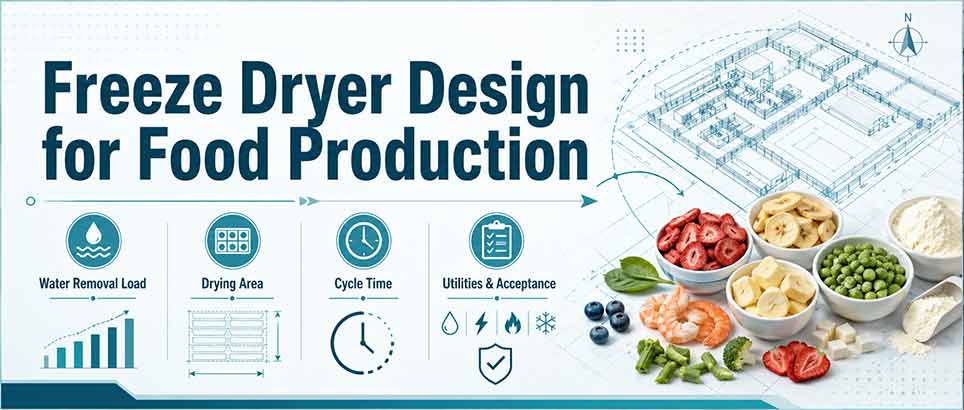
Freeze dryer design for food production should convert a defined product and production target into a testable capacity basis. Before comparing model names, document the water to remove, tested loading per square metre, usable drying area, verified cycle and turnaround, condenser duty, utilities, and the evidence a supplier will provide.
This guide is a preliminary design and quotation-review worksheet for food processors, project engineers, and procurement teams. It does not replace detailed production-system planning, a product trial, or the final technical agreement.
Already Comparing Freeze Dryer Quotations?
Send the product, planned wet load, thickness or liquid depth, moisture data, and the capacity claims in the quotations. The engineering team can identify missing assumptions and the tests or records needed before you compare models and prices.
Request a Design-Basis Check Send the Project on WhatsAppFreeze Dryer Design: What This Page Does—and Does Not—Cover
The design task begins after a business has identified a product or product family and a commercial output target. Readers who are still comparing applications should first review which foods can be freeze-dried. Readers who need a process diagram or an explanation of sublimation should use the separate guide to how a freeze dryer works.
This page owns one decision: how to turn product and factory data into a capacity basis that a buyer can calculate, question, and later test. Detailed freeze dryer construction and component functions belong in the freeze dryer components guide; model data belongs in the specifications guide.
1. Describe the Product and the Acceptance Target
“Fruit” or “food powder” is not a complete design input. Record the exact product, formulation or solids content, preparation, frozen dimensions, slice thickness or liquid depth, planned loading method, initial moisture, and the required final result.
Food research shows why this detail matters. A review of food freeze-drying found that formulation, total layer thickness, freezing history, shelf temperature, pressure, and dry-layer resistance can change both process behaviour and physical quality.[1] In a study of one apple variety, slice thickness, heating-plate temperature, and absolute pressure jointly affected moisture, colour, and crispness; the study’s numerical optimum is specific to that apple, preparation, and laboratory dryer.[2]
| Design Input | Preferred Source | If It Is Unknown |
|---|---|---|
| Initial moisture or solids | Representative batch measurement or controlled formulation | Use a labelled estimate only for screening; measure before final sizing. |
| Thickness, piece size, or liquid depth | Production preparation specification | Test the expected range, including the slowest-drying geometry. |
| Final moisture and quality target | Buyer product specification | Define moisture plus centre dryness, texture, colour, aroma, and rehydration as relevant. |
| Product range | Sales and production plan | Identify a representative and a worst-case product rather than averaging unlike foods. |
2. Calculate the Water Removal Load
Wet batch mass is not the same as condenser load. Start with a material balance. The formulas below assume that initial and final moisture are stated on a wet basis and that non-water solids are not lost during processing.
This calculation gives the approximate mass of water that must leave the product. It does not by itself determine the peak sublimation rate, cycle time, refrigeration duty, or the effect of ice accumulation on the condenser. Those require test data and equipment-specific analysis.
3. Convert Tested Loading Into Usable Drying Area
Tray count is a poor capacity measure unless tray dimensions, blocked or unusable area, product thickness, and wet loading are all stated. Use net usable drying area, not an external chamber dimension or a nominal shelf figure.
The word “tested” is essential. A loading density from another fruit, an unusually thin demonstration batch, or a catalogue default may not reproduce the required endpoint. The separate guide to trays and loading capacity explains how tray dimensions and product placement affect the usable area.
Ask the supplier to state the assumed thickness, kg/m², tray count, net area, product preparation, and whether the figure comes from a real batch, a comparable case, or an engineering estimate. That distinction turns a brochure number into an auditable design input.

4. Check the Full Cycle and Daily Throughput
A machine with a credible wet load can still miss the daily target if the complete batch slot is too long. Include pre-freezing responsibility, loading, vacuum drying, unloading, defrosting, cleaning, and preparation for the next batch.
Monitoring research in food freeze drying has shown that process-monitoring approaches can be applied to liquids in trays and individually quick-frozen products, supporting endpoint assessment with process data rather than relying only on a fixed time assumption.[4] Therefore, daily output should be based on a recorded loaded cycle and full turnaround—not the primary-drying time alone.
If required machine-batches exceed the available slots, the design must change: increase tested batch load, select more area, add parallel machines, extend the operating schedule, or revise the production target. Do not hide the gap inside an assumed “batches per day” figure.
5. Verify Condenser and Vapour-Path Capacity Under Load
The condenser must capture the batch water load, but total ice-holding capacity is only one check. The equipment must also handle the peak vapour flow without losing pressure control. A 2023 freeze-drying process-design update discussed how equipment capability can be limited by condenser performance or restricted vapour flow, and how minimum controllable pressure and maximum sublimation rate are equipment-specific.[3] The study used pharmaceutical vial systems, so it supports the engineering boundary—not a universal food pressure or kg/h value.
For a quotation, request the condenser’s usable ice capacity, test basis, expected peak load, defrost method, vapour-path arrangement, and evidence that pressure remains controllable during the agreed loaded case. Minimum empty-condenser temperature alone cannot answer those questions. The condenser and cold-trap guide covers this subsystem without repeating it here.

6. Balance Heat Input, Product Limits, and Refrigeration
Primary drying needs heat, but the acceptable rate is constrained by the product and by vapour removal. The food review cited above explains the trade-off: too little heat extends the process, while aggressive conditions can cause melting, shrinkage, colour change, or structural collapse.[1]
A practical freeze dryer design review should connect the proposed heating method and control profile to product temperature evidence, not only to installed heater power. It should also confirm that refrigeration supports the intended freezing and condenser duties under the factory’s ambient and utility conditions.

Keep operating recipes on the page that owns freeze-drying temperature and pressure. For this design brief, the buyer’s question is narrower: what loaded test or calculation shows that heat input and refrigeration remain inside the agreed product and equipment limits?
7. Define Vacuum Performance, Controls, and Records
A vacuum pump must evacuate the chamber, remove non-condensable gases, and support pressure control, while the condenser captures most of the water vapour. Pump motor power or ultimate vacuum alone does not prove loaded performance.
Specify how pump-down, leak or pressure-rise behaviour, production pressure, sensor identification, alarms, recipes, and batch records will be demonstrated. Detailed pump selection belongs in the vacuum-pump guide; the record structure belongs in the monitoring guide.


For repeatable production, retain original temperature and pressure trends, stage durations, alarms, operator actions, defrost time, and endpoint evidence. These records support troubleshooting and provide a factual basis for comparing the design case with later production batches.
8. Connect the Freeze Dryer to the Factory and the Contract
For commercial food projects, freeze dryer design must also fit the installation route, floor and maintenance space, electrical supply, cooling-water conditions, steam where applicable, drainage, ventilation, defrost handling, and packaging schedule. These site questions are owned by the freeze-drying facility planning guide and the installation guide.

The design basis should also become a contract and test basis. Identify which figures are estimates, which are supported by comparable projects, which require a sample trial, and which will be acceptance criteria. Then connect the technical agreement to the planned FAT, SAT, and loaded acceptance tests.
Worked Example: A Preliminary Design Calculation
Consider a hypothetical food project with a 500 kg wet batch, 85% initial moisture, 2% target final moisture, and an assumed wet loading of 12 kg/m². The loading figure is used only to demonstrate the calculation; it is not a recommended default.
| Step | Calculation | Preliminary Result | What Must Still Be Verified |
|---|---|---|---|
| Dry solids | 500 × (1 − 0.85) | 75 kg | Representative initial-moisture measurement and non-water mass losses. |
| Final product mass | 75 ÷ (1 − 0.02) | 76.53 kg | Final-moisture basis and the buyer’s complete quality endpoint. |
| Water removed | 500 − 76.53 | 423.47 kg | Condenser ice capacity, peak vapour load, defrost, and safety margin. |
| Net drying area | 500 ÷ 12 | 41.67 m² | Product-specific thickness, tested kg/m², usable tray area, and uniformity. |
This result does not justify ordering a “42 m² machine.” The project still needs a product trial or comparable evidence for loading and cycle time, an equipment-specific condenser and vapour-flow check, a full-turnaround model, utility confirmation, and written acceptance criteria.
Need a Preliminary Design Basis Before Comparing Quotations?
Send the product name, photos and dimensions, slice thickness or liquid depth, daily wet-material target, initial moisture or solids, target final quality, operating schedule, installation country, voltage, and available utilities.
The engineering team can use these inputs to review the preliminary material balance, identify missing project data, indicate the capacity class that should be evaluated, and recommend whether pilot testing or a formal quotation should come next. Final capacity and performance remain subject to the confirmed product, test basis, equipment configuration, and technical agreement.
Send Project Data for Review Discuss the Design Brief on WhatsAppWhat Evidence Should Support a Freeze Dryer Quotation?
| Quotation Claim | Evidence to Request | Do Not Accept as a Substitute |
|---|---|---|
| Wet kg per batch | Product, dimensions, thickness, kg/m², net area, initial moisture, final endpoint, and test or estimate status. | Tray count or chamber volume alone. |
| Daily throughput | Loaded-cycle record plus loading, unloading, defrost, cleaning, and operating-hours basis. | Batch mass multiplied by an assumed number of daily cycles. |
| Condenser capacity | Total capture, peak-load basis, vapour path, pressure-control evidence, and defrost strategy. | Minimum empty temperature alone. |
| Vacuum performance | Defined pump-down and hold tests, calibrated pressure records, and loaded production behaviour. | Pump power or ultimate vacuum alone. |
| Heat and refrigeration capability | Loaded trends, control method, product-temperature basis, ambient conditions, and utility assumptions. | Installed kW or unloaded temperature range alone. |
| Repeatable result | Representative loaded run, sampling plan, centre-dryness or moisture results, quality checks, and raw records. | A photograph of one successful batch. |
First-party cases are useful only when their boundaries are visible. For an example of how project type and scale can be documented, review the India shrimp freeze-drying project case. A different product still requires its own loading, cycle, and acceptance basis.
Freeze Dryer Design FAQ
What determines freeze dryer capacity?
Capacity is the tested relationship among product geometry, wet loading per square metre, usable drying area, water removal, full cycle and turnaround, condenser and vapour-path capability, utilities, and the required endpoint. A nominal kg figure without those conditions is incomplete.
How do I calculate the initial machine size?
Calculate dry solids and water removal, divide tested wet batch mass by tested loading per square metre, and compare required machine-batches with the verified full turnaround. Then check condenser, vacuum, heat, refrigeration, controls, and utilities against the same case.
Can one design process several food products?
Often yes, but the design should identify a representative product and a worst-case product. Each food may need different preparation, thickness, loading, recipe, endpoint, and cleaning procedure.
Does a larger vacuum pump make drying faster?
Not automatically. Once the required pressure is controllable, product resistance, heat input, vapour-path conductance, condenser capability, and product-temperature limits can control the process. Ask for loaded evidence rather than pump power alone.
Is the worked example a machine recommendation?
No. It demonstrates a material and area calculation with disclosed assumptions. The loading density, cycle, condenser performance, utilities, and acceptance criteria must be confirmed for the actual product and equipment.
References
- Nowak D, Jakubczyk E. The Freeze-Drying of Foods—The Characteristic of the Process Course and the Effect of Its Parameters on the Physical Properties of Food Materials. Foods. 2020;9(10):1488. https://doi.org/10.3390/foods9101488
- 孟宪军, 高琨, 李斌, 颜廷才, 崔晓雅, 阎婷. 响应面法优化寒富苹果真空冷冻干燥工艺[J]. 食品科学, 2013, 34(10): 92-97. DOI: 10.7506/spkx1002-6630-201310020.
- Tchessalov S, Maglio V, Kazarin P, Alexeenko A, Bhatnagar B, Sahni E, Shalaev E. Practical Advice on Scientific Design of Freeze-Drying Process: 2023 Update. Pharmaceutical Research. 2023;40:2433-2455. https://doi.org/10.1007/s11095-023-03607-9
- Pisano R, Barresi AA, Fissore D. Innovation in Monitoring Food Freeze Drying. Drying Technology. 2011;29(16):1920-1931. https://doi.org/10.1080/07373937.2011.596299
Conclusion: Make Every Capacity Claim Traceable
A useful freeze dryer design is not a collection of impressive component ratings. It is a traceable chain from product and quality target to water load, tested loading, usable area, verified turnaround, equipment capability, factory utilities, and acceptance evidence.
Use the calculations to expose assumptions early. Then require product testing, equipment-specific checks, raw batch records, and a written technical agreement before treating preliminary capacity as a purchasing commitment.