
How to Freeze Dry Fish for Commercial Production
To freeze dry fish reliably at commercial scale, control raw-material history, piece geometry, tray load, freezing, product temperature, condenser load, final moisture, oxidation, and packaging. For commercial teams, freeze drying fish requires more than selecting a machine and copying a standard cycle. Fish fillets, salmon cubes, trout mince, and cooked seafood portions each require product-specific validation.
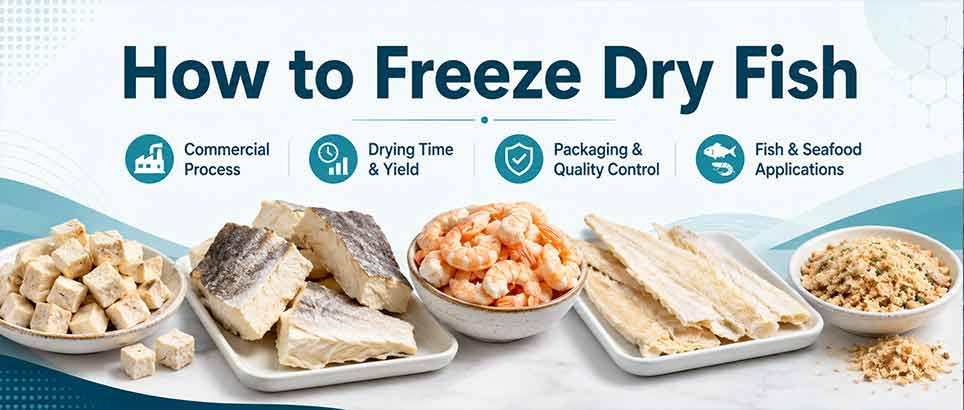
Can Fish Be Freeze-Dried Successfully?
Yes, but “fish” is not one process category. If you plan to freeze dry fish commercially, start by defining the product the customer will actually buy and how it will be used.
| Product route | Main processing risk | What the pilot must measure |
|---|---|---|
| Raw fillet or cube | Uneven center moisture, raw-product hazards, oxidation | Maximum thickness, center dryness, final moisture, cook instructions |
| Cooked ready-to-eat piece | Cook validation, post-cook contamination, texture loss | Validated lethality step, handling controls, rehydration and sensory result |
| Fish mince or powder ingredient | Dense loading, protein functionality, oxidation, powder handling | Layer depth, solubility or binding target, final moisture, oxygen exposure |
| Pet treat | Whole-piece variability, fat oxidation, label and microbial requirements | Piece-size distribution, breakage, final moisture, shelf-life protocol |
| Soup, meal, or snack component | Rehydration mismatch with the final recipe | Rehydration time in the real serving medium, not water alone |
Fatty species need a stronger oxidation-control and shelf-life plan than lean white fish. Raw products also need different food-safety instructions from cooked, ready-to-eat products. These decisions belong in the product specification before the freeze-dryer recipe is finalized.
For beef, poultry, and other meat products, use the separate commercial meat freeze-drying guide. This page focuses on fish and seafood processing.
How to Freeze Dry Fish: Commercial Process
-
Control the incoming fish
Record species, supplier lot, harvest or slaughter information when relevant, receiving temperature, chilled or frozen state, storage time, and sensory condition. For histamine-forming species, receiving and time-temperature records are part of hazard control, not paperwork to add later.
-
Define raw, cooked, seasoned, or formulated status
Cooking can support a ready-to-eat design only when the heat process is validated and post-cook contamination is controlled. Brines, sugars, salts, oils, and sauces change freezing behavior, mass transfer, sensory quality, and endpoint interpretation.
-
Standardize geometry
Fix the maximum thickness, length, width, skin state, bone state, and orientation. A review of aquatic-product freeze drying identifies slicing and other pretreatments as important influences on drying performance and final quality. It also summarizes research showing that fish-fillet thickness and muscle-fiber orientation can change drying efficiency.[1] The practical lesson is to standardize geometry and validate the actual product, rather than copy one laboratory cutting method.
-
Measure the tray load
Record wet kilograms per tray and kg/m² of usable shelf area. Keep pieces in a repeatable layer and document gaps, contact with the tray, and product depth. Do not publish a universal kg/m² limit for fish: a thin fillet and dense mince do not impose the same heat and vapor load.
-
Freeze the product completely
The product center must be frozen before primary drying. Freezing rate affects ice-crystal structure, but the tradeoff between drying rate and product texture is product-specific. Establish the freezing endpoint with center-temperature data and, when necessary, thermal characterization rather than copying a single setpoint.
For the underlying engineering relationship, see freeze-drying temperature and pressure and how industrial freeze drying works.
-
Control primary and secondary drying
During primary drying, add enough shelf heat to sustain sublimation without allowing the product to lose structure or partially melt. During secondary drying, remove bound moisture to the validated product specification. Save shelf, product, chamber-pressure, and condenser data for every development batch.
-
Verify the endpoint before unloading
Time alone is not an endpoint. Use a defined combination of final moisture, representative center samples, pressure or endpoint tests, mass consistency, and sensory acceptance. Then move the product into controlled-humidity packaging without unnecessary exposure.
How Long Does It Take to Freeze Dry Fish?
A defensible answer is about 9 hours to more than 24 hours in published fish and shellfish examples, with thicker pieces extending further. These studies used different products, loads, machines, endpoints, and pretreatments, so they are comparison anchors—not a production guarantee.
| Published example | Reported conditions and result | What a buyer should learn |
|---|---|---|
| Pacific salmon cubes | 9 h; less than 10% moisture; 26-28.4% processing yield.[4] | A fast result belongs to defined small cubes and a specific endpoint. |
| Oyster meat | -30 to -35 °C pre-freeze, 20 Pa, 15 h; test endpoint below 5% moisture.[2] | The last portion of residual moisture dried more slowly than the first 90%. |
| Rainbow-trout mince | -35 °C freeze, +10 °C shelf, 20 Pa, about 24 h; 2.11% final moisture.[3] | Mince depth and preparation can produce a longer cycle than small cubes. |
For broader planning ranges, use the commercial freeze-drying time chart, then replace the generic range with pilot data for the actual fish product.
Fish Freeze-Drying Yield and Capacity Calculation
When you freeze dry fish at production scale, separate product yield from machine capacity. Yield is primarily a mass-balance question; capacity also depends on shelf area, tested loading density, cycle time, condenser capture, loading/unloading, defrost, cleaning, and shift schedule.
Use pilot yield to estimate packaging units and sales output. Use a conservative utilization factor to include non-drying time and normal production variation. Do not use a laboratory cycle as the only basis for a factory throughput guarantee.
Set Measurable Quality Specifications
“Fully dry” and “rehydrates well” are not acceptance criteria. Before the pilot, agree on the measurements that decide whether a batch passes.
| Specification | Why it matters | Recommended record |
|---|---|---|
| Final moisture | Supports mass balance and process consistency | Method, sampling locations, mean and range |
| Center dryness and batch uniformity | Confirms that thick pieces and different tray positions reach the endpoint | Sampling locations, center condition, tray-to-tray variation and acceptance result |
| Rehydration | Predicts performance in the customer’s real use | Medium, temperature, time, ratio, texture and yield |
| Oxidation and sensory quality | Especially important for fatty fish and powders | Odor, flavor, color, analytical marker when justified |
| Physical integrity | Affects saleable yield and packaging | Breakage, shrinkage, bulk density, fines |
In one rainbow-trout mince study, freeze drying produced 2.11% final moisture, yet the rehydrated mince did not recover all of its original water-holding capacity.[3] An oyster study likewise showed that the final part of drying was slower and measured rehydration separately.[2] The practical lesson is to evaluate final moisture together with center dryness, rehydration, and customer-use quality rather than relying on one number.
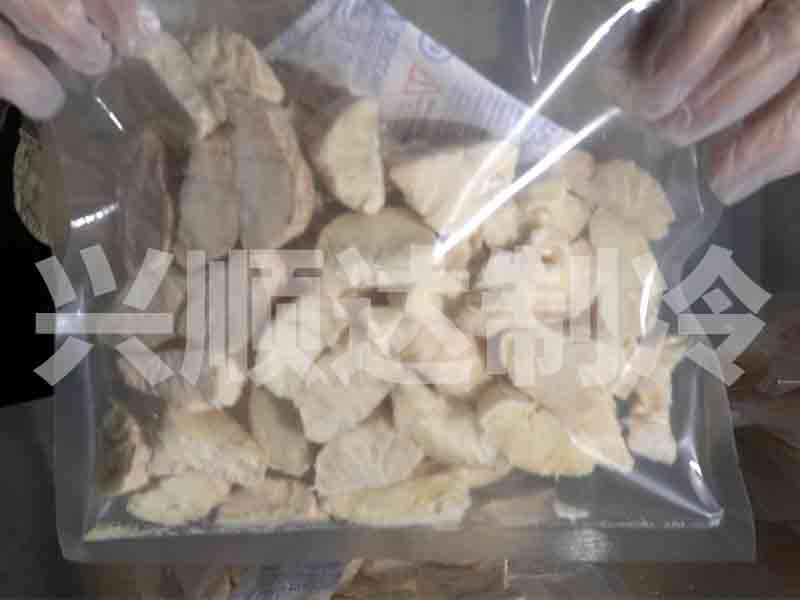
Oxidation also deserves an explicit plan. A study of freeze-dried saithe protein ingredients found that processing history and formulation affected oxidation, functional properties, and rancid odor/flavor.[5] For buyers, that means raw-material freshness, oxygen exposure, antioxidant strategy where legally permitted, pack barrier, and shelf-life testing should be discussed together.
Package Freeze-Dried Fish for Moisture and Oxygen Control
Freeze-dried fish can take up moisture after unloading, while its lipid fraction remains vulnerable to oxidation. Packaging must therefore be selected and verified as part of the product system.
- Move product from the dryer to packaging under controlled humidity.
- Specify moisture-vapor and oxygen-barrier performance for the expected shelf life.
- Validate seal strength, seal contamination risk, and package integrity.
- Evaluate nitrogen flushing, oxygen absorbers, or another oxygen-control approach for the actual product and package.
- Run real-time shelf-life work; use accelerated testing only as a supporting tool.
- Define post-opening storage and use instructions.
See the dedicated guide to freeze-dried food packaging for commercial production for barrier and seal-selection questions.
Food Safety: Freeze Drying Is Not Sterilization
The U.S. FDA’s seafood guidance is designed to help processors identify species-related and process-related hazards and develop controls. It specifically covers receiving and storage, time-temperature exposure, histamine-forming species, inadequate drying, pathogen survival, post-process contamination, allergens, and HACCP plan development.[6]
- Classify the product as raw, cooked, or ready-to-eat and write instructions accordingly.
- Assess species-specific hazards, including parasites, natural toxins, histamine, aquaculture drugs, and chemical contaminants where applicable.
- Validate any lethality step separately from the freeze-drying cycle.
- Control employee, equipment, room, and packaging hygiene after a validated cook.
- Set and verify the final-moisture limit, center-sample locations, and acceptance method using a documented sampling plan.
- Include fish allergen labeling and cross-contact controls.
For a focused explanation, read whether freeze drying kills bacteria and viruses. Regulatory requirements vary by product and destination market; use the competent local authority and a qualified food-safety professional for the final plan.
Commercial Reference: 200 m² Shrimp Line in India
The manufacturer’s engineering records document a 2025 shrimp freeze-drying line in Kochi, India. The installation uses an SDG6000 with 200 m² of drying area. The record includes tray area, loading density, batch load, cycle time, final moisture, and energy use. These values are specific to this shrimp project and are not a universal performance guarantee for fish fillets, mince, or another factory.

| Recorded project item | Project record value |
|---|---|
| Product | Shrimp |
| Equipment | SDG6000 industrial freeze dryer |
| Drying area | 200 m² |
| Loading density | 11.6 kg/m² |
| Calculated wet load | Approximately 2,320 kg per batch |
| Drying time | Approximately 8 h |
| Final moisture | 1.68% |
| Energy record | Approximately 1.02 kWh electricity and 1.41 kg steam per kg of raw material |
Before using this reference in a purchase decision, review the batch record, measurement methods, product dimensions, utility boundary, and operating conditions. Review the complete 200 m² shrimp case study.
How to Select a Fish Freeze Dryer
A freeze dryer for fish should be sized from the validated product load, required endpoint, and daily output. A generic “kg per batch” label is not enough for a purchasing decision.
| Buyer question | Evidence to request | Why it matters |
|---|---|---|
| How much of this exact product per 24 h? | Pilot kg/m², cycle time, utilization and defrost assumptions | Converts shelf area into practical output |
| Can the condenser capture the batch water load? | Ice capacity per cycle and capture rate under stated conditions | Prevents vapor overload and cycle extension |
| How uniform are shelf and product temperatures? | Mapping method, sensor positions and batch curves | Reduces edge-to-center inconsistency |
| How is vacuum performance verified? | Pump specification, leak test, pressure measurement and maintenance plan | Supports repeatable sublimation conditions |
| How will seafood sanitation be handled? | Cleanability review, drainage, materials, access and sanitation procedure | Controls contamination and downtime |
| What data can operators retain? | Recipe control, product/shelf temperature, pressure, alarms and batch export | Supports traceability and troubleshooting |
| What happens after installation? | Commissioning scope, training, spare-parts list and service responsibility | Reduces scale-up and ownership risk |
Match the equipment category to the decision stage
- Product development: compare pilot lab freeze dryers for recipe and endpoint work.
- Commercial production: compare commercial freeze dryers after the product and daily output are defined.
- Factory-scale seafood: compare industrial freeze dryers with utilities, loading, defrost, cleaning, redundancy, and plant layout included.
Common Fish Freeze-Drying Problems
| Observed problem | Likely investigation | Corrective direction |
|---|---|---|
| Dry outside, moist center | Maximum thickness, loading, center temperature, endpoint sampling | Standardize geometry; reduce depth or revise the cycle |
| Rancid or strong fishy odor | Raw-material age, fat level, oxygen exposure, process time, package barrier | Improve freshness and oxygen-control strategy; validate shelf life |
| Cycle becomes longer after scale-up | kg/m², vapor path, condenser load, vacuum leak, product distribution | Scale by heat and mass transfer, not tray count |
| Poor rehydration or tough texture | Freezing history, structural damage, drying temperature, rehydration method | Test freezing and cycle changes against the intended use |
| Product softens after packaging | Room humidity, exposure time, seal quality, moisture barrier | Shorten exposure; improve humidity and package control |
| Good moisture result but unstable quality | Sampling coverage, oxygen, fat oxidation, light and storage temperature | Use a multi-factor specification and shelf-life study |
Information Needed Before a Fish or Seafood Pilot Test
| Product details | Target specification | Factory plan |
|---|---|---|
| Species, source and fat level | Raw, cooked, RTE, ingredient or pet treat | Wet kg/day and production days |
| Piece form and maximum dimensions | Final-moisture limit and center-dryness acceptance criteria | Shift hours and target batches/day |
| Skin, bone, seasoning and pretreatment | Rehydration, texture and sensory targets | Electrical, steam, cooling and room conditions |
| Initial moisture or solids | Packaging and target shelf life | Loading, unloading, cleaning and defrost plan |
Scientific References
- 吴燕燕, 石慧, 李来好, 杨贤庆, 林婉玲, 陈胜军. 水产品真空冷冻干燥技术的研究现状与展望[J]. 水产学报, 2019, 43(1): 197-205. DOI: 10.11964/jfc.20180911453.
- 高加龙, 沈建, 章超桦, 秦小明. 真空冷冻干燥对牡蛎品质的影响[J]. 现代食品科技, 2015, 31(4): 253-257. DOI: 10.13982/j.mfst.1673-9078.2015.4.041.
- Corapci B, Guneri N. Comparative assessment of nutritional composition and physicochemical properties of fresh, freeze-dried and rehydrated rainbow trout (Oncorhynchus mykiss Walbaum, 1792) mince. Food Science and Technology. 2020;40(Suppl. 1):163-169. Comparative Assessment of Fresh, Freeze-Dried and Rehydrated Rainbow Trout Mince — DOI: 10.1590/fst.08419.
- Crapo C, Oliveira ACM, Nguyen D, Bechtel PJ, Fong Q. Development of a Method to Produce Freeze-Dried Cubes from 3 Pacific Salmon Species. Journal of Food Science. 2010;75(5):E269-E275. Development of a Method to Produce Freeze-Dried Cubes from Pacific Salmon — DOI: 10.1111/j.1750-3841.2010.01642.x. See also the USDA ARS publication record.
- Shaviklo GR, Thorkelsson G, Arason S, Sveinsdottir K. Characteristics of freeze-dried fish protein isolated from saithe (Pollachius virens). Journal of Food Science and Technology. 2012;49(3):309-318. Characteristics of Freeze-Dried Fish Protein Isolated from Saithe — DOI: 10.1007/s13197-011-0285-4.
Regulatory Reference
- U.S. Food and Drug Administration. Fish and Fishery Products Hazards and Controls Guidance. June 2022 edition; page content current as of 1 August 2024. DOI: not applicable.