
Freeze Dryer for Dog Food and Treats: Commercial Production Guide
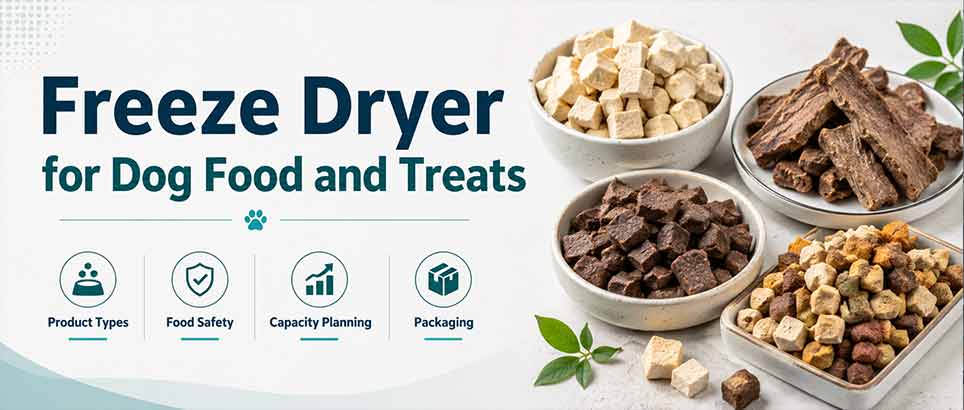
A freeze dryer for dog food should be selected from the product type, wet material load, piece thickness, drying cycle, water-removal demand, food safety plan and packaging method—not from tray count alone. This guide is written for pet food manufacturers, contract processors and food factories planning repeatable commercial production, not for home freeze-dryer users.
Last reviewed: June 30, 2026
Quick answer: dog treats and complete dog food can both be freeze-dried, but they do not use one universal process. Thin, single-ingredient meat pieces usually dry more predictably than dense, high-fat or mixed formulas. In addition, freeze drying is not a validated kill step. Commercial producers must control raw materials, pretreatment, sanitation, cross-contamination, final moisture, representative centre dryness, microbiological verification and packaging as separate parts of the food-safety plan.
Can Dog Food and Dog Treats Be Freeze-Dried?
Yes. Freeze drying can produce lightweight meat treats, porous food pieces and shelf-stable products when the process and packaging are correctly developed. However, suitability depends on more than ingredient name. Formula solids, fat level, particle size, shape, pretreatment and intended product claim all affect drying behavior.
For example, sliced chicken breast behaves differently from ground beef patties. A complete dog food containing meat, organs, vegetables, oil and micronutrients is more complex again. Therefore, a commercial pet food freeze dryer should be selected after the manufacturer defines the exact SKU and verifies its process.
| Product Type | Common Form | Main Process Risk | Recommended First Step |
|---|---|---|---|
| Single-ingredient chicken or beef treats | Thin slices, strips or cubes | Uneven thickness, pathogens and oxidation | Confirm thickness, loading density and safety control |
| Liver and organ treats | Slices, cubes or formed pieces | High fat, strong odor and variable structure | Run a pilot test and packaging trial |
| Fish-based dog treats | Pet-treat pieces, strips or formed portions | Fat oxidation, odor and raw material variability | Test raw material handling and oxygen control |
| Mixed-formula dog food | Nuggets, patties, pellets or cubes | Uneven drying caused by mixed ingredients | Validate recipe, forming size and drying curve |
| Raw pet food | Chunks, patties, mince or formed pieces | Pathogen and virus hazards | Define a validated safety plan before equipment sizing |
| Cooked pet food | Meat-and-vegetable pieces or formed meals | Post-process contamination and recipe variation | Control cooling, hygienic handling and packaging |
Topic boundary: this page covers fish only when it is used as a dog-food or dog-treat ingredient. General fish and seafood processing belongs to the commercial fish freeze-drying guide. General beef, chicken, pork, lamb and prepared-meat production belongs to the commercial meat freeze dryer guide.
Dog Treats and Complete Dog Food Need Different Processes
In the United States, treats, supplemental products and complete-and-balanced pet foods are not identical regulatory categories. AAFCO separates snacks and treats, intermittent or supplemental foods, complete-and-balanced foods and special-purpose products. Therefore, product positioning should be settled before the formula, label and production plan are finalized [AAFCO 1].
Manufacturers planning a complete-and-balanced claim also need nutritional substantiation and an appropriate nutritional adequacy statement [AAFCO 2]. Equipment selection cannot replace formulation, feeding, labeling or regulatory work.
| If Your Product Is… | Main Risk | Validate Before Equipment Sizing |
|---|---|---|
| Single-ingredient dog treats | Thickness variation, pathogens and oxidation | Cut size, loading density, safety control and packaging |
| Complete dog food nuggets | Formula uniformity, drying uniformity and label claims | Recipe consistency, final moisture, centre-dryness criteria and label plan |
| Raw freeze-dried pet food | Pathogens, viruses and cross-contamination | Validated preventive control, zoning and verification testing |
| High-fat organ or fish treats | Rancidity, odor and shelf-life failure | Oxygen barrier, residual oxygen, peroxide value and storage trial |
Freeze Drying Is Not a Validated Kill Step
Freeze drying removes water from a frozen product under vacuum. A sufficiently dry product that remains protected from moisture can limit microbial growth during storage. However, dryness does not prove that bacteria, bacterial spores or viruses entering with the raw material have been destroyed.
Critical safety boundary: a dry appearance does not prove that a dog food or treat is microbiologically safe. The manufacturer must use a product-specific hazard analysis, validated preventive controls, sanitation procedures, verification testing and regulatory review appropriate to the production market.
The FDA states that Salmonella can contaminate pet food and treats, including frozen and freeze-dried raw pet food [FDA 3]. In addition, covered cat and dog food manufacturers using uncooked or unpasteurized poultry or cattle materials must consider H5N1 in their food-safety-plan analysis [FDA 2]. Therefore, a raw pet food producer should never assume that the freeze dryer controls these hazards by itself.
Controls to Define Before Commercial Production
- Approved raw material suppliers and incoming inspection
- Cold-chain management and raw material segregation
- A validated cooking, pasteurization, HPP or other applicable control where required
- Hygienic transfer from pretreatment to trays
- Separation of raw and post-treatment areas
- Cleaning and sanitation for trays, carts, tools and contact surfaces
- Final moisture specification, representative centre checks and a documented sampling plan
- Environmental and finished-product verification appropriate to the hazard plan
- Moisture- and oxygen-barrier packaging
- Batch records, traceability and recall readiness
For a focused explanation of process limits, see the internal guide on whether freeze drying kills bacteria and viruses. The FDA animal-food preventive-controls rule provides the U.S. regulatory framework for covered facilities [FDA 1]. Requirements vary by country and product, so a qualified food safety professional should review the final plan.
Product Preparation Before Freeze Drying
1. Standardize Raw Materials
Raw material consistency supports repeatable drying. The manufacturer should define species, cut, fat level, supplier specification, storage temperature and maximum holding time. Variable fat and connective tissue can change heat transfer, drying behavior, texture and oxidation risk.
2. Control Cutting, Grinding and Forming
Uniform pieces dry more evenly than a tray containing mixed sizes. Sliced meat should use a controlled thickness. Ground formulas should use consistent forming dimensions and density. Moreover, large voids, compressed centers and irregular shapes can create different vapor paths within one batch.
3. Use Thickness as a Test Variable
For many meat-based treats, an engineering starting range for early trials is approximately 4–10 mm. Products under about 15 mm are generally easier to dry evenly than thick blocks. Nevertheless, the final specification must balance drying time, desired bite, breakage, batch loading and market presentation. A review of fish and meat freeze drying identifies product structure and process conditions as important drivers of efficiency and quality [1].
4. Confirm Pretreatment Before Equipment Sizing
Cooking, blanching, marination, grinding, emulsification and fat adjustment can all alter the product. Therefore, the capacity test should use the intended commercial recipe—not an unseasoned laboratory substitute that behaves differently.
Commercial Freeze-Dried Pet Food Production Process
A reliable project links food safety, product handling and freeze dryer performance into one controlled workflow.
- Receive and inspect raw materials. Confirm supplier, lot, temperature and acceptance criteria.
- Cut, grind, mix or form the product. Hold piece size, weight and density within the process specification.
- Apply the validated pretreatment. Cooking or another control should be managed separately from freeze drying.
- Cool and load hygienically. Prevent contamination between the control step and tray loading.
- Pre-freeze the product. Confirm that the product core is fully frozen before primary drying begins.
- Establish vacuum and start primary drying. Ice sublimes and the condenser captures the resulting vapor.
- Complete secondary drying. Controlled heat reduces remaining bound moisture.
- Verify the endpoint. Check process records, final moisture, representative centre samples, mass stability, texture and tray-to-tray consistency.
- Unload and package promptly. Limit exposure to ambient moisture and oxygen.
- Release the batch. Review required quality, safety, labeling and traceability records.
Each SKU should have a controlled recipe and drying program. A single setting for chicken slices, liver cubes and mixed nuggets is unlikely to produce the same result.
Loading Density and Drying Time for Dog Food
Loading density determines how much wet material is placed on each square meter of usable tray area. Product thickness determines the distance that water vapor must travel from the center to the surface. Consequently, both values affect the drying cycle and real daily output.
Engineering reference—not a dog food claim: a 2024 commercial meat project used an SDG350 with 10 m² of drying area. After testing several thicknesses, the processor selected 10 mm meat chunks, loaded approximately 12.1 kg/m² and processed about 121 kg per batch. Drying took 12 hours, and final moisture reached 1.49%. The chamber operated at approximately 26–103 Pa.
This meat case provides a useful starting reference for meat-based dog treats, but it is not a substitute for pet food testing. Fat level, ingredients, pretreatment and piece structure may require a different load and cycle. General human-food applications remain covered in the separate commercial meat freeze dryer guide.
Practical Starting Range for Trials
- Loading density: an engineering starting point is approximately 10–13 kg/m² for many cut meat trials, while keeping early tests below about 14 kg/m².
- Thickness: commonly 4–10 mm for controlled meat pieces; avoid exceeding about 15 mm without product-specific test data.
- Drying time: many suitable food products fall within 8–15 hours; controlled meat products often target around 12 hours, but the real value depends on formula, thickness, load and endpoint.
- Final endpoint: set a product-specific final-moisture limit and centre-dryness criteria, then verify texture, mass stability, package performance and storage behaviour.
Overloading does not always increase daily output. If a heavy load extends the cycle, creates wet centers or causes batch rejection, the cost per kilogram may rise even though the tray held more material. For broader time planning, see the freeze-drying time chart for commercial food production.
How to Calculate Freeze Dryer Capacity for Dog Food
A freeze dryer for dog food or dog treats should be sized from wet material and real cycle data. Final dried weight alone does not show the tray area, water-removal load or production time required. This is where a commercial freeze dryer for dog food differs from a home machine: the buyer must prove repeatable output, not only produce a good sample.
Step 1: Define Wet Material per Batch
“Practical batches” must include loading, vacuum preparation, drying, unloading, defrosting and cleaning. A 12-hour drying program does not automatically guarantee two complete batches every 24 hours.
Step 2: Estimate Water to Be Removed
For example, 240 kg of product at 70% initial moisture contains 72 kg of dry solids. At a target final moisture of 2%, the estimated finished weight is approximately 73.47 kg. Therefore, the freeze dryer must remove approximately 166.53 kg of water. The condenser must also provide margin for the peak sublimation rate and operating variation.
Step 3: Estimate Required Tray Area
At 12 kg/m², a 240 kg wet batch needs approximately 20 m² of usable tray area. However, the result is only an initial estimate. The manufacturer must still confirm piece thickness, cycle time, condenser performance and product endpoint.
Step 4: Protect Capacity Against Turnaround Time
Suppose a batch needs 12 hours of drying plus 2 hours for unloading, defrosting, inspection and reloading. The total operating cycle becomes about 14 hours. In that case, a plan based on two full daily cycles would be unrealistic unless the project uses staggered machines, alternating condensers or another production arrangement.
Step 5: Send the Correct Data for Selection
| Required Input | Why It Matters |
|---|---|
| Product and complete formula | Identifies fat, sugar, salt, solids and ingredient interactions |
| Raw, cooked or otherwise treated | Defines process sequence and safety boundaries |
| Piece size and thickness | Affects heat and mass transfer |
| Wet kg per day | Sets production scale |
| Initial moisture and solids | Supports water-removal and dry-yield estimates |
| Target final moisture and acceptance criteria | Defines the endpoint, centre-sampling plan and storage objective |
| Expected packaging | Influences oxygen, moisture and shelf-life planning |
| Available power, steam, water and space | Determines which machine category can be installed |
Send Product Photos and Daily Wet Capacity
For an initial capacity range, the buyer can provide the product type, main ingredients, raw or cooked status, product photos, piece dimensions, daily wet material target and available utilities. A complete formula is only needed later when product-specific process testing requires it.
Pilot, Commercial or Industrial Pet Food Freeze Dryer?
| Production Stage | Typical Wet Material Capacity | Recommended Equipment | Best Use |
|---|---|---|---|
| Process validation | 60–120 kg / 24h | SDG60 or SDG90 pilot lab freeze dryer | Formula, thickness, loading, drying curve and packaging tests |
| Commercial production | 340 kg–1.36 t / 24h | SDG350, SDG700 or SDG1100 | Regular batch production for growing pet food businesses |
| Industrial production | 1.2–8 t / 24h | SDG1600, SDG3000 or SDG6000 | Factory-scale output, steam-supported operation and utility planning |
Start with Pilot Testing When the Formula Is Uncertain
A pilot program is appropriate when the product contains mixed ingredients, high fat, dense forming, seasoning or an unverified safety process. The test should produce engineering data rather than only attractive samples. See the lab freeze dryer and pilot testing guide.
Choose Commercial Scale for Regular Batch Sales
Commercial models are suitable after the recipe, loading and cycle have been confirmed. Buyers can compare the SDG350, SDG700 and SDG1100 commercial freeze dryers by wet material capacity, power, site space and production objective.
Choose Industrial Scale for Multi-Ton Output
Industrial systems require coordinated planning for steam, electricity, cooling water, drainage, floor load, unloading and maintenance access. The SDG1600, SDG3000 and SDG6000 industrial freeze dryers cover approximately 1.2–8 tons of wet material per 24 hours.
Equipment Features Pet Food Manufacturers Should Compare
Two machines with similar tray area can deliver different real output. Therefore, a buyer should request performance data and project scope instead of comparing exterior dimensions alone.
| Selection Item | Question to Ask | Why It Matters |
|---|---|---|
| Usable tray area | What area can actually hold product? | Decorative chamber volume does not equal production area |
| Vacuum-down speed | How long does the loaded chamber take to reach 133 Pa? | Slow pump-down can increase meltback risk and delay the cycle |
| Condenser capacity | What water load and peak capture rate can it handle? | An undersized condenser destabilizes pressure and extends drying |
| Heating uniformity | How are shelf and product temperatures controlled? | Uneven heating produces uneven endpoints |
| Pressure measurement | Which gauge is used and how is it protected from vapor? | Reliable pressure data supports process repeatability |
| Recipe and data records | Can the system store curves and export batch data? | Records support validation, troubleshooting and training |
| Hygienic design | Can trays, carts, chamber and condenser areas be cleaned safely? | Pet food production requires controlled sanitation |
| Project support | Are testing, layout, installation, training and first-batch support included? | Process support reduces commissioning risk |
A Pet Food Line Needs More Than a Freeze Dryer
The freeze dryer is the central moisture-removal system, but the factory also needs equipment that protects product consistency and hygienic flow. Typical project scope may include:
Preparation
- Cold storage
- Cutting or grinding
- Mixing and forming
- Cooking or other validated treatment
- Cooling and pre-freezing
Freeze-Drying Support
- Food-grade trays and carts
- Cooling water system
- Steam system for industrial models
- Tray washing and sanitation
- Maintenance and spare parts
Quality and Packaging
- Final-moisture testing and representative centre sampling
- Microbiological verification and metal detection
- Weighing and filling
- Nitrogen flushing or oxygen control
- Seal integrity inspection
Factory layout should separate raw material handling from post-treatment and post-drying areas. It should also provide enough room for loading, unloading, defrosting, cleaning, packaging and maintenance.
Packaging Freeze-Dried Dog Food and Treats
Freeze-dried meat can absorb moisture quickly. In addition, oxygen can accelerate rancidity and flavor change in high-fat products. Packaging should therefore be selected from product fat level, intended shelf life, pack size, distribution temperature and residual oxygen target.
Food freeze-drying literature explains why this matters: the porous structure left after sublimation increases exposure to oxygen and ambient moisture. Reviews recommend high-barrier packaging and, where validated, vacuum packaging or nitrogen flushing to limit moisture uptake and oxidation while protecting the product from light and breakage [2], [3]. For high-fat freeze-dried dog treats, packaging is part of the shelf-life control system, not a cosmetic choice.
Packaging Controls to Evaluate
- High moisture-barrier and oxygen-barrier laminate
- Rapid transfer from the dryer to the packaging area
- Controlled packaging-room humidity
- Nitrogen flushing or validated oxygen-control method where suitable
- Correct use of oxygen absorbers or desiccants when appropriate
- Seal temperature, dwell time and seal integrity checks
- Protection from crushing during storage and transport
- Shelf-life testing under the intended commercial package
The detailed packaging decision belongs in a separate specification. The internal freeze-dried food packaging guide explains barrier materials, oxygen control, moisture protection and production-line considerations.
Production Cost and ROI for Freeze-Dried Pet Food
Purchase price is only one part of the business case. A credible cost model should include raw material, pretreatment, labor, energy, steam, cooling water, cleaning, packaging, quality testing, maintenance, product loss and financing.
Dry yield matters because a wet formula may lose most of its weight as water. Therefore, a manufacturer should compare cost against saleable dry output—not wet input alone. A review of fish and meat freeze drying identifies energy consumption and cost as continuing scale-up constraints, which is why cycle time, qualified output and utility demand must be tested before purchase [1].
For a broader calculation framework, review the freeze-drying production cost guide. Profit claims should be based on the manufacturer’s own formula, market price, utilization rate and qualified output.
Pilot Testing Before Buying a Large Pet Food Freeze Dryer
A pet food project should not scale from appearance alone. A useful pilot test records enough data to estimate tray area, condenser load, drying time, output, packaging behavior and cost.
| Test Record | Data to Capture | Scale-Up Purpose |
|---|---|---|
| Product identity | Formula, supplier, lot, raw/cooked status and pretreatment | Ensures batches are comparable |
| Cutting and loading | Piece size, thickness, tray area, kg/tray and kg/m² | Calculates usable production area |
| Freezing | Freezer temperature, time and product core condition | Prevents false conclusions caused by incomplete freezing |
| Drying curve | Shelf temperature, product temperature, chamber pressure and condenser temperature | Builds a repeatable recipe |
| Water removal | Wet weight, dry weight, yield and estimated water removed | Sizes condenser and batch capacity |
| Finished quality | Final moisture, centre dryness, mass stability, texture, odor, appearance and rehydration | Confirms the commercial endpoint |
| Safety verification | Finished-product testing, environmental plan and pathogen controls required by the hazard analysis | Confirms that dryness is not being treated as the only safety control |
| Fat oxidation | Peroxide value, acid value, odor and retained-sample observations for high-fat products | Protects flavor and shelf-life in chicken, fish, liver and organ treats |
| Packaging trial | Package type, residual oxygen, seal result and storage observations | Supports shelf-life planning |
E-E-A-T principle: where the site has no verified pet food customer case, the article uses clearly labeled meat-processing references, pet-food literature and engineering starting ranges. It does not invent a pet food installation, drying result or customer outcome.
Common Mistakes When Buying a Freeze Dryer for Dog Treats
- Selecting by tray count alone. Usable area, loading density, cycle time and condenser load determine real output.
- Using one recipe for every SKU. Chicken, liver, fish and mixed nuggets need different validation.
- Treating freeze drying as sterilization. Safety controls must be defined separately.
- Loading pieces too thickly. Dry surfaces can hide wet centers.
- Relying on surface appearance or final weight alone. Final moisture, the thickest centre samples, batch consistency and package performance should be checked together.
- Ignoring fat oxidation. High-fat treats need oxygen-control and shelf-life testing.
- Assuming two 12-hour batches fit into one day. Defrosting, cleaning and handling consume production time.
- Scaling directly from a home machine. Commercial heat transfer, vacuum, loading and condenser conditions are different.
- Buying large equipment before formula validation. A larger system magnifies process problems.
- Comparing only purchase price. Unit cost depends on qualified output, energy, labor, maintenance and downtime.
Request a Pilot Test or Formal Equipment Proposal
After the product type, wet capacity and site utilities are defined, the engineering team can review whether the project needs a pilot test, commercial batch system or industrial production line. A formal proposal can then cover tray area, condenser load, model, utilities, installation scope and process support.
FAQ About Freeze Dryers for Dog Food and Treats
Can raw dog food be freeze-dried?
Yes, but raw pet food requires a product-specific hazard analysis and validated controls. Freeze drying should not be treated as a kill step for Salmonella, E. coli or viruses. The raw material, pretreatment, hygienic handling, testing and packaging plan must be established before commercial production.
Does freeze drying kill Salmonella in dog treats?
Not reliably. Salmonella may survive the process. Therefore, manufacturers should use validated preventive controls appropriate to the product and market rather than relying on dryness alone.
How long does it take to freeze-dry dog treats?
Many commercial food trials fall within about 8–15 hours. Actual time depends on formula, thickness, loading density, freezing, vacuum, temperature program and the validated endpoint. See the loading and drying-time section above.
What loading density should a pet food producer use?
A common engineering starting range for cut meat trials is approximately 10–13 kg/m², while mixed, high-fat or dense products may need a lower load. The final value must come from product testing.
What size freeze dryer is needed for 500 kg of wet dog food per day?
The answer depends on batch size, tested kg/m², drying time, turnaround time and water-removal load. For example, 250 kg per batch at 12 kg/m² needs about 20.8 m² of usable area before safety margin and cycle scheduling are considered. The final model should be based on real product testing.
How should a pet food factory confirm the drying endpoint?
The factory should use a documented final-moisture method and representative samples from the thickest pieces and different tray positions. Centre dryness, mass stability, texture, odor, batch consistency, packaging performance and storage observations should support the release decision. Appearance or crispness alone is not enough.
What packaging is suitable for high-fat freeze-dried dog treats?
A high moisture- and oxygen-barrier package is usually required. Nitrogen flushing, oxygen absorbers or other controls may help, but the final system should be validated through residual oxygen, seal and shelf-life testing.
When should a company run a pilot test?
Pilot testing is recommended when the formula, forming size, loading density, drying cycle, endpoint, packaging or food safety process is not yet confirmed. It reduces the risk of under-sizing or over-sizing commercial equipment.
Authoritative External References
Research References
- 江兆清,周然. 鱼及肉制品真空冻干技术研究现状[J]. 肉类研究, 2012, 26(7): 39–43. DOI: 10.7506/rlyj1001-8123-201207011.
- 吴新颖,李钰金,郭玉华,李银塔. 真空冷冻干燥技术在食品工业中的应用[J]. 肉类研究, 2010, 24(1): 75–78. DOI: 10.7506/rlyj1001-8123-201001018.
- 李兢思,李俊欣,付佳佳. 冷冻干燥技术及其在食品加工行业的应用[J]. 食品安全导刊, 2022. DOI: 10.16043/j.cnki.cfs.2022.34.024.
Technical and regulatory note: process ranges in this article are engineering starting points, not universal guarantees. Pet food manufacturers remain responsible for product formulation, hazard analysis, validation, labeling, registration, shelf-life verification and compliance in each destination market.