
Is a Freeze Dryer Worth It for a Food Business?
Is a freeze dryer worth it? For a food business, the answer depends on product value, raw material supply, daily production volume, selling price, energy cost, labor, packaging, and sales channels.
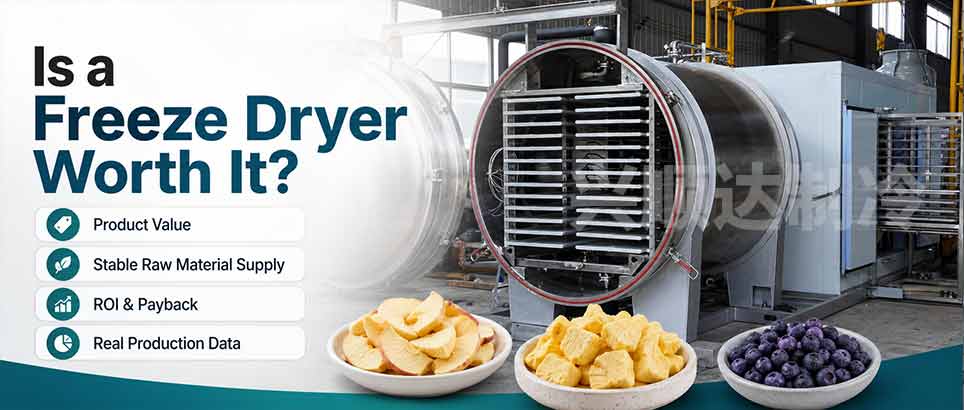
A freeze dryer is worth it when the finished product can sell at a premium price and the machine can run with stable batch volume. However, it may not be worth it for low-margin products, occasional production, or projects that have not completed sample testing.
For this reason, food manufacturers should not judge the investment only by machine price. Instead, they should review product fit, drying time, final moisture content, operating cost, production stability, annual equipment utilization, and payback potential.
Quick Answer: When Is a Freeze Dryer Worth It?
A freeze dryer is usually worth it when the business can create a product with higher value than ordinary dried food. Therefore, the decision should start with product economics, not machine size.
| Business Situation | Worth It? | Reason |
|---|---|---|
| The product can sell at a premium price. | Usually yes | Higher selling price can support equipment, labor, energy, and packaging cost. |
| The raw material supply is stable. | Usually yes | Stable supply keeps the machine loaded and improves utilization. |
| The product has clear market demand. | Usually yes | Sales volume is necessary for payback. |
| The machine will run only occasionally. | Usually no | Low utilization increases cost per kilogram. |
| The product has low selling value. | Usually no | Low-margin products may not recover the investment. |
| The product has not been tested. | Test first | Drying time, quality, final moisture, and yield must be confirmed before equipment selection. |
Practical answer: The real question is not only “is a freeze dryer worth it?” The better question is: “Can this product generate enough margin to support the equipment, energy, labor, packaging, maintenance, and sales cycle?”
Why Do Buyers Ask If a Freeze Dryer Is Worth It?
Buyers ask this question because freeze dryers require a serious investment. A commercial freeze dryer is not just a drying cabinet. It includes a vacuum chamber, cold trap, refrigeration system, vacuum system, heating system, control system, trays, piping, and safety protection.
In addition, freeze drying takes longer than many ordinary drying methods. The process must freeze the product, remove ice by sublimation, and then remove bound moisture during secondary drying. Because of this, the buyer must calculate both machine investment and operating cost.
Before purchasing, buyers often compare machine price, electricity use, daily wet material capacity, finished product value, payback time, and production risk. For a deeper background, buyers can read why freeze dryers are expensive.
What Makes a Freeze Dryer Valuable for Food Production?
Freeze drying is valuable because it can turn perishable food into a shelf-stable, lightweight, high-value product. Research on plant-based foods notes that freeze drying is widely used for high-value products because it can better retain food quality than many other drying methods, although the process is expensive and takes longer. Source
Higher Product Value
Freeze-dried products can often sell at a higher price than ordinary hot-air dried products. This is especially true for fruit snacks, instant meals, seafood, meat, soup ingredients, and pet food.
Better Texture and Rehydration
Freeze drying removes water at low temperature and under vacuum. As a result, the product structure, shape, and rehydration performance are often better preserved.
Longer Selling Window
Fresh fruit, cooked meals, seafood, and meat lose value quickly. However, freeze drying can extend the selling window when the product is properly dried and packaged.
For product suitability, buyers can also read what foods can be freeze dried.
Food safety note: Freeze drying does not replace sanitation or microbial control. The University of Minnesota Extension notes that freeze-dried foods absorb moisture easily and need proper moisture-proof packaging. It also explains that freeze drying does not kill illness-causing microorganisms. Source
When Is a Freeze Dryer Not Worth It?
A freeze dryer is not suitable for every business. In fact, knowing when not to buy one can help buyers avoid expensive mistakes.
When the Product Has Low Added Value
If the final product cannot sell for a much higher price, freeze drying may not be worth it. For example, some low-cost vegetables or low-margin bulk ingredients may not support the investment. In this case, hot-air drying or other dehydration methods may be more economical.
When Batch Volume Is Too Small
Commercial freeze dryers need stable loading. If the machine often runs half-empty, the energy cost and labor cost per kilogram will increase. For small food businesses, a small commercial freeze dryer or pilot testing may be a safer first step.
When the Drying Process Has Not Been Tested
Different foods dry differently. Thickness, sugar content, fat content, water content, shape, density, and pre-treatment all affect drying time and final quality. Without testing, the buyer may choose the wrong capacity, underestimate drying time, or overestimate daily output.
How to Calculate Whether a Freeze Dryer Is Worth It
A simple ROI estimate should include product value, output, operating cost, labor, packaging, and machine investment. This section gives a practical framework. For a deeper calculation, buyers can read the guide on the real cost of an industrial freeze dryer.
Step 1: Estimate Finished Product Value
The buyer should first estimate the selling price of the final freeze-dried product. The basic logic is:
Fresh material cost + freeze drying cost + packaging + labor + loss = total product cost
Selling price – total product cost = gross margin
If the margin is too low, the freeze dryer may not be worth it. However, if the product can sell as a premium snack, ready meal, pet treat, or functional ingredient, the investment may become more reasonable.
Step 2: Estimate Daily Output
Daily output is not only about tray area. It depends on loading density, drying time, product thickness, final moisture target, and product yield. Therefore, two products with the same tray area may produce very different daily output.
Step 3: Include Energy, Labor, and Packaging
Energy cost should not be judged only by installed power. A better method is to calculate energy consumption per kilogram of raw material or per kilogram of removed water. For more detail, buyers can read how much electricity a freeze dryer uses.
Packaging is also important. Dried foods can absorb moisture during storage, so they must be packed properly and stored in dry conditions. The National Center for Home Food Preservation also warns that dried foods are susceptible to moisture reabsorption and need proper packaging and storage. Source
Step 4: Estimate Payback Time
A simple payback estimate can use this formula:
Machine investment ÷ monthly net profit = estimated payback months
However, this is only a starting point. Real payback also depends on sales speed, product rejection rate, raw material price, packaging cost, maintenance cost, and production stability.
Need a Preliminary Capacity Recommendation?
If the product type, daily wet material capacity, target final moisture, and packaging method are already clear, buyers can send these details for an initial freeze dryer size recommendation.
Request a Freeze Dryer SolutionWhich Food Products Make a Freeze Dryer Worth It?
Product selection is one of the key factors that determine whether a freeze dryer is worth it. In general, businesses should evaluate products from raw material supply, market demand, product quality after drying, selling price, storage needs, processing speed, and equipment utilization.
Stable Raw Material Supply and Clear Market Demand
The most important factor is whether the business has a stable raw material source and a clear sales channel. Freeze-dried food often uses fresh agricultural products, seafood, cooked food, or high-value ingredients. To protect quality, reduce transportation loss, and control processing cost, the freeze-drying plant should be close to the raw material production area when possible.
Products That Keep Quality After Freeze Drying
A good freeze-dried product should keep its original nutrition, shape, color, aroma, and texture as much as possible. Foods with too much fat are usually not ideal for freeze drying. High-fat products may create oxidation, poor drying performance, texture problems, or shorter shelf life. Therefore, buyers should test high-fat meat, dairy, sauces, and oily products carefully before choosing a large freeze dryer.
Nutritious and High-Value Products
Freeze drying is more suitable for nutritious, high-value, or premium-positioned foods. Although the processing cost is higher, the product can support a higher selling price when quality is good. This is why freeze drying is often used for premium fruit snacks, instant meals, seafood, meat ingredients, soup ingredients, functional foods, pet food, and export-oriented agricultural products.
Products That Need Long Storage or Long-Distance Transport
Freeze-dried food is light, easy to package, and suitable for long storage when properly dried and sealed. Therefore, it is useful for export food, seasonal fruit snacks, instant meals, camping food, emergency food, travel food, aviation food, and other products that need long-distance transport or long selling cycles.
Small, Thin, and Fast-Drying Products
Small pieces and thin slices usually dry faster than large pieces. This can reduce processing time and improve machine utilization. Product shape and cutting thickness are not small details. They directly affect drying time, energy cost, daily output, and payback.
Foods for Special Use Scenarios
Some freeze-dried foods are valuable because they serve special use scenarios. These products may include mountaineering food, travel food, outdoor camping meals, maritime food, border supply food, emergency rescue food, and aviation food. These applications need light weight, long shelf life, easy transport, and convenient preparation.
Products That Support Year-Round Equipment Use
A freeze dryer is more worth it when it can run throughout the year. If a factory depends on only one seasonal raw material, the machine may sit idle for several months. For better economic results, businesses should consider multiple products across different seasons.
In many projects, a good production plan should aim for 300 to 330 operating days per year when raw material supply and sales demand allow it. This helps improve equipment utilization and shorten the payback period.
Common Food Categories Worth Testing
| Category | Examples | Why It May Be Worth It |
|---|---|---|
| Fruit snacks | Apple slices, blueberries, pineapple, durian, figs, pear slices, strawberries, mango pieces | Good appearance, crisp texture, premium snack positioning, and strong consumer acceptance. |
| Meals and soup ingredients | Cooked rice, instant soup ingredients, mushroom soup ingredients, noodle toppings | Fast rehydration, convenient use, and good value for ready-meal brands. |
| Meat, seafood, and pet food | Shrimp, meat cubes, chicken breast, beef pieces, pet food ingredients | Higher raw material value and stronger premium positioning, but process control must be strict. |
Home Freeze Dryer vs Commercial Freeze Dryer: Which One Is Worth It?
Many search results for “is a freeze dryer worth it” focus on home freeze dryers. However, a food business needs a different answer.
A home freeze dryer may be useful for personal food storage, small recipe trials, or hobby use. However, it is not designed for stable commercial food production.
A commercial freeze dryer is different. It is built for higher loading, stronger refrigeration, a larger cold trap, better vacuum performance, and more consistent batch control.
| Freeze Dryer Type | Suitable Use | Business Fit |
|---|---|---|
| Home freeze dryer | Personal storage, hobby use, small recipe trials | Not suitable for stable commercial production |
| Lab or pilot freeze dryer | Sample testing and small batches | Good for process validation |
| Commercial freeze dryer | Food startups and medium production | Good for stable sales and batch production |
| Industrial freeze dryer | Large factories and export projects | Good for high-capacity production |
Buyers can compare the lab pilot freeze dryer, commercial freeze dryer, and industrial freeze dryer according to daily wet material capacity.
Freeze Dryer vs Dehydrator: Which Is More Worth It?
A freeze dryer and a dehydrator serve different business models. A dehydrator usually has lower equipment cost and simpler operation. Therefore, it can be better for low-cost dried foods. However, the product may shrink more, darken more, or have lower rehydration quality.
A freeze dryer has higher investment and higher technical requirements. However, it can create a premium product when texture, color, shape, flavor, and rehydration matter.
Simple rule: Choose a dehydrator for low-cost drying. Choose a freeze dryer for premium food products. Compare both only after checking the target selling price and product positioning.
For a deeper comparison, read the full dehydrator vs freeze dryer comparison.
How to Know the Right Freeze Dryer Size Before Buying
The right size depends on daily wet material capacity, drying time, tray area, product thickness, target final moisture, and expected output.
Before choosing a model, buyers should prepare product name, fresh material weight per day, slice thickness or product size, target final moisture, expected drying time, selling price, packaging method, factory power conditions, cooling water or steam availability, installation space, and target sales volume.
After these details are confirmed, the manufacturer can recommend a lab, commercial, or industrial freeze dryer more accurately. If the project is still in the early stage, pilot testing should come first. If the process is already confirmed and the sales channel is stable, a commercial or industrial system may be more suitable.
Real Project Data: Why Testing Matters Before Judging ROI
A freeze dryer is worth it only when the process and product economics are clear. Real production data is more useful than theory because different products need different drying curves, loading densities, and moisture targets.
| Product | Equipment | Drying Time | Loading Density | Final Moisture | Reference |
|---|---|---|---|---|---|
| Freeze-dried pineapple | SDG700 | 12 h | 12.2 kg/m² | 2.31% | Case study |
| Freeze-dried blueberries | SDG1100 | 13 h | 12 kg/m² | 1.97% | Case study |
| Freeze-dried rice | SDG350 | 6 h | 12.5 kg/m² | 1.28% | Case study |
| Freeze-dried shrimp | SDG6000 | 8 h | 11.6 kg/m² | 1.68% | Case study |
| Freeze-dried meat | SDG350 | 12 h | 12.1 kg/m² | 1.49% | Case study |
These examples show why one fixed answer cannot apply to every business. A fruit snack factory, a ready-meal producer, a pet food company, and a seafood processor all need different drying curves and capacity calculations.
Therefore, buyers should use sample testing, drying records, and batch data before making the final investment decision. More real examples are available in the freeze drying case studies.
Questions to Ask Before Deciding Whether a Freeze Dryer Is Worth It
Before purchasing a freeze dryer, buyers should answer these questions:
- What product will be freeze dried?
- What is the expected selling price?
- What is the fresh material cost?
- Is the raw material supply stable?
- How many kilograms need to be processed per day?
- What final moisture content is required?
- What packaging will be used?
- Is the product high in sugar, fat, or oil?
- Can the machine run across different seasons?
- Does the factory have enough power, water, space, or steam?
- Has the product been tested before choosing a large machine?
If these answers are unclear, the project should start with sample testing instead of direct equipment purchase.
Final Verdict: Is a Freeze Dryer Worth It?
A freeze dryer is worth it for a food business when the product can achieve a higher selling price, the raw material supply is stable, the machine can run at steady capacity, and the buyer has tested the drying process before investing.
However, it is not worth it when the business only compares machine price, ignores energy and packaging cost, has no clear sales channel, or chooses products with low added value.
For commercial and industrial buyers, the best decision is based on real data. Product testing, drying time, loading density, final moisture, energy use, packaging cost, and annual equipment utilization should all be reviewed before choosing a model.
Request a Freeze Dryer Solution
Before choosing a commercial or industrial freeze dryer, buyers can prepare their product type, daily wet material capacity, target moisture, packaging method, raw material season, and factory utility conditions.
A technical evaluation can help confirm whether freeze drying is suitable, which machine size fits the project, and whether the expected output can support the investment.
Request a Freeze Dryer SolutionFAQ
Is a freeze dryer worth it for a small food business?
Yes, a freeze dryer can be worth it for a small food business if the product has a premium selling price, stable demand, and confirmed drying results. However, if the business is still testing the market, a small commercial freeze dryer or pilot test is usually safer than buying a large system immediately.
How long does it take for a freeze dryer to pay for itself?
Payback time depends on machine investment, product margin, daily output, energy cost, labor cost, packaging cost, and sales speed. A simple estimate can be made by dividing the machine investment by monthly net profit, but real payback should be calculated from tested production data.
Is a commercial freeze dryer worth it?
A commercial freeze dryer is worth it when the buyer has stable production volume and a product that can sell at a higher price than ordinary dried food. It is not worth it if the machine will run only occasionally or if the product has not been tested.
Is a freeze dryer better than a dehydrator?
A freeze dryer is better for premium products that need better shape, color, texture, and rehydration. A dehydrator is better for low-cost drying when product quality requirements are lower. The better choice depends on product positioning and profit margin.
What foods make a freeze dryer more worth it?
Freeze-dried fruits, instant meals, soup ingredients, seafood, meat, pet food, outdoor food, travel food, and emergency food often make a freeze dryer more worth it because these products can support higher selling prices or special use demand.
What products are not suitable for freeze drying?
Products with very high fat or oil content are usually harder to freeze dry and may have oxidation, drying, or shelf-life problems. Buyers should test high-fat meat, dairy, sauces, and oily products before choosing commercial equipment.
Should buyers test products before buying a freeze dryer?
Yes. Product testing is strongly recommended before buying a commercial or industrial freeze dryer. Testing helps confirm drying time, thickness, loading density, final moisture, product quality, and estimated output.
Internal links in this article point to related product, cost, electricity, comparison, food suitability, and case study pages on goodfreezedryer.com. External links are non-competitor references used for food quality, food safety, and packaging support.