
Small Commercial Freeze Dryer for Food Business: How to Choose the Right Size
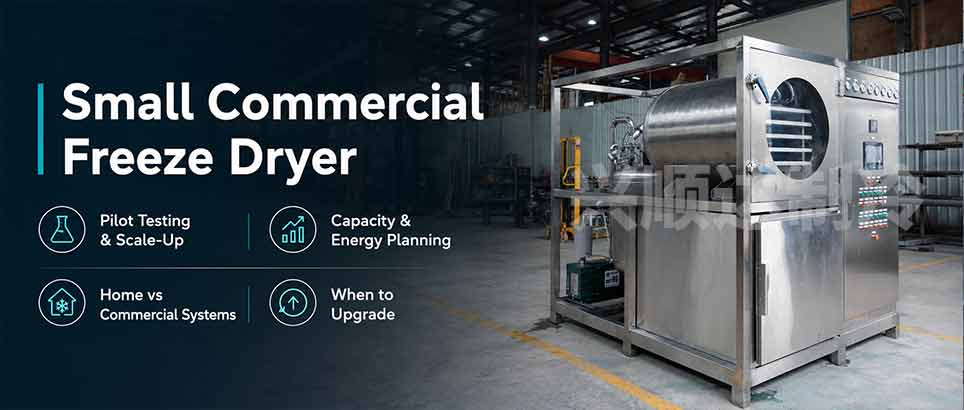
A small commercial freeze dryer can be a practical starting point for food businesses that want to test products, produce small batches, or prepare for commercial freeze-dried food sales. However, buyers should not choose a machine only by tray area, chamber size, or price.
For real food production, the right freeze dryer must match product type, wet material capacity, moisture content, slice thickness, drying time, condenser load, factory space, and future expansion plans. Therefore, a small machine may be enough for testing, but it may not support stable commercial orders.
This guide explains how food businesses can choose between a home freeze dryer, a pilot freeze dryer, a small commercial freeze dryer, and a larger commercial or industrial freeze-drying system.
What Is a Small Commercial Freeze Dryer?
A small commercial freeze dryer is a freeze-drying system used for small food business production, pilot production, or early commercial sales. It should provide better stability, stronger condenser performance, and more useful production data than a basic home freeze dryer.
However, the term “small commercial” does not have one fixed standard. In practice, buyers should define it by daily wet material capacity and business purpose.
| Freeze Dryer Type | Best For | Main Purpose | Recommended Direction |
|---|---|---|---|
| Home / Prosumer Freeze Dryer | Home storage, hobby use, very small side business | Small batches and simple product trials | Not ideal for commercial scale-up planning |
| Pilot Freeze Dryer | Food testing, process validation, small trial production | Confirm product data before scale-up | SDG60 / SDG90 pilot lab freeze dryer |
| Small Commercial Freeze Dryer | Small food factories and stable commercial orders | Daily commercial batch production | SDG350 commercial freeze dryer |
| Larger Commercial Freeze Dryer | Growing food brands and medium production projects | Higher daily output | SDG700 / SDG1100 commercial freeze dryer |
| Industrial Freeze Dryer | Large food factories and factory-scale projects | Multi-ton daily wet material processing | Industrial freeze dryer models |
Is a Small Commercial Freeze Dryer Enough for Real Food Production?
A small commercial freeze dryer can support real food production when the daily order volume is limited and the product process has already been tested. However, it may not be enough if the business needs stable output every day.
Before choosing a machine, buyers should check several key factors:
- Daily wet material weight.
- Raw material moisture content.
- Slice thickness or product size.
- Expected drying time per batch.
- Target final moisture.
- Weekly production schedule.
- Factory space and power supply.
- Future expansion plan.
For example, a fruit snack startup may begin with product testing and small batch sales. In that case, a pilot freeze dryer may be enough. However, if the same company receives stable retail orders, it should calculate daily wet material capacity before buying a small commercial freeze dryer.
As a result, the best choice is not always the smallest machine. The best choice is the machine that can produce stable batches without creating a bottleneck in loading, drying, defrosting, cleaning, and packaging.
Home Freeze Dryer vs Small Commercial Freeze Dryer
A home freeze dryer can help buyers test whether a product can be freeze-dried. However, it usually does not provide reliable production data for commercial or industrial scale-up.
The key difference is not only size. Home machines and commercial machines often have different chamber structures, condenser capacity, vacuum performance, heating methods, loading density, and control systems. Therefore, a recipe that works in a home freeze dryer may not guide a larger commercial project accurately.
A home freeze dryer is usually more suitable for home food storage, hobby production, and simple trials. In contrast, a small commercial freeze dryer is designed for small business production and commercial batches.
For this reason, buyers who plan to build a food business should avoid relying only on home freeze dryer settings. They need test data that can support the next production stage.
Pilot Freeze Dryer vs Small Commercial Freeze Dryer
If the buyer is still testing freeze-dried fruit, pet food, seafood, prepared meals, herbs, or functional food, a pilot freeze dryer is often a better starting point. Its value is not maximum output. Instead, it helps the buyer confirm slice thickness, tray loading weight, drying time, final moisture, texture, and rehydration performance.
A small commercial freeze dryer is more suitable after the buyer has already confirmed the product process and needs stable daily output. At that stage, the main concern is no longer whether the product can be freeze-dried. The main concern becomes whether the machine can support production schedules, order delivery, labor efficiency, and future growth.
For buyers who need 60–120 kg wet material per 24 hours for testing or trial production, SDG60 and SDG90 pilot freeze dryers can help confirm process data before larger investment.
For buyers who already need 340–450 kg wet material per 24 hours, SDG350 is usually a better commercial production choice. If the project needs higher output, SDG700 and SDG1100 can support larger commercial production.
Why Pilot Freeze Dryer Data Matters for Commercial Scale-Up
For a food business, a pilot freeze dryer should not only produce small batches. It should also help the buyer build practical process data for the next commercial or industrial production stage.
SDG60 and SDG90 pilot freeze dryers are designed with the same scale-up logic used in larger commercial freeze dryers. They use a high-capacity vapor trap that can handle more than 2.0 kg H2O/m²/h of sublimation vapor. They also use a water-based heating system, uniform radiation heating, and real-time condenser temperature and pressure monitoring with records.
Because of this design, process data from SDG60 and SDG90 can be used as a practical reference for SDG350, SDG700, and SDG1100 commercial freeze dryers. Product thickness, tray loading density, drying time, final moisture, texture, color, and rehydration result can all help engineers design a larger production process.
For industrial freeze dryers, the pilot data is still valuable. However, industrial models often use steam-supported heating. Therefore, when engineers use SDG60 or SDG90 data as a reference, the final industrial drying time may become faster after process adjustment.
This is a major difference between a true pilot freeze dryer and a home freeze dryer. A pilot freeze dryer does not only answer “Can this product be freeze-dried?” It also helps answer “How should this product be produced at a larger scale?”
Scale-up advantage: Pilot data from SDG60 and SDG90 can support commercial freeze dryer model selection, initial drying curve design, loading density planning, and final moisture target confirmation.
Example: From SDG90 Pilot Testing to SDG350 Commercial Production
A ginseng slice startup first used an SDG90 pilot freeze dryer to test American ginseng slices. During the pilot stage, the customer confirmed a 2 mm slice thickness, 12.5 kg/m² loading density, 13-hour drying time, and final moisture below 1.93%.
After the product quality and process data were confirmed, the customer upgraded to an SDG350 commercial freeze dryer for daily batch production. This path reduced investment risk because the buyer did not need to guess the commercial production process from zero.
This is the main value of a true pilot freeze dryer. It helps a food business test the product, confirm market quality, and prepare process data before investing in larger commercial equipment.
Buyers can also review more freeze-drying project references in the customer success story library.
Why Home Freeze Dryer Settings Are Difficult to Scale Up
A home freeze dryer can be useful for early product trials. However, its process settings are usually difficult to apply directly to commercial or industrial freeze dryers.
Different Heating Method
Many home freeze dryers use electric heating plates. Heat distribution may be less uniform, and temperature adjustment is often slower. In contrast, commercial and industrial freeze dryers use hollow anodized aluminum plates as radiation heating plates.
A flowing heat-transfer liquid inside the plate supplies heat evenly, and the temperature can rise or fall according to the product process. This helps keep the material within a suitable temperature range during drying.
Lower Condenser Performance
Home freeze dryer cold traps usually handle a lower sublimation vapor load, often below 1.0 kg H2O/m²/h. As a result, the loading density must stay low.
SDG60 and SDG90 use high-capacity vapor traps designed to handle more than 2.0 kg H2O/m²/h, which is closer to commercial production requirements.
Cooling Stability in Hot Conditions
SDG60 and SDG90 use water-cooled heat rejection, so they can operate more stably even in hot summer conditions. Many home freeze dryers use air cooling, which may create shutdown risk when the ambient temperature is high.
Vacuum Measurement Accuracy
Many small home units use thermocouple vacuum gauges, which may have a much larger measurement error. SDG60 and SDG90 use INFICON CDG020D series capacitance diaphragm vacuum gauges, with an accuracy of 1% of reading for the 3CA3 series according to INFICON technical data.
This is the same vacuum measurement logic used in larger freeze dryers. Only accurate vacuum data can support meaningful process comparison and scale-up design.
Therefore, home freeze dryer recipes may help users understand whether a product can be freeze-dried. However, they should not be treated as reliable production data for commercial or industrial freeze-drying projects.
Pilot Freeze Dryer vs Home Freeze Dryer vs Commercial Freeze Dryer
| Factor | Home Freeze Dryer | SDG60 / SDG90 Pilot Freeze Dryer | Commercial / Industrial Freeze Dryer |
|---|---|---|---|
| Main Purpose | Home use and basic product trials | Food testing, process validation, and scale-up preparation | Stable commercial or factory-scale production |
| Heating Method | Electric heating plate | Water-based radiation heating | Water-based or steam-supported radiation heating |
| Vapor Capture Capacity | Usually below 1.0 kg H2O/m²/h | More than 2.0 kg H2O/m²/h | Designed for commercial or industrial sublimation load |
| Cooling Method | Usually air-cooled | Water-cooled | Water-cooled or project-specific cooling system |
| Vacuum Gauge | Often thermocouple gauge | INFICON CDG020D capacitance diaphragm gauge | Capacitance diaphragm gauge |
| Vacuum Measurement Accuracy | Lower accuracy for scale-up data | 1% of reading | Designed for production process control |
| Scale-Up Value | Low | High | Production stage |
This comparison explains why pilot freeze dryer data has stronger production value than home freeze dryer data. A buyer who plans to build a real freeze-dried food business should test products on equipment that uses commercial-scale design logic.
Capacity Calculation Example for a Small Freeze-Drying Business
Many buyers choose a small commercial freeze dryer by looking at the final dried product weight. This can lead to serious underestimation. A better method is to calculate from wet raw material weight.
For example, suppose a food startup wants to produce 50 kg of freeze-dried fruit snacks per day. If the fresh fruit contains about 80% water, the dry yield is about 20%.
Daily wet material load = target dried product output ÷ dry yield 50 kg ÷ 20% = 250 kg wet material per dayIn this case, the buyer needs to process about 250 kg of fresh material per day. SDG60 or SDG90 may be suitable for product testing and pilot production, but they may not be enough for stable daily commercial output. The buyer should review a small commercial freeze dryer such as SDG350.
Energy cost should also be considered. If the average electricity consumption is about 2.5 kWh per kg of raw material, then the estimated daily electricity use is:
250 kg × 2.5 kWh/kg = 625 kWh per dayThis calculation does not replace a real project quotation, because actual energy use depends on product moisture, slice thickness, loading density, drying time, ambient conditions, and equipment configuration. However, it helps buyers understand why daily wet material capacity is more important than tray quantity alone.
When Should a Business Upgrade to a Larger Commercial Freeze Dryer?
A business should upgrade when the small machine can no longer support the production schedule. In many cases, the problem is not drying quality. Instead, the problem is daily output, labor efficiency, and order delivery pressure.
Buyers should consider a larger commercial freeze dryer when daily wet material demand is higher than 120 kg. They should also consider an upgrade when the product formula and drying result have already been confirmed.
Another signal is batch pressure. If the machine needs to run too many small batches to meet orders, labor cost and production management become difficult. Loading, unloading, defrosting, cleaning, and packaging may become bottlenecks.
In addition, the condenser must have enough vapor capture capacity. If the condenser approaches its water capture limit, drying speed may drop and production stability may suffer.
A larger commercial freeze dryer is also more suitable when the business is preparing for retail, pet food, export, food service, or larger wholesale channels. These markets usually require stable batch output, repeatable quality, and better production planning.
For smaller commercial food production, buyers can review the SDG350 commercial freeze dryer, which is designed for 340–450 kg wet material per 24 hours. If the project needs higher output, SDG700 and SDG1100 can support larger commercial production before industrial scale.
Specifications That Matter More Than Machine Size
Machine size alone does not decide production performance. In fact, two machines with similar outer dimensions may produce very different results. Therefore, buyers should focus on production-related specifications.
Wet Material Capacity
Buyers should ask whether the capacity refers to wet fresh material or final dried product. Since final dried weight depends on moisture content, wet material capacity gives a clearer production reference.
For example, 50 kg of finished freeze-dried fruit may require about 250 kg of fresh fruit if the dry yield is 20%. Therefore, a machine that looks suitable by dried weight may be too small for daily wet material processing.
Drying Time
Drying time affects daily output. Therefore, buyers should not only ask how much material the machine can load. They should also ask how long one batch may take under suitable product thickness and loading density.
For many food products, thickness has a strong effect on drying time. As a result, process testing before commercial production is important.
Condenser Capacity
The condenser must capture water vapor during sublimation. If the condenser is too small, drying speed may drop and production stability may suffer.
For small commercial and pilot production, condenser performance should match the expected sublimation load. SDG60 and SDG90 are designed to handle more than 2.0 kg H2O/m²/h of sublimation vapor, which makes their data more useful for commercial scale-up.
Vacuum Stability
Stable vacuum supports stable sublimation. Therefore, buyers should check vacuum-down speed, vacuum pump configuration, sealing design, monitoring system, and vacuum gauge accuracy.

Accurate vacuum measurement also matters. SDG60 and SDG90 use INFICON CDG020D series capacitance diaphragm vacuum gauges, with an accuracy of 1% of reading. If the vacuum gauge has a large measurement error, the process data may not be useful for scale-up.
Heating System
The heating system affects product temperature, drying speed, color, texture, and final moisture. Home freeze dryers often use electric heating plates, while commercial and industrial systems use more controlled heating methods.
SDG60 and SDG90 use water-based radiation heating. This design provides more uniform heat input and allows better temperature adjustment during drying.
Cooling Method
Cooling stability affects condenser performance. Air-cooled systems may become less stable in hot summer conditions. In contrast, water-cooled systems can provide more stable operation when ambient temperature is high.
Because SDG60 and SDG90 use water-cooled heat rejection, they are more suitable for pilot production and process validation in real factory conditions.
Food-Contact Material
Food businesses should also consider cleaning, corrosion resistance, and long-term hygiene. For food production, sanitary operation and production control matter.
Buyers should check whether the drying chamber, trays, heating plates, and material-contact areas are suitable for food production. They should also consider cleaning workflow, operator access, and maintenance convenience.
For food safety background, buyers can review the FDA page on Current Good Manufacturing Practices for food and dietary supplements.
Process Records and Operation Support
For business use, buyers should not rely only on manual operation. A suitable system should support process setting, monitoring, data records, and clear operator training.
This is especially important for food businesses that plan to scale up. Without reliable records, engineers cannot compare pilot batches, adjust drying curves, or prepare larger equipment settings accurately.

Recommended Selection Path for Food Businesses
The right freeze dryer depends on the buyer’s current business stage. Therefore, the manufacturer recommends choosing by product validation status and daily wet material target.
| Business Stage | Typical Need | Recommended Direction |
|---|---|---|
| Product idea or sample testing | Confirm whether the food can be freeze-dried | Start with pilot testing |
| Small trial production | Confirm thickness, loading density, drying time, and final moisture | SDG60 / SDG90 pilot freeze dryer |
| Early commercial production | Produce stable batches for business sales | SDG350 commercial freeze dryer |
| Growing commercial output | Support higher daily production | SDG700 / SDG1100 commercial freeze dryer |
| Factory-scale production | Process multi-ton wet material per day | Industrial freeze dryer series |
Questions to Ask Before Buying a Small Commercial Freeze Dryer
Before requesting a quotation, buyers should prepare practical production information. This helps engineers recommend a suitable model instead of guessing by tray size.
- What product will be freeze-dried?
- What is the target wet material weight per day?
- What is the raw material moisture content?
- What slice thickness or product size will be used?
- What final moisture is required?
- How many hours can each batch run?
- How many production days are planned per week?
- Is three-phase power available?
- What cooling water conditions are available?
- What factory space and ceiling height are available?
- Will the project expand to larger commercial or industrial production later?
Need Help Choosing a Small Commercial Freeze Dryer?
The engineering team helps food businesses evaluate product type, wet material capacity, drying time, condenser load, energy conditions, factory space, and future expansion plans before selecting a machine.
Send the product name, target daily output, moisture content, slice thickness, and available factory space. The engineering team can help confirm whether a pilot freeze dryer, small commercial freeze dryer, or larger commercial system is more suitable.
Contact usFAQ About Small Commercial Freeze Dryers
What is the best small commercial freeze dryer for a food business?
The best small commercial freeze dryer depends on product type, daily wet material capacity, moisture content, drying time, final moisture target, factory space, and future expansion plan. Buyers should choose by real production demand, not only by chamber size or price.
Can a small freeze dryer be used for commercial food production?
Yes, a small freeze dryer can support early commercial production if the order volume is limited. However, stable food business production needs enough condenser capacity, vacuum stability, process control, and operator support.
Is a home freeze dryer enough for a food business?
A home freeze dryer may help with early product testing or very small batches. However, its process settings are usually difficult to transfer directly to commercial or industrial freeze dryers. Buyers who plan to scale up should use pilot test data from equipment designed for commercial process development.
What size freeze dryer does a small business need?
A small business should start with daily wet material weight. Then it should confirm moisture content, dry yield, slice thickness, drying time, target final moisture, and weekly production schedule.
When should a business move from a pilot freeze dryer to a commercial freeze dryer?
A business should move to a commercial freeze dryer when product testing is complete, orders become stable, daily wet material demand increases, or the pilot machine cannot support production schedules efficiently.
Why is pilot freeze dryer data useful for larger equipment?
Pilot freeze dryer data can help confirm product thickness, loading density, drying curve, final moisture, texture, and rehydration result. In addition, SDG60 and SDG90 use INFICON CDG020D series capacitance diaphragm vacuum gauges with 1% of reading accuracy. This helps make vacuum data more reliable when engineers compare pilot test results with larger commercial or industrial freeze dryers.
Why are home freeze dryer settings difficult to use for commercial scale-up?
Home freeze dryers usually have different heating methods, lower condenser capacity, air-cooled heat rejection, lower loading density, and less accurate vacuum measurement. Therefore, home freeze dryer recipes may not provide reliable production data for larger commercial or industrial systems.
How much electricity does a small commercial freeze dryer use?
Electricity use depends on product moisture, slice thickness, loading density, drying time, ambient conditions, and machine configuration. As a practical estimate, if average electricity consumption is about 2.5 kWh per kg of raw material, processing 250 kg of wet material may require about 625 kWh per day.
Conclusion
A small commercial freeze dryer is not only a smaller version of a large machine. It must match the buyer’s real production stage, product type, wet material capacity, drying time, condenser load, heating method, vacuum accuracy, and expansion plan.
For early testing, a pilot freeze dryer may provide better scale-up value than a home freeze dryer. This is because SDG60 and SDG90 use commercial-scale design logic, including high-capacity vapor trapping, water-based radiation heating, water-cooled heat rejection, and accurate vacuum measurement.
For stable business orders, a small commercial freeze dryer can improve daily output and production efficiency. Meanwhile, larger commercial and industrial systems become necessary when the project moves toward higher capacity and factory-scale operation.
Therefore, buyers should choose a freeze dryer based on real product data and business planning. This approach reduces investment risk and helps build a more reliable freeze-dried food production process.