
How to Start a Food Freeze Drying Business: Feasibility, Cost and Scale-Up
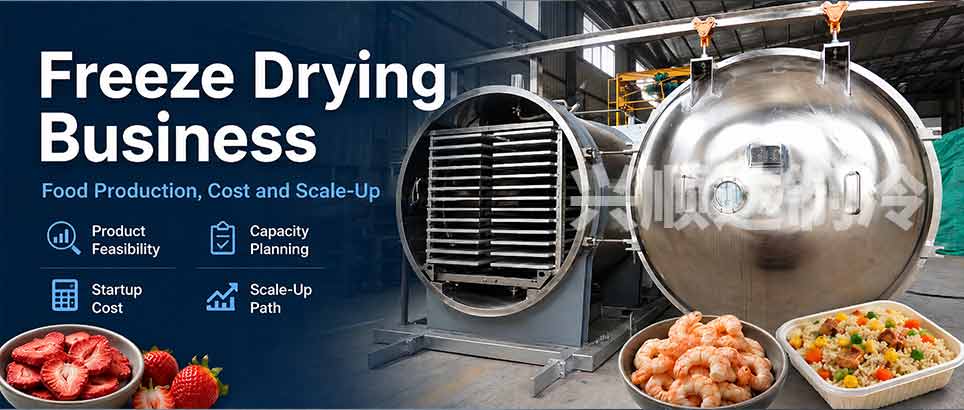
A profitable freeze drying business for food production depends on verified product data, safe processing, realistic capacity and repeatable orders. Before buying equipment, a producer should test the recipe, measure finished yield, confirm moisture and water activity targets, calculate cost per kilogram, check packaging and shelf-life risk, and then choose pilot, commercial or industrial freeze drying equipment.
Request a Freeze-Drying Business Feasibility Review
Share the product, daily wet-material target, current test data, packaging goal and factory utility conditions. The engineering team can review whether your project should begin with pilot testing, commercial equipment, industrial equipment or outsourced processing.
Request Project Evaluation Review Real Project DataWho This Food Freeze Drying Business Guide Is For
This guide serves food brands, farms, ingredient suppliers, contract processors and food factories evaluating a commercial freeze drying business. It focuses on product feasibility, production capacity, food safety, factory utilities and equipment selection.
It is not a home freeze dryer side-hustle guide. Home or hobby machines can help with early product curiosity, but their tray size, condenser load, vacuum stability, heating method, sanitation workflow and data recording are not enough for a reliable food factory plan.
Best-Fit Readers
Food producers, farms, exporters, ready-meal brands, snack brands, pet food manufacturers, ingredient suppliers and buyers comparing pilot, commercial and industrial freeze dryers.
Lower-Fit Readers
Users only looking for home freeze dryers, DIY machines, freeze-dried candy side hustles or very small retail batches without a licensed production plan.
Is Freeze Drying Suitable for the Product?
Freeze drying can create lightweight, porous, high-value food with good shape, color and rapid rehydration. However, the process is slower and more capital-intensive than ordinary dehydration. A freeze drying business should therefore focus on products whose quality, shelf stability, convenience, export value or selling price can justify the added cost.
Strong Product Candidates
Fruit snacks, vegetables, ready meals, soup ingredients, seafood, meat, pet food, tea, coffee, herbs and high-value food ingredients often benefit from low-temperature moisture removal.
Products That Need Testing
High-fat meat, dairy formulas, sugary products, dense pieces, sauces and mixed meals may need special pretreatment, thickness control, freezing profile and drying curves.
Weak Business Candidates
Low-margin raw materials, unstable seasonal supply, unverified demand or products with long cycles and low selling value may not recover equipment, labor and packaging cost.
Producers should not select a product only because it can be freeze-dried. Instead, they should assess raw-material supply, finished yield, target customer, sales channel, packaging, regulatory requirements and achievable selling price. The guide to foods suitable for freeze drying provides a broader application comparison.
Use a Feasibility Scorecard Before Buying Equipment
A freeze dryer business plan becomes much stronger when each major risk is scored before investment. The table below helps separate projects that are ready for quotation from projects that still need pilot testing or market validation.
| Feasibility Area | Ready to Scale | Needs Validation | High-Risk Signal |
|---|---|---|---|
| Market demand | Repeat orders, buyer feedback or signed distribution interest | Samples are liked but no price or volume is confirmed | Demand is based only on social media claims or competitor revenue screenshots |
| Product data | Moisture, yield, drying time, quality and packaging data are recorded | Only small samples have been made | No tested recipe, no target final moisture and no cycle data |
| Raw-material supply | Stable seasonal or annual supply with known price range | Supply exists but sorting loss and seasonal price are unclear | Irregular raw material, unstable quality or high waste rate |
| Food safety | Product hazards, pretreatment, sanitation and traceability are planned | General safety plan exists but product-specific controls are missing | Freeze drying is assumed to be a kill step without validation |
| Packaging and shelf life | Moisture-barrier packaging, seal checks and shelf-life tests are planned | Packaging format is selected but storage data are missing | Product is exposed to air after drying or sold without stability checks |
| Factory utilities | Power, steam, cooling water, drainage and installation route are known | Factory exists but utility capacity is not verified | Machine size is selected before site conditions are checked |
If several items fall into the high-risk column, the producer should conduct product testing or a small trial production run before purchasing production equipment.
Choose the Right Freeze Dryer Business Model
The same machine can support different revenue models. Each model creates different requirements for product development, capacity, packaging, quality control and customer service.
| Business Model | Main Revenue | Key Requirement | Typical Risk |
|---|---|---|---|
| Own-brand products | Retail or wholesale product sales | Brand, packaging, distribution and repeatable quality | Slow sales and inventory pressure |
| Contract freeze-drying | Processing fees for other brands or farms | Flexible recipes, scheduling, traceability and clear service terms | Frequent changeovers and uneven orders |
| B2B ingredient supply | Fruit pieces, powders, meal components or specialty ingredients | Specification control, batch records and reliable volume | Price pressure and strict customer standards |
| Pilot production | Samples, development batches and market validation | Accurate process records and scalable equipment | Buying full production capacity too early |
Projects with uncertain demand can reduce risk by comparing contract freeze-drying services with buying a freeze dryer. Outsourcing may suit early market validation. Ownership becomes more attractive when the product, orders, process and utilization rate are stable.
Validate the Product Before Buying Production Equipment
A commercial quotation is only reliable when the product data are reliable. Pilot testing should establish more than appearance. It should create a repeatable drying record that supports capacity, utility, packaging and cost calculations.
What a Pilot Test Should Record
| Data Type | What to Record | Why It Matters |
|---|---|---|
| Raw material | Variety, maturity, pretreatment, initial moisture and solids | Different raw materials change yield, cycle time and finished quality |
| Geometry and loading | Slice thickness, piece size, tray loading density and batch weight | Thickness and loading affect heat transfer, mass transfer and daily output |
| Freeze-drying cycle | Freezing method, shelf temperature, vacuum pressure, primary drying, secondary drying and total cycle time | Cycle data are required for production capacity and utility planning |
| Quality indicators | Final moisture, water activity, rehydration, color, texture, flavor and key nutrients where relevant | Quality determines whether the product can justify freeze-drying cost |
| Safety and stability | Microbial checks, pretreatment validation, package seal, oxygen/moisture exposure and storage test | Food safety and shelf life are part of the business model, not afterthoughts |
Why Small-Machine Results May Not Scale Directly
A small machine may make an acceptable sample. However, production scale adds condenser load, vapor-flow resistance, vacuum stability, tray loading, heating uniformity, defrost time, cleaning workflow and operator control. Therefore, a home-machine cycle should not be copied directly into a commercial factory plan.
For reliable scale-up, the pilot system should use production-relevant heating, refrigeration, vacuum measurement and data recording. The SDG60 and SDG90 pilot lab freeze dryers support product testing and trial production before larger investment. The detailed food R&D pilot testing guide lists the data that a test program should capture.
Request Pilot Test Guidance
When the recipe or cycle is not confirmed, the engineering team should establish product data before selecting production equipment.
Discuss a Product TestCalculate Freeze Drying Business Capacity from Wet Material
Capacity should start with the amount of fresh or prepared food entering the machine. Comparing tray quantity or final dried weight can mislead a buyer because products have different moisture, thickness, loading density and cycle time.
Required wet material per batch = daily wet-material target / complete batches per day
Estimate the Water Removal Load
Suppose a fruit project plans to process 500 kg of prepared material at 85% initial moisture and 2% final moisture. The batch contains about 75 kg of dry solids. At 2% final moisture, the finished mass is approximately 76.5 kg. Therefore, the freeze dryer must remove about 423.5 kg of water.
This value affects cold-trap capacity, peak condensing rate, refrigeration load, vacuum stability, drying time and defrost planning. Two machines with similar tray area may deliver very different real output.
Drying Time Changes Daily Output
Many tested sliced foods can dry in approximately 8-15 hours after the recipe has been optimized. Liquids, dense meals, high-solids formulas, high-fat foods and thicker products may require longer cycles. Cleaning, loading, unloading, freezing, defrosting and packaging time must also be included in daily capacity.
Choose Pilot, Commercial or Industrial Freeze Drying Equipment
Once the product and daily wet-material target are clear, the equipment category becomes easier to define. The ranges below describe wet material before drying, not packaged finished product.
| Project Stage | Reference Wet-Material Capacity | Equipment Range | Best Fit |
|---|---|---|---|
| Product testing | Small batches for recipe and process development | Lab or pilot freeze dryer | Recipe validation, sample production, cycle development and buyer samples |
| Trial production | Dozens to hundreds of kilograms per day, depending on product | Commercial freeze dryer | Small food factories, new brands, farms and contract test batches |
| Commercial expansion | Regular daily production with stable orders | Large commercial or small industrial system | Food businesses with confirmed product-market fit and repeatable cycle data |
| Industrial production | High-volume processing, often more than one ton of wet material per day | Industrial freeze dryer | Large factories with stable supply, utilities, operators and quality systems |
Review the commercial freeze dryer range for SDG350-SDG1100 production or the industrial freeze dryer range for steam-supported factory-scale systems. The broader food freeze dryer capacity guide explains the main selection variables.
Get a Capacity and Utility Recommendation
Useful inputs include daily wet material, initial moisture, product thickness, target final moisture, expected operating hours, voltage, steam, cooling water and available site space.
Request Capacity ReviewEstimate the Freeze Drying Business Startup Cost
Machine price is only one part of a freeze drying startup cost. A realistic budget should include the complete production route from raw-material preparation to finished packaging.
Processing Equipment
Freeze dryer, washers, cutters, cookers, freezers, trays, loading carts, metal detection, moisture measurement and packaging equipment.
Facility and Utilities
Electrical upgrades, cooling water, steam, drainage, floor loading, ventilation, sanitary zoning, installation access and commissioning.
Business and Working Capital
Testing, permits, labels, shelf-life work, raw materials, packaging, labor, spare parts, inventory, sales and allowance for failed batches.
The investment decision should also compare utilization. A lower-priced machine that needs 24-36 hours for a cycle may create a higher cost per kilogram than a properly matched system completing stable cycles. For pricing factors, buyers can review the commercial freeze dryer price guide or the industrial freeze dryer price guide.
Calculate Cost per Kilogram and Break-Even Volume
Producers cannot judge profitability from revenue screenshots or a competitor’s retail price. Each product has a different yield, cycle, energy demand, packaging cost, sales channel and waste rate.
Raw material + energy + labor + packaging + maintenance + depreciation + quality testing + failed-batch allowance
Cost Template for a Freeze Dryer Business Plan
| Input | Use in Calculation | Common Mistake |
|---|---|---|
| Wet material per batch | Defines loading, water removal and daily capacity | Using finished product weight as machine capacity |
| Finished yield | Converts raw-material cost into saleable product cost | Ignoring trimming loss, sorting loss and rejected batches |
| Cycle hours | Determines batches per day and monthly output | Counting only drying time and forgetting loading, defrosting and cleaning |
| Utility consumption | Supports electricity, steam and cooling-water cost estimates | Calculating only compressor electricity |
| Packaging cost | Can be a major cost for retail snacks and ready meals | Using cheap packaging that cannot protect low-moisture food |
| Depreciation and utilization | Shows whether the equipment can pay back at realistic volume | Assuming the machine runs fully loaded every day from month one |
Finished yield matters because 500 kg of high-moisture fruit may produce far less than 100 kg of packaged product. The sales model should use tested finished weight, not incoming raw-material weight. The freeze drying cost analysis gives a detailed calculation framework, while the electricity and utility guide explains energy benchmarks.
Break-even volume can then be estimated by dividing fixed monthly costs by the contribution margin per saleable kilogram. The forecast should use conservative sales, planned downtime, seasonal raw-material supply and realistic machine utilization.
Plan Food Safety Before Starting a Freeze Dry Business
Freeze drying removes moisture and can lower water activity, but it should not automatically be treated as a microbial kill step. Product safety depends on raw-material control, validated pretreatment, sanitation, moisture control, packaging, storage and the legal requirements of the intended market.
Useful official references include the FDA guide on how to start a food business and the University of Minnesota Extension guidance on freeze-dried foods and food safety.
Product-Specific Controls May Include
- Approved raw-material suppliers
- Cooking, blanching or other validated pretreatment
- Personnel hygiene and sanitation
- Allergen separation and labeling
- Final moisture and water-activity limits
- Packaging seal verification
- Batch identification and traceability
- Shelf-life and storage validation
Meat, seafood, dairy, ready meals, pet food and export products need particular attention because their hazards and regulatory routes differ. A machine supplier can provide process and equipment information, but the food business remains responsible for legal and food-safety requirements in its market.
Plan Packaging and Shelf-Life Validation
Freeze-dried foods absorb moisture quickly. The product should move from unloading to suitable moisture-barrier packaging without unnecessary exposure. Packaging selection should consider water-vapor barrier, oxygen sensitivity, light exposure, seal integrity, distribution conditions and target shelf life.
Packaging Checks for Freeze-Dried Food
- Moisture-barrier packaging material
- Oxygen control for oxidation-sensitive foods
- Desiccant or oxygen absorber when appropriate
- Seal strength and leak testing
- Light protection for color-sensitive products
- Batch coding and traceability
- Storage temperature and humidity limits
- Shelf-life test plan with real product
Confirm the Endpoint Before Packaging
Texture alone is not enough. The production team should check product interior, final moisture, water activity where required, batch consistency and stability after sealing. Shelf-life work is especially important for complete meals, meat, seafood, dairy-containing formulas, pet food, fruit snacks and export products.
Check Factory Utilities and Installation Conditions
A freeze dryer business can fail even with a good product if the factory cannot support the selected equipment. Utility review should happen before final quotation and layout confirmation.
Factory and Utility Checklist
- Country, voltage, frequency and available electrical load
- Steam pressure and capacity for industrial systems
- Cooling-water temperature, flow and water quality
- Drainage for defrost and cleaning water
- Room height, access doors and lifting route
- Floor loading and equipment foundation
- Raw-material, processing and packaging zones
- Ambient temperature and ventilation
- Operator training and maintenance access
- Spare parts and remote support arrangements
Real Freeze Dryer Business Scale-Up Examples
Project data are more useful than general profit claims because they connect loading, cycle time, final moisture and equipment size. The following examples come from food freeze-drying projects completed at different production scales. Because results vary by product and process, buyers should use them as reference data rather than guaranteed output.
| Project | Equipment / Shelf Area | Loading | Drying Result | Business Lesson |
|---|---|---|---|---|
| Cooked rice, India | SDG350 / 10 m2 | 12.5 kg/m2 | 6 h; 1.28% final moisture; 1.67 kWh/kg wet material | A confirmed ready-meal process can support compact commercial production. |
| Pineapple, Indonesia | SDG700 / 20 m2 | 12.2 kg/m2 | 12 h; 2.31% final moisture; 1.73 kWh/kg wet material | Thickness, loading and stable fruit supply determine commercial output. |
| Pear slices, United States | SDG3000 / 100 m2 | 12 kg/m2 | 12 h; 2.21% final moisture; electric and steam-supported operation | Industrial planning requires utilities, factory integration and stable volume. |
| Shrimp, India | SDG6000 / 200 m2 | 11.6 kg/m2 | 8 h; 1.68% final moisture | Large seafood projects need confirmed pretreatment, fast handling and industrial throughput. |
Additional fruit, vegetable, meat, soup, tea and herbal projects are available in the customer case study library.
Common Freeze Dryer Business Mistakes
- Buying production equipment before testing the product. Without drying time, loading, yield and quality data, capacity and cost estimates remain uncertain.
- Comparing machines only by tray count. Real performance also depends on cold-trap load, heating, vacuum, vapor path and defrost time.
- Using finished product weight as machine capacity. Equipment selection should begin with incoming wet material and water removal.
- Assuming every product uses the same cycle. Fruit, meat, meals, liquids and candy require different preparation and drying profiles.
- Ignoring packaging and shelf-life validation. A dry product can still fail after absorbing moisture or oxygen.
- Calculating only electricity. Labor, packaging, utilities, maintenance, depreciation, quality control and sales costs also affect margin.
- Overbuilding before orders are stable. Low equipment utilization raises the cost of every kilogram.
- Treating freeze drying as a kill step. Product safety must be designed and validated separately.
Before investment, the article Is a Freeze Dryer Worth It for a Food Business? can help evaluate product value, utilization and return potential.
A Practical Freeze Drying Business Scale-Up Roadmap
Market and Product Validation
Confirm the target customer, product format, price and raw-material supply.
Pilot Testing
Record the product-specific cycle, quality, finished yield and packaging response.
Trial Production
Produce repeatable batches, measure operating cost and verify repeat orders.
Commercial Expansion
Select commercial capacity from tested wet-material volume, cycle time and realistic utilization.
Industrial Production
Move to industrial capacity only when orders, utilities, staffing and process records support the output.
Information Required for a Freeze Dryer Proposal
A supplier can prepare a more accurate recommendation when the buyer provides project data instead of requesting only a machine price.
- Product name, ingredients and photos
- Daily wet-material target
- Initial moisture or solids content
- Target final moisture and water activity
- Slice thickness or piece size
- Tested loading density
- Known drying time and finished yield
- Packaging format and target shelf life
- Food-safety or regulatory requirements
- Country, voltage and frequency
- Steam and cooling-water conditions
- Factory dimensions and installation access
- Current stage: idea, testing, sales or expansion
Plan a Freeze-Drying Production Project
Share the product, wet-material target, test status and factory utility conditions. The engineering team can evaluate whether the project should begin with pilot testing, commercial equipment, industrial equipment or outsourced processing.
Request a Project-Based Recommendation Compare Equipment CategoriesFAQ About Starting a Freeze Drying Business
Business Planning and Cost
Is a freeze drying business profitable?
It can be profitable when the product has verified demand, a selling price that supports processing cost, stable raw-material supply, repeatable quality and sufficient equipment utilization. Producers should calculate profit from tested yield and actual sales assumptions rather than general market claims.
How much does it cost to start a freeze drying business?
The cost depends on equipment scale, factory utilities, pretreatment, freezing, packaging, testing, permits, labor, working capital and installation. A pilot project may start with testing or outsourced processing, while a commercial factory requires a complete production budget.
What should be included in a freeze dryer business plan?
A practical plan should include target product, market demand, raw-material supply, pilot data, food-safety controls, packaging, shelf-life testing, equipment capacity, utilities, cost per kilogram, sales channel and a scale-up roadmap.
Should a startup buy a freeze dryer or use a processing service?
A service can reduce initial risk when demand and process data are uncertain. Ownership becomes more practical when the product is validated, production is regular, confidentiality matters and expected utilization can support equipment and factory costs.
Equipment, Scale-Up and Food Safety
What size freeze dryer does a food business need?
Buyers should base equipment size on daily wet material, tested loading density, water removal, drying time, working days, future growth, power, steam, cooling water and site space. Tray count alone is not enough.
Does freeze drying kill bacteria?
Freeze drying should not automatically be treated as a kill step. Pathogens may survive the process. The food business should use safe raw materials, validated pretreatment where needed, sanitation, moisture control, packaging and a product-specific food-safety plan.
When should a business move from pilot to commercial production?
The move is appropriate when the product formula, loading, cycle, quality, yield, packaging, cost, customer demand and raw-material supply are repeatable. The buyer should also have a clear daily wet-material target and suitable utilities.
When is an industrial freeze dryer necessary?
Industrial equipment becomes relevant when the business has stable high-volume orders, generally needs more than about 1.2 tons of wet-material capacity per 24 hours, and can support steam, cooling water, electrical load, installation space, staffing and factory integration.

About the Author
Zheng Wei – Founder & Freeze-Drying System Engineer
Zheng Wei participates in the company’s food freeze-drying projects, including product testing, equipment selection, vacuum-system configuration, refrigeration planning, installation guidance and drying-process optimization. His work covers fruit, vegetables, prepared meals, seafood, meat, herbs and other food applications.
Company: Fuzhou Xing Shun Da Refrigeration Facility Project Co., Ltd.
Editorial note: This article combines practical equipment selection experience with literature-backed freeze-drying principles. Product safety, labeling and facility requirements should always be confirmed with the authorities responsible for the target market.