
Freeze Drying Chocolate: Pilot Test Before Commercial Scale-Up
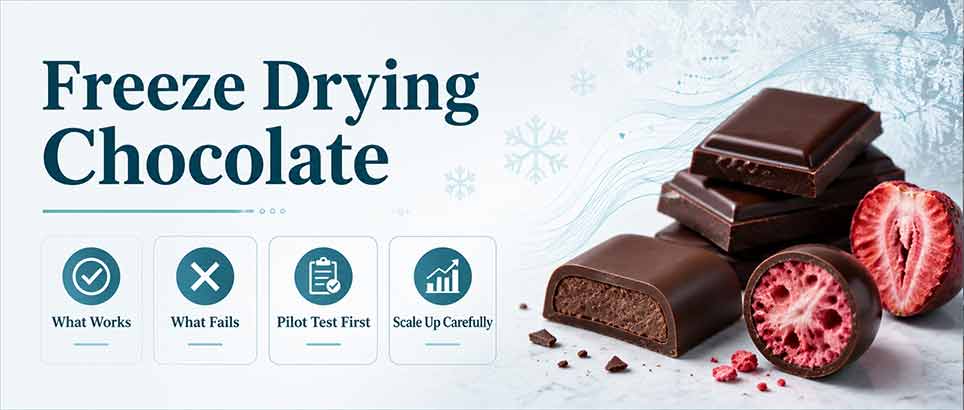
Freeze drying chocolate is not a standard machine-setting problem. It is a product-development decision: identify the phase that contains removable water, prove the target texture and stability in a controlled trial, then select production capacity from the verified water load and cycle.
Can You Freeze Dry Chocolate?
Yes, but chocolate does not describe one predictable freeze-drying material. A plain solid tablet, a high-moisture filling, a freeze-dried fruit with a later chocolate coating, and an engineered chocolate emulsion are different product routes. They should not share a copied recipe or an assumed output rate.
Published research has demonstrated a specifically formulated freeze-dried chocolate system developed by integrating emulsification and freeze-drying, with heat resistance and tunable texture as product-development objectives. This supports the feasibility of engineered chocolate formulations, but it should not be generalized to ordinary solid chocolate bars.[1]
For a food manufacturer, the first question is not which model should we buy? It is what water is the process intended to remove, and what product benefit will that create? If the product concept has no measurable benefit after a pilot, a larger freeze dryer will not solve the formulation problem.
Choose the Process Route Before You Size Equipment
| Product concept | What to establish first | Commercial next step |
|---|---|---|
| Plain solid chocolate | Whether the formulation has sufficient removable water and a clear texture, handling, or market benefit. | Run a small feasibility screen; do not promise puffing or shelf-life improvement in advance. |
| Filled chocolate or confectionery | Moisture distribution, shell/filling compatibility, piece geometry, and the target endpoint for the centre. | Test the complete product and record cross-tray repeatability. |
| Freeze-dried fruit with a chocolate coating | Whether drying the fruit first gives better control of the dry core and the coating operation. | Validate the dry ingredient, coating, package, and storage as one product system. |
| Engineered chocolate emulsion | Formulation, emulsion stability, freezing behaviour, and the intended porous structure. | Use R&D development; treat it as a new product rather than ordinary chocolate. |
A full-text study of freeze-dried strawberries later coated with dark or milk chocolate found lower equilibrium moisture uptake for the coated samples than for the uncoated fruit under its test conditions. That is useful evidence for evaluating a dry-core-first, coat-later route, not a guarantee for every chocolate product, package, or storage environment.[2]
For the broader confectionery context, see the site’s commercial candy freeze-drying guide. For product-temperature and pressure concepts, use the freeze-drying temperature and pressure guide; neither page replaces a product trial.
What a Chocolate Freeze-Drying Pilot Must Prove
A pilot is successful only when it answers a production decision. A crunchy sample is not enough for an equipment purchase or a launch decision.
Record the product basis
- Formula, shell/filling description, and declared ingredient changes
- Initial mass and measured initial moisture where available
- Piece dimensions, thickness, and tray loading
- Pre-freezing condition and batch identification
Record the process and result
- Product and shelf-temperature history, plus absolute chamber pressure
- Cycle duration and a validated final-moisture or other release endpoint
- Final mass, centre texture, appearance, and handling after packaging
- Variation between trays and repeat batches
Use a lab or pilot freeze dryer to establish the product window before forecasting factory capacity. If the core remains soft, the shell changes unexpectedly, or trays disagree, record the condition and revise the product/process experiment; do not mask the result with a generic longer cycle.
How to Judge Scale-Up Readiness
Scale-up starts after a repeatable pilot endpoint, not by multiplying tray area. Build the request around wet batch load, removable water, tested loading geometry, verified cycle time, target batches per day, and the intended finished-product output.
- Product release: defined endpoint, acceptable texture and appearance, and a documented packaged-product check.
- Process repeatability: comparable results across trays and across pilot batches.
- Equipment basis: the condenser, refrigeration, vacuum system, and tray arrangement evaluated against the proven vapour load, not tray area alone.
- Commercial basis: a cycle that fits the required production schedule and packaging workflow.
The freeze dryer condenser guide explains why vapour handling must be checked against the product’s measured water load. For process documentation, link the project team to food freeze-dryer validation rather than treating one successful batch as qualification.
Once the pilot data are repeatable, the project can move to commercial freeze dryer selection using the verified batch load, water-removal requirement, cycle time, and daily output target.
Packaging and Storage Are Part of the Test
For a coated freeze-dried product, measure the packaged product after a defined storage check, not only the sample at unload. In the cited strawberry study, increasing moisture was associated with lower glass-transition temperatures, and coating changed sorption behaviour. The practical implication is to validate the actual formula, package, storage humidity, and temperature as a combined system.[2]
Use the site’s freeze-dried food packaging guide for the packaging workstream. It should not be read as a claimed shelf-life period for a new chocolate product.
Frequently Asked Questions
Can plain chocolate be freeze-dried?
It can be screened, but the commercial question is whether removing water produces a verified product benefit. Measure the formulation and test the intended outcome before planning capacity.
Should chocolate-coated fruit be freeze-dried as one product?
It may be tested, but drying the fruit first and coating it afterward is a distinct route that can offer more control. Compare both routes using the same defined acceptance criteria.
What data is needed for a commercial equipment discussion?
Send the product description, initial moisture if measured, piece dimensions, wet batch target, verified pilot cycle, target endpoint, and required output per day. These inputs are more useful than a tray-area request alone.
Planning a Chocolate Product Pilot?
Send your product format, formula or filling description, piece dimensions, wet batch target, and required finished-product output. The engineering discussion can then determine whether a pilot is needed and what trial data are required before commercial sizing.
Discuss a Chocolate Freeze-Drying ProjectTechnical References
- Li Q, Zhang L, Zhang X, et al. Innovative emulsification and freeze-drying techniques for developing heat-resistant chocolates with tunable textures and sensory attributes. Food Chemistry. 2025;493(Pt 2):145822. DOI: 10.1016/j.foodchem.2025.145822.
- Ostrowska-Ligęza E, Szulc K, Jakubczyk E, et al. The Influence of a Chocolate Coating on the State Diagrams and Thermal Behaviour of Freeze-Dried Strawberries. Applied Sciences. 2022;12(3):1342. DOI: 10.3390/app12031342.