
Triple Point in Freeze Drying: What Food Processors Should Know
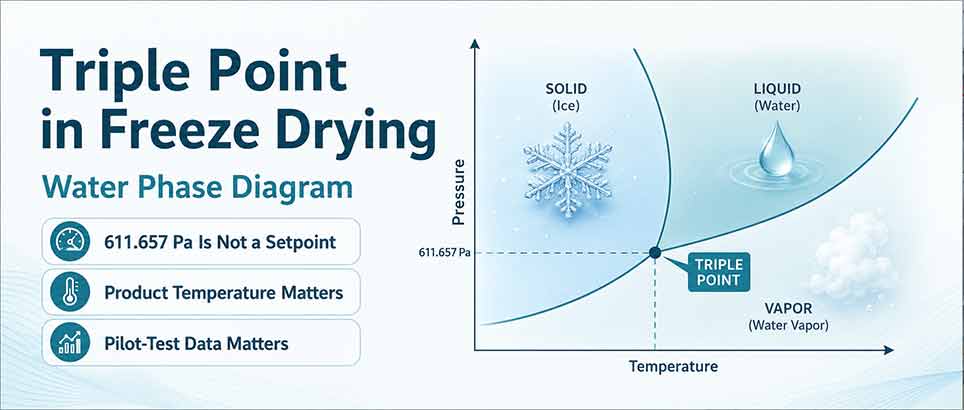
The triple point in freeze drying explains why ice can be removed as vapor during primary drying. For ordinary water, the reference is 273.16 K (0.01 °C) and 611.657 Pa. However, that value is a thermodynamic reference—not a universal food-process setpoint. A practical food process must also respect the product’s temperature limit while balancing heat input, vapor resistance and condenser load.
What Does the Triple Point in Freeze Drying Mean?
A triple point is the temperature and pressure at which the solid, liquid and vapor phases of a substance coexist in equilibrium. The International Association for the Properties of Water and Steam (IAPWS) specifies the normal triple point of ordinary water as 273.16 K and 611.657 Pa.[1]
This reference matters because freeze drying removes frozen water by sublimation. Instead of first melting into bulk liquid water, ice can pass directly to vapor when the process is operated on the appropriate side of the phase boundary.
However, the triple point explains only the thermodynamic basis. The full freezing, primary-drying and secondary-drying sequence is covered separately in the guide to how freeze drying works. Keeping those topics separate prevents a narrow phase-equilibrium article from becoming another general working-principle page.
Freeze Drying Phase Diagram: Where the Triple Point Sits
Understanding the triple point in freeze drying becomes easier when the freeze drying phase diagram is viewed first. Pressure is plotted against temperature, and the diagram separates the regions in which water is stable mainly as solid, liquid or vapor. The triple point is where the three principal phase boundaries meet.[1]
The practical lesson is straightforward. A freeze dryer does not need to “run at the triple point.” Instead, the phase diagram explains why ice can sublime under sufficiently low pressure while controlled heat supplies the energy for the phase change.
Why 611.657 Pa Is Not a Freeze-Dryer Setpoint
611.657 Pa describes pure-water equilibrium. It does not prescribe a chamber-pressure setpoint for fruit, dairy, meat, soups or another formulated food. Therefore, a buyer should not convert this number into a universal vacuum recipe.
In addition, a pressure that a machine can reach without product does not prove that it can maintain the required condition while a wet batch releases water vapor. Food freeze drying is a coupled heat- and mass-transfer process, and resistance through the dried layer can increase as primary drying progresses.[3]
The broader question of how chamber pressure interacts with shelf temperature, product temperature and condenser conditions belongs to the dedicated freeze-drying temperature and pressure guide. This page intentionally remains focused on the triple point and phase diagram.
The Water Triple Point Is Not a Food’s Critical Temperature
The triple point belongs to water. By contrast, a food has composition-dependent process limits. A formulation may be constrained by eutectic behavior, glass transition or collapse behavior rather than by the triple-point value alone. Food freeze-drying literature describes how composition and process conditions influence structure, heat transfer, mass transfer and final quality.[2]
| Term | What it describes | What the processor should do |
|---|---|---|
| Triple point of water | A pure-water phase-equilibrium reference. | Use it to understand why sublimation is possible under suitable pressure-temperature conditions. |
| Eutectic behavior | A melting-related limit in some multi-component frozen systems. | Determine whether it is relevant to the specific formulation before defining the cycle. |
| Glass transition / collapse | Structural limits that can matter in amorphous or sugar-rich foods. | Do not infer a safe product temperature from a water-only phase diagram. |
As a result, the more useful engineering question is not “What is the triple-point pressure?” but “What product temperature can this formulation tolerate at this stage of drying?” That product-specific question should then be tested under representative loading.
What Defines a Usable Food Freeze-Drying Window?
The triple point establishes the physical background, but it does not size the machine or complete the recipe. In practice, a usable window depends on a short list of product and system conditions:
- Product condition: formulation, initial moisture or solids, slice thickness or liquid depth, and the relevant structural limit.
- Product temperature: the material’s actual condition during primary drying, not merely the shelf-temperature setting.
- Vapor resistance: the path through the dried layer and the loading geometry.
- Vapor removal: the condenser and vacuum system under representative water-vapor load.
- Endpoint: the agreed final-moisture or product-release criterion for the intended product and packaging plan.
Published food-engineering work shows that heat and mass transfer depend on product characteristics and drying conditions.[3] Engineering inference: laboratory results should therefore be treated as scale-up evidence, not as direct guarantees of commercial production capacity.
For the vapor-capture side, see the freeze-dryer condenser guide. The vacuum-pump guide covers the vacuum-system side without duplicating them here.
What Should Be Recorded in a Pilot Test?
Published monitoring research has adapted pressure-rise methods to food liquids in trays and individually quick-frozen products, illustrating why endpoint assessment should be based on observed drying behavior rather than a fixed time alone.[4]
For a useful pilot, the record should connect the product to the loaded machine:
| Record | Why it matters | Question it answers |
|---|---|---|
| Product and shelf temperatures | Separates the heat source from the material’s actual condition. | Did the product remain inside the intended process window? |
| Chamber-pressure trend and sensor details | Shows the loaded drying environment rather than only a no-load vacuum claim. | Was pressure stable while vapor load changed? |
| Wet load, moisture/solids, thickness and tray layout | Defines the batch water load and vapor path. | Can the test be compared or repeated? |
| Condenser condition and cycle trend | Connects vapor removal to the complete drying cycle. | Was vapor capture a limiting condition? |
| Endpoint and final product result | Links process data to an acceptance criterion. | Did the batch meet the agreed product target? |
Processors building a test plan can use the food R&D and pilot freeze-drying guide. For instruments, alarms and batch records, see freeze-dryer monitoring.
What Should a Buyer Ask a Freeze-Dryer Supplier?
Therefore, the triple point is most useful when it leads to better procurement questions. A buyer can ask the supplier to clarify:
- which absolute-pressure sensor is used, together with its range, accuracy and placement;
- how product temperatures are measured during a representative loaded test;
- what wet batch mass, moisture or solids, tray loading and thickness were used for any quoted cycle result;
- how condenser capability is checked under the expected vapor load;
- which pressure-temperature trends and endpoint evidence will be available for a pilot or acceptance test; and
- which assumptions must still be verified before pilot data are converted into production capacity.
This evidence is more decision-useful than ultimate vacuum, tray area or a single condenser-temperature number alone. For the broader system checklist, use freeze-dryer components. When the product data are ready for equipment comparison, the commercial food freeze-dryer selection guide covers capacity and machine selection.
Turn the Triple-Point Question into a Test Plan
Send the product type, wet batch mass, initial moisture or solids, loading thickness, target final moisture and planned production schedule. A project-data review can then define what should be verified in a representative pilot before equipment capacity and acceptance criteria are fixed.
Request a Project-Data ReviewFAQ: Triple Point in Freeze Drying
What is the triple point of water in freeze drying?
For ordinary water, the normal triple point is 273.16 K (0.01 °C) and 611.657 Pa.[1] At this condition, solid, liquid and vapor phases can coexist in equilibrium.
Is 611 Pa the correct pressure for a food freeze dryer?
No. It is a pure-water thermodynamic reference. The useful chamber pressure for a food process must be validated together with product temperature, heat transfer, loading, vapor resistance and condenser behavior.
Is the triple point the same as a eutectic point or collapse temperature?
No. The triple point describes phase equilibrium for water. Eutectic behavior and glass-transition or collapse behavior relate to multi-component products and may define more relevant product-specific limits during drying.
Does lower pressure always make freeze drying faster?
No. Freeze drying is a coupled heat- and mass-transfer process. Lowering chamber pressure alone does not establish a faster or safer cycle; the loaded product and complete system must be evaluated together.[2]
References
- International Association for the Properties of Water and Steam (IAPWS). Revised Release on the Pressure along the Melting and Sublimation Curves of Ordinary Water Substance. Normal triple-point reference: 273.16 K and 611.657 Pa. Official IAPWS release. DOI: not applicable.
- Nowak D, Jakubczyk E. The Freeze-Drying of Foods—The Characteristic of the Process Course and the Effect of Its Parameters on the Physical Properties of Food Materials. Foods. 2020;9(10):1488. DOI: 10.3390/foods9101488.
- Ratti C. Freeze drying for food powder production. In: Handbook of Food Powders. Woodhead Publishing; 2013:57–84. DOI: 10.1533/9780857098672.1.57.
- Pisano R, Barresi AA, Fissore D. Innovation in Monitoring Food Freeze Drying. Drying Technology. 2011;29(16):1920–1931. DOI: 10.1080/07373937.2011.596299.

Technical Reviewer: Zheng Wei
Founder & Freeze-Drying System Engineer
Zheng Wei has participated in food freeze-dryer design, refrigeration and vacuum-system planning, equipment production, installation guidance and process testing for commercial and industrial food projects.
Technical review date: July 24, 2026 · Fuzhou Xing Shun Da Refrigeration Facility Project Co., Ltd.