
Freeze Dryer for Milk: Commercial Dairy Production Guide
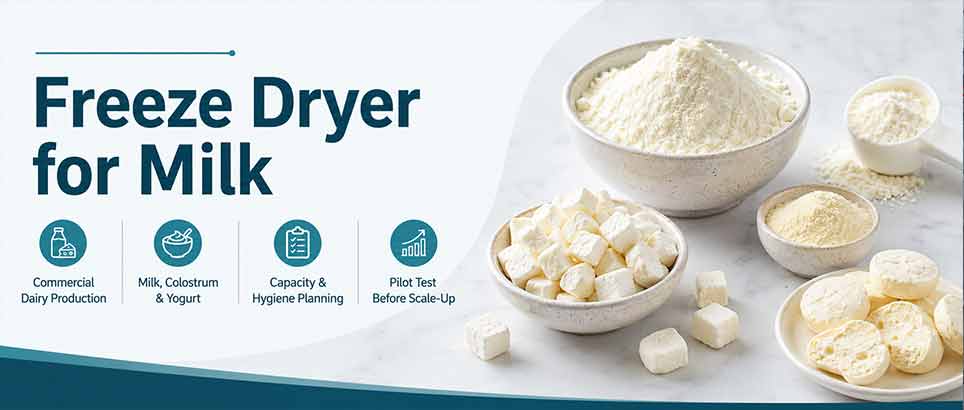
A freeze dryer for milk can support commercial production of specialty milk powders, bovine colostrum, yogurt pieces, starter cultures, probiotic formulations, and premium dairy snacks. However, it is not the most economical route for every milk powder project. A dairy processor should evaluate solids, water-removal load, tray depth, food safety, packaging, product value, and pilot-test results before selecting equipment.
Technical review: Zheng Wei, Founder and Freeze-Drying System Engineer, Fuzhou Xing Shun Da Refrigeration Facility Project Co., Ltd. | Last reviewed: August 13, 2026 | Written for dairy processors, food manufacturers, pilot plants, and project engineers.
Planning a dairy project? Review the milk pilot-test results and dairy quotation checklist before requesting a model review.
Quick answer: Commercial freeze drying is usually easier to justify for high-value or heat-sensitive dairy products, including colostrum, specialty goat or camel milk, yogurt bites, dairy cultures, and functional ingredients. By contrast, large-volume commodity milk powder is normally better suited to concentration and spray drying. The final decision should follow product testing, a verified drying cycle, and a cost calculation per kilogram of finished product.
Who Should Use This Freeze Dryer for Milk Guide?
This guide is written for commercial and industrial buyers rather than household users. It is most useful when a dairy team must test, scale, package, and sell a stable commercial product.
Good Fit
- Dairy ingredient manufacturers
- Colostrum and functional dairy processors
- Yogurt snack and dairy inclusion producers
- Starter culture and probiotic formulation teams
- Food R&D labs moving from samples to batches
- Factories needing multi-product batch flexibility
Usually Not the Main Target
- Breast milk storage for household use
- Commodity skim or whole milk powder at very high volume
- Buyers looking only for the cheapest dehydration method
- Projects without a defined product specification
- Products without packaging or shelf-life validation
- Facilities without a food-safety and cleaning plan
Search-intent note: searches for a “freeze dryer for milk” may include household milk preservation or breast milk services. A commercial dairy project is different. It requires capacity calculations, sanitary design, validated pre-treatment, controlled loading depth, measurable moisture or water activity targets, and repeatable production data.
Which Milk and Dairy Products Are Suitable for Freeze Drying?
A commercial dairy freeze dryer can process many milk-based products, but the business case changes by product type. The strongest applications are usually products where gentle drying, porous texture, active ingredient protection, or small-to-medium batch flexibility creates value beyond ordinary powder production.
| Dairy Product | Why Freeze Drying May Help | Key Test Data Needed |
|---|---|---|
| Specialty milk | Useful for goat, camel, sheep, buffalo, or other premium milk products where the selling value supports a slower drying route. | Total solids, fat, protein, lactose, viscosity, layer depth, final moisture, flavor, and reconstitution. |
| Bovine colostrum | Can support products where bioactive components and premium positioning matter more than bulk powder cost. | Concentration, immunoglobulin target, microbial plan, tray loading, drying time, and packaging protection. |
| Yogurt pieces or yogurt powder | Useful for crisp snacks, cereal inclusions, instant products, and functional dairy formulations. | Recipe, stabilizers, culture survival, crispness, moisture, water activity, and storage stability. |
| Dairy cultures and probiotic products | Freeze drying is widely used for long-term preservation of cultures, but survival depends on strain and protection system. | Strain, protectant, pre-freezing conditions, viable count before and after drying, storage temperature, and oxygen exposure. |
| Dairy bites, cubes, sheets, or inclusions | Freeze drying can create a light porous structure that is difficult to obtain with conventional drying. | Shape, thickness, solids, foaming risk, breakage, bulk density, packaging volume, and sensory result. |
Standard whole milk powder or skim milk powder is a different decision. If the product is sold mainly on price and requires very high daily output, spray drying is normally the better industrial benchmark. A dairy freeze dryer should be selected only when the finished product needs qualities that justify the higher drying cost.
Freeze Drying Milk Products vs Spray Drying
Spray drying is established for large-scale dairy powder production because it atomizes concentrated liquid into a hot drying stream and creates powder quickly. Freeze drying removes ice from a frozen product under vacuum. The spray drying vs freeze drying comparison explains why the two methods are not direct substitutes in every project.
| Decision Factor | Freeze Drying | Spray Drying |
|---|---|---|
| Typical positioning | Premium, heat-sensitive, specialty, structured, culture-based, or smaller-volume products. | High-throughput milk powders and commodity dairy powder production. |
| Drying condition | Frozen product under vacuum with controlled heat input. | Atomized droplets exposed to heated drying air. |
| Product form | Porous cake, sheet, pieces, granules, or powder after milling. | Free-flowing powder when formulation and tower conditions are optimized. |
| Throughput | Batch-based and usually slower. | Continuous or high-throughput. |
| Water-removal cost | Usually higher per kilogram of water removed. | Usually lower at suitable industrial scale. |
| Best selection basis | Value, sensitive ingredients, desired structure, verified cycle, and batch flexibility. | Large output, powder specification, and production efficiency. |
A peer-reviewed study found that freeze drying and spray drying can produce different changes in milk-fat-globule size, composition, and microstructure. Therefore, a processor should compare the finished product rather than assume that either method is universally superior. The RSC Advances study on milk fat globules provides the supporting comparison.
Evidence That Should Guide Dairy Pilot Testing
Published research is most useful when it identifies variables that a dairy processor must verify. It should not be treated as a universal recipe for every formulation or machine.
Drying Method Changes Milk Structure
Yao and co-authors compared freeze-dried and spray-dried milk and reported differences in the physical, chemical, and microstructural characteristics of milk fat globules. Consequently, powder structure and product behavior should be evaluated under the intended drying route.
Colostrum Presents Quality Trade-Offs
A 2024 bovine colostrum study reported higher protein and defensive proteins such as IgG and IgA in the freeze-dried sample. However, spray-dried colostrum received higher flavor and aroma scores, while the freeze-dried sample was preferred for appearance. The result supports product-specific decisions rather than a blanket claim that one method is better.
Culture Survival Depends on the Cycle
Research on Bifidobacterium longum showed that pre-freezing and sublimation temperatures significantly affected survival. Most viability loss in that study occurred during sublimation drying. Therefore, starter-culture and probiotic projects should measure viable count before drying, after drying, and during storage.
Layer Depth Must Be Tested
A deeper liquid layer increases the heat- and mass-transfer path and can leave a wet center beneath a dry surface. Nevertheless, there is no single loading depth for all dairy products. Total solids, viscosity, sugars, fat, tray geometry, shelf heating, and condenser performance must be tested together.
Practical interpretation: published results should define the pilot-test plan, not replace it. A commercial setpoint should be based on the actual formulation, tray loading, equipment configuration, moisture target, and packaging requirement.
Milk Freeze-Drying Pilot Test Results
The manufacturer’s engineering team conducted this controlled milk freeze-drying pilot test in 2025 to verify tray loading, drying time, finished-product yield, product output, and final moisture under defined operating conditions. The complete test video was published on YouTube on August 13, 2026. Keeping the experiment year and video publication date separate makes the first-party test record clear for commercial dairy process evaluation and scale-up planning.
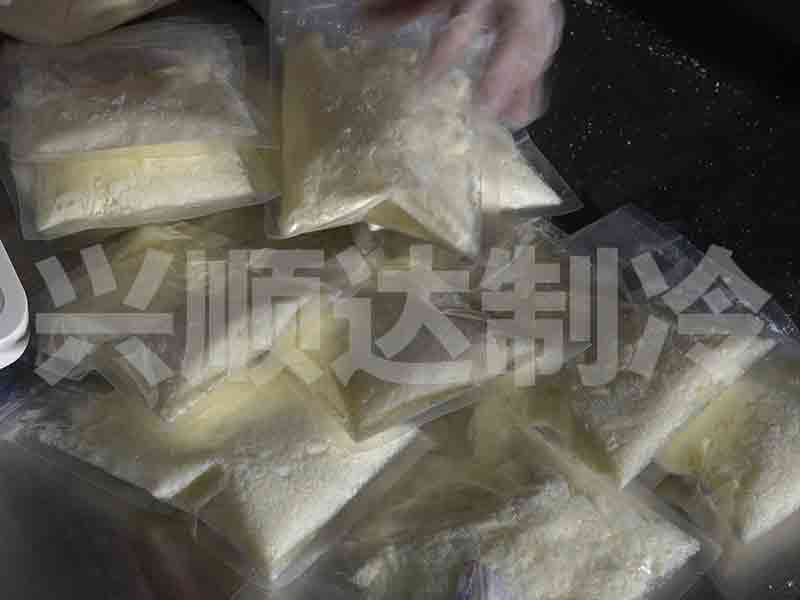
2025 milk freeze-drying experiment. The video documents pre-freezing, pre-drying weighing, freeze-drying start, 1000× process monitoring, drying completion, post-drying weighing, and moisture testing. Video published on YouTube: August 13, 2026.
| Measured Item | Test Result |
|---|---|
| Total tray area | 0.30 m² |
| Initial milk weight | 4,489.08 g |
| Loading capacity | 14.96 kg/m² |
| Final freeze-dried product weight | 558.52 g |
| Product output | 1.86 kg/m² |
| Product yield | 12.4% |
| Final moisture content | 0.50% |
| Freeze-drying start time | 08:22:50 |
| Freeze-drying end time | 19:48:36 |
| Total drying time | 11 h 25 min 46 s |
Engineering interpretation: this 2025 test shows that milk was dried to 0.50% final moisture at a wet loading of 14.96 kg/m² within an 11 h 25 min 46 s drying cycle under these specific test conditions. The values should not be treated as universal setpoints. Milk solids, fat and protein composition, concentration, tray depth, freezing method, shelf-temperature program, vacuum performance, and condenser capacity can change the cycle and yield.
For scale-up, the engineering team would repeat the trial, check edge-to-center uniformity, confirm moisture or water activity across representative trays, and calculate the total water load against the selected condenser capacity. This first-party data gives prospective buyers a more realistic starting point than a generic machine-capacity claim.
Commercial Dairy Freeze-Drying Process
The commercial process begins before the product enters the drying chamber. Raw-material control, concentration, pasteurization or another validated safety step, freezing, vacuum drying, unloading, milling, packaging, and storage all affect the finished product.
1. Define the Dairy Material
Document milk source, total solids, fat, protein, lactose or other sugars, mineral content, pH, viscosity, homogenization status, stabilizers, cultures, and heat-sensitive components. A milk powder intended for reconstitution has different priorities from a crisp yogurt bite or a live-culture ingredient.
2. Apply the Required Food-Safety Process
Freeze drying removes water, but it is not a validated substitute for pasteurization or another required kill step. The U.S. Food and Drug Administration explains that raw milk can carry pathogens, and dairy processors should review the FDA guidance on raw milk safety and the rules that apply in the destination market.
The project should define raw-material acceptance, pasteurization or equivalent safety treatment, hygienic transfer, environmental controls, sampling plan, post-process handling, and dry-room packaging. The site guide on freeze drying and microbial safety explains why low moisture does not mean all microorganisms have been destroyed.
3. Evaluate Pre-Concentration
Liquid dairy products contain much more water than solids. Direct freeze drying may overload the condenser and extend the cycle. Pre-concentration can reduce the water that must be frozen and sublimated, but it also changes viscosity, ice formation, vapor pathways, lactose behavior, and final texture. For that reason, concentration should be tested instead of assumed.
4. Load Trays at a Controlled Depth
Uniform tray loading is one of the most important controls for liquid dairy products. Deep or uneven loading creates different drying paths across the tray and may leave wet centers under a dry surface. Specify tray dimensions, fill depth, wet load per tray, wet load per square meter, and headspace for foaming or expansion.
5. Freeze the Product Completely
The product must be frozen throughout before primary drying. Freezing rate influences ice-crystal size and the porous network left after sublimation. Composition also influences freezing behavior. Record product temperature and freezing time instead of relying only on freezer air temperature.
6. Control Primary and Secondary Drying
During primary drying, heat input drives ice sublimation while the vacuum system and condenser remove vapor. During secondary drying, bound or adsorbed water is reduced to reach the final moisture or water activity target. For dairy products, the endpoint should be verified by weight trend, moisture, water activity, product temperature, and storage behavior.
7. Package Quickly in a Dry Environment
Freeze-dried dairy products can absorb moisture quickly. Fat-containing powders and dairy snacks may also need oxygen and light protection. Packaging should be selected based on moisture barrier, oxygen barrier, seal quality, headspace control, distribution temperature, and shelf-life target.
How to Size a Freeze Dryer for Milk
Do not size a dairy freeze dryer only by chamber volume or nominal kilograms per batch. The real production load depends on solids, water removal, tray area, drying time, condenser capture, cleaning time, and packaging workflow.
Basic mass-balance calculation
Dry solids = Wet feed × Solids fraction Final product mass = Dry solids ÷ (1 − Final moisture fraction) Water removed = Wet feed − Final product mass Batches per day = Available operating hours ÷ (Drying time + Turnaround time) Daily finished output = Finished output per batch × Batches per dayStep 1: Calculate Dry Solids and Finished Yield
For example, 1,000 kg of dairy feed at 15% total solids contains 150 kg of dry solids. If the final product is specified at 2% moisture on a wet basis, the calculated final product mass is 150 ÷ 0.98 = 153.06 kg.
Step 2: Calculate Water Removal and Condenser Load
Using the same example, water removal is 1,000 − 153.06 = 846.94 kg before process loss. The condenser must capture this vapor within the verified cycle. Both total ice capacity and hourly capture rate matter. The freeze dryer condenser guide explains why condenser sizing is central to equipment selection.
Step 3: Convert Tray Loading to Batch Load
Batch capacity should be built from tray area, product depth, wet load per square meter, and verified dry cycle. A high wet-load number is not useful if the product dries unevenly, foams, collapses, or exceeds the condenser capture rate.
Step 4: Convert Batch Data into Daily Capacity
Daily output depends on the drying cycle plus pre-freezing, loading, unloading, defrosting, cleaning, inspection, milling, packaging, and shift schedule. One batch should not automatically be treated as one day.
Engineering principle: equipment selection should be based on measured water-removal load and verified tray loading, not only on nominal chamber capacity. This reduces the risk of an undersized condenser, unrealistic cycle time, or a capacity promise that the dairy product cannot actually reach.
Build the Equipment Plan from Measured Dairy Data
A processor can submit the product type, total solids, daily wet load, target product form, trial loading depth, moisture or water activity target, and available utilities. The engineering team can then determine whether pilot testing, a commercial machine, or an industrial system is the appropriate next step.
Choosing a Pilot, Commercial, or Industrial Milk Freeze Dryer
The correct equipment category depends on process maturity and daily wet-feed demand. Pilot testing should come first when the formulation, tray depth, drying curve, final moisture, culture survival, or product structure is not yet confirmed.
| Equipment Category | Manufacturer’s Wet-Material Benchmark | Best Use in a Dairy Project |
|---|---|---|
| SDG60 / SDG90 Pilot Lab Freeze Dryers | 60-80 kg / 24 h and 90-120 kg / 24 h | Recipe development, concentration trials, loading-depth comparison, endpoint validation, culture survival checks, and small trial production. |
| SDG350 / SDG700 / SDG1100 Commercial Freeze Dryers | 340-450 kg, 680-900 kg, and 1.02-1.36 t wet material / 24 h | Confirmed dairy products moving into stable commercial batches with defined moisture, packaging, and cleaning procedures. |
| SDG1600 / SDG3000 / SDG6000 Industrial Freeze Dryers | 1.2-2 t, 3-4 t, and 6-8 t wet material / 24 h | Factory-scale production with utility planning, room layout, cleaning workflow, packaging room coordination, and long-term operating management. |
Capacity note: these wet-material benchmarks are developed around typical food production conditions and approximately 15% solids. Actual dairy throughput must be corrected for total solids, tray depth, product form, drying time, final moisture, condenser load, cleaning time, and packaging workflow.
Hygienic Design Requirements for Dairy Freeze Dryers
Dairy products are sensitive to microbial contamination and cleaning failures. Hygienic design should be reviewed together with drying performance. The Grade “A” Pasteurized Milk Ordinance is one important U.S. reference for dairy safety systems, and the FDA provides current background through its Pasteurized Milk Ordinance information.
- Cleanable product-contact trays and chamber surfaces
- Material compatibility with dairy soil and cleaning chemicals
- Accessible corners, drains, seals, and condenser surfaces
- Controlled handling of defrost water and cleaning water
- Protection against vacuum-pump backflow or oil contamination
- Separation of raw, pasteurized, drying, and dry-packing zones
- Recorded product temperature, shelf temperature, vacuum, and condenser data
- Documented cleaning, inspection, and pre-operation release
- Controlled personnel and material movement
- Environmental and finished-product sampling as required
Also confirm how trays are washed and dried, how the chamber is inspected, how door gaskets are cleaned, how the condenser is defrosted, and how dry product is protected after unloading. A machine can reach low pressure and still be unsuitable for dairy production if cleaning access and hygienic workflow are weak.
Common Problems When Freeze Drying Dairy Products
| Observed Problem | Likely Causes | Practical Checks |
|---|---|---|
| Foaming or tray overflow | Overfilled tray, unstable formulation, entrained air, or pressure reduction that is too aggressive. | Reduce depth, leave headspace, review deaeration, and test the vacuum ramp. |
| Collapsed or sticky structure | Product temperature exceeded the safe limit, sugar or lactose behavior was not controlled, or residual moisture remained too high. | Review product-temperature records, shelf heat input, pressure, and endpoint method. |
| Wet center below a dry surface | Liquid layer too deep, uneven loading, short primary drying, or poor vapor pathways. | Measure depth at several tray positions and test representative center samples. |
| Long and unstable cycle | Low solids, excessive water load, limited condenser capture, poor vacuum, or conservative temperature settings. | Calculate water removal, inspect the vacuum curve, and compare condenser load with vapor demand. |
| Low culture survival | Strain sensitivity, weak protectant system, unsuitable pre-freezing temperature, oxygen exposure, or storage stress. | Measure viable count before drying, after drying, and after storage under real packaging conditions. |
| Powder caking after packaging | Moisture pickup, weak barrier packaging, seal leaks, warm packing conditions, or hygroscopic formulation. | Measure final moisture and water activity, validate seals, and reduce exposure time after unloading. |
| Oxidized or stale flavor | Oxygen exposure, light, fat oxidation, unsuitable headspace, or long warm storage. | Review oxygen barrier, nitrogen flushing, residual oxygen, storage temperature, and shelf-life data. |
| Poor reconstitution | Composition, particle size, milling damage, fat behavior, agglomeration, or dense dried structure. | Define reconstitution test conditions and compare several process routes. |
Dairy Freeze Dryer Cost and Economic Fit
The purchase price is only one part of the project. A useful cost model should include water removed, cycle time, electricity, steam where applicable, cooling water, labor, cleaning, defrosting, product recovery, milling, packaging, testing, maintenance, and annual operating days.
Calculate Cost per Kilogram of Finished Product
Energy per kilogram of wet feed can be misleading because low-solids milk produces a relatively small amount of finished powder. Therefore, processors should calculate cost per kilogram of finished product and cost per kilogram of water removed. The site’s freeze-drying cost analysis provides a structured calculation framework.
When Does Freeze Drying Make Commercial Sense?
The business case is stronger when the product commands a premium, contains sensitive functional components, requires a porous structure, needs culture preservation, or benefits from flexible multi-product batches. By contrast, commodity powder with very high throughput and limited price premium is usually a weaker fit. A processor should also confirm the sales channel, packaging system, and shelf-life target before ordering large equipment.
Pilot Testing Before Buying a Production Machine
Pilot testing converts a dairy product idea into measurable engineering data. The 2025 milk pilot test above demonstrates how tray loading, drying time, finished yield, product output, and final moisture can be documented before scale-up. It also prevents a large freeze dryer from being selected on assumptions. The manufacturer guide on lab freeze dryers and pilot testing explains how testing supports process validation and scale-up.
A useful dairy freeze-drying test should record:
- Product type and complete formulation
- Total solids, fat, protein, sugars, pH, and viscosity
- Pasteurization or other validated safety process
- Concentration method and feed temperature
- Tray size, liquid depth, and wet load per tray
- Wet load per square meter
- Freezing method, time, and product temperature
- Shelf-temperature and product-temperature curves
- Vacuum and condenser-temperature records
- Drying time and endpoint method
- Finished weight, moisture, and water activity
- Appearance, porosity, breakage, and powder flow
- Culture count or active marker when relevant
- Reconstitution, flavor, sensory result, and storage plan
- Packaging method and seal validation
- Cleaning, unloading, and product-loss observations
The trial should be repeated to evaluate batch consistency. A single attractive sample is not enough for scale-up. Repeatability, water-removal rate, edge-to-center uniformity, cleaning time, unloading behavior, packaging losses, and shelf-life results all influence the final equipment decision.
Information Needed for a Milk Freeze Dryer Recommendation
A project-based freeze dryer for milk recommendation is more reliable when the processor provides specific operating data. The following information should be prepared before requesting a quotation:
- Exact product: cow milk, goat milk, camel milk, colostrum, yogurt, culture, dairy snack, protein ingredient, or another formulation.
- Daily wet-feed target: kilograms or tons per day, not only finished powder output.
- Total solids: before and after any planned concentration step.
- Composition: fat, protein, sugars, stabilizers, cultures, and heat-sensitive components.
- Product form: cake, sheet, pieces, granules, milled powder, or packed snack.
- Target specification: final moisture, water activity, reconstitution, viable count, particle size, texture, and shelf life.
- Production schedule: shifts, batches per day, cleaning window, and annual operating days.
- Factory utilities: voltage, frequency, electrical power, steam, cooling water, compressed air, drainage, and ambient conditions.
- Site and compliance: installation country, hygiene standard, room layout, and available access for delivery and maintenance.
- Test status: existing drying curve and product data, or a request for pilot testing before machine selection.
Get a Dairy Freeze Dryer Recommendation
The engineering team can review the formulation, solids, wet load, loading depth, hygiene requirement, utilities, and existing trial data. The resulting recommendation can match tray area, condenser capacity, vacuum performance, water-removal demand, and factory workflow.
FAQ About a Freeze Dryer for Milk
Can milk be freeze-dried commercially?
Yes. Milk can be frozen and dried under vacuum to produce a porous cake, pieces, granules, or powder after milling. Commercial performance depends on total solids, formulation, loading depth, product temperature, condenser performance, final moisture, hygiene, and packaging.
Should milk be concentrated before freeze drying?
Pre-concentration can reduce the amount of water that must be frozen and sublimated. However, higher solids also change viscosity, ice formation, and vapor pathways. Therefore, several concentrations should be compared during pilot testing.
How long does it take to freeze dry milk?
There is no universal cycle. Drying time depends on solids, layer depth, formulation, freezing method, product-temperature limit, vacuum, shelf heat input, condenser capacity, and final moisture target. A verified pilot cycle is required before commercial sizing.
Does freeze drying milk replace pasteurization?
No. Freeze drying is a dehydration process, not a validated replacement for pasteurization or another required food-safety step. The processor must establish an appropriate safety plan and comply with the rules for the product and destination market.
How much milk can a commercial freeze dryer process?
Capacity depends on total solids, tray loading, liquid depth, verified cycle time, condenser load, cleaning time, and turnaround time. Model benchmarks are suitable for initial screening, but actual dairy throughput should be confirmed with product data.
What packaging is suitable for freeze-dried dairy products?
The package should provide an appropriate moisture barrier and, when required, oxygen and light protection. Selection depends on fat content, powder or snack format, storage temperature, target shelf life, headspace control, and seal integrity.
Conclusion
Selecting a freeze dryer for milk requires product and process evaluation rather than a simple comparison of chamber sizes. Total solids determine potential yield, while formulation and loading depth influence heat and mass transfer. The vacuum system and condenser must handle the actual vapor load, and the hygienic workflow must protect the dried product after unloading.
The most reliable route is to test the dairy formulation, calculate the water-removal load, verify repeatable quality, and scale the proven loading and cycle. This approach gives the buyer a more realistic capacity, operating cost, and investment decision.

About the Author
Zheng Wei – Founder and Freeze-Drying System Engineer
Zheng Wei participates in food freeze-drying projects at Fuzhou Xing Shun Da Refrigeration Facility Project Co., Ltd. His work includes product testing, equipment selection, vacuum-system configuration, refrigeration planning, installation guidance, process optimization, and scale-up support for milk and dairy products, fruits, vegetables, prepared foods, seafood, meat, herbs, liquids, and other food materials.
Technical References
- U.S. Food and Drug Administration. Food Safety and Raw Milk.
- U.S. Food and Drug Administration. Pasteurized Milk Ordinance Centennial.
- Yao Y, Zhao G, Yan Y, et al. Effects of freeze drying and spray drying on the microstructure and composition of milk fat globules. RSC Advances. 2016;6:2520–2529. doi:10.1039/C5RA22323G.
- Fatima M, Sajid M, Saima H, et al. In vitro evaluation of spray and freeze-dried bovine colostrum powder and their effects on nutritional and functional properties. International Journal of Food Properties. 2024;27(1):985–1002. doi:10.1080/10942912.2024.2374488.
- Sang Y, et al. Influence of Temperature during Freeze-Drying Process on the Viability of Bifidobacterium longum BB68S. Microorganisms. 2023;11(1):181. doi:10.3390/microorganisms11010181.
- Nowak D, Jakubczyk E. The Freeze-Drying of Foods—The Characteristic of the Process Course and the Effect of Its Parameters on the Physical Properties of Food Materials. Foods. 2020;9(10):1488. doi:10.3390/foods9101488.
Regulatory note: This article provides equipment and process-planning information. It is not a substitute for a validated food-safety plan, local dairy regulations, professional regulatory advice, or product-specific shelf-life testing.