
Fruit Freeze Dryer Machine for Commercial Fruit Production
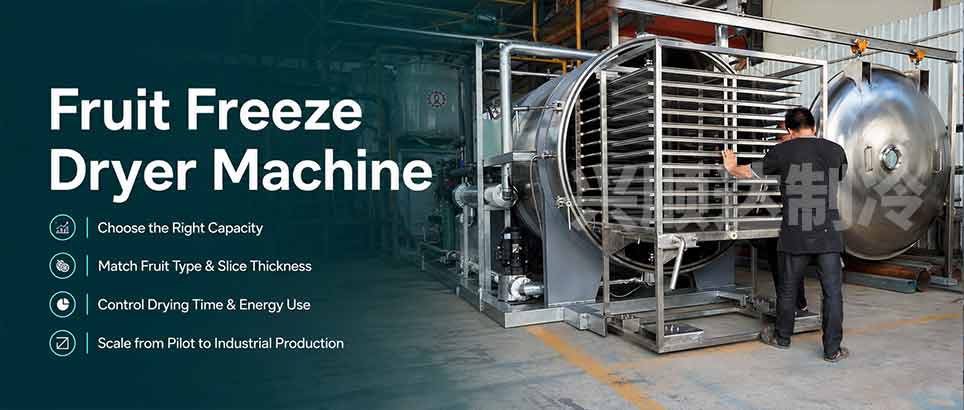
A fruit freeze dryer machine helps food processors produce high-value freeze-dried fruit snacks, fruit ingredients, fruit powders, and export-ready products. However, buyers should not choose a machine by tray number or batch capacity alone.
For a real fruit production project, the correct model depends on fruit type, slice thickness, wet material capacity, drying time, condenser load, vacuum stability, heating uniformity, and factory utility conditions. Therefore, a commercial fruit freeze dryer should be selected after sample testing and production calculation, not only by comparing equipment size.
Some buyers search for a “freeze dryer fruit machine.” In practice, they usually need a fruit freeze drying solution that can protect color, texture, flavor, and production efficiency at the same time.
Need a Fruit Freeze Dryer Selection Plan?
Send your fruit type, slice thickness, target daily wet capacity, and factory utility conditions to get a practical machine recommendation.
Request a Fruit Freeze Drying SolutionWhat Is a Fruit Freeze Dryer Machine?
A fruit freeze dryer machine removes moisture from frozen fruit under vacuum. During the process, ice inside the fruit changes directly into vapor. Then, the condenser captures the vapor as ice, while the heating system provides controlled energy for sublimation.
This process helps fruit processors produce low-moisture products with a crisp structure and better shape retention than many heat-drying methods. In addition, freeze-dried fruit can be used for snacks, cereal toppings, yogurt ingredients, bakery ingredients, instant drinks, and fruit powder production.
The University of Minnesota Extension explains that freeze-drying dehydrates food by freezing it and then vaporizing the ice crystals. As a result, the process can produce shelf-stable food while helping retain quality characteristics such as taste and smell. Buyers can read the public explanation here: University of Minnesota Extension freeze-drying guide.
For food safety and shelf-life planning, processors should also monitor final moisture and water activity. The FDA explains that water activity affects the available moisture that supports bacteria, yeast, and mold growth. Therefore, finished freeze-dried fruit should be tested and packed according to the target market’s food safety requirements. Learn more from the FDA guide on water activity in foods.
Who Needs a Commercial Fruit Freeze Dryer?
A commercial fruit freeze dryer is suitable for companies that need stable production, repeatable product quality, and a clear scale-up path.
Fruit Snack Brands
Fruit snack brands use freeze drying to make premium apple slices, pineapple pieces, banana slices, strawberries, mango, blueberries, and durian snacks. These products often sell at a higher value than traditional dried fruit because they offer a light, crisp texture and strong visual appeal.
Fruit Farms and Processing Factories
Fruit farms and processing factories use freeze drying to reduce seasonal fruit waste and increase product value. For example, farms can process surplus fruit, second-grade fruit, or export-grade fruit into shelf-stable products.
Ingredient and Powder Producers
Ingredient producers use fruit freeze drying machines to make fruit powders, yogurt toppings, cereal ingredients, bakery inclusions, and beverage ingredients. In these projects, color, aroma, solubility, and final moisture are important quality targets.
Pilot Production Before Factory Expansion
Pilot production teams can use a smaller freeze dryer to test fruit thickness, loading density, drying time, and final texture before investing in a larger commercial or industrial system.
Which Fruits Can Be Freeze Dried?
Many fruits can be freeze dried, but each fruit needs a suitable process. High-moisture fruit requires enough condenser capacity. High-sugar fruit needs careful temperature control. Meanwhile, whole berries often need pretreatment because their skins slow down moisture removal.
| Fruit Type | Processing Notes | Machine Selection Notes |
|---|---|---|
| Apple slices | 6–10 mm often gives better crispness. | Suitable for commercial and industrial fruit production. |
| Pineapple | High moisture load requires careful tray loading. | Needs stable condenser capacity and controlled slicing. |
| Blueberry | Skin slows moisture removal. | Pretreatment such as punching improves drying performance. |
| Durian | High sugar and sticky texture need careful control. | Requires tested drying curves and even loading. |
| Fig | Soft texture and high sugar increase drying difficulty. | Avoid excessive tray loading. |
| Pear slices | Suitable for stable large-scale processing. | Good fit for industrial fruit freeze drying. |
| Mango and banana | High sugar products may stick to trays. | Requires thickness and loading tests before scale-up. |
For broader food suitability, buyers can also read What Foods Can Be Freeze Dried.
How to Choose the Right Fruit Freeze Dryer Machine
Choosing a fruit freeze dryer machine starts with the product, not the machine catalog. A good selection process should answer four questions: what fruit will be processed, how thick it will be loaded, how much wet material must be processed per day, and what final product quality is required.
Start with 24-Hour Wet Fruit Capacity
Fruit processors should calculate capacity by 24-hour wet material processing ability, not only by batch volume. This is important because different fruits have different drying times.
For example, thin apple slices may dry faster than whole blueberries. Meanwhile, pineapple and durian may need more careful control because of moisture, sugar, and texture. As a result, two fruits loaded at the same weight may require different drying cycles.
A small fruit business may only need pilot or small commercial capacity. However, a factory that wants stable daily production should compare commercial and industrial systems.
Recommended equipment pages: Lab / Pilot Freeze Dryer, Commercial Freeze Dryer, and Industrial Freeze Dryer.
Check Slice Thickness and Loading Density
Slice thickness has a direct effect on fruit texture and drying time. If fruit is too thick, the center may dry slowly. If it is too thin, the final product may become fragile or lose the target mouthfeel.
For apple slices, 6–10 mm often gives better crispness. For pineapple, slice direction and thickness affect drying speed. For blueberries, whole fruit usually needs skin pretreatment. For durian, the material should be spread evenly to avoid local overloading.
Therefore, buyers should test fruit thickness before choosing a large machine. This helps confirm drying time, final moisture, texture, and packaging stability.
Match Condenser Capacity with Fruit Moisture Load
Fruit contains a high amount of water, so the condenser is one of the most important parts of a fruit freeze drying machine. If the condenser cannot capture water vapor fast enough, drying time becomes longer and production capacity drops.
A weak condenser may turn a normal 12–15 hour process into a much longer cycle. Consequently, the factory may need more machines, more labor, and more power to achieve the same daily output.
For technical details, read this guide to the freeze dryer condenser.
Compare Vacuum Speed and Vacuum Stability
Vacuum performance affects both product quality and drying efficiency. If vacuum builds too slowly, frozen fruit may soften before stable sublimation begins. This can cause collapse, uneven drying, poor texture, or color changes.
A reliable fruit freeze dryer should use a suitable vacuum pump system and stable vacuum measurement. In commercial and industrial projects, vacuum data should be monitored and recorded during testing. As a result, engineers can adjust the drying curve based on actual product behavior.
Choose a Heating System with Good Uniformity
Freeze drying is not simply a low-temperature process. The product still needs controlled heat to support sublimation. However, too much heat may damage color, shape, or flavor.
For this reason, heating uniformity matters. A stable shelf heating system helps reduce uneven drying between trays. It also helps the operator build repeatable drying recipes for different fruits.
Recommended Machine Size for Fruit Freeze Drying Projects
The right fruit freeze dryer depends on the production stage. A start-up brand, a farm, and an export factory usually need different machine sizes.
| Project Type | Typical Need | Recommended Direction |
|---|---|---|
| Sample testing | Test color, texture, drying time, and final moisture. | SDG60 / SDG90 |
| Small fruit snack business | Small batch commercial production. | SDG90 / SDG350 |
| Commercial fruit factory | Stable daily production. | SDG350 / SDG700 / SDG1100 |
| Industrial fruit processing | Large wet fruit capacity. | SDG1600 / SDG3000 / SDG6000 |
This table should be used as a starting point. Before ordering a larger system, buyers should confirm fruit thickness, loading weight, drying time, condenser load, and final product quality through testing.
Planning a Fruit Freeze Drying Project?
Share the target fruit, daily wet material capacity, and expected final product form to get a suitable machine recommendation.
Get a Model Selection PlanReal Fruit Freeze Drying Cases
Real case data is more useful than a general machine description. Fruit projects often look similar on paper, but the actual process can vary by fruit variety, sugar level, size, and cutting method.
Freeze-Dried Apple Slices
Apple slices are suitable for commercial fruit snack production. However, slice thickness has a clear effect on crispness and drying time. In actual production, 6–10 mm apple slices often perform better for crisp texture.
Freeze-Dried Blueberries
Blueberries need special attention because the skin slows water removal. Pretreatment such as punching helps create a better moisture path, improves drying uniformity, and reduces product defects.
Freeze-Dried Pineapple
Pineapple has high moisture content, so condenser performance and loading density are important. A stable commercial freeze dryer helps maintain production efficiency while protecting product shape and color.
Freeze-Dried Durian
Durian is a more difficult fruit because of its sugar, fat, and sticky texture. The drying curve should be tested carefully to avoid uneven drying and surface quality problems.
Freeze-Dried Pear Slices
Pear slice projects are suitable for larger fruit processing factories. For industrial production, buyers should evaluate product quality, daily wet material capacity, steam or electricity use, factory height, installation space, and operator training.
Fruit Freeze Dryer Machine Price Factors
The price of a fruit freeze dryer machine depends on more than chamber size. A lower purchase price may not mean a lower production cost.
Important price factors include effective shelf area, condenser capture capacity, refrigeration system configuration, vacuum pump system, heating system design, control system, material quality, installation, commissioning, operator training, spare parts, and after-sales support.
For fruit processors, the most important question is not “Which machine is cheapest?” Instead, the better question is “Which machine can produce stable fruit quality at the required daily capacity?”
For budget planning, read the Commercial Freeze Dryer Price Guide or the guide on how to calculate the real cost of an industrial freeze dryer.
Energy Use in Fruit Freeze Drying
Energy use should be calculated by real production output, not only by installed power. A large machine may have a higher total power rating, but it can still have a better unit cost if it processes more wet fruit per day.
Several factors affect the energy cost of freeze-dried fruit, including fruit moisture content, slice thickness, tray loading weight, drying cycle time, condenser efficiency, vacuum stability, heating method, and factory cooling water conditions.
If the condenser is too small or the vacuum system is weak, the drying cycle becomes longer. As a result, the unit cost per kilogram of wet fruit increases.
For more details, read How Much Electricity Does a Freeze Dryer Use.
Fruit Freeze Dryer vs Fruit Dehydrator
Some buyers compare a fruit freeze dryer with a fruit dehydrator. Both machines remove moisture, but the product quality and market positioning are different.
| Item | Fruit Freeze Dryer | Fruit Dehydrator |
|---|---|---|
| Drying method | Freezing, vacuum, and sublimation. | Hot air drying. |
| Texture | Light, porous, and crispy. | Chewy, hard, or leathery. |
| Color | Better color retention. | More color change. |
| Product value | Higher. | Lower. |
| Typical use | Premium fruit snacks, powders, and export products. | Low-cost dried fruit. |
| Investment | Higher. | Lower. |
A dehydrator may be enough for low-cost dried fruit. However, a fruit freeze dryer is usually more suitable for premium fruit snacks, high-value ingredients, and products that need better color, shape, and rehydration performance.
For a deeper comparison, read Dehydrator vs Freeze Dryer.
Common Mistakes When Buying a Fruit Freeze Dryer Machine
Only Comparing Batch Capacity
A machine that holds more fruit per batch does not always produce more fruit per day. Buyers should compare drying time, 24-hour wet material capacity, condenser load, and actual product quality.
Ignoring Condenser Load
Fruit contains a lot of water. If the condenser is undersized, the machine may dry slowly even if the chamber looks large.
Using One Recipe for All Fruits
Apple, pineapple, blueberry, fig, mango, banana, pear, and durian need different drying curves. Therefore, processors should not use one recipe for every fruit.
Buying Without Sample Testing
Sample testing confirms color, crispness, final moisture, loading weight, and drying time. It also helps buyers avoid choosing a machine that is too small or too large.
Choosing the Lowest Price Without Service
A fruit freeze drying project needs installation, commissioning, training, and process support. Without these services, the first production batches may fail, which can cost more than the price difference between machines.
What Information Should Buyers Prepare Before Requesting a Quote?
A clear project description helps engineers recommend the right fruit freeze dryer machine. Before requesting a quote, buyers should prepare the following information:
- Fruit type
- Product form, such as slices, cubes, whole fruit, puree, or powder
- Target daily wet material capacity
- Expected final moisture
- Planned working hours per day
- Slice thickness or material depth
- Factory power supply
- Cooling water, steam, and compressed air conditions
- Packaging method
- Whether sample testing is required
With this information, the engineering team can estimate machine size, drying time, utility needs, and project cost more accurately.
Request a Customized Fruit Freeze Drying Solution
Send your fruit details and target daily production capacity. The engineering team can recommend a suitable freeze dryer size, testing direction, and scale-up plan.
Contact the Engineering TeamFAQ
What is the best freeze dryer machine for fruit?
There is no single best machine for every fruit. The right fruit freeze dryer machine depends on fruit type, slice thickness, daily wet material capacity, drying time, condenser load, and budget. For new projects, sample testing is recommended before choosing a larger commercial or industrial model.
How long does it take to freeze dry fruit?
Most sliced fruit products require about 8–15 hours, depending on fruit type, thickness, loading weight, vacuum stability, and condenser performance. High-sugar fruit, whole berries, or liquid fruit products may need longer drying cycles.
Can one freeze dryer process different fruits?
Yes. One freeze dryer can process different fruits, but each fruit needs a suitable drying recipe. Apple slices, blueberries, pineapple, durian, and mango should not use exactly the same drying curve.
Is freeze-dried fruit better than dehydrated fruit?
Freeze-dried fruit usually has a lighter, crispier texture and better shape retention. Dehydrated fruit is usually cheaper to produce, but it often has a chewy texture and more color change. The better option depends on the target product and market position.
How much fruit can a commercial freeze dryer process per day?
Daily capacity should be calculated by 24-hour wet material processing ability. The actual output depends on fruit moisture, thickness, loading density, drying time, and machine configuration.
Do fruit processors need sample testing before buying a large freeze dryer?
Yes. Sample testing helps confirm product color, texture, final moisture, drying time, and loading density. It also reduces the risk of buying the wrong machine size.