
Stainless Steel Freeze Dryer for Food Production: 304 vs 316L and Buyer Checks
A stainless steel freeze dryer is not defined by polished exterior panels. Before comparing quotations, food manufacturers should confirm the material and finish of the process-side parts, the corrosion and cleaning conditions they will face, and the documents that will prove the delivered machine matches the agreement.
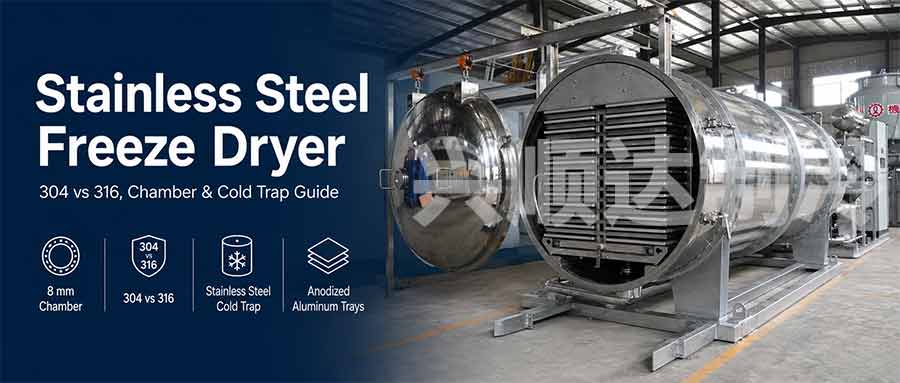
A useful specification identifies material by component—not with a blanket “full stainless steel” claim.
What Should “Stainless Steel Freeze Dryer” Mean?
The phrase can describe very different machines. It may refer only to outer covers, or to the vacuum chamber, condenser, vapor path, trolleys, racks and other process-side assemblies. These are not equivalent specifications.
| Supplier wording | What it may mean | Buyer action |
|---|---|---|
| Stainless steel exterior | Outer panels or covers only. | Ask separately for chamber, condenser, vapor path, rack and tray materials. |
| Stainless steel chamber | The vacuum vessel is stainless steel; other wet or process-side components may differ. | Request the grade, drawing, weld/finish specification and material certificate for the agreed chamber. |
| Full stainless steel | An undefined marketing phrase that can omit functional or hidden components. | Replace it in the technical agreement with a component material schedule. |
For the wider system map, see the freeze dryer components guide. This page owns the narrower decision: material specification and verification.
304 vs 316L Stainless Steel: Choose by the Actual Service Environment
304 can be a practical baseline for many food projects. A 316-family grade may warrant review where chloride exposure, acidic residues, cleaning chemistry, temperature, weld condition or other corrosion risks materially change the duty. The alloy name alone is not a specification.
Use the product, sanitation procedure and exposure history to discuss the choice with the supplier. Material-selection guidance from Outokumpu similarly treats corrosion resistance as a service-condition question rather than a generic ranking.[2]
| Question to resolve | Why it changes the decision | Evidence to include in the RFQ |
|---|---|---|
| What foods, residues and ingredients contact the process-side surfaces? | Salt, acidity and hold time can change the corrosion environment. | Product description and representative formulation information where available. |
| How is the machine cleaned? | Concentration, temperature, contact time and frequency of cleaning chemistry matter. | Cleaning procedure and chemical compatibility requirement. |
| Which welds and surfaces are critical? | Fabrication and accessible cleaning detail affect the finished assembly. | Weld/finish requirement and photographs before final assembly. |
“Food Grade” Is More Than an Alloy Number
For U.S.-regulated food operations, 21 CFR §117.40 requires equipment to be adequately cleanable and food-contact surfaces to be corrosion-resistant when in contact with food; it also addresses the smooth maintenance of seams to prevent accumulation of food particles and organic matter.[1] It is a useful regulatory example, not a substitute for the requirements that apply in the destination market.
For a food freeze dryer, review the finished process-side construction: weld condition, accessible seams, gasket grooves, drainage after defrost or washing, cleaning access and compatibility with the plant’s sanitation program. A grade stamp without those details is incomplete evidence.
Component-by-Component Buyer Checks
| Component | Material question | Decision boundary |
|---|---|---|
| Vacuum chamber and door | Confirm grade, geometry, wall thickness, reinforcement, weld construction, seals and vacuum design basis. | An 8 mm wall is the engineering team’s preferred starting point for many commercial and industrial food chambers, but the final thickness must still be justified by chamber dimensions, reinforcement and external-pressure design. |
| Condenser / cold trap and vapor path | Confirm material, corrosion/defrost exposure, cleanability and access. | Material alone does not prove vapor-capture performance. Compare removable water, usable ice capacity, loaded temperature, surface configuration and defrost arrangement in the condenser selection guide. |
| Loading trolley, rack and trays | Check material, welds, corners, drainage, handling weight and cleaning method. | Stainless steel may be useful for durability and washdown; tray choice still depends on the application and heat-transfer needs. |
| Heating plates | Ask for the base material and surface treatment. | Do not reject a non-stainless heat-transfer component merely because it is not stainless steel. Assess its intended function and food-contact compatibility. |
| Exterior enclosure | Confirm the stated finish if the environment requires it. | Usually lower priority than the process-side construction. |
8 mm Chamber Thickness: Engineering Preference, Not a Universal Rule
For many commercial and industrial food freeze-dryer projects, the engineering team prefers an 8 mm stainless steel chamber wall as a conservative starting point when the chamber size, reinforcement layout and fabrication design support it. On otherwise comparable geometry, a thicker shell can provide more structural margin than a 4 mm or 6 mm shell and can be more tolerant of fabrication, handling and long-term operating loads.
However, the thickness number must not be used alone. A freeze-dryer chamber operates under external atmospheric pressure when evacuated, so structural stability also depends on diameter, unsupported length, reinforcement spacing, material properties, weld construction and the design basis. ASME external-pressure design guidance likewise treats shell thickness together with geometry and design length rather than as an isolated purchasing metric.[3]
For sealing, pressure-rise testing, vapor conductance and vacuum acceptance, see the separate freeze-dryer vacuum chamber guide.
Illustrative Cold-Trap Calculation: Why 304 May Need About 1.4% More Area
304 stainless steel has much lower thermal conductivity than aluminum alloy. However, a real condenser or cold trap includes several thermal resistances in series. Therefore, comparing only the metal conductivity can greatly overstate the practical difference.
- Cold-trap wall thickness, δ = 0.003 m
- Refrigerant-side heat-transfer coefficient, αi = 500 W/m²·K
- Vapor/outer-side heat-transfer coefficient, αo = 100 W/m²·K
- Illustrative thermal conductivity: aluminum alloy λ = 167 W/m·K; 304 stainless steel λ = 16.2 W/m·K
Using these assumptions:
- Aluminum: R ≈ 0.012018 m²·K/W; U ≈ 83.21 W/m²·K
- 304 stainless steel: R ≈ 0.012185 m²·K/W; U ≈ 82.07 W/m²·K
Result: in this illustrative UA comparison, the 304 stainless steel surface would need about 1.39%—approximately 1.4%—more heat-transfer area to match the aluminum surface.
This is not a universal condenser-sizing rule. Actual cold-trap performance also depends on refrigerant-side conditions, vapor desublimation, ice thickness and distribution, surface geometry, vapor-path restriction, loaded temperature and defrost design. Once ice forms, the ice layer adds another thermal resistance and can reduce the relative importance of the metal wall.
Therefore, the 1.4% result should be used only to show why total thermal resistance is more meaningful than metal conductivity alone. Final condenser sizing still belongs in the freeze dryer condenser sizing and verification guide.
Material Choice and Service Life: What Stainless Steel Actually Changes
Material choice can influence the physical life and maintenance burden of the chamber, cold trap, vapor path and other wet-process structures. Stainless steel provides corrosion resistance through the alloy itself, while coated carbon steel depends more heavily on the integrity of its protective coating.
| Lifecycle factor | Stainless steel process structure | Coated carbon steel process structure |
|---|---|---|
| Corrosion protection | Does not depend on a paint or powder-coat barrier alone. | Protection can decline if the coating is scratched, cracked or chemically damaged. |
| Cleaning exposure | Often better suited to repeated wet cleaning when the selected grade matches the chemistry. | Cleaning method must also protect the coating from damage. |
| Surface maintenance | Usually focuses on inspection, weld/surface condition and corrosion monitoring. | May also require coating inspection and localized repair. |
| Physical service life | Can remain serviceable for a long period when corrosion, weld condition and vacuum integrity remain acceptable. | Can also remain serviceable, but coating breakdown can add a separate maintenance and corrosion pathway. |
There is no defensible universal number of years for a stainless steel chamber or an entire commercial freeze dryer. A sound stainless-steel chamber may outlast pumps, seals, sensors, compressors or control generations, while the machine’s economic life can end earlier because of performance, support or spare-parts constraints. The separate guide on freeze dryer service life covers that system-level question in detail.
Turn a Material Claim into an Acceptance Requirement
Put the following evidence in the technical agreement before production begins, then verify it during factory acceptance rather than relying on brochure wording.
- A component material schedule identifying the agreed grade or material for chamber, condenser, vapor path, racks, trolleys, trays and specified process-side parts.
- Traceable material certificates for the agreed critical stainless-steel components.
- Dimensioned chamber and condenser drawings, including the stated vacuum or design basis where applicable.
- Agreed process-side weld and surface requirements, with pre-assembly photographs of hidden details.
- A factory-acceptance record that reconciles the material schedule, drawings, certificates and delivered machine.
Use the food freeze dryer FAT/SAT guide to define the wider acceptance plan. Capacity, vacuum, controls and utilities belong in the machine-selection review, not in this material page.
Request a Material and Configuration Review
Send the product type, representative batch load, cleaning method and chemicals, known salt/chloride or acidic exposure, destination market and target production scale. The engineering team can review the project requirements and return a component material schedule, the quotation inputs still needed, and an acceptance-document checklist for comparison.
FAQ About Stainless Steel Freeze Dryers
Is 304 stainless steel suitable for a food freeze dryer?
It can be a practical baseline for many projects. Select the final grade against the actual product, residue, cleaning chemistry, temperature and chloride exposure—not the word “food” alone.
Is 316L always better than 304?
No. It can offer a different corrosion-resistance margin in relevant service conditions, but it is not a substitute for a defined exposure assessment or a well-finished, cleanable construction.
Is an 8 mm stainless steel chamber always required?
No. The engineering team prefers 8 mm as a conservative starting point for many commercial and industrial food chambers, but final thickness must be justified by chamber diameter, length, reinforcement, material, fabrication and external-pressure design.
Does a 304 stainless steel cold trap always need 1.4% more area?
No. The 1.4% figure comes from the stated illustrative UA assumptions. Real condenser sizing depends on the complete heat-transfer and vapor-capture system, including ice formation, geometry, refrigerant conditions, vapor flow and loaded temperature.
Does stainless steel guarantee a longer freeze dryer lifespan?
No material guarantees a fixed machine lifespan. Stainless steel can reduce dependence on protective coatings in wet process structures, but overall service life still depends on corrosion environment, fabrication, vacuum integrity, refrigeration, pumps, controls, maintenance and spare-parts support.
How can a buyer verify the stainless steel grade?
Require a component material schedule, traceable certificates for agreed critical parts, drawings, process-side photographs and an acceptance record that connects those documents to the delivered machine.
External Technical References
- U.S. Electronic Code of Federal Regulations. 21 CFR §117.40 — Equipment and utensils.
- Outokumpu. Corrosion tables and advice on stainless steel materials selection.
- ASME. Section VIII, Division 1 — external-pressure vessel design discussion.