
Food freeze-drying engineering
Pre-Freezing Before Freeze Drying: Requirements for Food Production
Follow the food load from freezing through measured readiness, protected transfer and a repeatable production schedule.
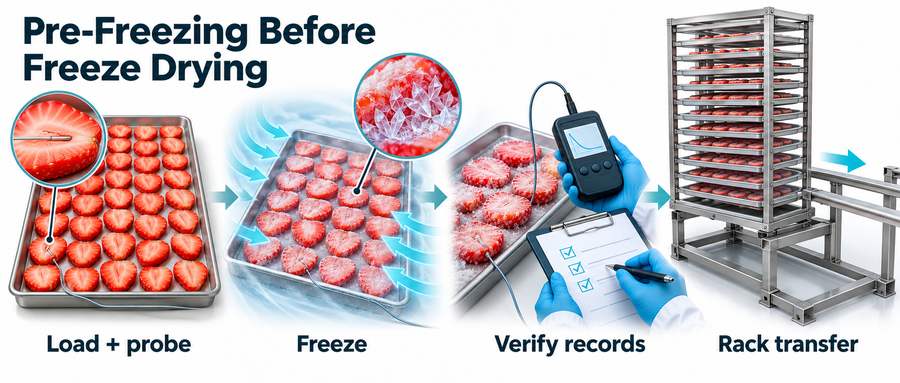
Set the release condition for the food before choosing the freezing equipment. For conventional ice-sublimation drying of water-containing foods, freeze dryer pre-freezing requirements must describe the actual product, tray load and acceptable frozen condition. A separate pre-freezer is optional if the selected dryer can perform the required freezing stage. In either arrangement, qualify representative product temperatures, the freezing method, any hold and the transfer to drying. A cold freezer display or a hard surface alone cannot release the load. [1] [3]
The practical question is whether the next load will reach the dryer in the condition that the food trial established. Work backward from that handoff through your handling route, the freezing method and product measurements. Then check whether the freezer can repeat that cycle often enough to support your production schedule.
This guide covers the requirements before drying starts. It treats equipment capability, product quality, food safety and line capacity as separate checks, so a pass in one area never stands in for the others.
Start with the process
Does the food need a separate pre-freezer?
Ask the supplier whether the quoted dryer can freeze your food load directly in its chamber. If it can, freezing may take place there before drying begins. If your production plan relies on an external freezer, you must freeze, hold and transfer prepared trays to the dryer under the same qualified procedure.
Use food trials and your full production schedule to decide between these setups. Moving freezing out of the chamber changes which machine is occupied; by itself, it does not remove the freezing requirement or prove that the drying stage will be shorter.
These are distinct decisions: the food needs a suitable frozen state; the factory may or may not need a separate freezer. Confirm the selected machine’s actual functions and the quoted supply boundary. Do not assume that every freeze dryer includes a product-freezing system. [1] [3] [4]
Scope: this is conventional ice-sublimation drying of water-containing foods, not a recipe for expanding low-moisture candy. It does not authorize bypassing the machine’s required freezing or equilibration steps.
The food freeze-drying equipment guide compares broader line configurations. For either arrangement, the next step is defining what you must measure in the food.
Measure the food
How do you show that the actual load is ready?
Specify a product endpoint and any required hold based on trials with the actual food, formulation and loading pattern. Keep the freezer’s operating settings separate from the product condition used for release. While a timer describes how a trial ran, it cannot prove that a different batch has reached the same frozen state.
Neither −18°C nor an overnight or 24-hour freeze is a universal release rule. As ice forms, solutes concentrate in the remaining unfrozen phase. Composition and frozen structure therefore matter: a concentrated formulation can behave differently from intact plant tissue. Being below the freezing point of pure water does not establish readiness for the intended drying process. [1] [3]
| Measurement | What it tells you | What it does not prove alone |
|---|---|---|
| Freezer air or cooling-surface temperature | The cooling environment and how it changes during the run. | The condition at the warmest representative product location. |
| Representative product temperatures, including justified centre locations | Whether the selected food locations reach and maintain the qualified condition. | The condition at every tray position without evidence that the probes and loading pattern are representative. |
| Product-specific thermal characterization | Transitions and formulation behavior relevant to choosing trial conditions. | A complete industrial recipe without loaded equipment and product-quality trials. |
Run loaded trials to locate the slowest-freezing product positions and show that routine probe locations truly represent load readiness. Never assume that the geometric centre freezes slowest. Record the exact position of each probe, its contact with the food and how trays occupy the rack; without those details, later temperature traces will be difficult to interpret.
| Limit to establish | What the trial must examine | Record to retain |
|---|---|---|
| Depth and arrangement | Proposed thickness, piles, tray spacing and rack pattern at full load and relevant partial loads. | Food preparation, dimensions, net tray weights and a position diagram. |
| Temperature measurement | Product locations alongside air or shelf readings; probe placement, contact, response and calibration. | Sensor identities and positions, with complete time–temperature traces. |
| Routine probe coverage | Whether routine locations represent the slowest freezing found within the approved loading pattern. | The approved loading boundary and changes that require reassessment. |
Ganguly and colleagues’ equipment qualification guide (2023) distinguishes loaded from unloaded shelf tests in a pharmaceutical context. It supports asking what the equipment test actually measured; it does not supply food release temperatures, probe counts or tolerances.
Whenever product dimensions, fill geometry or loading patterns change, verify that the original trial still represents the load. Never extend an approved boundary based on matching freezer settings alone. Use the food freeze-drying temperature and pressure guide to examine wider control relationships, and keep release decisions anchored to product evidence.
Choose for the product
Which freezing method gives the required finished quality?
Define what the finished food must look like and do before picking a freezing method just because it is fast. An intact snack, a porous block and an easy-dissolving powder have different acceptance criteria. Compare freezing time alongside drying behavior, handling loss and finished product quality.
When comparing freezing methods, keep formulation, geometry and the loading basis common. Describe the saleable form—pieces, blocks, flakes or powder feedstock—and agree on practical tests for texture, rehydration or dissolution. Carry that tested method into routine production, or qualify any process change before adopting it.
No freezing rate is best for every food. Freezing changes ice formation and the structure left after sublimation. Bhatta and colleagues’ plant-food review connects freezing conditions with subsequent drying and product structure. That relationship calls for testing the required result, rather than minimizing freezing time by itself. [1]
Malik and colleagues found that changing the freezing history changed pore structure and reconstitution in concentrated coffee and gum-arabic systems; formulation also changed the response. Use that finding qualitatively. Their thin-layer systems do not provide a universal program for fruit slices, meat, dairy snacks or a production-scale dryer. [2]
A successful dried sample is only part of the comparison. Its freezing and loading records must describe a method your receiving equipment can reliably reproduce. The pilot checks below turn that requirement into a verifiable test.
Follow the load to the dryer
What must survive frozen holding and transfer?
Include the actual holding area, handling route and dryer-loading sequence in your trials. Check the product at the relevant handoff, not only at the freezer exit. Record the lot identity, departure and arrival times, the route taken and the product condition that must be confirmed on arrival.
Before routine production begins, agree who reviews product warming, transit delay, probe failure or a changed load. Keep measured temperature logs clearly separate from unknown history, whether from unmonitored intervals or failed sensors. A satisfactory departure reading does not prove acceptable product conditions after transfer to the dryer.
There is no universal transfer-time allowance. Qualify the actual food, tray geometry, room conditions, route and loading sequence, together with the allowed frozen holding conditions.
After an excursion or an undocumented handoff, identify and hold the affected lot for the responsible review before routine release. Cooling it again does not reconstruct the missing temperature history or demonstrate acceptable texture and rehydration. Record the food-safety and product-quality decisions, including whether the approved load or handoff boundary needs reassessment.
Maintain hygienic separation and lot identification throughout handling. Freezing and freeze drying must not be assumed to be a validated pathogen kill step. Required pretreatment and sanitation controls belong to the food process even when the load looks frozen. [5]
The food freeze-drying facility guide covers plant layout, while the food-safety guide explains microbial-control boundaries. Use the holding and transfer records you collect to inform your final load-release decisions.
Make the release decision explicit
Who can release the frozen load, and against what evidence?
Engineering and production teams should build the checklist below directly from actual food trials. In the release record, name the person responsible for checking deviations or missing data before drying starts. Checklists work when they state the acceptance rule, the required measurement and the exact release decision; a simple checkmark next to “frozen” leaves critical points unchecked.
| Item | Define and record before the trial | Evidence to check before release |
|---|---|---|
| Food and formulation | Identity, ingredients, pretreatment and the relevant solids or moisture basis. | The load matches the qualified formulation and preparation. |
| Geometry and tray load | Cut size or fill depth, net tray weight, arrangement and rack positions. | The tested pattern represents the intended batch, including difficult locations. |
| Freezing method | Equipment, operating program, initial food condition and freezing sequence. | The actual method and any departure from the trial plan are recorded. |
| Product endpoint and hold | The qualified product criterion, representative probes and any required hold. | Selected locations meet the criterion; visual hardness is supporting observation only. |
| Frozen holding | Allowed conditions, lot identification and handling sequence. | The holding history stays within the qualified boundary. |
| Transfer to drying | The route, handling method, loading sequence and arrival check. | The product is acceptable at the handoff, not just when it leaves the freezer. |
| Deviation and release | Who reviews missing data, an excursion or changed loading. | A documented decision before drying; an alarm or incomplete record is not silently accepted. |
Keep sensor identities, measurement locations, observed values and times with the original records. Record the reviewer, whether the lot is accepted, held or rejected, any missing evidence and the action required before drying. The tray and cart guide addresses physical compatibility, and the monitoring guide covers batch-record workflows; retain original freezing and transfer logs with that batch record.
Repeat the handoff
Can freezing keep up with the dryer?
Draw out the repeating operating cycles for both the freezer and the dryer. Check when each qualified batch will be ready and when the equipment is free for the next run. Preparing one batch ahead of time does not show that the freezer can feed repeated dryer cycles on time.
Hypothetical planning example: assume a 500 kg prepared wet load, 6 h freezing, 12 h drying and 2 h dryer turnaround. These are invented inputs, not measured equipment performance. For this calculation only, assume drying and turnaround are unchanged between arrangements.
| Arrangement | Dryer occupied per batch | Theoretical average wet-load rate |
|---|---|---|
| Freezing, drying and turnaround use one chamber in sequence. | 6 h + 12 h + 2 h = 20 h | 500 kg × 24 h/day ÷ 20 h = 600 kg/day |
| A separate freezer supplies a qualified load when the dryer is available. | 12 h + 2 h = 14 h | 500 kg × 24 h/day ÷ 14 h ≈ 857 kg/day |
These are arithmetic upper bounds from chamber occupancy over a repeating schedule, not a promise of complete batches in each calendar day. The external freezer must actually deliver a qualified 500 kg load at every required handoff, including its own loading, freezing, unloading and defrost constraints.
Separating freezing can free dryer occupancy; it does not by itself shorten drying. Real output also depends on preparation, cooling conditions, frozen holding, maintenance, staffed shifts, packaging and quality release. External freezing adds equipment and energy demand, so this example establishes neither energy nor cost savings.
Give each bidding supplier the same food recipe and finished-product acceptance basis. Allow each setup to propose the freezing profile and dryer program it needs, but require suppliers to state those differences clearly with supporting evidence. Forcing identical machine settings can hide a real process difference, while comparing different foods or output definitions can hide an unfair capacity comparison.
| Part of the comparison | Information required |
|---|---|
| Common food and acceptance basis | Formulation and preparation, wet load and solids/water basis, geometry, final quality tests and the definition of accepted output. |
| Measured differences between routes | Initial and endpoint condition, freezing profile and hold, any adjusted dryer program, and measured product quality. |
| Complete repeating schedule | Freezer loading, unloading and defrost; buffer and transfer; evacuation and drying; condenser defrost, cleaning and reload; staffed hours. |
Use the batch capacity guide to calculate overall throughput. Before accepting an equipment proposal, check that both the freezing parameters and the full drying and turnaround cycle are laid out plainly.
Make the trial useful at production scale
What must a pilot prove for the receiving equipment?
Request the complete trial records along with your dried food samples. Buyer and supplier should agree on the food input, sampling locations, finished-product tests and supply boundary before judging trial results. A good dried sample without freezing history and tray-loading data cannot prove that proposed production equipment will deliver the same acceptable product.
- Describe the input: note the formulation, product form, initial condition and tray or rack arrangement.
- Record freezing and handling: record the equipment, representative product sensor locations, target endpoints, any holding period and transfer steps.
- Test the dried result: evaluate final moisture or other agreed release tests, visual appearance, handling and application-specific rehydration or dissolution.
- Compare representative loads: examine repeat batches for consistency and explain differences between the pilot and proposed production scale.
- Name what the proposal includes: list the freezing equipment, holding areas, transfer gear, controls and supporting acceptance evidence included in the offer.
Use pre-agreed sampling locations and the same test method when comparing pilot and production results. For rehydration, state the product amount, water-to-product ratio, water temperature, elapsed time and agitation. Assess texture at the same stage. A result from an easy tray position does not establish the condition of the receiving load.
Retain the receiving equipment’s load map, raw records, failed runs and adjustments alongside accepted results. Different equipment may need a different program to meet the agreed product criteria. Matching setpoints alone is not acceptance evidence.
The food pilot-testing guide details scale-up data, while the FAT and SAT guide addresses equipment acceptance. Connect pre-freezing criteria directly to your equipment acceptance checks rather than taking pilot samples as separate guarantees.
Put the evidence in one place
What should go into the project review?
Bring the batch details, qualified criteria, sensor readings, transfer notes and release decisions together in one summary. State what is known, and write UNKNOWN where evidence is missing. That makes the next trial or supplier question visible without mistaking unverified guesses for real process limits.
When asking suppliers to evaluate equipment, provide the prepared wet weight in kg per batch and per day, the required finished form, existing freezers and available plant utilities. Include the food recipe, cut size or fill depth, available product temperature records and the actual transfer route.
These records support review of freezer/dryer coordination and the trials needed before selection. A blank worksheet does not validate a temperature, transfer duration, food-safety process or production capacity; the project inputs do not establish a guaranteed cycle or output without verification.
Complete a frozen-load release record
A release record should identify the qualified criterion, where the product was checked and who reviewed any deviation. Complete it from the actual trial and handling route.
- Load identity
- Food/formulation, lot, geometry, tray arrangement and freezing method
- Qualified criterion
- Product endpoint and hold criterion; supporting trial reference; measurement method
- Measurement record
- Representative locations, sensor identification, observed values and time; retain original record
- Transfer check
- Freezer departure and dryer arrival; actual route; product-condition check and deviations
- Release decision
- Reviewer, accepted/held/rejected disposition, missing evidence and action before drying
This blank record does not validate a temperature, transfer duration, food-safety process or production capacity.
Copy the completed notes into the message field on the project enquiry page. Information entered here is not submitted or stored by this worksheet.
Review the freezing and dryer-capacity assumptions
Submit your project data and available records for engineering review. A technical review can identify freezer and dryer coordination questions and highlight trials needed before choosing equipment.
Quick answers
FAQ about freeze dryer pre-freezing requirements
Does every freeze dryer need an external freezer?
No. Confirm whether the selected machine can perform the required product-freezing stage in its chamber. A separate freezer is a line-configuration choice; a suitable frozen condition before drying remains required.
Is −18°C enough before freeze drying?
It is not a universal endpoint. Agree the criterion for the actual food, formulation, geometry and drying process, and check representative product measurements. A storage-temperature label is not that evidence.
Will 24 hours of pre-freezing qualify any load?
No. Starting condition, dimensions, tray arrangement and freezer performance affect the result. Release against the qualified endpoint and any required hold, rather than elapsed time alone.
Does a hard surface show that the whole load is ready?
No. Check the justified product locations and loading pattern. Surface hardness cannot establish the condition at the warmest representative locations.
Does external pre-freezing shorten drying?
Moving freezing outside the dryer can reduce chamber occupancy. It does not establish a shorter drying stage. Compare the actual freezing history, dried result and complete repeating schedule.
Should the fastest freezing method always be chosen?
No. Compare the required texture, rehydration or dissolution using the same food and acceptance basis. A freezing recipe for another food does not establish the right method.
May the pilot and production use different freezing methods?
A different method can be useful during exploration. Before scale-up, review whether the production freezing and transfer route supplies an acceptable input to drying; do not accept the change from matching setpoints alone.
References and evidence scope
- Bhatta S, Stevanovic Janezic T, Ratti C. Freeze-Drying of Plant-Based Foods. Foods. 2020;9(1):87. DOI: 10.3390/foods9010087. A plant-food review; its reported conditions are not universal production recipes.
- Malik N, Gouseti O, Bakalis S. Effect of freezing on microstructure and reconstitution of freeze-dried high solid hydrocolloid-based systems. Food Hydrocolloids. 2018;83:473–484. DOI: 10.1016/j.foodhyd.2018.05.008. Concentrated coffee and gum-arabic systems; findings are used qualitatively within that scope.
- Labconco. A Guide to Freeze Drying for the Laboratory. Technical guide, prefreezing section. Background principles for laboratory applications, rather than an industrial food recipe.
- Barley J. Basic Principles Of Freeze-Drying. SP Scientific Products. Technical note. General equipment and freezing-process context.
- Utah State University Extension. Can I Freeze-Dry That? A Practical Guide to Safe and Effective Freeze-Drying. 23 January 2026. Food-safety guidance. Used for the microbial-control and sanitation reminder.
The release checklist is an engineering planning framework, and the schedule is an explicitly hypothetical calculation. Neither is presented as a measured customer result, a validated food process or a regulatory approval.
About the Author: Zheng Wei
Founder & Freeze-Drying System Engineer
Fuzhou Xing Shun Da Refrigeration Facility Project Co., Ltd.
Zheng Wei participates in food freeze-drying trials, equipment selection, vacuum-system configuration, refrigeration planning, installation guidance, process optimization, and project handover. The project experience covers fruit, vegetables, cooked foods, seafood, meat, dairy products, herbs, and extracts.