
Freeze Dryer Machine Indonesia: Price & Buying Guide
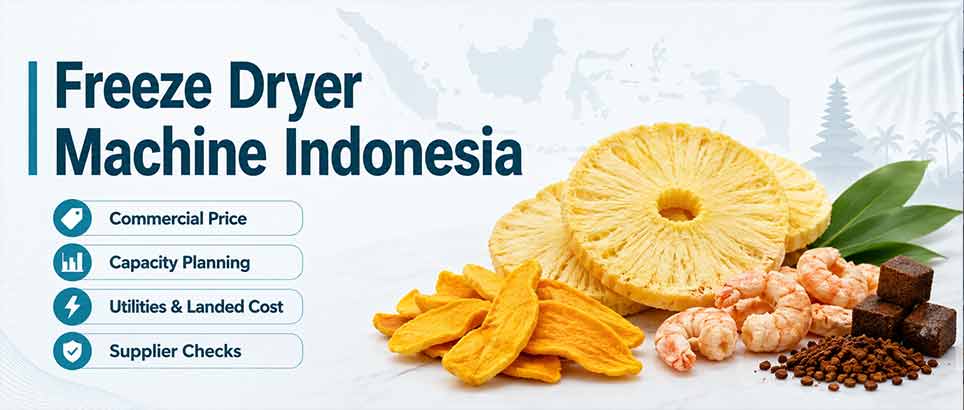
Buyers using the search phrase “freeze dryer machine Indonesia” should compare prepared wet-food load, usable shelf area, water removed per batch, complete turnaround time, utilities, and acceptance evidence—not tray count or chamber size alone. This guide is for Indonesian fruit, coffee, seafood, ready-meal, ingredient, and snack processors choosing commercial or industrial equipment.
Which Freeze Dryer Machine Indonesia Buyers Need
Indonesian search results mix compact units, laboratory lyophilizers, pilot equipment, and factory systems. Buyers may also search for a mesin freeze dryer Indonesia or mesin pengering beku vakum. Regardless of the term used, a low online price may refer to a machine processing only a few kilograms, while a food factory quotation may cover hundreds of kilograms, cooling-water equipment, carts, controls, commissioning, and training. Start with the production job, not the product name.
| Class | Use it for | Ask the supplier to prove | Do not assume |
|---|---|---|---|
| Laboratory | Feasibility, formulation, analysis | Temperature and pressure control, test flexibility | That test capacity equals factory throughput |
| Pilot | Recipe development, samples, market validation | Scale-up method and repeatable endpoint | That a short test cycle transfers unchanged to a larger load |
| Commercial | Regular small-to-medium food production | Wet load, shelf area, water removal, cycle, utilities, cleaning | That condenser “kg” equals food kilograms per batch |
| Industrial | High-volume factories and stable export orders | Material flow, redundancy, defrost strategy, installation and acceptance | That nominal daily output includes loading, defrost and cleaning |
For general equipment selection without the Indonesia-specific costs and site checks, use the food freeze dryer selection guide. Buyers can also compare lab and pilot freeze dryers, commercial freeze dryer systems, and industrial freeze dryer systems. The sections below focus on Indonesia-specific landed cost, factory utilities, installation planning, and acceptance requirements.
Freeze Dryer Machine Indonesia Price and Landed Cost
The ranges below are supplier budget figures for planning in July 2026, not public price guarantees. Final price depends on shelf area, refrigeration architecture, vacuum system, heating method, automation, documentation, export packing, commissioning, and the agreed delivery boundary.
| Production class | Budgetary equipment range | Approximate USD range | Use the figure for |
|---|---|---|---|
| Lab / pilot | CNY 280,000–310,000 | USD 41,000–46,000 | Testing and pilot-scale planning |
| Commercial | CNY 540,000–1,390,000 | USD 79,000–204,000 | Regular food-production budgeting |
| Industrial | CNY 1,690,000–3,900,000 | USD 248,000–573,000 | Factory-scale feasibility |
Source and boundary: Fuzhou Xing Shun Da budgetary equipment ranges, July 2026. USD values use CNY 6.8047 per USD, the July 3, 2026 central parity reference; rounded values are for comparison only. Exchange rate, scope and freight change. Check the current reference at China Foreign Exchange Trade System.
Build a landed project budget
Equipment price is only one line. Indonesian buyers should separately budget ocean freight, insurance, port and customs charges, inland transport, unloading and lifting, foundations, power distribution, transformer work, cooling-water equipment, drainage, installation labor, travel, commissioning, spare parts, packaging equipment, and applicable taxes.
Compare quotations on the same scope
- Machine-only, FOB, CIF and installed prices are different commercial offers.
- Installed power is not the same as measured batch electricity use.
- Condenser ice-holding capacity is not prepared food load.
- A price without product-test conditions does not establish usable throughput.
- Warranty duration matters less if exclusions, response method, parts supply and local responsibilities are unclear.
Use the site’s commercial freeze dryer price guide for global cost drivers; keep country logistics and import planning on this Indonesia page.
How to Calculate Commercial Freeze Dryer Capacity
Capacity begins with food after washing, peeling, cutting, cooking, draining or concentrating. Raw purchasing weight and prepared wet load are rarely identical.
1. Convert daily demand into a prepared batch load
State the target finished output, initial and final moisture, working days, batches per day, and realistic changeover time. If the finished target is known but wet load is not, calculate dry solids first rather than guessing from chamber volume.
2. Calculate usable shelf area
Loading density is product-specific. Peer-reviewed food studies show that thickness, shelf temperature and chamber pressure can change final moisture, colour and texture; thicker layers increase the internal heat-and-mass-transfer path.[1][2] Therefore, a loading value from sliced apple, pineapple or soup must not be presented as a universal machine rating.
3. Calculate water removal
Initial solids, oil and sugar content, skin or cuticle, particle geometry and layer depth all affect the duty. Reviews of plant foods specifically identify waxy skins and high-sugar matrices as barriers that can change freezing and vapour escape.[5] Ask the supplier to show the mass balance and the condenser basis.
4. Use complete turnaround time
Food freeze-drying time and energy depend on the product, equipment configuration, and process variables.[3] For factory capacity planning, the manufacturer recommends including loading, pull-down, primary drying, secondary drying, pressure release, unloading, condenser defrost, drainage, cleaning, and reloading in the complete turnaround boundary.
First-Party Indonesia Pineapple Project Record
Project: An Indonesian processor used an SDG700 with 20 m² usable drying area for round pineapple slices. The company project record reports the following results:
| Loading density | 12.2 kg/m² |
|---|---|
| Vacuum range | 26–92 Pa |
| Condenser design basis | 2 kg water/m²/hour |
| Energy record | Approximately 1.73 kWh/kg of fresh material |
| Product form | Round slices cut across the fruit’s long axis |
Review the full Indonesia pineapple case and project photos.
Send the product, prepared kilograms per batch, slice thickness or layer depth, factory city, and available utilities. The engineering team can provide a preliminary capacity and utility calculation before a formal quotation.
Request a Capacity CalculationFactory Utilities and Food-Production Fit in Indonesia
A production freeze dryer is a factory system. Before civil or electrical work is fixed, review the site’s commercial freeze dryer setup and installation requirements, then ask the supplier for a signed utility list and general arrangement drawing.
| Area | Information to confirm | Why it matters |
|---|---|---|
| Electricity | Voltage, frequency, phase, installed load, normal operating load, starting current, protection and grounding | Prevents undersized transformer, cable and switchgear decisions |
| Heat rejection | Cooling method, inlet temperature range, flow, pressure, water quality and ambient design condition | Hot-site performance depends on the agreed design basis |
| Drainage | Defrost volume, outlet position, slope and sanitation | Affects turnaround, hygiene and floor design |
| Layout | Footprint, maintenance clearance, carts, lifting path, floor load and door access | A machine that fits on paper may still be impossible to install or service |
| Product flow | Pre-freezing, loading, unloading, cleaning and moisture-barrier packaging route | Protects product from delay and moisture pickup |
Food-contact surfaces, trays, welds, seals, drainage and cleanability should fit the intended product and the processor’s hazard-control plan. ISO 22000 provides a food-safety management framework, while the Codex General Principles of Food Hygiene support hygienic design and operating review. These resources do not replace Indonesian legal or BPOM advice; confirm current obligations with the relevant authority.
12 Specifications to Check Before Buying
Use the freeze dryer specifications guide to compare supplier data on a consistent basis before reviewing the project-specific checks below.
- Prepared product basis: food, form, thickness, initial moisture or solids and target endpoint.
- Usable shelf area: net area available to product, not chamber-wall area.
- Validated loading density: kg/m² tied to the tested product and tray depth.
- Water-removal load: kg per batch and condenser design margin.
- Complete turnaround: drying, unloading, defrost, drainage, cleaning and reload.
- Product temperature control: sensor locations, shelf-fluid control and alarm limits.
- Vacuum evidence: pump configuration, pull-down test, leak criterion and gauges.
- Refrigeration basis: condenser temperature, capture rate, ambient and cooling-water conditions.
- Energy boundary: installed kW, typical operating profile and whether auxiliary systems are included.
- Data and alarms: define recipe control, trend export, batch records, interlocks and remote-support requirements; the freeze dryer monitoring guide explains the main records and alarm functions to compare.
- Cleaning and food contact: materials, weld finish, access, drainage, seals and allergen/changeover plan.
- Delivery support: FAT, manuals, drawings, spares, installation boundary, training and SAT criteria.
Use Product Trials, FAT and SAT to Reduce Purchase Risk
Monitoring studies show that product temperature and sublimation behaviour should be verified during drying rather than inferred from recipe time alone.[4] For commercial acceptance, the manufacturer recommends recording loading, product geometry, final moisture, mass stability, texture, rehydration, and batch consistency for the buyer’s actual product.
Before the order: product trial
Record raw and prepared weight, slice or layer dimensions, solids or moisture, tray area, loading density, recipe, pressure, product and shelf temperatures, drying endpoint, final moisture, texture or rehydration target, and energy boundary. Keep the sample and signed report.
Factory Acceptance Test (FAT)
Agree pass/fail criteria for vacuum pull-down and leak performance, refrigeration and condenser operation, temperature control, safety interlocks, alarms, data recording, electrical functions, documentation and the contracted product test.
Site Acceptance Test (SAT)
After installation in Indonesia, verify utilities, rotation and direction of pumps, cooling performance, drainage, controls, safety devices, communication, training and an actual-product batch where feasible. The site’s food freeze dryer FAT and SAT guide provides a more detailed acceptance structure. After acceptance, define inspection intervals, consumables, spare parts and remote-support responsibilities using the freeze dryer service and preventive maintenance guide.
Information Needed for an Accurate Indonesia Quotation
Send enough data for the supplier to calculate a process, not just select a catalog model:
- Product name, photo, ingredients and whether it is sliced, whole, cooked, liquid or extract
- Prepared wet kg/batch and required kg/day
- Thickness, diameter or liquid layer depth
- Initial moisture or total solids and target final moisture
- Target texture, colour, rehydration or other release criterion
- Factory city, ambient condition, voltage/frequency/phase and cooling-water information
- Preferred delivery term, installation boundary and target commissioning date
- Packaging method and maximum time allowed between unloading and sealing
For product-specific preparation data, fruit processors can review the commercial fruit freeze-drying guide, while seafood processors can use the commercial fish freeze-drying guide before submitting trial and capacity information.
Request an Indonesia Freeze Dryer Proposal
Provide the product data above. The proposal can return a recommended model range, capacity and water-removal basis, utility list, budgetary scope, layout requirements, testing plan and the open assumptions you need to confirm before ordering.
Frequently Asked Questions
How much does a freeze dryer machine cost in Indonesia?
For planning, the current supplier ranges are about USD 41,000–46,000 for lab/pilot equipment, USD 79,000–204,000 for commercial systems and USD 248,000–573,000 for industrial systems. These are equipment-budget ranges, not landed Indonesia quotations. Add freight, customs, local utilities, installation, commissioning and taxes.
Why are some Indonesia online prices much lower?
Many visible listings are compact machines processing only a few kilograms. Compare prepared wet load, shelf area, water removed, cycle, power, cooling, warranty scope and acceptance evidence before comparing the headline price with a commercial or industrial system.
What size is suitable for a fruit-processing business?
Size depends on prepared kilograms per batch, slice geometry, initial moisture, loading density, final-moisture target, full turnaround and batches per day. The 20 m² pineapple project processed 244 kg per batch, but that record is not a universal rating for other fruits or preparations.
Can one machine process pineapple, mango, durian, coffee and seafood?
The same system may process different products if its temperature, vacuum, condenser, cleaning and control range are suitable. Each product still needs its own preparation, loading rule, recipe, endpoint, cleaning procedure and packaging plan.
How long does commercial freeze-drying take?
There is no reliable universal time. Product type, thickness, loading, freezing, pressure, shelf temperature, condenser performance and endpoint all matter. Ask for the drying time and the complete batch turnaround under documented test conditions.
References
- 孟宪军, 高琨, 李斌, 颜廷才, 崔晓雅, 阎婷. 响应面法优化寒富苹果真空冷冻干燥工艺[J]. 食品科学, 2013, 34(10): 92-97. DOI: 10.7506/spkx1002-6630-201310020.
- Liu Y, Zhang Z, Hu L. High efficient freeze-drying technology in food industry. Critical Reviews in Food Science and Nutrition. 2022;62(12):3370-3388. High Efficient Freeze-Drying Technology in Food Industry — DOI: 10.1080/10408398.2020.1865261
- Waghmare RB, Choudhary P, Moses JA, Anandharamakrishnan C, Stapley AGF. Trends in Approaches to Assist Freeze-Drying of Food: A Cohort Study on Innovations. Food Reviews International. 2022;38(sup1):552-573. Trends in Approaches to Assist Freeze-Drying of Food — DOI: 10.1080/87559129.2021.1875232
- Pisano R, Barresi AA, Fissore D. Innovation in Monitoring Food Freeze Drying. Drying Technology. 2011;29(16):1920-1931. Innovation in Monitoring Food Freeze Drying — DOI: 10.1080/07373937.2011.596299
- Bhatta S, Stevanovic Janezic T, Ratti C. Freeze-Drying of Plant-Based Foods. Foods. 2020;9(1):87. Freeze-Drying of Plant-Based Foods — DOI: 10.3390/foods9010087