
Food factory procurement · Nigeria
Freeze Dryer in Nigeria: Food Project Buying Guide
Choose the equipment class, confirm the import route and define the production evidence before committing to an order.
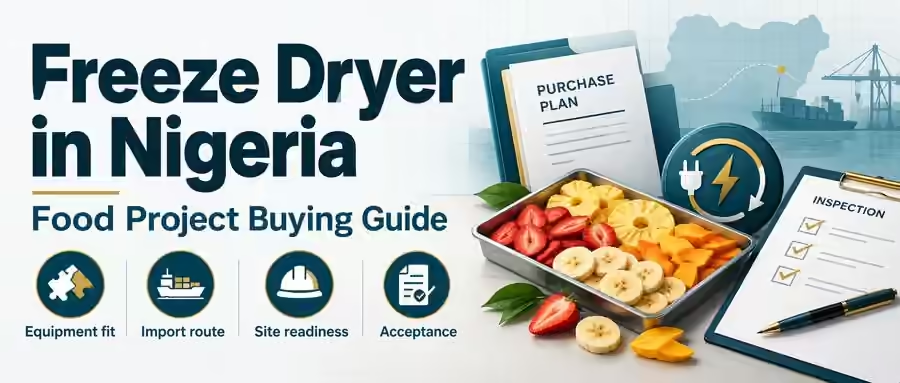
A freeze dryer in Nigeria should be selected against a defined food product and operating site. A useful offer identifies the actual freeze-drying process, prepared wet load, complete batch schedule, utilities, delivery responsibilities and acceptance evidence. A marketplace price or laboratory collector capacity cannot establish the output of a food factory.
This guide serves food processors evaluating pilot, commercial, or industrial equipment. It provides a purchasing framework rather than a Nigerian stock list or a claim of local installation support. Laboratory, pharmaceutical, and household projects require their own equipment and process assessment.
01 / Equipment fit
Start with the right equipment class
Broad equipment searches can bring together hot-air food dehydrators, small freeze dryers, laboratory lyophilizers and production systems. Buyers should establish the process and intended duty before comparing tray counts, temperature labels or prices.
| Equipment class | Question to resolve | Food-project buying action |
|---|---|---|
| Hot-air dehydrator | Does the process dry unfrozen food with heated air? | Compare the required product quality and economics through the dehydration comparison guide. |
| Small or laboratory freeze dryer | What sample, tray load, collector duty and operating schedule does the offer support? | Use a defined trial to establish suitability; the model label alone does not prove repeatable production output. |
| Commercial or industrial food system | What prepared wet load and complete turnaround are supported for the intended food? | Compare the food-equipment ranges against product, site and acceptance requirements. |
On a narrow screen, scroll inside the table to read every column.
For a small food business, the smallest suitable system is the one that can meet the verified duty and quality target. A larger installation requires the same operational evidence, together with a workable freezing, handling, and packaging workflow. Laboratory shelf area or ice-holding capacity should not be converted directly into daily food output.
02 / Nigeria readiness
Resolve the Nigeria import and food-readiness tracks
Importing the equipment and preparing a food-production operation are separate tasks. Assign each task to a named party before shipment, and keep the equipment description, importer identity, and intended use consistent across the offer and supporting documents.
The Standards Organisation of Nigeria (SON) describes a conditional import-permit route for qualifying manufacturers importing industrial machinery. Its guidance does not make every freeze dryer automatically exempt from conformity requirements. The importer should confirm the applicable route with SON for the actual equipment and intended use.[2]
SON’s notice published on March 31, 2026 describes the migration of specified permit processes to the National Single Window (NSW), effective March 27, 2026, and explains the distinction between certificate issuance and activation. The importer should check the current procedure before starting applications or arranging dispatch.[3]
NAFDAC separately publishes food-facility inspection and enterprise guidance. Its MSME resource page is a starting point for identifying the relevant food-production requirements; equipment delivery is not evidence that the planned facility or product has received approval.[4]
| Track | Confirmation to obtain | Record before commitment |
|---|---|---|
| Machine import | Importer and SON confirmation of the applicable equipment route and current processing steps. | Named responsible party, equipment description, required evidence and outstanding questions. |
| Food operation | Relevant NAFDAC facility and product requirements for the actual food and enterprise. | Applicable guidance, responsible operator and preparation or inspection actions. |
| Shipment and delivery | Agreed packing, freight, clearance, inland transport and unloading boundaries. | Written inclusions, exclusions and documents tied to the quoted configuration. |
This guide assigns no HS code, duty rate, exemption, or approval outcome. Those decisions require the current equipment details and confirmation from the responsible Nigerian authorities and import professionals.
03 / Product evidence
Put one food product on the test sheet
A useful trial starts with the food as it will enter the dryer. Record the variety or recipe, preparation, initial moisture or solids where known, slice thickness or fill depth, prepared wet load and proposed loading arrangement. Define the finished-product checks before the trial.
Ratti’s food-powder chapter explains that differences between laboratory and commercial freeze dryers can affect product temperature during scale-up. Geometry and heat transfer matter alongside the selected process settings. A successful sample therefore supports development; it does not by itself establish the proposed factory’s capacity.[1]
A bounded engineering example
Good Freeze Dryer’s published 2022 China apple case reports an SDG700 with 20 m² drying area, approximately 254 kg of 8 mm apple slices per batch, a 12-hour drying period and 1.97% final moisture.[5] These are first-party reported conditions from that case, not a Nigerian installation or an independently certified capacity test.
The drying period is not the complete loading, unloading, defrosting and cleaning turnaround. The record does not establish the same result for another food, preparation, equipment configuration or site. A new project needs its own agreed test and measurement method.
Keep wet input, water removed, dried output, and saleable packed output distinct. The batch-capacity guide explains how the full schedule affects daily production; it remains the detailed sizing reference.
04 / Operating site
Check power continuity and heat rejection at the actual site
The purchase specification should use the intended site’s conditions. Where grid and backup supplies are part of the plan, the equipment supplier and site electrical engineer should agree which loads must remain available, the transfer arrangement, alarm records, and the shutdown or restart procedure.
- Electrical supply: confirm voltage, frequency, phase, available capacity, protection, earthing and the offered configuration.
- Backup duty: obtain the equipment load schedule and motor-starting requirements; include other simultaneous factory loads in the engineering review.
- Cooling: agree the design ambient and cooling-water conditions, flow, heat-rejection arrangement and responsibility for the auxiliary equipment.
- Physical flow: verify receiving access, unloading, floor and service clearances, pre-freezing, defrost drainage and the route to packaging.
- Operating handover: document alarm response, recovery decisions, operator training, consumables and the agreed service arrangements.
Installed machine power alone does not determine transformer or backup-generator capacity. Starting behavior, simultaneous loads and site conditions require a project-specific electrical assessment. No universal generator size or national outage assumption is used here.
The commercial setup guide provides the detailed utility and installation checklist. For a project with solar or battery supply, refer to the separate PV and battery planning guide.
05 / Quote comparison
Compare the complete quote instead of a headline price
There is no verified single price for a freeze dryer in Nigeria in this guide. A current quotation should identify its currency, date, exact configuration, validity, and delivery basis. Offers for different equipment classes or supply boundaries cannot be compared fairly by the headline amount.
| Cost group | Items to clarify |
|---|---|
| Equipment package | Chamber, refrigeration, vacuum system, controls, trays, accessories and agreed freezing equipment. |
| Shipment and import | Export packing, freight, insurance, import-related costs, clearance, inland transport and unloading. |
| Site completion | Electrical and backup arrangements, cooling, drainage, building work and handling equipment. |
| Handover and support | Installation scope, travel where agreed, commissioning, training, initial spares, warranty and exclusions. |
| Operation | Measured cycle energy, labor, packaging, maintenance and the realistic production schedule. |
A feasibility calculation should use trial-supported output and the business’s actual selling, utilization, and operating assumptions. It should also show the effect of a slower turnaround or lower saleable yield. The total-cost guide supplies the wider evaluation framework; neither a listed machine price nor one successful sample proves a return on investment.
06 / Acceptance
Agree the production proof before dispatch
Write an acceptance plan that names the product, prepared load, loading pattern, required process records and finished-product criteria. Separate equipment checks from the loaded production test, and identify what must be repeated or confirmed after site installation.
- Before dispatch: confirm the supplied configuration, agreed functional checks, trial conditions, documents and unresolved findings.
- At the site: confirm utilities, installation interfaces, safety functions, operator access and the agreed loaded acceptance work.
- For the food: record the moisture or water-activity method and other specified quality checks, with sampling and acceptance responsibilities.
- For repeatability: state the agreed run sequence and criteria rather than extrapolating from an attractive sample.
- For support: name the remote or on-site scope, responsible party, spare-parts arrangements and commercial terms.
An empty-chamber vacuum reading or delivery receipt does not demonstrate loaded food output. Packaging, storage assessment, and applicable food-production requirements also require their own evidence. The food FAT/SAT guide and packaging guide explain those separate tasks.
07 / Next decision
Prepare a Nigeria project brief
Send the same starting information to each equipment supplier. Mark unknown items openly so the first response can identify the missing trial, site, or delivery evidence.
- Food product, preparation and intended finished form.
- Prepared wet-input target, planned work schedule and packaging approach.
- Known thickness or fill depth, loading method and finished-product criteria.
- Nigeria destination, installation location, available utilities and backup plan.
- Importer contact or responsible party, with the machinery-route and food-readiness questions still to confirm.
- Required quotation inclusions, test records, installation, training and support scope.
Request a preliminary equipment review
Provide the food product, wet-load target, Nigeria destination and known site conditions. Good Freeze Dryer can use these inputs to discuss equipment selection, trial questions and preliminary utility requirements. Import approval, food-facility approval and any local installation or service arrangement require their own confirmation and written project scope.
Frequently asked questions
Can a small freeze dryer support a food business?
It may fit a defined development or production duty, but the offered system must be assessed using the intended food, prepared load, complete turnaround, and quality endpoint. Small size alone establishes neither suitability nor unsuitability.
Does a Nigeria price listing include import and installation?
The written offer must identify those inclusions. Request equipment, shipment, import-related, site, and handover costs separately; do not infer them from a listing title or seller location.
Does importing the machine complete the food-production approval process?
The importer and food operator should confirm their separate responsibilities with the relevant authorities. Machinery import documentation is not evidence of regulatory approval for the planned food facility or product.
Does a published overseas case guarantee a local result?
No. It provides evidence within its identified conditions. The planned food, equipment configuration, site, and acceptance criteria require their own verification.
References and evidence
- Ratti C. Freeze drying for food powder production. In: Handbook of Food Powders: Processes and Properties. Woodhead Publishing; 2013:57–84. DOI: 10.1533/9780857098672.1.57. Supports the bounded scale-up explanation, not a Nigeria equipment rating.
- Standards Organisation of Nigeria. SONCAP FAQ. Manufacturer machinery import-permit guidance; applicability requires confirmation. Accessed October 29, 2026.
- Standards Organisation of Nigeria. Mandatory Migration of Soncap and Import Permit Processes to the National Single Window (NSW) Platform. Published March 31, 2026; accessed October 29, 2026.
- NAFDAC. Micro, Small & Medium Enterprises (MSME). Food-facility guidance resource; no fee, enterprise classification or approval outcome adopted here. Accessed October 29, 2026.
- Good Freeze Dryer. Freeze-Dried Apples Case Study. First-party reported China project, 2022; the reported conditions are not a Nigerian performance guarantee.
About the Author: Zheng Wei
Founder & Freeze-Drying System Engineer
Fuzhou Xing Shun Da Refrigeration Facility Project Co., Ltd.
Zheng Wei participates in food freeze-drying trials, equipment selection, vacuum-system configuration, refrigeration planning, installation guidance, process optimization, and project handover. The project experience covers fruit, vegetables, cooked foods, seafood, meat, dairy products, herbs, and extracts.