
Food plant energy planning
Solar Powered Freeze Dryer: PV, Battery and Backup Planning
A solar proposal should explain how a food freeze dryer will finish its batch, including the hours when the panels produce no electricity. Start with that operating requirement, then compare the equipment and evidence offered to meet it.
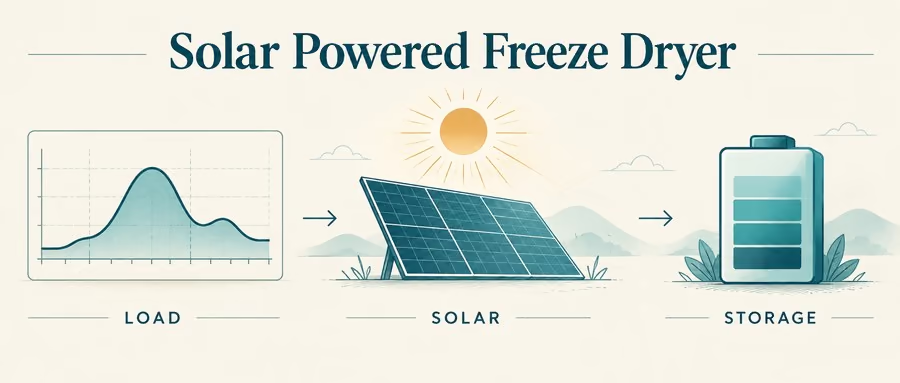
Can solar power run a freeze dryer? Yes. A compatible photovoltaic (PV) power system can supply an electric freeze dryer, but the complete supply must meet the machine’s electrical demand throughout the intended duty. On a working grid, electricity from the grid can cover the night. An overnight batch therefore does not automatically require a battery; operation during a grid outage is a separate requirement.
For a food business, the useful starting question is what must happen to the batch if solar output falls or another power source fails. A panel count cannot answer that question without the load record, production schedule and supply arrangement. This guide follows those decisions through the quotation, the witnessed test and preparation for the next batch.
On smaller screens, scroll tables sideways to view every column.
What must keep running when solar power falls?
Tell the dryer supplier and the appointed energy-system designer whether the project aims to buy less grid electricity, use stored electricity later, or keep specified equipment running when the grid is unavailable. A project may need more than one function. Each function needs its own supporting design and evidence.
If reducing purchased electricity is the only objective and the grid remains available, the dryer can continue drawing from the grid after sunset. If a batch must continue through an outage, name the loads to retain, the duty they must complete and the interruption behavior the equipment can tolerate. Those are the requirements to resolve before choosing hardware quantities.
| Proposed route | What it is intended to do | What the buyer should ask to see |
|---|---|---|
| Grid-connected PV | Offset part of daytime demand; the grid supplies the remaining electricity. | Demand and PV output matched in time, with the import and export assumptions stated. |
| PV with storage | Move some available energy to a later operating period. | Usable energy, charging and discharging limits, losses and the loads actually supplied. |
| Standalone or hybrid supply | Support a defined duty without depending on a normal grid connection. | A low-sun plan, available backup, recovery arrangements and verified supply capability. |
A battery alone does not establish backup capability. The Australian Government’s Solar Consumer Guide explains that many grid-connected systems stop supplying power during an outage, and that some battery systems also do not power the property. The appointed contractor must confirm how the proposed system can operate independently of the grid, often called islanding, and which plant loads it will supply.[1] This is a general distinction, not a claim that Australian installation rules apply at every site.
Once the intended function is clear, the next question is whether the supplier has described the actual load that function must support. A quotation for a different product, operating schedule or set of auxiliaries is answering a different question.
What does this batch actually draw?
kW describes power at a moment; kWh describes energy over a period. Power capability determines whether the supply can serve the operating load and its starting events. Deliverable energy determines how much of the intended duty can be supplied. A daily energy total does not establish starting capability, and a power rating does not establish overnight duration.
Give the designer the machine’s electrical specification together with a measured trace from a representative production duty. State where the measurement starts and ends, and keep its process record beside it. This lets the designer distinguish the dryer itself from other loads the project is expected to support.
Ask the qualified electrical team to identify how the trace was measured. Keep the meter or analyzer identity, measurement method, connection boundary and any calibration or verification record. The measuring arrangement must suit the actual equipment; a household plug-in meter is not a general instruction for an industrial supply.
Send enough context to interpret the trace
- Electrical supply: required voltage, phase and frequency, rated input, and manufacturer-specified starting or transient demand.
- Whole duty: freezing, evacuation, primary drying, secondary drying, turnaround and preparation for the next batch.
- Included equipment: refrigeration, vacuum pumps, heaters, external pre-freezing, cooling and other auxiliaries. Identify simultaneous loads and anything outside the measurement.
- Product and programme: food and formulation, prepared wet load, thickness, equipment configuration, programme version, stage times, endpoint result and operating environment.
- Time and data quality: timestamps, time zone, recording interval and whether the values are instantaneous readings, interval averages or interval maxima. Mark gaps and manual changes; label estimates as estimates.
- Starts and interruptions: which starts and simultaneous auxiliaries were captured, plus controller retention, alarms, the supplier-approved restart sequence and the required assessment of an interrupted batch.
An interval average does not establish brief starting demand. If the measurement did not capture a transient, leave that item open for the qualified electrical team rather than inferring it from the average.
Luo and Shu’s food freeze-drying analysis distinguishes freezing, sublimation drying, vapor condensation and vacuum maintenance. It relates drying time to material thickness and heat and mass transfer.[2] These distinctions help define what a load record should describe. The paper’s theory and example curves do not give a universal electricity figure, PV capacity or battery size for a freeze dryer.
For background terminology and the company’s separate project references, see the freeze dryer electricity-use guide. Use the measured duty for the solar proposal rather than substituting a general example from that guide. The resulting trace can now be compared with the electricity available at the same times.
Will the supply cover the batch hour by hour?
Ask the energy-system designer to place the expected PV output and the complete dryer duty on the same operating clock. Identify when solar power is used directly, when energy could be stored or exported, and when the grid or another source must supply the difference. Keep the plant location, production timetable and generation assumptions with that comparison.
A monthly electricity bill or annual solar forecast can provide useful context, but neither shows the supply available at a critical moment in a batch. Even a daylight total can conceal periods when demand exceeds generation. The comparison must also respect the available battery charge, charging and discharging power limits, losses and any reserve being kept for a later event.
PVWatts estimates electricity production for a defined PV system using typical or representative weather data. Its documentation treats monthly and annual results as better indicators of long-term performance than of a particular future period, and identifies shading, system losses and operating conditions that affect results.[3] A modeled yield is therefore an input to the project assessment, not a guarantee that a particular batch or cloudy period will be covered. No site simulation has been performed for this article.
A sunny start does not establish a sunny finish. Scheduling may change when electricity is purchased, but it must preserve the validated drying programme and required product endpoint. An overnight plan and a cloudy-period plan address different supply conditions.
Before moving to a quotation, check whether the proposed sources supply enough energy as well as enough power. The following deliberately simple example shows why adding battery capacity alone cannot repair a shortage of generated energy.
Why more battery cannot fill an energy deficit
Arithmetic example only. Assume a hypothetical process uses 100 kWh over a 24-hour period: 40 kWh during a defined daylight interval and 60 kWh at night. Assume PV produces 80 kWh during daylight and no electricity at night. These are selected teaching values, not company test data, a measured dryer cycle or a sizing recommendation.
| Interval | Process demand | PV generation | Interval balance |
|---|---|---|---|
| Daylight | 40 kWh | 80 kWh | 40 kWh surplus |
| Night | 60 kWh | 0 kWh | 60 kWh shortfall |
| Whole period | 100 kWh | 80 kWh | 20 kWh net energy deficit |
At most 40 kWh of that day’s surplus could be moved to night, even with ideal storage. That is less than the assumed 60 kWh night demand, and real deliverable energy would be lower after losses. The full assumed duty cannot be supplied from that day’s PV alone. A larger nominal battery does not create the missing 20 kWh.
The designer must still resolve the timing within each interval, the initial battery charge, power limits and reserve. The calculation also needs an agreed source for any shortfall and a plan to restore energy before the next duty. It does not select a battery, prove an inverter can start the load or establish an acceptable interruption for the dryer.
This is why quotations should be compared against the same operating requirement and evidence, rather than against panel or battery quantities in isolation.
What should each quotation commit to?
Send each supplier the same duty description and ask it to show what its offer covers. Separate the drying equipment, PV system, storage, backup function, electrical integration and commissioning. This makes a daytime electricity-offset offer distinguishable from an offer intended to support production during an outage.
For each proposed function, keep the offered value, supporting document and responsible party together. If a function is missing, unverified or excluded, assign an action and owner instead of treating it as included. The comparison below is a blank procurement aid; it does not show that either prospective supplier has validated the complete duty.
| Function | What the offer should describe | What needs an assigned answer |
|---|---|---|
| Generation | Site, production timetable, modeled yield, weather basis and losses; electricity used directly, stored or exported. | Who verifies the assumptions and the remaining grid import or low-sun requirement? |
| Stored supply | Usable deliverable energy and power at stated conditions, supported loads, reserve, aging assumptions, discharge window and charging restrictions. | Which loads, limits, auxiliaries or future replacement costs are excluded? |
| Backup transfer | The actual backup or islanding arrangement, interruption and controller response requirements, and proposed integrated verification. | Who owns the interface between the power system and the dryer controls? |
| Handover | Commissioning, witnessed records, operating instructions, alarm response, warranty and support, and closure of outstanding actions. | Who supplies each record, accepts the result and resolves a failed or untested item? |
The PPA/SEIAPI design guide separates the specified loads’ energy needs from maximum and starting power demands, and distinguishes usable capacity from total capacity. It also calls for a load assessment, expected system performance and equipment and maintenance information.[4] Its historical worked examples and standards list are not a design or a statement of current compliance for this plant.
Compare financial assumptions as carefully as equipment scope: energy price and tariff, export terms, the solar electricity actually used, maintenance, storage replacement and the production consequences of interruptions. Keep the same finished-product specification and saleable-output basis. Buying less grid electricity does not by itself mean that the dryer uses less energy per accepted batch.
The industrial freeze-drying cost guide covers the wider equipment budget. Here, the immediate task is to turn an offered function into a clear commitment and an agreed way to verify it.
How will the team prove backup works?
The responsible site team must approve the test method, precautions and acceptance criteria before testing. The following is a proposed record for the supplier and energy contractor to agree. It is not an instruction to disconnect a live supply, a universal test standard or a report of a completed company test.
Ask the team to demonstrate the promised duty under agreed conditions, rather than relying on a battery label or a restored control display. The record needs to show which equipment was supported, how long it was supplied and how the dryer responded at transfer. A component’s own test does not answer every question about its interface with this dryer.
Keep the conditions, event and decisions together
- Test basis: actual equipment and software, representative load, supported auxiliaries, initial usable energy or charge condition, operating environment and intended duty.
- Event record: power-source event, measured transfer response, dryer stage and process trends on a documented timebase. Retain instrument settings, alarms, operator actions and missing data.
- Electrical result: observed power, duration and equipment response compared with the agreed limits, including the operating or shutdown sequence. Record deviations, corrective actions, retest evidence and the person accepting the result.
- Product decision: review the affected batch’s complete history and agreed quality or release tests separately. Name who decides to hold, investigate, resume or dispose of it under the approved process.
A successful electrical transfer or a restored display does not establish product acceptance. The electrical result and the batch decision need separate evidence and responsible people.
Before signing acceptance, identify any condition that was not demonstrated and who will resolve it. Do not turn an untested item into an assumed capability. Physical installation and utility interfaces belong in the commercial freeze dryer setup guide; utilities other than electricity remain separate supply items that PV generation alone does not satisfy.
Can the next batch start after a cloudy day or outage?
Before committing to the next start time, ask when the required usable reserve will be restored. Charging may have to occur while the dryer and its auxiliaries are still drawing electricity. Include those concurrent loads, the permitted charging power and the assumed low-sun period. If the available generation cannot complete the next duty, keep the start time open until an agreed grid, backup or recharge arrangement closes the shortfall.
A system that completes an overnight run has not necessarily demonstrated readiness for repeated production. Keep both questions visible: can it supply this duty, and can it recover in time for the next one? Starting a new batch in sunshine does not answer either question on its own.
Before restarting equipment or loading the next batch, verify the agreed energy reserve, available backup and stable supporting utilities. Confirm that monitoring and alarm communications work under the intended outage conditions, with a named person to receive and act on alerts.
Restart the machine only under the supplier-approved site procedure. The responsible product reviewer must separately assess the affected batch from the recorded process history and agreed quality or release evidence. Restoring power alone establishes neither permission to restart nor permission to release product.
The buyer does not need to invent these missing values. A useful handoff makes the unknowns visible so the dryer supplier, electrical designer and site team can each answer the part for which they are responsible.
What should the buyer send first?
A food processor can use this sheet to organise measured electrical demand before a discussion with the dryer supplier and a qualified local solar designer. A household appliance search and a factory load study require different equipment information; this sheet addresses the latter.
- Product and duty
- Food, formulation, wet kg/batch, required finished form, shifts and batches/week
- Measured boundary
- Meter location; dryer model; auxiliaries included/excluded; external pre-freezing recorded separately
- Time series
- Timestamped kW data; interval and units; cycle/stage labels; measured start-up events, if available
- Supply objective
- Grid offset, defined backup duty or off-grid operation; loads to retain during an outage
- Site and responsibility
- Location, available supply, proposed PV/battery designer; missing records and party responsible
A completed sheet is an input record, not a PV design, battery specification or runtime guarantee.
Copy the completed notes into the message field on the project enquiry page. Information entered here is not submitted or stored by this worksheet.
Discuss the dryer duty and the utility inputs
Food producers can send the product and form, prepared wet load, required output, drying or pilot records, plant location, existing supply and any measured load trace. State whether the aim is daytime electricity offset, overnight operation or defined outage support.
The company’s engineering review can address the freeze-drying duty and equipment utility inputs. The appointed solar and electrical contractor should develop and verify the PV, storage and backup design against those inputs.
Questions before requesting equipment quantities
Can panels connect directly to the dryer?
Panel output alone is not a compatible equipment supply. The proposed system must match the exact dryer’s electrical requirements and operating demand. The energy contractor and equipment supplier should verify that interface.
Is a battery always necessary?
No. A grid-connected offset project can use solar electricity by day and buy the remainder from an available grid. Storage and outage backup are separate design decisions; battery ownership alone proves neither overnight autonomy nor backup capability.
How many panels does a freeze dryer need?
There is no universal count. It depends on the measured duty, production timetable, location-specific generation, supply arrangement and losses. A nameplate rating or daily energy average is not a complete system specification.
Is solar food drying the same process?
No. Solar hot-air drying removes moisture using heated air. Using PV electricity to supply a freeze dryer changes its source of electricity; primary drying still removes ice by sublimation under the specified process conditions.
Sources and limits of the evidence
- Australian Government, Solar Consumer Guide. Design considerations. Complete main body recovered and read November 7, 2026; provider cache dated November 6. Used for objectives, grid connection and configured backup. Regional rules and financial examples are not applied universally.
- Luo N, Shu H. Analysis of Energy Saving during Food Freeze Drying. Procedia Engineering. 2017;205:3763–3768. doi:10.1016/j.proeng.2017.10.330. Full paper and original figures reviewed; theory and example curves support process-boundary questions, not a solar-system size or universal energy figure.
- PVWatts documentation. Cautions for Interpreting the Results. Full cached cautions text reviewed; original access October 27, 2026. Used for representative-weather/model limits. No site simulation was performed for this article.
- PPA/SEIAPI. Grid Connected PV Systems with Battery Energy Storage Systems: Design Guidelines. July 2020. Previously verified complete 59-page original reused; relevant claim passages re-read. Used for separate power/energy requirements, supported loads, usable capacity and handoff. Historical design examples and standards are not current site compliance advice.
About the Author: Zheng Wei
Founder & Freeze-Drying System Engineer
Fuzhou Xing Shun Da Refrigeration Facility Project Co., Ltd.
Zheng Wei participates in food freeze-drying trials, equipment selection, vacuum-system configuration, refrigeration planning, installation guidance, process optimization, and project handover. The project experience covers fruit, vegetables, cooked foods, seafood, meat, dairy products, herbs, and extracts.