
Commercial Freeze Dryers · Food Production Guide
Commercial Freeze Dryers for Food Production: Capacity Planning Guide
In practice, commercial freeze dryers help food businesses move from product testing to stable batch production. However, the right machine should not be selected only by tray area, price, or chamber size.
In practice, the correct decision for fruit, vegetables, meat, seafood, pet food, ready meals, and food ingredients should start with wet material capacity, drying time, product thickness, moisture removal load, cold trap performance, energy use, and real production data.
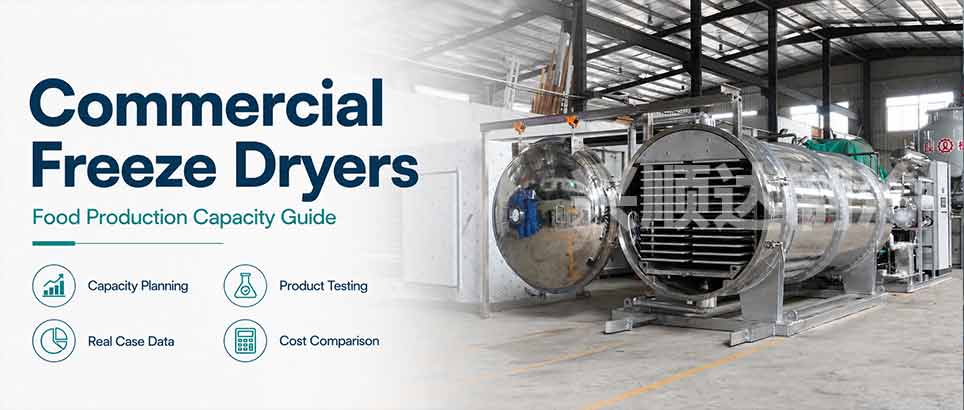
What Are Commercial Freeze Dryers?
In practice, commercial freeze dryers are freeze-drying systems designed for business food production. During the process, they remove moisture from frozen products under vacuum, while the condenser captures water vapor released during drying. As a result, food manufacturers can produce dried products with controlled moisture, stable shape, and repeatable batch quality.
However, unlike home freeze dryers, commercial freeze dryers must support higher wet material capacity, stronger refrigeration, larger condenser load, stable vacuum control, food-grade construction, and daily production planning. Therefore, buyers should evaluate them as production equipment, not as enlarged household machines.
In addition, buyers can review the commercial freeze dryer product page for model specifications. Meanwhile, this external reference explains the basic science of how freeze drying removes ice under low pressure by sublimation: The Freeze-Drying of Foods.
Who Needs a Commercial Freeze Dryer?
In practice, a commercial freeze dryer is suitable when the product has moved beyond basic testing and now needs stable batch output. Usually, the buyer already knows the product category, target market, and expected daily production volume.
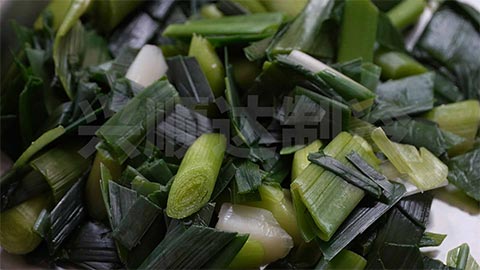
For example, apple slices, pineapple slices, blueberries, figs, lemon slices, garlic sprouts, mushrooms, onions, and other plant-based products need controlled thickness, loading density, color retention, crispness, drying time, and final moisture.
In addition, these products require careful process control because thickness, fat content, protein structure, final moisture, and rehydration quality can all affect the finished product.
Meanwhile, cooked rice, soup blocks, and mixed ingredients may contain starch, oil, seasoning, vegetables, protein, or sauce. Therefore, they need practical drying tests before commercial production.
As a result, once sales channels become clearer, these buyers need higher batch capacity and stable quality. Therefore, at that stage, a commercial freeze dryer can help move from product validation to repeatable production.
Commercial Freeze Dryer vs Pilot and Industrial Freeze Dryer
Meanwhile, commercial freeze dryers sit between pilot testing equipment and large industrial freeze-drying systems. Therefore, the correct category depends on daily wet material capacity, project stage, factory utilities, and production goals.
| Equipment Type | Best For | Typical Goal | Main Selection Factor |
|---|---|---|---|
| Pilot lab freeze dryer | Product testing and process validation | Confirm product quality, drying time, and final moisture | Testing accuracy |
| Commercial freeze dryer | Small to medium food production | Build stable batch sales | Wet material capacity, drying time, energy use |
| Industrial freeze dryer | Large factory-scale production | Multi-ton output and long-term operation | Steam, layout, utilities, ROI |
In addition, buyers still testing products can start with the pilot lab freeze dryer page. Meanwhile, factories that need 1.2–8 tons of wet material capacity per 24 hours can review the industrial freeze dryer page.
Start with Capacity, Not Tray Area
Many buyers first ask for tray area. However, tray area alone does not show real production capacity. Instead, a better method starts with daily wet material capacity.
First, wet material capacity means fresh material before freeze-drying. In other words, it does not mean finished dry product weight. Therefore, final dry weight depends on the raw material moisture content and target final moisture.
For example, a fruit product with high water content will lose much more weight than a prepared food product with lower water content. Therefore, two products loaded into the same machine may produce very different final dry weights.
Finally, only after these points become clear can the buyer estimate daily output, energy use, labor demand, and equipment size.
SDG350 vs SDG700 vs SDG1100 Commercial Freeze Dryer Comparison
In addition, Goodfreezedryer.com’s commercial freeze dryer series includes SDG350, SDG700, and SDG1100. Meanwhile, these models are designed for food businesses moving from pilot testing to stable commercial production.
| Model | Suitable Production Scale | Fresh Material Capacity / 24h | Drying Time | Final Moisture | Total Power | Site Space | Machine Weight | Shipping |
|---|---|---|---|---|---|---|---|---|
| SDG350 | Small commercial production | 340–450 kg wet material | 8–15 h | <3% | 58.16 kW | 20–30 m² | 5 tons | 1 × 40HQ |
| SDG700 | Medium commercial production | 680–900 kg wet material | 8–15 h | <3% | 111.6 kW | 60–100 m² | 8.5 tons | 1 × 40HQ + 1 × 20GP |
| SDG1100 | Larger commercial production before industrial scale | 1.02–1.36 tons wet material | 8–15 h | <3% | 155.9 kW | 60–100 m² | 9.5 tons | 1 × 40HQ + 1 × 20GP |
As a result, these values help buyers compare production scale, power demand, factory space, and shipping conditions. However, actual drying time and energy use still depend on product moisture content, thickness, loading density, freezing condition, drying profile, and final moisture target.
For SDG350, the project usually needs 340–450 kg wet material capacity per 24 hours and about 20–30 m² of site space.
For SDG700, the project usually needs 680–900 kg wet material capacity per 24 hours and requires medium commercial output.
With SDG1100, the project can target more than one ton of wet material capacity per 24 hours before moving to industrial scale.
Why Product Testing Matters Before Choosing Commercial Freeze Dryers
First, product testing helps buyers avoid expensive sizing mistakes. However, different foods do not dry in the same way. Moreover, even within the same category, slice thickness, pretreatment, loading density, sugar content, fat content, and product structure can change drying time and final moisture.
Therefore, buyers should not choose commercial freeze dryers only by brochure data. Instead, they should test the real product and confirm the process before final model selection.
Before-and-After Product Examples
In addition, visual comparisons help buyers understand how product shape, color, and packaging appearance change after freeze drying.


Thickness, Pretreatment, and Process Data
Moreover, the table below connects product preparation with drying time and final moisture, so buyers can see why testing matters before equipment sizing.
| Product | Tested or Selected Process | Selected Thickness or Preparation | Model | Batch Load | Drying Time | Final Moisture | Key Lesson |
|---|---|---|---|---|---|---|---|
| Apple slices | Compared different slice thicknesses | 8 mm | SDG700 | Approx. 254 kg/batch | 12 h | 1.97% | For example, 6–10 mm gave better crispness; 8 mm balanced quality, drying speed, and output. |
| Meat chunks | Tested 4 mm, 6 mm, 10 mm, 11 mm, and 12 mm | 10 mm | SDG350 | Approx. 121 kg/batch | 12 h | 1.49% | In this case, 10 mm balanced drying performance, loading efficiency, and practical production output. |
| Blueberries | Compared perforation, surface scratching, top/bottom skin removal, and Na₂CO₃ soaking | Perforation pretreatment | SDG1100 | Approx. 360 kg/batch | 13 h | 1.97% | As a result, perforation improved moisture release while preserving structure and appearance. |
| Pineapple slices | Compared slicing direction | Round cross-cut slices | SDG700 | Approx. 244 kg/batch | 12 h | 2.31% | Therefore, cross-cut slices exposed more capillary cross-sections and supported moisture removal. |
| Half-cut figs | Product preparation test | Cut in half before freeze-drying | SDG350 | Approx. 136 kg/batch | 13 h | 1.79% | In addition, half-cut preparation exposed inner tissue and supported more efficient moisture removal. |
| Durian pieces | Pretreatment for soft tropical fruit | Frozen first, then cut into pieces | SDG1100 | Approx. 390 kg/batch | 13 h | 2.09% | Meanwhile, freezing before cutting reduced deformation and improved tray loading. |
| Cooked fried rice | Prepared food drying test | Cooked fried rice | SDG350 | Approx. 125 kg/batch | 6 h | 1.28% | Therefore, cooked starch, oil, seasoning, and mixed ingredients require stable vacuum and controlled heat input. |
Real Commercial Freeze-Drying Case Data
In practice, real production data provides stronger evidence than general marketing claims. Moreover, it helps buyers compare batch load, drying time, vacuum range, final moisture, and energy use before choosing equipment.
| Product | Country | Model | Drying Area | Batch Load | Loading Density | Drying Time | Final Moisture | Vacuum Range | Energy Use |
|---|---|---|---|---|---|---|---|---|---|
| Freeze-dried apple slices | China | SDG700 | 20 m² | Approx. 254 kg/batch | 12.7 kg/m² | 12 h | 1.97% | 26–93 Pa | 1.82 kWh/kg |
| Freeze-dried meat chunks | Mongolia | SDG350 | 10 m² | Approx. 121 kg/batch | 12.1 kg/m² | 12 h | 1.49% | 26–103 Pa | 1.77 kWh/kg |
| Freeze-dried durian | Thailand | SDG1100 | 30 m² | Approx. 390 kg/batch | 13 kg/m² | 13 h | 2.09% | 30–90 Pa | 1.73 kWh/kg |
| Freeze-dried cooked fried rice | India | SDG350 | 10 m² | Approx. 125 kg/batch | 12.5 kg/m² | 6 h | 1.28% | 26–89 Pa | 1.67 kWh/kg |
| Freeze-dried blueberries | Czech Republic | SDG1100 | 30 m² | Approx. 360 kg/batch | 12 kg/m² | 13 h | 1.97% | 26–90 Pa | 1.8 kWh/kg |
Together, these cases show that commercial freeze dryers should not be compared only by tray area. For example, SDG350 can support prepared food and meat projects, SDG700 is suitable for medium fruit production, and SDG1100 can support higher-value fruit projects such as durian and blueberries.
In addition, buyers can review the full customer case studies for more real project data.
Installation Site Example
In addition, installation photos help buyers evaluate chamber size, tray structure, and factory space before making a purchase decision.

Key Systems to Compare Before Buying Commercial Freeze Dryers
In practice, a commercial freeze dryer is a complete production system. Therefore, the buyer should compare the main engineering systems before placing an order.
First, the cold trap captures water vapor during drying. In addition, buyers should check water vapor capture capacity, total condenser load, defrost method, and performance under real product load.
Next, vacuum stability affects sublimation efficiency and product structure. Therefore, the engineering team should check vacuum-down speed, operating vacuum range, pump configuration, and maintenance needs.
Meanwhile, after freezing, the system must supply controlled heat so ice can sublimate. Otherwise, uneven heat input may cause some trays to dry faster than others.
Finally, a touchscreen HMI, temperature records, pressure records, condenser monitoring, and remote control can help operators manage each batch more clearly.
Food-Grade Chamber and Cleaning Design
The chamber, condenser, tray system, drainage, defrosting, and cleaning access all matter in food production. In addition, stainless steel construction improves corrosion resistance during freezing, vapor capture, defrosting, and repeated operation. However, material alone is not enough. Therefore, buyers should also check cleaning convenience, water drainage, tray handling, and long-term maintenance.
Food Safety and Final Product Quality
Commercial freeze-dried food should meet the buyer’s local food safety requirements. However, final moisture content is not the same as water activity. Therefore, food manufacturers should test both product moisture and water activity when required by their market.
In addition, the U.S. For example, the U.S. FDA explains that water activity relates to the amount of water available for microbial growth: FDA Water Activity in Foods.
Moreover, for ready-to-eat low-moisture foods, the factory should also pay attention to sanitation, packaging, storage, and process control. A freeze dryer can remove moisture, but it does not replace a complete food safety system.
Commercial Freeze Dryer Cost: What Buyers Should Compare
In practice, the purchase price is only one part of the real cost. However, a cheaper machine may cost more later if it dries slowly, consumes more energy, needs frequent repair, or lacks process support.
- Equipment price
- Wet material capacity per batch
- Drying time per batch
- Energy use per kg of fresh material
- Final moisture consistency
- Cold trap capacity
- Defrost time and water use
- Labor and loading method
- Spare parts and maintenance
- Supplier training and support
In addition, buyers can continue with this internal guide for cost calculation: Freeze Drying Cost Analysis.
New vs Used Commercial Freeze Dryers
Meanwhile, some buyers consider used commercial freeze dryers to reduce initial investment. Although this can work in limited situations, the buyer should inspect the machine carefully before purchase.
Therefore, important inspection points include refrigeration system condition, condenser performance, vacuum pump performance, chamber sealing, shelf heating uniformity, control system reliability, food-contact material condition, spare parts availability, installation support, and whether the machine matches the current product.
In short, low purchase price should not replace reliability for food businesses. Therefore, a used freeze dryer without technical support can create higher hidden costs, especially when the product needs a stable drying curve.
What Information Should Buyers Send Before Requesting a Quote?
In practice, a good quotation should come from real production data. Therefore, buyers should prepare the following information before asking for a commercial freeze dryer recommendation.
| Information Needed | Why It Matters |
|---|---|
| Product name | For example, different foods dry differently. |
| Fresh material weight per day | Therefore, this decides the required capacity. |
| Raw material moisture content | In addition, this helps estimate water removal load. |
| Target final moisture | Moreover, this affects drying time and product stability. |
| Slice thickness or product size | Because thickness strongly affects drying speed. |
| Loading method | Meanwhile, tray loading changes batch capacity. |
| Expected batches per day | As a result, this affects production planning. |
| Factory voltage and frequency | Therefore, power supply must match the machine. |
| Available factory space and height | In addition, installation requires space, access, and floor load. |
| Cooling water and drainage conditions | Moreover, utilities affect system selection and operation. |
| Target product market | For example, snacks, ingredients, pet food, and ready meals may need different processes. |
| Expansion plan | Finally, future capacity affects model selection. |
Request a Commercial Freeze Dryer Solution
Send product details to Goodfreezedryer.com’s engineering team to get a suitable commercial freeze dryer configuration, quotation sheet, layout suggestion, and project documents.
Recommended Buying Path for Food Businesses
As a result, a clear buying path reduces risk. Instead of comparing machines only by price, buyers should follow a project-based process.
First, fruit snacks, pet food, ready meals, seafood ingredients, and vegetable products may require different packaging and quality targets.
Next, test color, shape, texture, rehydration, drying time, final moisture, and loading density before final model selection.
Then, after testing, calculate the required daily fresh material capacity instead of asking only for tray area.
Afterward, compare SDG350, SDG700, and SDG1100 by capacity, power, site space, cold trap capacity, and energy use.
In addition, real cases and training support can reduce production risk and improve operator confidence.
Finally, ask for a model recommendation, factory layout suggestion, quotation sheet, and technical documents.
FAQ About Commercial Freeze Dryers
Capacity and Production Questions
What size commercial freeze dryer does a food business need?
In general, the right size depends on fresh material weight, moisture content, target final moisture, product thickness, drying time, loading density, and daily production plan. Buyers should confirm these data before selecting a model.
How long does commercial freeze drying take?
Typically, many food products can dry within 8–15 hours under suitable process conditions. However, actual drying time depends on product type, thickness, loading density, moisture content, freezing condition, heat input, vacuum level, and condenser capacity.
Can a home freeze dryer be used for commercial food production?
In early testing, a home freeze dryer may help with small samples. However, it usually cannot support stable commercial output, higher loading, food factory operation, or repeatable batch production.
Product and Cost Questions
What foods can commercial freeze dryers process?
In addition, commercial freeze dryers can process fruits, vegetables, meat, seafood, pet food, ready meals, soup blocks, herbs, dairy ingredients, and food components. However, each product may need a different thickness, loading density, and drying profile.
Operation and Buying Questions
Is lower cold trap temperature always better?
Not always. Although cold trap temperature matters, condenser capacity, water vapor capture rate, refrigeration stability, and real moisture load matter more. Therefore, a lower temperature alone does not guarantee faster or better drying.
What is the difference between commercial and industrial freeze dryers?
In general, commercial freeze dryers serve small to medium production projects. By contrast, industrial freeze dryers serve larger factory-scale projects that need higher wet material capacity, larger site space, steam support, and stronger utility planning.
How can buyers reduce commercial freeze drying cost?
For example, buyers can reduce cost by optimizing product thickness, loading density, freezing condition, drying profile, cold trap matching, vacuum stability, defrosting, and labor flow. Product testing is the safest way to find these improvements.
Should buyers choose a standard model or a customized commercial freeze dryer?
In some projects, a standard model can work when the product and capacity target are clear. However, customized support may be better for soft fruits, whole berries, high-fat products, ready meals, or products with special packaging and quality requirements.
Conclusion
In conclusion, commercial freeze dryers should be selected as production equipment, not as simple drying chambers. For food manufacturers, the right machine must match product type, wet material capacity, drying time, final moisture, cold trap performance, vacuum stability, energy use, factory space, and operator support.
Therefore, the safest buying decision starts with real product testing and real case data. After that, buyers can compare SDG350, SDG700, and SDG1100 by capacity, utilities, layout, and production goals.
Finally, food businesses planning commercial freeze-dried fruit, vegetables, meat, seafood, pet food, or ready meals should send product details and request a project-based configuration.
Get a Commercial Freeze Dryer Configuration
First, share the product name, daily wet material target, slice thickness, target moisture, factory space, and power supply. Then, the engineering team can recommend a suitable commercial freeze dryer model and project layout.