
Fruit ingredient production
Freeze-Dried Fruit Powder Production: From Juice or Puree to a Usable Ingredient
Start with the food the customer intends to make. A powder for a clear beverage, a puree-based drink and a bakery mix may need different fruit fractions and different acceptance tests. Choose the feed and formulation around that use, then test what survives drying, milling and packing.
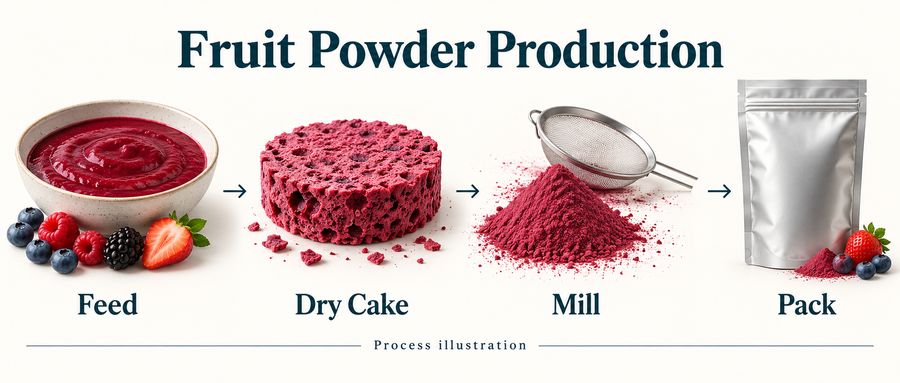
Can juice or puree become freeze-dried powder? Suitable formulations can be frozen and dried into a cake or sheet, then milled. Producing a dry cake is only the first result. The process must also recover usable powder, keep it usable during handling and storage, and deliver the required performance in the customer’s food. The blackberry-juice study cited here demonstrates a possible route under its own formulation and laboratory conditions; it does not establish one recipe for every fruit. [1]
1. What must the powder do in the customer’s food?
Agree whether the ingredient should retain pulp and fibre, provide selected pieces for milling, or supply a clarified fraction. Then select the feed route. A sample that dries easily is not necessarily the ingredient the customer wants.
Fruit pieces, puree and juice carry different parts of the fruit through the process. They also create different preparation, separation and handling losses. Record which edible material belongs in the product before comparing trials.
| Feed route | Product decision | What to test |
|---|---|---|
| Fruit pieces, dried and milled | Retain the selected edible fruit material; define whether peel, seeds and fibre belong in the ingredient. | Dryness before milling, particle distribution, rejected fractions and texture in the application. |
| Puree, dried as a layer | Develop a repeatable puree composition and cake that can be recovered and milled. | Layer uniformity, tray release, milling behaviour, dispersion and sediment. |
| Clarified or formulated juice | Define the soluble fraction, clarification losses and any added carrier. | Cake integrity, recovered solids, handling stability and the agreed dissolution method. |
Decide whether a carrier-free trial answers the buyer’s requirement. Identify the actual fruit, feed form and intended use. Compare the proposed formulation with a clearly identified alternative, using consistent preparation and acceptance methods. Check cake release, usable powder recovery and food application together. Leave requirements that have not been tested unverified.
A carrier-assisted research result does not prove that a carrier is necessary for every juice. A failed household trial does not prove that commercial carrier-free production is impossible. Either conclusion needs evidence for the actual formulation and powder specification.
Use the liquid-food equipment guide for the broader sizing question. This article follows the ingredient from feed selection to usable powder. For preparation of fruit pieces, see the commercial fruit process guide; evaluate mango work with the mango-specific process review. A slice trial and a puree trial do not qualify the same powder route.
2. What is in the feed, and what will the carrier change?
Give the supplier the actual feed specification: fruit variety or source, pulping or clarification method, measured total solids, relevant soluble-solids readings and the complete formulation. State which inputs were measured and which remain assumptions.
Keep the total-solids result separate from a Brix reading. A balance that includes pulp or added ingredients cannot silently treat the Brix value as the total mass of dry material.
If a carrier is proposed, record its identity, grade, amount and denominator. “Carrier per incoming juice,” “carrier per formulated feed” and “carrier per total dry solids” describe different formulations. Check the resulting fruit-solids concentration, flavour, colour and compatibility with the customer’s ingredient specification.
In the blackberry-juice study, maltodextrin and a trehalose–maltodextrin mixture gave powders with different physical and functional behaviour. The freeze-dried and spray-dried feeds also used different carrier proportions. Their results therefore cannot isolate the effect of drying method alone. [1]
Adding carrier adds dry material, not fruit solids. A successful carrier level for one juice does not establish a recipe for lemon juice, another cultivar or a different puree. Qualify the actual formulation rather than transferring a published percentage.
3. How much usable powder does the mass balance describe?
Write down what “yield” measures before comparing a result. Powder per kilogram of prepared fruit, recovery of formulated dry solids and recovery through a mill are different quantities. Put the numerator, denominator, moisture basis and process boundary beside each figure.
For whole-fruit intake, first account for peel, stones, seeds and discarded preparation material. The prepared fruit feed in the example below begins after those losses. Keep native fruit dry solids, added carrier and water separate.
Total input dry solids = fruit dry solids + added carrier dry solids
Potential powder mass = total input dry solids ÷ (1 − powder moisture fraction)
Dry-solids recovery = saleable powder × (1 − powder moisture fraction) ÷ total input dry solids
A Hypothetical Recovery Ledger
Assumptions only: 100 kg of prepared fruit feed contains 12% total solids. Add 3 kg of completely dry carrier. Assume no other inputs, powder at 3% moisture on a wet basis, and 90% recovery of the formulated dry solids into saleable powder. These values demonstrate the calculation; they are not a recipe, release limit or measured production result.
| Quantity | Calculation | Result |
|---|---|---|
| Native fruit dry solids | 100 × 0.12 | 12.00 kg |
| Total formulated dry solids | 12 + 3 | 15.00 kg |
| Potential powder, before solids losses | 15 ÷ 0.97 | 15.46 kg |
| Recovered saleable dry solids | 15 × 0.90 | 13.50 kg |
| Saleable powder at the assumed moisture | 13.5 ÷ 0.97 | 13.92 kg |
| Powder per prepared fruit-feed mass | 13.5 ÷ 0.97 ÷ 100 | 13.92% by mass |
| Fruit share of input dry solids | 12 ÷ 15 | 80.00% |
The 13.92 kg includes carrier and retained water. It is not 13.92 kg of fruit solids. The 80% input fruit-solids share is not a measured composition of every recovered fraction: selective losses could change the finished powder. Neither the recovery assumption nor this balance predicts drying time.
The example separates potential powder mass from the saleable powder actually recovered under the assumptions. More carrier can increase the reported powder mass without increasing recovered fruit solids. It cannot establish better physical recovery unless the dry-solids comparison also shows that result.
Keep a further balance for milling and sieving. Compare the saleable dry solids leaving those operations with the dry solids entering them. Record retained sieve material, fines, equipment residue, samples, spills, rejects and any controlled rework separately. A good cake-recovery figure must not conceal finishing or packing losses.
Use these results to identify the next missing measurement. The balance does not predict drying time, prove the composition of a fraction lost selectively, or guarantee commercial output.
4. Has the cake passed drying checks, and has the powder passed finishing checks?
Keep separate decisions for releasing the dried cake and releasing the finished powder. In the drying record, identify the formulation, batch load, representative sample positions, product-temperature history and validated endpoints. A brittle sample can help with screening; it does not establish uniform dryness throughout a commercial batch.
Before milling, weigh the recovered cake and state its moisture basis. Define the particle-size distribution and the customer’s measurement method. Then record milling, sieving and exposure conditions, together with the mass that each step accepts, retains or loses.
The blackberry study obtained freeze-dried powder by mechanically pulverizing the dried cake and identified pulverization conditions as a factor in its morphology. That shows why finishing belongs in the evaluation; the laboratory preparation is not an industrial mill specification. [1]
Decide which fractions can be sold, which may enter controlled rework and which must be rejected. Track the time and exposure between unloading, milling, sampling and sealing. Test the proposed handling sequence rather than judging the process from the cake alone.
Drying itself involves coupled heat and mass transfer, so a formulation’s mass balance is not a universal cycle. The food-powder engineering chapter supports that process reasoning without supplying one setting for all fruits. For the general process context, use the temperature and pressure guide and the pre-freezing requirements guide.
5. At which stage does the powder begin to change?
Retain a sealed reference at the drying endpoint. Compare it with samples after milling and sieving, after the actual packing sequence, and after a handling challenge that represents the customer’s use. Use consistent sampling and measurement methods so that the first changed comparison gives a useful place to investigate.
Check moisture and water activity at the relevant stages. Record handling temperature, humidity, exposure duration, package barrier and seal condition. Powder that flows immediately after grinding still needs evaluation in the proposed hopper, during shipping or after opening. Recheck flow and food application performance after that exposure.
| Comparison | Record and next question |
|---|---|
| Drying-endpoint reference | Lot, sample position, sealing time, moisture basis, water-activity measurement conditions and observed cake condition. Does the reference meet the agreed endpoint? |
| After milling and sieving | Finishing setup, sample timing, exposure, recovered fractions and the same powder checks. Is the first difference associated with finishing? |
| After the actual packing sequence | Exposure conditions and duration, pack and seal identity, then the same physical and application checks. Does the difference appear before or after sealing? |
| After the agreed handling challenge | Test the actual pack and relevant hopper, transport or opening conditions. Record accepted, rejected or inconclusive, plus the next controlled comparison. |
An observed change identifies where to investigate next; it does not identify a unique cause by itself. Consider sampling variation, measurement conditions, formulation, heat, moisture exposure and mechanical handling before assigning a cause.
The tested freeze-dried blackberry formulations had a narrower humidity range for remaining glassy than the tested spray-dried formulations. Separate Carabao mango work linked moisture sorption, glass transition and microstructure. These are reasons to test the actual formulation’s physical stability; neither study supplies a universal room-humidity, water-activity or glass-transition margin. [1] [2]
Qualify the actual pack and seal as part of that route. Use the food packaging guide for the wider packaging context. A package specification or storage period must follow the product and handling evidence; this comparison record does not supply a universal package or shelf life.
6. Will the powder work in the intended beverage or bakery process?
Agree the preparation method and acceptance criteria before making pilot samples. Name the comparator and test both products under the customer’s intended conditions. Record the observation against the criterion, then decide whether the result is accepted, rejected or still inconclusive.
Judge wetting, dispersion and dissolution separately. Milling changes particle size; it does not remove insoluble fibre or make every fruit constituent dissolve. A puree powder that retains fibre should not be promised to produce a clear drink. Solubility measured under controlled laboratory mixing does not prove instant dissolution in the customer’s process.
| Acceptance item | Agree the method | Decision supported |
|---|---|---|
| Moisture and water activity | Sample location, method, temperature where relevant, and timing after handling. | Whether drying and finishing meet the product-specific release specification. |
| Particle distribution and flow | Sieve or instrument method; hopper, dosing or blending conditions. | Whether the powder can be transferred and dosed consistently. |
| Reconstitution | Powder-to-water ratio, water temperature, mixing energy, time and sediment observation. | Whether the intended drink, puree or dispersion performs acceptably. |
| Colour, aroma and ingredient performance | Compare at the customer’s actual inclusion rate and application conditions. | Whether a technically dry powder delivers the required food quality. |
| Caking and package performance | Proposed pack, seal, storage and handling challenge; reassessment after exposure. | Whether the delivered ingredient remains usable through the specified period. |
| Composition and food safety | Declared formula, agreed composition checks, and the manufacturer’s validated food-safety controls. | Whether the ingredient meets the buyer’s specification beyond physical dryness. |
For a beverage trial, record the powder and water or other base, their ratio, temperature, mixing method and time, and the interval before observation. Assess wetting, dispersion, sediment or required clarity, flavour and colour separately. Identify the comparator’s preparation and observation conditions as well.
For a bakery trial, record the base formulation, actual powder inclusion, any water adjustment, mixing and baking conditions, and when the finished food is assessed. Compare distribution, texture, flavour and colour in that food. The appearance of dry powder cannot answer those application questions.
For each trial, retain the agreed criterion, observed result and decision. Name the missing checks and the next trial when evidence is insufficient. Mark an unperformed test unverified rather than treating an attractive sample as acceptance.
Application performance does not establish microbiological safety, nutrient retention or the claimed shelf life. The manufacturer needs validated food-safety controls and the agreed composition checks; nutrient-retention and shelf-life claims require their own empirical validation. Physical dryness alone does not establish those results.
7. What does each supplier include, and what has actually been demonstrated?
Send each supplier the same feed, formulation, ingredient use and acceptance requirements. Ask who supplies and qualifies freezing, tray loading, cake removal, milling, sieving and packing. Record the handover between suppliers so that an excluded operation does not disappear from the project.
Separate measured trial results from calculations and estimates. For a capacity claim, identify the accepted output per completed batch and the full turnaround. State whether freezing, finishing, cleaning or packing time has been left out. A dry-cake result and an accepted packed-powder result are different output boundaries.
| Record | Evidence to identify | Status to state |
|---|---|---|
| Prepared feed | Material lot and form; mass; total-solids method and result; carrier identity, quantity and denominator. | Measured, assumed or unknown; attach the relevant sample or report. |
| Equipment boundary | Who supplies and qualifies freezing, tray loading, cake removal, milling, sieving and packing. | Included, excluded or awaiting confirmation for each step. |
| Claimed duty | Feed formulation, loading basis, complete turnaround and the stage at which output was weighed. | Demonstrated trial, calculation or supplier estimate; keep these distinct. |
| Acceptance responsibility | Required ingredient use, test method, agreed criterion and party responsible for verification. | Verified, rejected or untested; identify the missing evidence. |
Compare offers only after their recovery and capacity figures use the same basis. If a denominator, loss fraction or test condition is missing, ask for it before treating a higher figure as better. A blank field is a question to resolve, not evidence that the supplier has demonstrated the duty.
| Comparison field | Record for each offer or trial |
|---|---|
| Mass and composition basis | Prepared-feed mass; native fruit and added-carrier dry solids; stated powder-moisture method and wet/dry basis. |
| Recovery boundary | Numerator and denominator; dry cake or accepted packed powder; retained sieve material, residue, samples, rejects and rework identified separately. |
| Capacity boundary | Accepted output per completed batch and full turnaround; identify excluded freezing, finishing, cleaning or packing time. |
| Strength of evidence | Actual lot, formulation and conditions; measured result versus assumption; unperformed application or storage checks. |
The recovery ledger is a hypothetical example, not a guaranteed yield or equipment capacity. An input fruit-solids share is not a measurement of the recovered powder’s fruit fraction when selective losses are unknown. Capacity and ingredient-quality conclusions remain conditional on the actual formulation, complete process boundary and trial results.
What can the published studies support?
Use the studies to decide what needs checking, and retain the material and test conditions beside the finding. The records in this guide translate those bounded findings into questions for the project; they are not reported commercial trial results.
| Source | Useful finding | Boundary |
|---|---|---|
| Blackberry juice powder study [1] | Carrier matrix, drying route and finishing influence powder properties. | Specific laboratory formulations; different carrier proportions confound a simple drying-method comparison. |
| Carabao mango powder study [2] | Moisture sorption and physical state matter to powder stability. | One mango material and experimental system; no transferable commercial shelf-life or humidity guarantee. |
| Food-powder engineering chapter [3] | Freeze-drying involves coupled heat and mass transfer. | Supports process reasoning; does not provide one cycle for every fruit formulation. |
Record a fruit-powder sample evaluation
Keep formulation, recovered mass and application testing together. A good-looking cake alone does not answer whether the recovered powder is suitable for the intended ingredient use.
- Feed and formulation
- Fruit/material lot; juice or puree; measured solids basis; carrier identity and denominator
- Mass ledger
- Feed and added dry material; recovered cake; milling/sieving losses; test method and moisture basis
- Finishing and exposure
- Milling/sieving setup; time and conditions before packing; package and lot identity
- Application test
- Intended use; preparation/mixing method; specified measures; agreed acceptance criteria
- Disposition
- Observed result; unperformed checks; accepted/rejected/inconclusive decision and next trial
Blank entries remain unverified. The sheet supplies no universal carrier ratio, storage limit, nutrient-retention claim or commercial yield.
Copy the completed notes into the message field on the project enquiry page. Information entered here is not submitted or stored by this worksheet.
Prepare the information for an equipment discussion
Complete the notes above with the raw juice or puree specification, measured solids, carrier constraints, daily feed throughput, target powder output, intended food use and proposed pack. Identify assumptions and missing evidence so the next discussion can focus on the trial and equipment questions that remain.
The engineering discussion can then focus on missing pilot evidence, water-removal duty, finishing requirements and the acceptance tests needed before equipment sizing. Capacity and product-quality conclusions remain conditional on the actual formulation and trial results.
Frequently asked questions
Can fruit juice be freeze-dried without a carrier?
Test the actual juice and target ingredient. Check cake release, usable powder recovery, caking and the intended food application together. Carrier-assisted research and failed household trials cannot establish the answer for every juice.
Will milling make freeze-dried fruit instantly soluble?
No. Specify the required wetting, dispersion, sediment or dissolution result and test it using the intended preparation method. Smaller particles do not remove insoluble fibre or establish instant dissolution.
Does maltodextrin improve fruit-powder yield?
It adds dry solids, so the powder-mass result can rise without an increase in recovered fruit solids. Measure any improvement in physical recovery separately, using a stated dry-solids denominator and the same process boundary.
How should lemon juice powder be assessed?
Characterize the actual juice, test the formulation and finishing route, then qualify its food application. Freeze-dried lemon-slice data do not validate juice-powder behaviour, drying cycles, solids recovery or rehydration.
Can one moisture specification prevent every caking problem?
No universal value follows from these studies. Test the actual formulation, moisture and water activity, handling exposure, storage conditions, package and food use. A final moisture result by itself is not that complete qualification.
References
- Franceschinis L, Salvatori DM, Sosa N, Schebor C. Physical and Functional Properties of Blackberry Freeze- and Spray-Dried Powders. Drying Technology. 2014;32(2):197–207. DOI: 10.1080/07373937.2013.814664.
- Caparino OA, Sablani SS, Tang J, Syamaladevi RM, Nindo CI. Water Sorption, Glass Transition, and Microstructures of Refractance Window– and Freeze-Dried Mango (Philippine “Carabao” Var.) Powder. Drying Technology. 2013;31(16):1969–1978. DOI: 10.1080/07373937.2013.805143.
- Ratti C. Freeze drying for food powder production. In: Handbook of Food Powders. 2013. DOI: 10.1533/9780857098672.1.57.
About the Author: Zheng Wei
Freeze-Drying System Engineer
Zheng Wei participates in food freeze-drying projects at Fuzhou Xing Shun Da Refrigeration Facility Project Co., Ltd., including pilot testing, equipment selection, vacuum-system configuration, refrigeration planning and process optimization.