
Food freeze-drying engineering
Pre-Freezing Before Freeze Drying: Requirements for Food Production
Define a frozen-load release standard before selecting a freezer, transferring trays or committing to daily production output.
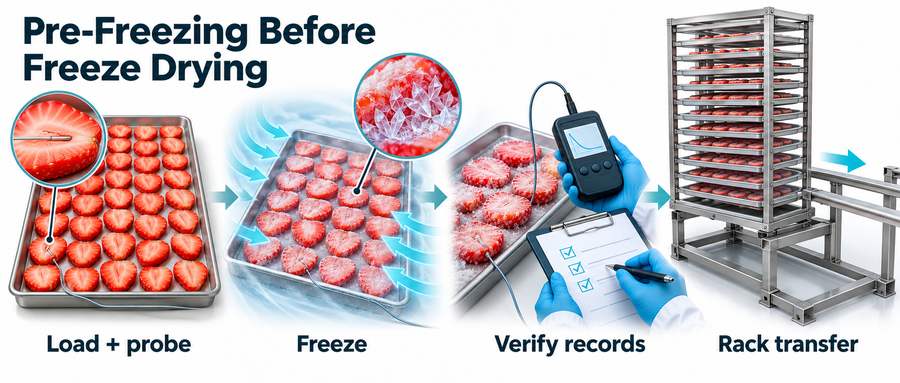
Freeze dryer pre-freezing requirements should be defined for the actual food, formulation and tray load. For conventional freeze drying of water-containing foods, the product must reach a suitable frozen state before ice-sublimation drying. A separate external freezer is optional when the selected dryer can perform the required freezing stage. Qualify representative product temperatures, the freezing method, holding and transfer conditions; freezer-air temperature or a hard-looking surface alone does not establish readiness.[1][3]
This guide helps food processors define that handoff specification. It focuses on verification requirements before drying starts, while linked equipment and facility guides address the broader production line.
Is external pre-freezing required before freeze drying?
The freezing step and a separate pre-freezer are different decisions. A dryer designed to freeze the loaded food can carry out freezing in its chamber. An industrial workflow may instead freeze prepared trays elsewhere, hold them frozen and load the dryer when it becomes available. Neither arrangement removes the need to qualify the food condition before drying.[1][3][4]
The purchasing evaluation must determine which arrangement aligns with product trials and the commercial production schedule. Buyers should confirm actual equipment capabilities and the supply boundary, rather than assume that every quoted freeze dryer includes an integrated product-freezing system.
Use the complete food freeze-drying equipment guide to compare line configurations. The criteria below define how a prepared load qualifies for the next processing stage.
Scope: this guide concerns conventional ice-sublimation drying of water-containing foods. It is not a recipe for expanding low-moisture candy, and it does not authorize skipping a machine’s required freezing or equilibration steps.
What temperature should food reach before freeze drying?
There is no single pre-freezing temperature or overnight duration that qualifies every food. Composition and frozen structure matter. Solutes concentrate as ice forms, and concentrated formulations can have thermal behavior that differs from intact plant tissue. Being below the freezing point of pure water does not prove that a food load is suitable for the intended drying process.[1][3]
An effective engineering specification identifies what parameters are measured and how data will be evaluated. It should clearly distinguish freezer operating conditions from the objective evidence needed to release the product.
| Measurement | What it helps assess | What it cannot establish alone |
|---|---|---|
| Freezer air or cooling-surface temperature | The cooling environment and its operating trend. | The condition at the warmest representative product location. |
| Representative product-centre temperatures | Whether the selected product locations reach and maintain the qualified condition. | Every tray position, unless the locations and loading pattern have been justified. |
| Product-specific thermal characterization | Relevant transitions and formulation behavior when selecting test conditions. | A complete industrial recipe without loading, equipment and product-quality trials. |
Record all selected measurement locations, probe arrangements and tray loading patterns in the trial history. If product dimensions or fill geometry change, verify whether original test evidence remains representative of the new load.
The food freeze-drying temperature and pressure guide explains the broader control relationship. This pre-freezing specification should establish a product-specific endpoint, rather than treating cold-storage temperatures as a universal drying release rule.
Is faster freezing always better for freeze drying?
No single freezing rate is best for every final product. Freezing influences ice-crystal formation and the structure left after sublimation. The plant-food review by Bhatta and colleagues connects freezing conditions with subsequent drying and product structure. That relationship is a reason to test the required texture and rehydration, rather than optimize freezing time in isolation.[1]
Malik and colleagues studied concentrated coffee and gum-arabic systems. Changing the freezing history altered pore structure and reconstitution behavior, while formulation also changed the response. This supports a product-specific trial; it does not provide a universal temperature program for fruit slices, meat, dairy snacks or a production-scale dryer.[2]
Identify the finished quality attributes customers evaluate before comparing freezing methods. A snack intended to retain structural shape and a powder engineered for rapid dissolution have fundamentally different acceptance criteria.
- Define the saleable form: intact pieces, porous blocks, flakes or a powder feedstock.
- Compare the same formulation, geometry and loading basis.
- Review freezing time together with drying behavior, handling loss and final-product quality.
- Carry the tested freezing method into the proposed production workflow, or qualify the change.
What should a pre-freezing release checklist include?
The following framework translates a general freezing instruction into a reviewable production requirement. Plant engineering and operations teams should complete each parameter using data from actual product trials.
| Item | Record before the trial | Evidence needed before release |
|---|---|---|
| Food and formulation | Product identity, ingredients, pretreatment and relevant solids or moisture basis. | The production load matches the qualified formulation and preparation. |
| Geometry and tray load | Cut size or fill depth, net tray weight, arrangement and rack positions. | The tested loading pattern represents the intended batch, including difficult locations. |
| Freezing method | Equipment, operating program, initial food condition and the proposed freezing sequence. | A record of the actual method used, including deviations from the trial plan. |
| Product endpoint and hold | Qualified product-temperature criterion, representative probe locations and any required hold. | The selected product locations meet the agreed criterion; visual hardness is supporting observation only. |
| Frozen holding | Allowed holding conditions, lot identification and handling sequence. | Storage history remains within the qualified process boundary. |
| Transfer to the dryer | Actual route, handling method, loading sequence and condition to verify on arrival. | The product remains acceptable at the handoff, rather than only when it leaves the freezer. |
| Deviation and release | Who reviews missing data, a temperature excursion or changed loading. | A documented decision before drying starts; an alarm or incomplete record is not silently accepted. |
The tray and cart guide addresses physical handling compatibility. The monitoring guide covers the wider batch record; ensure freezing and transfer records remain integrated with that documentation.
How should pre-freezing capacity match the dryer schedule?
Separate freezing can release chamber occupancy without automatically shortening the drying stage. Compare the time each resource is occupied, and then check whether the upstream freezer can consistently deliver the next qualified load.
Hypothetical example: assume a prepared wet load of 500 kg, freezing time of 6 h, drying time of 12 h and dryer turnaround of 2 h. These are invented planning inputs, not measured equipment performance. Assume the drying stage and turnaround are unchanged between arrangements.
| Arrangement | Dryer occupancy per batch | Theoretical average wet-load rate |
|---|---|---|
| Freezing, drying and turnaround use the same chamber sequentially. | 6 h + 12 h + 2 h = 20 h | 500 kg × 24 h/day ÷ 20 h = 600 kg/day |
| A separate freezer prepares each load before the dryer becomes available. | 12 h + 2 h = 14 h | 500 kg × 24 h/day ÷ 14 h ≈ 857 kg/day |
These rates are arithmetic upper bounds based only on chamber occupancy over a repeating schedule. They are not a guarantee of complete batches in each calendar day. The external freezer must deliver a qualified 500 kg load at each required handoff, with its own loading, freezing, unloading and defrost constraints included.
Real output also depends on product preparation, cooling conditions, frozen holding, maintenance, available shifts, packaging and quality release. External freezing adds equipment and energy demand; this example does not establish an energy or cost saving.
For the broader throughput calculation, use the batch freeze-dryer capacity guide. A supplier should state both the freezing basis and the full drying/turnaround basis in a comparable proposal.
How should frozen holding and transfer be checked?
Freezing trial data is most reliable when it replicates the intended factory handling route. Qualification should include every handling step between freezer discharge and dryer loading, rather than ending evaluation at the freezer door.
Do not assign a universal transfer-time allowance. Qualify the actual food, tray geometry, room conditions, route and loading sequence. Record the product condition at the relevant handoff and define how warming or an interrupted transfer will be reviewed. A load that leaves the freezer within its criterion may require reassessment after exposure during handling.
Maintain hygienic separation and lot identification through the route. Freezing and freeze drying must not be assumed to provide a validated pathogen kill step. Required pretreatment and sanitation controls belong to the food process, independently of whether the load appears frozen.[5]
The food freeze-drying facility guide addresses overall plant layout considerations. The freeze-drying food-safety guide explains the boundaries of microbial control.
What evidence should a pilot and acceptance test provide?
Request pilot results that can be evaluated directly alongside the proposed commercial production method. An attractive dried sample leaves critical purchasing questions unanswered if its freezing history and tray-loading parameters are missing.
- Define the input: the actual formulation, product form, initial condition and tray/rack arrangement.
- Record the freezing history: identify the equipment, representative product locations, endpoint criterion and any hold or transfer.
- Check the dried result: use agreed final-moisture or other release tests, appearance, handling and application-specific rehydration or dissolution.
- Review repeatability: compare representative loads and explain differences between the trial and proposed production scale.
- Agree the supply boundary: name the freezing equipment, holding, transfer, controls and acceptance evidence included in the proposal.
The food pilot-testing guide details scale-up data requirements, while the FAT and SAT guide covers broader equipment acceptance. This pre-freezing checklist should serve as an integral part of that qualification work.
Complete a frozen-load release record
A release record should identify the qualified criterion, where the product was checked and who reviewed any deviation. Complete it from the actual trial and handling route.
- Load identity
- Food/formulation, lot, geometry, tray arrangement and freezing method
- Qualified criterion
- Product endpoint and hold criterion; supporting trial reference; measurement method
- Measurement record
- Representative locations, sensor identification, observed values and time; retain original record
- Transfer check
- Freezer departure and dryer arrival; actual route; product-condition check and deviations
- Release decision
- Reviewer, accepted/held/rejected disposition, missing evidence and action before drying
This blank record does not validate a temperature, transfer duration, food-safety process or production capacity.
Copy the completed notes into the message field on the project enquiry page. Information entered here is not submitted or stored by this worksheet.
Prepare a pre-freezing and dryer-capacity review
For a food-production project, send the food and formulation, prepared wet kg per batch and per day, cut size or fill depth, existing freezing equipment, available product-temperature records, transfer route, required finished form and factory utilities.
These inputs support a review of the freezing/dryer coordination assumptions and the product trial needed before equipment selection. They do not establish a guaranteed cycle or output without verification.
FAQ about freeze dryer pre-freezing requirements
Does every freeze dryer need an external freezer?
No. Some systems perform product freezing in the chamber; other workflows use external freezing. Confirm the selected equipment’s actual functions and qualify the product condition before drying. External pre-freezing and the required freezing stage are different decisions.
Is −18°C enough before freeze drying?
It is not a universal release criterion. The required condition depends on the food, formulation, geometry and drying process. A storage-temperature label does not replace representative product measurements and an agreed trial basis.
Is 24 hours of pre-freezing always enough?
No fixed duration qualifies every load. The initial condition, product dimensions, tray arrangement and freezer performance can change the result. Use the qualified product endpoint and hold requirement, rather than time alone.
Does a hard surface prove the whole load is ready?
No. Visual hardness does not establish the condition at the warmest representative product locations. Use a justified loading pattern, appropriate product measurements and the agreed release criteria.
Does external pre-freezing reduce drying time?
It can move freezing outside the dryer’s occupancy schedule. That alone does not prove the drying stage becomes shorter. Compare the freezing history and dried-product result, then calculate the full line schedule.
Is the fastest freezing method always the best?
No. Freezing affects structure, and the required dried-product texture or reconstitution matters. Compare methods using the same formulation and acceptance criteria; do not select a freezing rate from a different food’s recipe.
Can a pilot use a different freezing method from production?
It can be useful for exploration, but the difference must be reviewed before scale-up. Qualification should establish whether the production freezing and transfer method delivers an equivalent acceptable input to drying.
References and evidence scope
- Bhatta S, Stevanovic Janezic T, Ratti C. Freeze-Drying of Plant-Based Foods. Foods. 2020;9(1):87. DOI: 10.3390/foods9010087. A plant-food review; its reported conditions are not universal production recipes.
- Malik N, Gouseti O, Bakalis S. Effect of freezing on microstructure and reconstitution of freeze-dried high solid hydrocolloid-based systems. Food Hydrocolloids. 2018;83:473–484. DOI: 10.1016/j.foodhyd.2018.05.008. Concentrated coffee and gum-arabic systems; findings are used qualitatively within that scope.
- Labconco. A Guide to Freeze Drying for the Laboratory. Technical guide, prefreezing section. Background principles for laboratory applications, rather than an industrial food recipe.
- Barley J. Basic Principles Of Freeze-Drying. SP Scientific Products. Technical note. General equipment and freezing-process context.
- Utah State University Extension. Can I Freeze-Dry That? A Practical Guide to Safe and Effective Freeze-Drying. 23 January 2026. Food-safety guidance. Used for the microbial-control and sanitation reminder.
The release checklist is an engineering planning framework, and the schedule is an explicitly hypothetical calculation. Neither is presented as a measured customer result, a validated food process or a regulatory approval.
About the Author: Zheng Wei
Founder & Freeze-Drying System Engineer
Fuzhou Xing Shun Da Refrigeration Facility Project Co., Ltd.
Zheng Wei participates in food freeze-drying trials, equipment selection, vacuum-system configuration, refrigeration planning, installation guidance, process optimization, and project handover. The project experience covers fruit, vegetables, cooked foods, seafood, meat, dairy products, herbs, and extracts.