
Types of Freeze Dryers for Food Manufacturing: A Buyer’s Guide
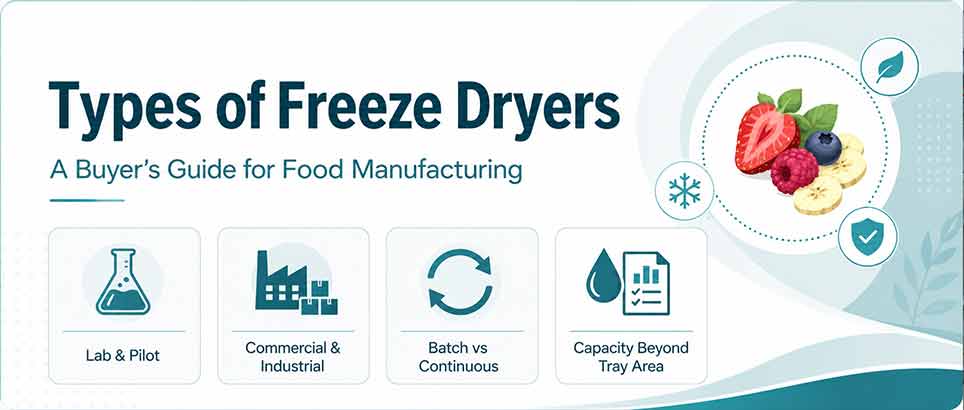
Food manufacturers use “types of freeze dryers” in more than one sense: laboratory, pilot, commercial and industrial describe a project stage; batch or continuous describes operating mode; and heating terms describe part of the process design.
The Main Types of Freeze Dryers for Food Projects: Project Stage
These labels are practical roles, not universal kilogram ranges. A supplier should state the tested product, loading method and cycle basis behind any capacity figure.
| Type | Primary job | What the buyer should learn | Next page |
|---|---|---|---|
| Laboratory | Product feasibility and early formulation work | Whether the product can dry acceptably, and which variables need development. | Lab and pilot equipment |
| Pilot | Representative trials before production investment | Loading method, thickness, product temperature behaviour, endpoint checks and a realistic cycle basis. | Food R&D and pilot testing |
| Commercial | Repeatable small-to-medium food batches | Saleable output per shift, changeovers, labour flow, condenser load and operating cost inputs. | Commercial selection guide |
| Industrial | Factory-scale throughput and plant integration | Water-removal path, utilities, loading logistics, maintenance access and validation at the intended load. | Industrial freeze dryers |
A laboratory result is not automatically a factory recipe. In food freeze-drying, differences between laboratory and commercial geometry and heat transfer can change product temperature; dry-layer resistance also increases as the dry layer becomes thicker.[1] Treat pilot work as the bridge that tests the production-relevant loading and control logic.


A Different Classification: Batch, Continuous and Heating Design
Batch systems
Best assessed when multiple foods, formats or recipe changes are expected. A complete load enters, dries and leaves as one planned batch. The key question is whether drying, unloading, defrost and reload time meet the daily schedule.
Continuous concepts
Worth evaluating only where feed, product format and process are highly standardised. They add mechanical and process-integration complexity; “continuous” is not automatically the better food-production choice.
Contact/shelf, radiant, microwave or infrared-assisted heating are not alternative scale labels. They describe how energy reaches the frozen product. In a standard food project, ask how temperature uniformity is verified under a representative loaded batch. More specialised assisted approaches require separate product trials; they should not be treated as a blanket upgrade.
For workflow and turnaround rather than equipment classification, see the batch freeze dryer guide and defrost-between-batches guide.
What about tray, manifold and rotary freeze dryers?
Some suppliers and technical sources use terms such as tray, manifold and rotary freeze dryers. These describe equipment configuration or the way product is presented to the drying system, not the same classification as laboratory, pilot, commercial and industrial scale. For food manufacturers, the important point is to avoid comparing different classification systems as though they were competing machine sizes.
Why Tray Area Alone Does Not Tell You Food Freeze Dryer Capacity
Tray area describes available loading surface. It does not independently establish kilograms per batch, kilograms per day or cycle time. Published plant-food studies show that product structure, composition and operating conditions can materially affect freeze-drying behaviour and final product quality.[2]
- Define wet product load and loading thickness.
- Estimate water to remove from initial moisture and the agreed final-moisture specification.
- Check the expected peak vapour load against the condenser and vapour path.
- Check heat-transfer control, vacuum behaviour and product-temperature monitoring under load.
- Use drying, defrost and turnaround time to test the daily production target.
removable water ≈ initial water in the wet load − water remaining in finished product
For example, a hypothetical 1,000 kg wet load at 80% initial moisture contains 800 kg of water and 200 kg dry solids. At 2% final moisture (wet basis), the finished mass is about 204 kg, leaving about 4 kg water; the preliminary removable-water estimate is therefore about 796 kg. This is a calculation example, not a recommended load for any machine.
Six Inputs to Prepare Before Requesting a Quote
A useful quotation begins with the product and production target, not a preferred model name.
- Product format and any representative sample or product specification.
- Wet material per batch and required saleable output per day.
- Initial moisture or solids, plus the final-moisture target and how it will be verified.
- Loading thickness, tray depth and intended loading method.
- Available operating hours, shifts, product changes and desired batches per day.
- Site utilities, installation constraints and required cleaning/defrost workflow.
Those inputs let a supplier return a traceable capacity basis instead of an area-only comparison. This page explains how freeze dryer types are classified; the detailed commercial buying decision belongs in the commercial food freeze dryer selection guide, while installation scope belongs in the commercial freeze dryer setup guide.
Get a Capacity-Basis Review for Your Food Project
Send the product type, wet load, initial moisture or solids, loading thickness, target batches per day and available utilities. The engineering team can use these inputs to review the preliminary water load, appropriate equipment range and the key capacity assumptions required before a formal quotation.
Frequently Asked Questions
What are the main types of freeze dryers?
For a food project, the most useful types of freeze dryers are laboratory, pilot, commercial and industrial roles. Then separately compare batch versus continuous workflow and the relevant heating/control design.
What is the difference between a commercial and industrial freeze dryer?
There is no single worldwide kilogram boundary. Commercial equipment is selected for repeatable business batches; industrial projects add factory throughput, utility integration, material flow and full-load verification.
Is a pilot freeze dryer necessary before buying production equipment?
Not in every case, but it is valuable when product behaviour, loading, cycle basis or quality endpoint has not been verified at a representative scale. A pilot programme should generate usable production inputs, not just a successful sample.
How should a food company compare capacity claims?
Ask for the product, initial moisture or solids, wet loading density, thickness, target endpoint, cycle and defrost assumptions behind the claim. Then compare water removal, condenser behaviour, heat transfer and schedule together.

Zheng Wei
Freeze-Drying Systems Engineer
Works on food freeze-drying equipment selection, process scale-up, condenser and vacuum-system matching, and commercial-to-industrial project planning. Learn more about the engineering team.