
Food Freeze-Drying Engineering Note
Sublimation Freeze Drying: What Controls the Primary Drying Rate?
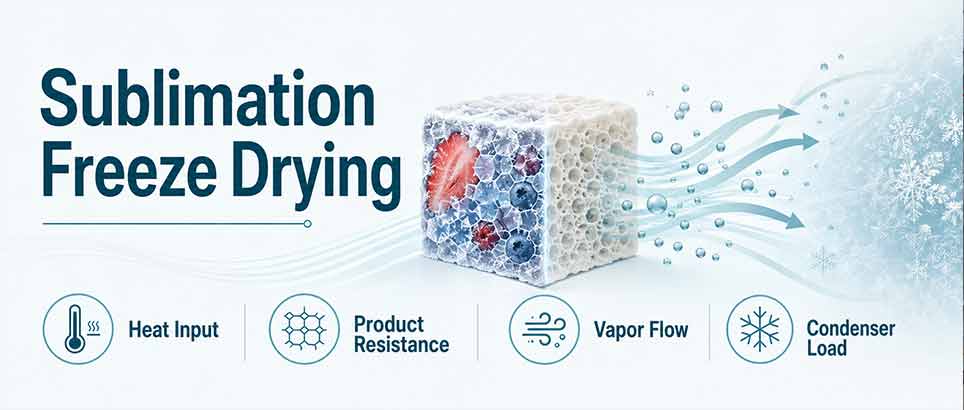
Sublimation freeze drying is the primary-drying stage in which frozen water leaves food as vapor. For a food producer, the useful question is not simply whether the chamber reaches a deep vacuum. It is whether heat can reach the frozen product, vapor can pass through the product and system, and the condenser can capture that vapor within a repeatable cycle.
Use this page to make one decision: compare a freeze dryer by removable water, loaded-cycle evidence and product limits—not by tray area or an empty-chamber vacuum figure alone.
What Sublimation Freeze Drying Means During Primary Drying
IUPAC defines sublimation as a direct solid-to-vapor transition. In a conventional food freeze-drying cycle, it is the main way ice is removed during primary drying. The later secondary-drying stage removes more strongly bound water; it is not the same process.
A food freeze-drying review describes the moving sublimation interface and the porous dry layer it leaves behind: heat must reach the interface, while water vapor must move through the dried layer.[1] This is why “more vacuum” is not a complete explanation for drying rate.
For the phase-diagram foundation, see the triple-point guide. For the broader equipment and vapor-flow sequence, see how freeze drying works.
What Actually Limits the Rate
During primary drying, performance is governed by one connected path:
controlled heat input→ ice sublimation→ vapor through the dry layer→ vapor path and condenser capture
Heat reaches the product
Ice needs energy to sublime. Insufficient heat can make a batch slow; excessive heat can take a food beyond its product-specific stability limit. Shelf or heating-medium temperature is therefore not a substitute for measured product response.
The product creates resistance
As the dry layer grows, vapor travels farther through a porous product. Thickness, fill depth, composition, freezing history and geometry can change that resistance. Plant-food research also shows that product composition and structure can materially change freeze-drying behavior, so one cycle or loading density cannot be assumed for every food.[2]
Pressure supports a process window
Pressure interacts with heat and mass transfer; it is not a universal speed dial. It should be selected and validated together with product temperature, drying progress and vapor load. The temperature-and-pressure guide covers that control question in more detail.
The system removes vapor
Once vapor leaves the food, it still has to cross the chamber and reach the condenser. A restriction in the vapor route, ice distribution, refrigeration margin or pressure control can limit a loaded batch. The condenser is therefore part of the process path, not an isolated accessory.
In commercial sublimation freeze drying, these limits must be evaluated as one heat- and mass-transfer system. Improving one part does not guarantee a shorter cycle if another part becomes the bottleneck.
Why Tray Area Is Not Production Capacity
Tray area tells a buyer how much product can be spread at a stated loading density. It does not establish how much water the complete machine can remove from the intended food in the required time. Two machines with the same nominal area can behave differently when water load, product thickness and vapor load rise.
A more useful sizing sequence is:
- Define the wet batch and initial moisture or solids.
- Calculate the water that must be removed to the target endpoint.
- Set a representative loading depth, geometry and product distribution.
- Review the peak vapor load, vapor route and condenser behavior under load.
- Confirm the loaded cycle with product temperature, chamber pressure, condenser data and endpoint verification.
This page deliberately does not publish a universal kg/m2, condenser-temperature or drying-time figure. Those values depend on food formulation, geometry, process window and machine configuration. For the broader procurement checklist, see freeze-dryer specifications.
Use Observations to Find the Bottleneck
| What you observe | Working hypothesis | What to review |
|---|---|---|
| Drying is slow while the product remains well below its process limit. | Available heat transfer may be limiting. | Heating strategy, tray contact, loading depth and temperature distribution. |
| Pressure response changes sharply when heat input rises. | Vapor removal may be limiting. | Condenser loading, refrigeration behavior, vapor route and control response. |
| Edges dry while the center remains wet. | Product resistance or non-uniform loading may be limiting. | Slice thickness, fill depth, tray loading and freezing consistency. |
| A batch slows late in primary drying. | The dry-layer path or changing condenser condition may matter. | Product profile, ice accumulation, pressure trend and endpoint method. |
These are diagnostic starting points, not universal failure rules. They should be reviewed together with the product, sensor position and actual system design.
Questions That Make a Supplier Discussion Useful
- For the intended wet batch and product geometry, how much water must the system capture per cycle?
- Which loaded-cycle data will be recorded: product temperature, chamber pressure, condenser condition and endpoint result?
- What evidence shows pressure stability and condenser behavior at the expected vapor load?
- Which assumptions in the quotation depend on moisture, solids, fill depth or required batches per day?
- How will a representative trial or factory acceptance test confirm the agreed process basis?
For timing and endpoint planning, use the separate freeze-drying time chart. For condenser-specific due diligence, use the freeze-dryer condenser guide.
Request a Product-Specific Water-Load Review
A useful preliminary review starts with the product type, wet batch size, initial moisture or solids, loading thickness or fill depth, target final moisture and required batches per day. The engineering review can then identify the quotation inputs that should be validated: removable water, loading basis, proposed cycle assumptions and the FAT evidence to request.
Request a preliminary sizing reviewFAQ
Is sublimation the same as freeze drying?
No. Sublimation is the primary-drying mechanism. A full freeze-drying cycle also includes freezing and secondary drying.
Does lower pressure always make a batch faster?
No. Once heat transfer, product resistance or vapor removal becomes limiting, lowering pressure alone may not shorten the validated cycle.
What data should be used to compare freeze dryers?
Compare product-specific removable water, loading geometry, loaded-cycle records, pressure and condenser behavior, endpoint evidence, and the agreed acceptance-test basis.
References
- Duan X, Yang X, Ren G, Pang Y, Liu L, Liu Y. Technical aspects in freeze-drying of foods. Drying Technology. 2016;34(11):1271-1285. https://doi.org/10.1080/07373937.2015.1099545
- Bhatta S, Stevanovic Janezic T, Ratti C. Freeze-Drying of Plant-Based Foods. Foods. 2020;9(1):87. https://doi.org/10.3390/foods9010087
Technical Review
Zheng Wei is a freeze-drying systems engineer focused on food freeze-dryer design, refrigeration, vacuum systems, process matching and commercial production scale-up.