
Freeze Drying Facility Planning for Food Production
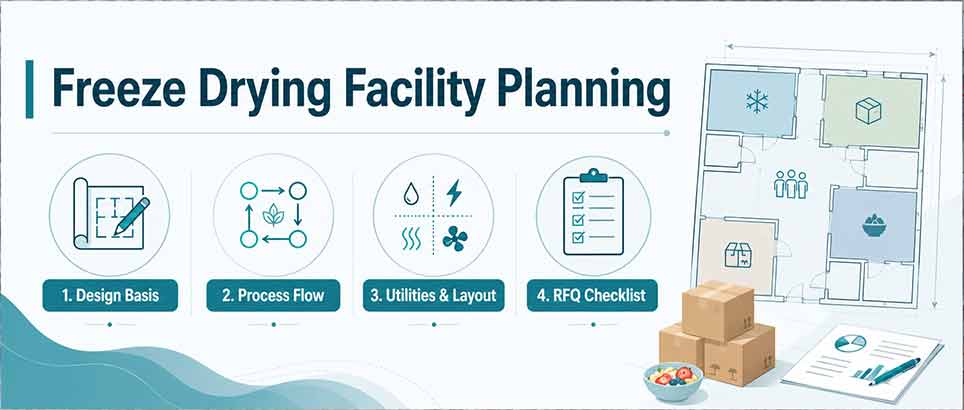
A freeze drying facility succeeds when product preparation, pre-freezing, drying, unloading, testing and packaging work at the same production rate. This guide helps food manufacturers turn a sales forecast and a product idea into a practical design basis before they request equipment quotations.
A freeze drying facility is a food-processing site that integrates product preparation, freezing, freeze-drying, unloading, quality control, packaging and the utilities required to support commercial production.
Use it to prepare an early project brief, compare supplier proposals and identify missing site data. It is not a substitute for a local food-safety plan, structural design, utility design or final equipment specification.
Define the Freeze Drying Facility Design Basis
Begin with the product and required output. Do not begin with tray area, external machine dimensions or an assumed cycle time. For a given food, resistance to vapor flow increases as the dry layer develops. Equipment geometry and heat transfer also change during scale-up.[1] Therefore, equal shelf areas do not guarantee equal daily throughput.
| Buyer input | Question it answers | Required project output |
|---|---|---|
| Product, recipe, piece size or liquid depth | What must be frozen and how far must heat and vapor travel? | Test load, tray format and product-specific risks |
| Prepared wet mass per day and production shifts | What full-line throughput is required? | Batch size, number of dryers and schedule assumptions |
| Initial solids or moisture and target finished specification | How much water must the condenser capture? | Transparent mass balance and water-removal basis |
| Validated drying time plus loading and turnaround time | How many complete batches fit in the operating plan? | Daily capacity range with stated assumptions |
| Texture, colour, rehydration, moisture and water-activity targets | What defines an acceptable batch? | Pilot protocol and release-test plan |
Ask suppliers to separate confirmed inputs from estimates. If a figure comes from another food, it should be labelled as a reference rather than a production guarantee. Detailed machine sizing belongs in the commercial freeze dryer selection guide.
Need a Preliminary Facility Capacity Review?
- Product and daily prepared wet mass
- Moisture or solids and piece thickness
- Finished-product target and shift plan
- Destination country and available site data
- Preliminary batch and water-load assumptions
- Likely upstream and downstream bottlenecks
- Utility and layout questions still to answer
- Pilot-test inputs needed before final selection

Map Product, People and Waste Flow Before the Layout
Blast-Freezing Integration
Plan the blast-freezing room and blast-freezer air cooler as upstream project systems with clear interfaces before freeze-dryer loading.


A food facility layout should follow the real process and its hazard analysis. Map raw materials, exposed dried product, people, packaging, cleaning tools and waste separately. The goal is to reduce backtracking and prevent raw or dirty movement from crossing the post-drying route.

The route is product-specific. Meat, seafood, ready meals and allergen-containing recipes may require different separation and sanitation controls from fruit or botanical ingredients. The Codex General Principles of Food Hygiene recommend a hazard-based approach to facility design, hygienic practices and HACCP. For projects in India, FSSAI also requires a documented food-safety management system and compliance with the applicable parts of Schedule 4.

Size the Entire Line, Not Only the Freeze Dryer
A nominal dryer batch is not daily saleable output. Preparation, freezing, loading, drying, defrosting, cleaning, testing and packaging must all support the same schedule. Research on food freeze-drying monitoring also shows that a fixed recipe does not guarantee identical conditions; endpoint behaviour can change with the cycle, load and product.[2]
| Process stage | Evidence to request | Typical planning failure |
|---|---|---|
| Preparation | Hourly washed, cut, cooked or filled output | Freeze dryer waits for product |
| Pre-freezing | Time, temperature history, batch mass and holding capacity | Frozen stock cannot support the loading schedule |
| Freeze drying | Wet load, water removed, full cycle and endpoint method | Brochure area is mistaken for proven throughput |
| Turnaround | Unload, pressure release, defrost, clean and reload time | Drying time is mistaken for the full cycle |
| Packaging | Pack rate per completed batch and maximum exposure time | Dried food waits in ambient humidity |
| Quality release | Sampling plan, test duration and hold procedure | Finished goods accumulate without release status |
Pre-freezing is not just a scheduling step. In a study of high-solids coffee and hydrocolloid systems, freezing conditions changed the pore structure and reconstitution behaviour of the dried product.[3] The exact result was formulation-specific, but the planning lesson is useful: match pre-freezing capacity and control to the product trial, not only to kilograms per hour.
Use the separate freeze-drying time and endpoint guide for cycle evidence, and the freeze-dried food packaging guide for barrier and line-planning details.
Confirm Utilities, Access and Service Space
Equipment Room Layout
Coordinate equipment-room service access and track-frame interfaces with the adjacent blast-freezing room in the approved facility layout.


Freeze-dryer selection and building design must exchange data before either is finalized. Give the supplier actual site conditions, and require a utility schedule that states normal load, peak load, connection points and operating assumptions.
Power and controls
Confirm voltage, frequency, phase, available capacity, protection requirements, control-panel location and any batch-data connection.
Cooling and heat rejection
Define ambient design conditions, cooling-water availability and where refrigeration heat will be rejected.
Heating and defrost
State the proposed heating source, defrost method, water route and drainage capacity. Do not add drains after the final equipment position is fixed.
Building and maintenance access
Check equipment weight, floor loading, door and lifting routes, chamber-door movement, trolley paths and service clearance for major components.
Ask for a dimensioned general-arrangement drawing, equipment loads, connection schedule and maintenance envelope before civil work is released. The commercial freeze dryer setup guide covers the installation details that this facility-level page intentionally does not repeat.


Build Food-Safety and Batch-Release Controls Into the Project
Do not describe ordinary food freeze-drying as a validated microbial kill step. A peer-reviewed study deliberately used freeze-drying to preserve viable probiotic bacteria; with suitable protectants, substantial viability remained after drying and storage.[4] This was not a pathogen challenge study, but it supports a conservative facility rule: raw-material controls, any required lethality step, hygienic design and finished-product verification must be planned separately.
- Raw-material approval, receiving limits and traceability
- Validated control steps where the hazard analysis requires them
- Hygienic zoning, sanitation verification and allergen controls
- Batch identity, recipe version, alarms and deviation handling
- Product temperature, pressure and endpoint records
- Finished moisture and water-activity specifications where applicable
- Packaging seal, barrier and storage-condition verification
- Release, hold, rework and rejection procedures
Indian food businesses should review the current FSSAI hygiene and Schedule 4 requirements. Other markets require their own regulatory review. Equipment acceptance checks are covered separately in the food freeze dryer validation guide.
Make Pilot Data Usable for Scale-Up
A useful pilot report records more than “the batch dried.” It should preserve the product condition, equipment scale, loading, time definition, endpoint method and quality result so another engineer can judge whether the data are transferable.
| Record | Why it matters during scale-up |
|---|---|
| Recipe, solids, pretreatment, piece size or liquid depth | Defines the product tested and prevents false comparisons |
| Freezing method, product temperature and hold condition | Links pre-freezing to structure and drying behaviour |
| Usable area, wet load per tray and total water load | Allows the batch to be compared with production equipment |
| Shelf/product temperature, pressure trend and cycle segments | Shows how the process was controlled |
| Endpoint test, moisture, water activity and quality checks | Defines what “finished” means |
| Yield, reject observations, turnaround and packaging delay | Connects the trial to saleable daily output |
Keep the trial record with the proposal assumptions. For batch data, sensor limits and alarm records, use the freeze dryer monitoring guide.
Freeze Drying Facility RFQ Checklist
A comparable quotation should show what the buyer supplied, what the vendor assumed and what remains subject to testing or site verification.
| Buyer provides | Supplier should return |
|---|---|
| Product brief, prepared wet mass, solids or moisture, geometry and finished specification | Capacity basis, mass balance, assumed loading and test gaps |
| Shift plan, production days and growth scenario | Batch schedule, number of units, turnaround assumptions and expansion option |
| Building plan, entry route, floor data and utility conditions | General arrangement, equipment loads, utility schedule and service envelope |
| Applicable market, food category and quality requirements | Material, hygienic-design, records and acceptance-test scope |
| Pilot or comparable product evidence | Transfer assumptions, remaining validation work and excluded guarantees |
| Commercial boundary and requested support | Inclusions, exclusions, commissioning, training, documentation and spare-parts scope |
Turn Your Product Data Into a Facility Discussion
Send the product, daily prepared wet mass, initial solids or moisture, piece thickness or liquid depth, target finished specification, operating schedule, destination country, utilities and available floor plan. The discussion can then focus on capacity assumptions, line boundaries, site questions and the pilot evidence required before final equipment selection.
Frequently Asked Questions
How much space does a food freeze drying facility need?
There is no universal area per kilogram of product. Space depends on preparation, pre-freezing, dryer count, trolley movement, utility equipment, hygienic separation, packaging, storage and maintenance access. Request a dimensioned layout only after the process flow and capacity basis are defined.
Can tray area be used to compare facility capacity?
Tray area is one input, not a daily-output guarantee. Compare wet load, water removed, product thickness, full cycle, condenser load, turnaround and finished-product acceptance criteria.
Does the facility need separate pre-freezing equipment?
It depends on the dryer and process. If products are frozen outside the dryer, pre-freezing capacity and frozen holding must support the loading schedule. The freezing method should also match the product trial because it can affect structure and quality.
Does freeze-drying make food microbiologically safe?
Do not assume so. Freeze-drying is a low-temperature dehydration process, not automatically a validated lethality treatment. Use a product-specific hazard analysis, required control steps, hygienic handling and finished-product verification.
What should be completed before requesting a final quotation?
Complete a product brief, daily-output target, preliminary mass balance, pilot-data review, full-line flow, site utility survey, building-access check and applicable food-safety requirements. Mark all untested values as assumptions.
Research References
- Ratti C. Freeze drying for food powder production. In: Bhandari B, Bansal N, Zhang M, Schuck P, editors. Handbook of Food Powders: Processes and Properties. Woodhead Publishing; 2013:57–84. https://doi.org/10.1533/9780857098672.1.57
- Pisano R, Barresi AA, Fissore D. Innovation in Monitoring Food Freeze Drying. Drying Technology. 2011;29(16):1920–1931. https://doi.org/10.1080/07373937.2011.596299
- Malik N, Gouseti O, Bakalis S. Effect of freezing on microstructure and reconstitution of freeze-dried high solid hydrocolloid-based systems. Food Hydrocolloids. 2018;83:473–484. https://doi.org/10.1016/j.foodhyd.2018.05.008
- Reddy KBPK, Awasthi SP, Madhu AN, Prapulla SG. Role of Cryoprotectants on the Viability and Functional Properties of Probiotic Lactic Acid Bacteria during Freeze Drying. Food Biotechnology. 2009;23(3):243–265. https://doi.org/10.1080/08905430903106811
Official food-safety resources
- FAO and WHO. General Principles of Food Hygiene (CXC 1-1969). Codex Alimentarius; 2023. https://doi.org/10.4060/cc6125en
- Food Safety and Standards Authority of India. Hygiene requirements and Schedule 4 resources.
Technical Review and Commercial Disclosure
Technical reviewer: Zheng Wei
Founder & Freeze-Drying System Engineer, Fuzhou Xing Shun Da Refrigeration Facility Project Co., Ltd.
Review scope: product inputs, preliminary capacity logic, facility interfaces, utility questions and equipment-proposal requirements. See the company profile and project references.
Good Freeze Dryer is the publishing website for Fuzhou Xing Shun Da Refrigeration Facility Project Co., Ltd. The company supplies freeze-drying equipment and project support. Final food-safety controls, building design, structural approval, utilities and regulatory compliance must be confirmed by the buyer’s qualified local professionals. Project-specific capacity and quality outcomes require product testing and an agreed acceptance basis.
Last technical and evidence review: 19 July 2026.