
Food Factory Sourcing & Due-Diligence Guide
Freeze Dryer China: 12 Checks Before You Buy
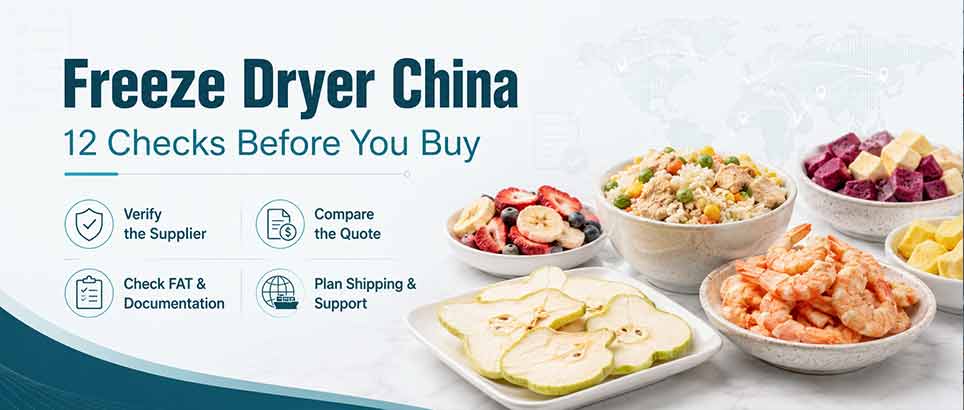
Buyers using the search phrase “freeze dryer China” will encounter home appliances, laboratory units, pharmaceutical lyophilizers and industrial food systems. Before a food factory compares prices, it should verify what is being offered, which company will deliver it and how performance will be accepted. This guide turns those questions into a practical pre-order checklist.
This checklist reflects the manufacturer’s experience with pilot, commercial and industrial food freeze-drying projects involving fruit, cooked meals, meat, seafood and food extracts in multiple export markets.
Quick answer
Buying a food freeze dryer from China can be practical when the supplier can connect the legal seller to a real factory, size the system from product data, normalize the complete project scope and pass a written factory acceptance test. Country of origin and a low quotation do not prove value. The useful evidence is a tested product basis, traceable configuration, comparable food cases, controlled drawings, clear payment milestones and support through commissioning.
An existing quotation scope can be submitted for review, or the buyer can provide the product, prepared wet load, dimensions, moisture basis, destination and available utilities. The engineering review can identify missing scope, unclear capacity assumptions and FAT questions before the project proceeds.
Is Buying a Freeze Dryer from China a Good Fit?
China sourcing is not automatically low-risk or high-risk. It is a project route with particular advantages and responsibilities. It may fit when the buyer wants a food-focused commercial or industrial system, can provide product samples and has engineering support for utilities, rigging and installation. A local route may fit better when same-day field service, local certification ownership or a turnkey local contractor is mandatory.
China sourcing may fit when
- The product can be tested before final model selection.
- The factory can review drawings, utilities and responsibility boundaries.
- The contract can define configuration, documentation, FAT and corrective work.
- The buyer can manage freight, customs, local labor and commissioning.
A local route may fit better when
- Immediate local field response is a production requirement.
- The buyer has no qualified installation or maintenance resource.
- A local integrator must own permits, conformity work or the complete line.
- The project cannot manage international logistics or cross-border remedies.
A credible supplier should discuss both sides. “Suitable for every food and every country” is a warning, not reassurance.
First Identify What “China Freeze Dryer” Means
The search phrase covers unrelated equipment. Classify the project before comparing suppliers.
| Equipment class | Typical purpose | Decision that matters | Use this guide? |
|---|---|---|---|
| Home appliance | Household preservation | Convenience, local warranty and consumables | No |
| Food pilot freeze dryer | Product trials and scale-up data | Representative controls, loading and repeatability | Yes, before larger investment |
| Pharmaceutical lyophilizer | Sterile or regulated products | GMP design, qualification and product-specific compliance | Different project basis |
| Commercial food freeze dryer | Established small-to-medium production | Usable area, water removal, cycle, energy and labor | Yes |
| Industrial food freeze dryer | Factory-scale production | System integration, utilities, logistics and uptime | Yes |
Do not compare a laboratory listing with a food production system because both use the word “freeze dryer.” Their condenser load, vacuum package, heating method, controls, installation scope and acceptance evidence are not equivalent.
Food Freeze Dryer Options Available from the Manufacturer
The equipment range should be matched to project stage and required daily wet-material capacity. The table below provides a routing guide rather than replacing product tests or a detailed capacity calculation.
| Project stage | Available models | Typical use | Next step |
|---|---|---|---|
| Pilot testing and product development | SDG60 / SDG90 | Sample testing, recipe development and scale-up evidence | Review pilot freeze dryers |
| Commercial food production | SDG350 / SDG700 / SDG1100 | Established small-to-medium food production | Review commercial freeze dryers |
| Industrial food production | SDG1600 / SDG3000 / SDG6000 | Factory-scale production and higher daily wet-material capacity | Review industrial freeze dryers |
Model selection should still be based on the buyer’s product, initial moisture, product dimensions, loading density, water removed, full cycle time, utilities and required daily throughput.
Prepare an RFQ That Can Produce a Defensible Design
“How much is a 500 kg freeze dryer?” is not enough. The number could mean raw material, prepared wet load, nominal batch load, dried product or daily output. Each interpretation changes the design.
Why product details belong in the RFQ
A food freeze-drying review found that loading amount, product thickness, freezing, chamber pressure and heating temperature can change drying time and product quality; the suitable values depend on the food and equipment.[1] For buyers, the implication is simple: a supplier should state its assumptions instead of converting tray count into a universal kilogram claim.
Verify the Legal Seller, Factory and Engineering Role
This page focuses on China-specific due diligence. For a broader comparison of system design and manufacturer capability, use the industrial freeze dryer manufacturer evaluation guide.
A Chinese freeze dryer supplier should be able to connect the legal seller, manufacturing site, engineering team and bank beneficiary through verifiable records. Company registration, certificates and factory images are inputs, not a complete conclusion; they must connect to the entity that will receive payment and accept technical responsibility.


How to Compare a Freeze Dryer China Quotation
Normalize every quote to the same product duty and delivery boundary. A low machine price can hide excluded refrigeration, vacuum components, cooling equipment, controls, packing, freight, installation or travel.
| Comparison line | Ask the supplier to state | Why it changes the decision |
|---|---|---|
| Capacity basis | Product, dimensions, wet load, moisture, endpoint and full cycle | Prevents unlike kilogram claims |
| Usable process area | Net loaded area, tray dimensions, spacing and cart arrangement | Separates usable area from nominal chamber size |
| Water removal | Water per batch, peak sublimation assumption, condenser capture and defrost | Exposes a common system bottleneck |
| Vacuum and refrigeration | Pump set, gauges, valves, refrigerant, compressor arrangement and loaded test | Shows whether subsystems match the duty |
| Controls and records | Recipes, trends, alarms, permissions, export format and program backup | Supports repeatability and troubleshooting |
| Project scope | Auxiliaries, packing, Incoterm, freight, duties, local labor, travel and commissioning | Builds a comparable landed project cost |
| Documentation | Approved drawings, manuals, BOM, certificates, FAT report and packing list | Turns promises into deliverables |
State the agreed Incoterms® rule and named place in the contract. An Incoterm allocates delivery tasks and risk; it does not replace a technical scope, payment schedule or warranty.
Do Not Approve Capacity from kg per Batch Alone
Capacity should be reconstructed from prepared wet load, initial water, usable area, loading density, product geometry, water removed, full cycle time, defrost, unloading, cleaning and planned operating hours.
Freeze drying is a coupled heat- and mass-transfer process. Ratti explains that resistance to vapor flow increases as the dry layer grows, while laboratory and commercial equipment differ in geometry, shelf contact and radiant heat transfer.[2] This means a successful pilot recipe is valuable evidence, but it is not a one-step guarantee of identical commercial performance.
Ask for this calculation trail
Prepared wet load → initial water → water removed → net loaded area → loading density → assumed loaded cycle → turnaround time → batches per day. Require the supplier to identify measured inputs, calculated values and safety margins. The proposed basis should then be tested with the buyer’s product.
Use the freeze dryer specification guide to compare the resulting configuration, and the commercial freeze dryer price guide to separate machine price from project cost.
Write the Factory Acceptance Test Before the Order
A FAT should define the starting condition, instruments, method, duration, limits, records, witness process and corrective action. “The machine became cold and reached vacuum” is not an acceptance standard.
Match the test to the equipment scale
Where a full product-loaded FAT is practical, the protocol should define the product, load and endpoint. When a full production load cannot be reproduced at the manufacturer’s factory, the parties should agree a representative load test, followed by product-specific SAT and first-batch acceptance at the customer’s site.
Why time alone is a weak endpoint
Research on tray freeze drying shows that endpoint monitoring must account for product form, loading conditions and heat transfer, including radiant heat from the upper shelf.[3] The paper evaluates a specialized pressure-rise method; it does not require every factory to use that method. The buyer takeaway is to agree a product-appropriate endpoint—such as final moisture, center dryness, mass stability and batch consistency—rather than accepting elapsed time alone.
Use the detailed food freeze dryer FAT and SAT guide and the monitoring and batch-record guide when writing the protocol.

Link the Contract and Payments to Evidence
Technical due diligence loses value if the contract contains only a model name and price. Attach the approved specification, responsibility matrix, drawing list, FAT protocol, documentation list and spare-parts schedule.
- Use payment milestones tied to agreed deliverables, not calendar dates alone.
- Define who approves drawings and what happens when a change affects cost or schedule.
- State whether shipment requires FAT acceptance or an agreed deviation plan.
- Define warranty start, exclusions, remote support, travel costs and replacement-part terms.
- Record the governing contract language, dispute route and bank beneficiary.
Commercial warning
Do not treat a marketplace badge, generic “CE” image or chat promise as project acceptance evidence. Verify the applicable destination requirements and put the agreed documents and responsibilities into the contract.
Plan Export, Shipping and Site Work Before FAT
Large systems may ship in several packages or containers. Approve package dimensions, weights, lifting points, preservation, reassembly work and the delivery route before dispatch.
| Work area | Typical buyer responsibility | Typical supplier responsibility |
|---|---|---|
| Site and structure | Foundation, openings, permits and structural checks | Loads, layout and service clearances |
| Utilities | Compliant power, water, steam and drainage to agreed points | Utility schedule and machine-side connections |
| Unloading and rigging | Local riggers, crane or forklift, access and permits | Package data, lifting points and agreed supervision |
| Installation | Local labor and licensed trades unless included | Instructions, drawings, supervision and checks as contracted |
| Commissioning | Ready utilities, staff, product and safe work area | Functional tests, loaded-run guidance and records |
Review the commercial freeze dryer setup guide for layout and utility questions. For EU projects, check the European Union’s official CE-marking guidance. U.S. importers can start with U.S. Customs and Border Protection. Final legal and conformity obligations are destination- and project-specific.


Convert “Lifetime Support” into Deliverables
Cross-border service should specify channels, records, access and cost. Confirm whether the project includes drawing review, installation supervision, vacuum and refrigeration commissioning, loaded testing, operator training and signed handover.
Training and handover
- Safe start-up, shutdown and isolation
- Recipe selection and controlled changes
- Loading, freezing and endpoint checks
- Vacuum pump, condenser and cleaning routines
- Alarm response, trend export and backups
Spares and diagnostics
- Start-up spares and a two-year recommended list
- Part numbers for seals, sensors, valves and pump items
- PLC/HMI backup and restore responsibility
- Remote-access method, authorization and cybersecurity boundary
- Escalation path for refrigeration, vacuum and controls faults
Ask who pays for travel, visas, local transport, accommodation, labor and replacement freight. These details determine whether “included support” is usable after delivery.
Final 12-Check Buyer Scorecard
If several items remain “to be discussed,” the order is not technically ready. Resolve the gaps before comparing the final price.
Comparable Food Project Records
The following are manufacturer project records, not independent laboratory results or universal guarantees. They are useful because they connect product form, system size, loading and endpoint. A new project still requires its own test basis.
Pear slices: United States
- System: SDG3000, 100 m²
- Product: 8 mm pear slices
- Loading: 12 kg/m²
- Drying time: 12 hours
- Final moisture: 2.21%
Prepared rice: India
- System: SDG350, 10 m²
- Product: cooked fried rice
- Loading: 12.5 kg/m²
- Drying time: 6 hours
- Final moisture: 1.28%
Shrimp: India
- System: SDG6000, 200 m²
- Product: prepared shrimp
- Loading: 11.6 kg/m²
- Drying time: 8 hours
- Final moisture: 1.68%

Freeze Dryer China FAQ
How much does a freeze dryer from China cost?
Price depends on usable area, product duty, condenser and refrigeration design, vacuum configuration, controls and delivery scope. Compare the machine, auxiliaries, testing, packing, freight, installation, training and spares on the same basis. A marketplace price is not a landed project cost.
Should samples be tested before ordering?
Yes, especially for a new food or a scale-up project. Testing should document product dimensions, loading density, recipe, cycle, final moisture, center dryness, texture and rehydration. The supplier should explain how pilot data will be translated to the proposed scale.
Can a Chinese supplier install the machine overseas?
It depends on the contract and destination. Support may include supervision, commissioning, loaded testing and training, while the buyer provides utilities, unloading equipment, local labor, permits and safe access. Put every responsibility and cost in writing.
What certificates should a food freeze dryer have?
There is no single certificate for every country and project. Identify the applicable machinery, electrical, pressure, food-contact, workplace-safety and import requirements. Verify the document issuer, scope and model, then assign responsibility in the contract.
What is the most important FAT item?
No single item is sufficient. The FAT should connect system tests to a controlled loaded run and signed records. For the product run, agree the material, dimensions, load, recipe and endpoint before testing.
Request a China Sourcing Project Review
Send the product, prepared wet load, dimensions, initial moisture, target final moisture, daily output, destination country and available utilities. The engineering review can identify the preliminary equipment category, water-removal basis, utility questions, FAT priorities and missing quotation scope before the buyer approves a supplier.
Technical review
Zheng Wei, Founder & Freeze-Drying System Engineer
Fuzhou Xing Shun Da Refrigeration Facility Project Co., Ltd.
The review scope covers product testing, model selection, vacuum and refrigeration configuration, installation planning and food drying-process optimization. See the company’s manufacturing and project evidence.
Disclosure: the company manufactures and sells food freeze dryers. Project examples are company records and should be verified for relevance to each buyer’s product and acceptance plan.
References
- Liu Y, Zhang Z, Hu L. High efficient freeze-drying technology in food industry. Critical Reviews in Food Science and Nutrition. 2022;62(12):3370–3388. High Efficient Freeze-Drying Technology in Food Industry — DOI: 10.1080/10408398.2020.1865261
- Ratti C. Freeze drying for food powder production. In: Handbook of Food Powders: Processes and Properties. Woodhead Publishing; 2013:57–84. Freeze Drying for Food Powder Production — DOI: 10.1533/9780857098672.1.57
- Pisano R, Barresi AA, Fissore D. Innovation in Monitoring Food Freeze Drying. Drying Technology. 2011;29(16):1920–1931. Innovation in Monitoring Food Freeze Drying — DOI: 10.1080/07373937.2011.596299
Official cross-border resources
- International Chamber of Commerce. Incoterms® rules.
- European Union. Official CE-marking guidance.
- U.S. Customs and Border Protection. Basic importing and exporting.