
Batch Freeze Dryer Capacity: How to Convert kg/Batch to kg/Day
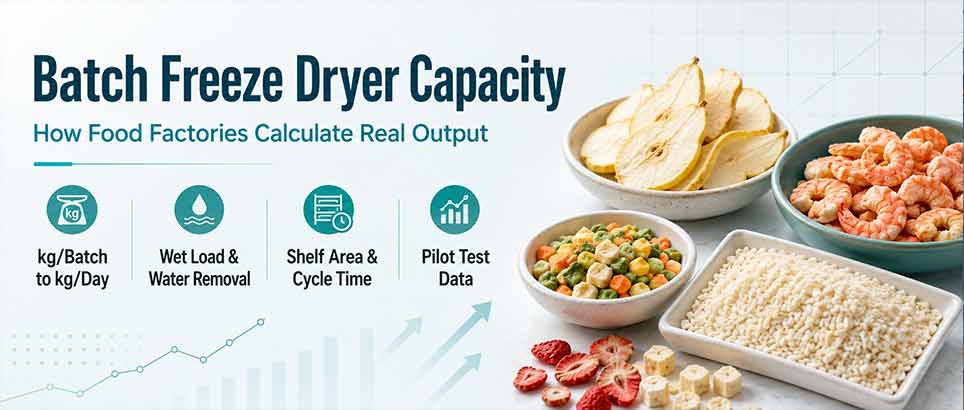
Food factories should calculate batch freeze dryer capacity from prepared wet load, water removal, usable shelf area, full cycle time, condenser duty, defrosting and pilot-test evidence.
For a food manufacturer, the buying question is not simply, “How many trays does the machine have?” The better question is, “How many kilograms of prepared product can the complete system dry to the required endpoint, and how many saleable batches can the factory finish per day?”
Need to turn a daily output target into a supplier brief? Use the kg/day worked example and prepare the batch-sizing data checklist before requesting a calculation.
Technical review: Zheng Wei, Founder & Freeze-Drying System Engineer, Fuzhou Xing Shun Da Refrigeration Facility Project Co., Ltd. | Updated .
Quick Answer: How Is Batch Freeze Dryer Capacity Calculated?
Real batch freeze dryer capacity starts with the prepared wet load. The calculation must then confirm usable shelf area, practical loading density, kilograms of water removed, drying time, unloading and cleaning time, defrosting strategy, condenser capacity and expected factory utilization.
Required shelf area = Wet material per batch / Practical loading density
Water removed = Wet material – Final product weight
Daily wet capacity = Wet load per batch x 24 / Full batch turnaround time x Utilization factor
Tray area alone cannot confirm output. A batch system may physically hold more material at the start, yet finish fewer kilograms per day if the product layer becomes too thick, vapor movement is restricted, the condenser is overloaded, or defrosting and handling time are ignored.
What Does Batch Freeze Dryer Capacity Mean?
A batch freeze dryer processes a defined product load through freezing, vacuum drying, pressure recovery, unloading and preparation for the next cycle. For capacity planning, the useful figure is not tray count alone. It is the quantity of prepared wet material that reaches the required endpoint within a repeatable full turnaround time.
What One Complete Batch Includes
- Product preparation and tray loading
- Pre-freezing or in-chamber freezing
- Vacuum build-down and primary drying
- Secondary drying to the required endpoint
- Pressure recovery and unloading
- Condenser defrosting, cleaning and preparation for the next load


Batch operation suits food factories that process several recipes, need traceable lots or require flexible scheduling. Continuous systems are more relevant to highly standardized, very high-volume production. The detailed equipment-type comparison belongs in the industrial food freeze dryer selection guide; this page remains focused on converting kg/batch into practical kg/day.
Four Different Meanings of Freeze Dryer Capacity
Capacity quotations often look similar while describing different measurements. Before comparing equipment, separate the following values.
1. Wet Material per Batch
This is the weight of prepared material loaded before drying. It is the clearest starting point for production planning because it matches raw material purchasing and daily factory input.
2. Usable Shelf or Tray Area
Area shows available loading surface. Real output still depends on loading density, product thickness, shelf contact, vapor path and uniform heating.
3. Water Removal per Batch
This is the main load on the condenser and refrigeration system. Two products with the same wet weight may release very different quantities of water.
4. Wet Material per 24 Hours
This value combines batch load and cycle frequency. It should include realistic downtime rather than assuming that every hour is productive drying time.
A large capacity freeze dryer should be evaluated by all four measurements. A chamber may have enough shelf area for a heavy load, but an undersized condenser or restricted vapor path can make chamber pressure unstable and extend the drying cycle.


How to Calculate Batch Freeze Dryer Capacity
Define the Daily Wet Material Target
Start with prepared product entering the freeze dryer, not harvested weight or final dry product. Trimming, peeling, cooking, concentration and other preparation steps can change the actual load.
Confirm Initial Moisture or Solids
Fresh fruit, cooked rice, shrimp, milk, egg liquid and concentrated extracts cannot use the same water-removal assumption. A moisture test or reliable product specification improves the estimate.
Estimate a Practical Loading Density
Use project data only as an initial engineering reference. The documented rice, pear and shrimp projects fall around 11.6-12.5 kg/m², but published food studies show loading density can vary widely by product form, moisture, thickness and drying target. Liquids, powders, slices and whole pieces must be tested separately.
Estimate Drying Time from Product Data
Use comparable project records when available, then verify with product testing. Many prepared foods can fall in the 8-15 hour range, while thick pieces, high-sugar materials, extracts, whole fruit and temperature-sensitive products may need longer.
Add Every Non-Drying Hour
Daily output must include loading, vacuum build-down, pressure recovery, unloading, cleaning, condenser defrosting and quality checks. Ignoring these hours is one of the fastest ways to overestimate production capacity.

Apply a Utilization Factor
A 24-hour factory schedule still includes operator delays, sanitation, product changeover, maintenance and batch release. A realistic utilization factor makes the estimate more useful for purchasing decisions.
Worked Example: From 600 kg per Batch to Real Daily Output
The following example shows the calculation logic. It is not a guaranteed recipe for every product.
| Input | Example value | Purpose |
|---|---|---|
| Wet load | 600 kg/batch | Raw material entering the chamber |
| Initial moisture | 85% | Defines initial water and solids |
| Final moisture | 2% | Defines the finished endpoint |
| Loading density | 12 kg/m² | Defines required usable area |
| Drying time | 12 hours | Primary and secondary drying |
| Other turnaround | 1.5 hours | Loading, pressure recovery, unloading, cleaning and allocated defrost time |
| Utilization factor | 90% | Allows for real factory losses |
Step A: Calculate Dry Solids and Final Product
Dry solids = 600 kg x (1 – 0.85) = 90 kg
Final product weight = 90 kg / (1 – 0.02) = 91.84 kg
Water removed = 600 kg – 91.84 kg = 508.16 kg
Step B: Calculate Required Shelf Area
Required area = 600 kg / 12 kg/m² = 50 m²
Step C: Calculate Daily Throughput
Full turnaround time = 12 hours drying + 1.5 hours handling and allocated defrost time = 13.5 hours
Theoretical daily capacity = 600 x 24 / 13.5 = 1,066.7 kg/day
Practical daily capacity = 1,066.7 x 0.90 = 960 kg/day
Therefore, a nominal 600 kg batch does not reliably meet a 1,000 kg/day wet-material target under these assumptions. To reach 1,000 kg/day at 90% utilization and a 13.5-hour turnaround, the required batch load is about 625 kg, equal to roughly 52.1 m² at 12 kg/m².
Need the same calculation for a real product? Send the product moisture, thickness and daily wet input for an engineering estimate.
What a Product Test Should Confirm Before Purchase
Product form, thickness, loading density, pressure and shelf temperature can change drying time, energy use and final quality. Therefore, a useful pilot test should produce records that can support equipment sizing rather than only a visually acceptable sample.
- Prepared product dimensions and tray photos
- Tested loading density in kg/m²
- Product-temperature and chamber-pressure records
- Drying time and complete turnaround time
- Total water removed and condenser duty
- Final moisture and water activity when required
- Product appearance, texture and rehydration result
- Recommended packaging and storage conditions
A supplier that gives a batch-capacity figure without asking about moisture, thickness, endpoint or factory schedule has not yet produced a reliable production plan.

What Limits the Real Batch Size?
Product Form, Thickness and Moisture
Thicker pieces create a longer internal vapor path, while high-moisture products place a heavier load on the condenser. High-solids extracts may instead require a slower temperature profile. Consequently, one kg/m² rule cannot fit fruit slices, liquids, cooked meals and whole pieces.
Condenser Capture Capacity
The condenser must hold the total ice from one batch and capture vapor during peak primary drying. Final sizing should use product-test data, total water removed, expected peak vapor rate and the defrost plan. The freeze dryer condenser capacity guide explains these checks in more detail.

Vacuum and Vapor Conductance
The vacuum pump removes air and non-condensable gases, while the condenser captures most water vapor. A larger pump cannot correct restricted pipework, condenser overload or chamber leakage. See the vacuum pump sizing guide.
Heating Uniformity and Endpoint
Poor heat distribution can leave some trays wet while others become overdried. The production plan should verify product temperature, final moisture and, when required, water activity. Packaging must then maintain the selected endpoint during storage; the supporting FDA source appears in the technical references.
Pilot, Commercial or Industrial Batch Freeze Dryer?
After the kg/day requirement is calculated, the factory can match it to a pilot, commercial or industrial platform. The following figures describe typical prepared wet material per 24 hours, not final dried product weight.
| Production stage | Models | Typical wet material / 24h | Best use |
|---|---|---|---|
| Pilot / R&D | SDG60 / SDG90 | 60-80 kg / 90-120 kg | Product validation, process records and trial production |
| Commercial | SDG350 / SDG700 / SDG1100 | 340-450 kg / 680-900 kg / 1.02-1.36 t | Stable commercial batches and growing food sales |
| Industrial | SDG1600 / SDG3000 / SDG6000 | 1.2-2 t / 3-4 t / 6-8 t | Factory-scale output, steam-supported heating and line integration |
Pilot and production systems should use comparable heating, condenser, vacuum and data-recording principles so that test results can support scale-up. The final selection must still confirm utilities, layout, batch scheduling and production risk.
Real Batch Freeze-Drying Project Data
Documented product data is more useful than a brochure capacity claim. The following projects show how loading density, area, drying time and final moisture combine at different scales.
SDG350 Cooked Rice
Area: 10 m²
Batch load: 125 kg
Loading: 12.5 kg/m²
Drying time: 6 hours
Final moisture: 1.28%
This India project demonstrates a relatively fast prepared-food cycle when product structure and loading are suitable.
SDG3000 Pear Slices
Area: 100 m²
Batch load: 1,200 kg
Loading: 12 kg/m²
Drying time: 12 hours
Final moisture: 2.21%
This Oregon project shows a full industrial fruit batch with controlled slice thickness and documented production data.
SDG6000 Shrimp
Area: 200 m²
Batch load: 2,320 kg
Loading: 11.6 kg/m²
Drying time: 8 hours
Final moisture: 1.68%
This Kochi project demonstrates high industrial throughput for a prepared seafood product.
These records do not mean another product will use the same cycle. Instead, they show the evidence a supplier should provide: prepared product, usable area, kg/m², batch weight, drying time, endpoint and energy data where available.
How to Increase Output Without Overloading the Batch
Higher output does not always require more material on each tray. A factory can often improve kilograms per day by removing bottlenecks around the drying chamber.
- Standardize slice or piece thickness
- Control tray fill depth and loading density
- Improve pre-freezing consistency
- Confirm sufficient condenser capture capacity
- Reduce chamber leakage and pump-down time
- Improve heating uniformity
- Shorten unloading and cleaning steps
- Use a planned defrost schedule
- Consider external dual condensers for alternating defrost
- Use parallel machines when production continuity matters
Overloading can produce the opposite result. A very dense load may extend a normal process far beyond the planned cycle. Although the batch starts heavier, the factory may complete fewer cycles and may also increase moisture variation between trays.
Cost per Batch and Cost per Kilogram
Once real batch capacity is known, the factory can estimate operating cost. The main cost categories are electricity, steam where applicable, labor, packaging, maintenance, defrosting downtime and depreciation.
Total batch cost = Electricity + Steam + Labor + Packaging + Maintenance + Downtime + Depreciation
Cost per kg wet material = Total batch cost / Wet batch load
Cost per kg finished product = Total batch cost / Finished product weight
Cost per kg water removed = Total batch cost / Water removed
Cost per kilogram of water removed is useful when comparing different machine designs. Installed power alone does not show real consumption because refrigeration, heating, vacuum and condenser loads change during the cycle. The separate freeze-drying cost analysis explains the full calculation without turning this capacity guide into a duplicate cost article.
Seven Common Capacity-Selection Mistakes
- Comparing tray count instead of usable area. Tray dimensions and loading depth can differ significantly.
- Confusing wet load with dried output. High-moisture products may lose most of their starting weight.
- Ignoring total and peak water removal. The condenser must hold the batch ice load and capture vapor during primary drying.
- Using drying time as the complete cycle. Loading, pressure recovery, unloading, cleaning and defrosting reduce kg/day.
- Increasing kg/m² without retesting. A heavier batch may extend the cycle and create wet centers.
- Accepting empty-chamber data as production proof. Loaded pressure, temperature and endpoint records are more useful.
- Skipping utilities and startup support. Voltage, cooling water, steam, access, training and first-batch adjustment affect real output.
Information Required Before Selecting a Batch Freeze Dryer
A useful quotation should start with product and production data. Sending the following information allows the engineering team to estimate area, batch load, condenser duty and the appropriate equipment category.
- Product name and clear product photos
- Prepared product form and dimensions
- Daily wet material target
- Desired kg per batch, if known
- Initial moisture or solids content
- Target final moisture or water activity
- Expected slice or layer thickness
- Available production hours per day
- Factory voltage and frequency
- Steam and cooling-water availability
- Workshop size, access and drainage
- Destination country and project schedule
Request a Project-Based Batch Capacity Calculation
Send the prepared product, daily wet input, moisture, thickness and factory utility conditions. The engineering team can estimate usable shelf area, expected batch load, water removal, equipment category and the information that still requires pilot testing.
FAQ About Batch Freeze Dryer Capacity
What is a batch freeze dryer?
It processes a defined product load through freezing, vacuum drying, pressure recovery and unloading as one production lot.
How many kilograms can one batch process?
Capacity ranges from pilot quantities to several tons. The usable figure depends on prepared wet load, shelf area, loading density, moisture, cycle time and condenser capacity.
Is capacity based on wet or dried product?
Suppliers should state the basis clearly. Prepared wet material per batch or per 24 hours is normally the most useful value for factory planning.
How is kg/batch converted to kg/day?
Multiply wet load per batch by 24, divide by the full turnaround time and apply a realistic utilization factor. Include loading, unloading, cleaning and defrosting.
Does more shelf area always mean more output?
No. The condenser, heating system, vacuum path, product thickness and turnaround time must support the additional load.
How long does a food batch take?
Many prepared foods can fall within 8-15 hours under suitable conditions. Whole fruit, thick pieces, extracts and temperature-sensitive products may require longer testing.
What information is required for a quotation?
The supplier needs product form, dimensions, daily wet input, initial moisture, target endpoint, loading plan, utilities, factory space and destination.
Technical References
- U.S. FDA: Water Activity (aw) in Foods — background on water activity and storage stability.
- Peer-reviewed review of food freeze-drying process variables — discussion of product properties, freezing, pressure, temperature and process optimization.
External references support the general process principles. The capacity figures and case data in this article remain specific to the stated equipment and products.
Conclusion: Select Capacity from Product Data, Not Tray Count
Food factories should evaluate a batch freeze dryer as a complete water-removal system. Wet load, usable area, product thickness, total water, peak vapor rate, condenser performance, vacuum stability, heating uniformity and full turnaround time all influence real output.
Therefore, buyers should request calculations based on their own food rather than accepting a generic tray count or empty-chamber specification. Pilot records and comparable project data provide the strongest basis for choosing a commercial or industrial batch system.