
Freeze-Dried Coffee Process: Commercial Production and Scale-Up Guide
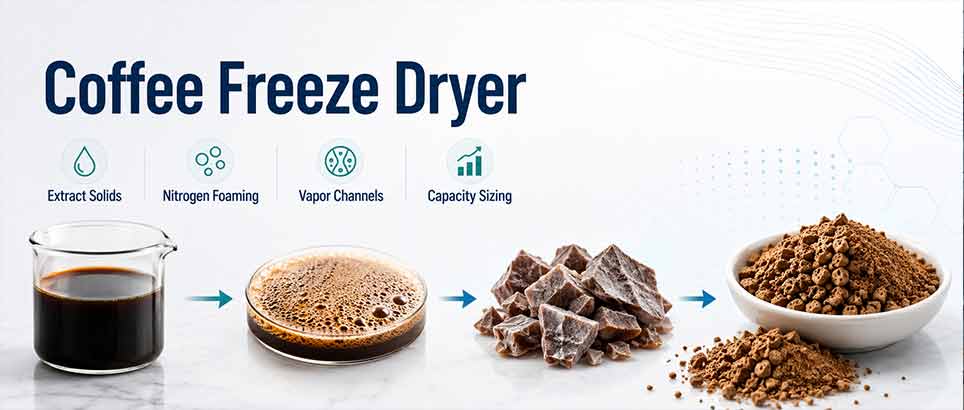
The commercial freeze dried coffee process normally starts with coffee extract, not whole roasted beans. The engineering sequence is extraction, concentration, feed preparation, controlled freezing, particle formation, freeze drying and moisture-barrier packaging. For equipment selection, the critical numbers are extract solids, kilograms of water to remove, usable drying area, condenser load and required finished output.
What Is the Commercial Freeze-Dried Coffee Process?
Commercial freeze-dried instant coffee is produced from soluble coffee extract. The upstream line roasts and grinds coffee, extracts soluble compounds, clarifies the liquid and usually concentrates it. The prepared extract is then frozen into a controlled form before water is removed under vacuum by sublimation.
This distinction matters to buyers. A coffee freeze dryer is one part of an instant-coffee line; it does not replace roasting, extraction, clarification, concentration or packaging equipment.
Readers who need the underlying sublimation mechanism can use the freeze-drying working principle guide. This page focuses on commercial coffee production and scale-up.
Step 1: Extract and Concentrate the Coffee Before Freeze Drying
After roasting and grinding, soluble coffee compounds are extracted into water. The liquid is clarified, and the plant measures solids concentration before choosing the downstream freezing and drying route.
Concentration matters because a freeze dryer removes water rather than creating coffee solids. Therefore, two batches with the same feed weight can produce very different finished output.
Lower-Solids Extract
Lower-solids feed is easier to pump and can use a simpler preparation route, but the freeze dryer must remove more water for each kilogram of finished coffee.
More Concentrated Extract
Higher solids reduce water removal and increase finished output per batch. However, viscosity, freezing behavior and particle preparation become more important.
In the manufacturer’s engineering practice, low-solids coffee extract can be frozen directly, while concentrated products intended as porous granules may benefit from controlled foaming, freezing and granulation. The route should be confirmed with pilot trials rather than treated as a universal recipe.
Step 2: Calculate Coffee Solids and Water Removal
A mass balance should be completed before discussing chamber size. It converts the buyer’s liquid-extract target into dry solids, finished coffee and condenser water load.
Illustrative Comparison: 100 kg of Coffee Extract
The following example assumes 2% final moisture. It is a mass-balance illustration, not a guaranteed production recipe.
| Feed | Dry Solids | Estimated Product at 2% Moisture | Estimated Water Removed |
|---|---|---|---|
| 100 kg at 20% solids | 20.0 kg | 20.4 kg | 79.6 kg |
| 100 kg at 35% solids | 35.0 kg | 35.7 kg | 64.3 kg |
The 35% solids batch contains 15 kg more dry coffee and requires roughly 15.3 kg less water removal than the 20% solids batch. That difference directly affects condenser duty, batch loading and cost per kilogram of finished product.
Step 3: Choose Direct Freezing or a Porous Granule Route
The frozen structure influences vapor movement during primary drying. A dense frozen slab, a porous frozen slab and prepared granules do not present the same resistance to heat and mass transfer.
Direct Freezing
For lower-solids extract or early product trials, the process can freeze coffee directly in trays or another controlled format. This route reduces upstream complexity, although the dryer carries the full water load of the dilute extract.
Foaming Before Freezing
For concentrated coffee intended as porous instant-coffee granules, the manufacturer has used food-grade nitrogen foaming before freezing. The objective is to create a stable pore structure that provides additional internal vapor paths after freezing.
Controlled Freezing and Granulation
The foamed or concentrated extract is frozen while the intended structure remains stable. The frozen material can then be granulated to a controlled particle range. Particle size, bed depth and uniform loading should be recorded because they affect scale-up.
A peer-reviewed study on instant coffee reported that initially porous frozen material can improve freeze-drying performance by creating a structure that favors vapor transport.[1] However, the paper’s preparation method and a manufacturer’s nitrogen-foaming process are not identical. Therefore, the literature supports the porous-material principle rather than a fixed commercial recipe.
Step 4: Freeze Dry the Prepared Coffee
After loading, the chamber is evacuated and controlled shelf heat supplies the energy required for sublimation. Water vapor moves from the frozen coffee toward the condenser, where it is captured as ice.
Product Temperature
The product must remain within a safe temperature range for the formulation and frozen structure. Excessive heat can cause softening, collapse or loss of the intended granule structure.
Absolute Chamber Pressure
The manufacturer’s food systems commonly operate under low absolute pressure, but the useful setpoint depends on product temperature, dry-layer resistance, vapor load and condenser behavior.
Sublimation Rate
Adding heat too aggressively can overload the vapor path or condenser. Adding too little heat extends the cycle without improving product quality.
Condenser Water Load
The condenser must hold the batch water load and capture vapor fast enough during peak primary drying. This is why low-solids extract can become a capacity problem even when shelf area appears sufficient.
The freeze dryer condenser guide explains why total ice capacity and vapor-capture performance must be checked together. For cycle planning, the freeze-drying time guide provides broader food-production context.
Endpoint acceptance should rely on final moisture, center dryness, mass stability, sensory quality, reconstitution, batch consistency and packaging performance. A single timer value should not be treated as proof that the coffee is dry.
How to Size a Coffee Freeze Dryer
A commercial sizing exercise should work backward from the required finished coffee per day.
Define Finished Coffee per Day
Start with the saleable output target rather than liquid extract or nominal tray capacity.
Confirm Extract Solids
Solids determine how much wet feed is required to make the target amount of dry coffee.
Calculate Water Removed per Batch
This establishes the minimum condenser ice load and provides the basis for vapor-load checks.
Confirm Loading Density and Usable Area
Frozen slabs and granules need different loading assumptions. Pilot data should define kilograms per square meter and loading depth.
Calculate Batches per Day
Include loading, pump-down, drying, pressure release, unloading, defrost and preparation. Drying time alone is not the full production cycle.
Example: From Coffee Extract to a 100 kg/Day Finished-Coffee Target
Assume a factory wants 100 kg/day of freeze-dried instant coffee at 2% final moisture, and pilot tests confirm a 30% solids coffee extract.
| Calculation | Illustrative Result | Why It Matters |
|---|---|---|
| Dry solids required | 98.0 kg/day | 100 kg finished product at 2% moisture contains 98 kg dry solids. |
| 30% solids extract required | About 326.7 kg/day | Defines wet feed handled by freezing and loading equipment. |
| Water removed | About 226.7 kg/day | Establishes the daily vapor and condenser load before safety margin. |
| Batch size | Set by validated kg/m² and cycle | Determines usable shelf area and number of batches. |
This calculation does not select a machine by itself. The engineering team would still need pilot loading density, particle geometry, cycle time, condenser margin, operating hours and expected utilization. However, it immediately prevents a common error: sizing the system from “326.7 kg of liquid” without recognizing that the customer only needs 100 kg of finished coffee.
Freeze-Dried Coffee vs Spray-Dried Coffee
Freeze drying and spray drying serve different commercial goals. Neither method is universally better; the right choice depends on product specification, throughput target, investment level and market positioning.
| Decision Factor | Freeze Drying | Spray Drying |
|---|---|---|
| Typical product form | Porous granules or particles | Fine powder, often followed by agglomeration |
| Heat exposure | Low-temperature vacuum drying | Hot-gas drying |
| Throughput | Lower for batch systems | Well suited to high continuous throughput |
| Process complexity | Freezing, vacuum and condenser management | Atomization and hot-air drying |
| Typical fit | Premium instant coffee and specialty products | Large-volume cost-sensitive production |
For a deeper technology comparison, see the spray dryer vs freeze dryer guide. The coffee page should remain focused on the freeze-dried coffee process rather than duplicating that comparison article.
Pilot Testing Before Commercial Scale-Up
Pilot work should create transferable engineering data, not only an attractive coffee sample. The test plan should connect product quality with water removal, loading and cycle performance.
| Variable | Record | Scale-Up Use |
|---|---|---|
| Extract solids | Solids/Brix, viscosity, batch weight | Mass balance and feed handling |
| Freezing route | Direct, foamed or granulated | Defines upstream equipment |
| Particle structure | Size, bulk density, loading depth | Controls vapor resistance and usable area |
| Drying data | Product temperature, shelf temperature, absolute pressure, condenser temperature | Defines a repeatable cycle |
| Endpoint | Final moisture, center dryness, mass stability | Confirms drying completion |
| Finished quality | Aroma, appearance, strength, reconstitution, batch consistency | Confirms saleable product |
For early process development, the SDG60 and SDG90 lab/pilot freeze dryers can support recipe screening before the project moves to commercial capacity. The final production model should only be chosen after the pilot data is converted into water load, usable area and daily output.
Five Common Coffee Freeze-Drying Scale-Up Mistakes
- Using liquid feed weight as finished capacity. The solids fraction must be known before equipment sizing.
- Ignoring condenser water load. A large chamber can still become production-limited by vapor capture.
- Selecting by tray count alone. Usable area, loading depth, particle structure and water removal are more important.
- Copying a cycle from another food. Coffee extract has different concentration, frozen structure and mass-transfer behavior.
- Scaling directly from a small test without production data. Pilot work should record kg/m², full cycle time, moisture endpoint and batch consistency.
What Data Should a Buyer Send a Coffee Freeze Dryer Supplier?
A useful quotation begins with process data. This allows the supplier to estimate the drying duty instead of matching a model to an undefined “kg/day” request.
Product Data
- Coffee extract solids or Brix
- Prepared feed kilograms per batch
- Direct-frozen, slab or granulated form
- Particle size and loading depth
- Target final moisture
- Required finished kilograms per day
Factory Data
- Operating hours and batches per day
- Electricity supply
- Cooling-water conditions
- Steam availability for larger systems, when applicable
- Workshop area and installation constraints
- Country, commissioning and training requirements
The commercial food freeze dryer selection guide explains the broader relationship between shelf area, material loading and water load. Coffee projects should use the same engineering logic with coffee-specific pilot data.
When the coffee process and daily water-removal target are already defined, buyers can compare commercial freeze dryer models as the equipment next step while keeping pilot data and coffee-specific loading assumptions separate from catalogue ratings.
Request a Coffee Freeze-Drying Capacity Evaluation
Buyers can send the coffee extract solids, prepared batch weight, desired finished output and product form. The engineering team can use those inputs to estimate dry solids, water removal, condenser duty, usable drying area and a suitable pilot or commercial equipment range.
Send
- Extract solids/Brix
- Feed kg per batch
- Target final moisture
- Particle or granule target
- Finished kg per day
- Available utilities
Receive
- Mass-balance estimate
- Water-load calculation
- Condenser-load check
- Usable shelf-area estimate
- Pilot-test recommendation
- Model-range recommendation
FAQ About the Freeze-Dried Coffee Process
Can coffee be freeze dried?
Yes. Commercial production normally freeze-dries soluble coffee extract after extraction, clarification, concentration or other feed preparation, freezing and controlled vacuum drying. Whole roasted beans are not the normal dryer feed.
How to freeze dry coffee at commercial scale?
To freeze dry coffee at commercial scale, manufacturers prepare coffee extract, define the solids level, freeze it into a controlled structure, and dry the frozen material under vacuum while the condenser captures sublimated water vapor. Granulation and porous-particle preparation can be added when the product specification requires them.
Why is coffee extract concentrated before freeze drying?
Concentration increases dry solids per kilogram of feed and reduces the amount of water the freeze dryer must remove. The practical limit depends on viscosity, freezing behavior, particle preparation and the required final product.
How long does coffee freeze drying take?
There is no universal cycle. Extract concentration, particle size, loading depth, product temperature, absolute pressure, vapor resistance, condenser performance and the final moisture target all affect time. Pilot testing should establish the production cycle.
How is coffee freeze dryer capacity calculated?
The calculation starts with required finished coffee and extract solids. From those values, the engineering team calculates wet feed and water removal, then checks usable shelf area, condenser duty, full cycle time and batches per day.
References and External Sources
- Wang W, Wang S, Pan Y, Yang J, Zhang S, Chen G. Porous frozen material approach to freeze-drying of instant coffee. Drying Technology. 2019;37(16):2126–2136. DOI: 10.1080/07373937.2018.1564759.
- U.S. OSHA guidance on inert gases and oxygen-deficient atmospheres — safety context for nitrogen use.
Published research and public safety guidance support the general principles cited above. First-party statements in this article are identified as manufacturer engineering practice and should be confirmed with the buyer’s coffee formulation, pilot data and site conditions before final equipment selection.

About the Author: Zheng Wei
Zheng Wei participates in food freeze-drying projects involving product testing, equipment selection, vacuum-system configuration, refrigeration planning, installation guidance and process optimization. The project experience includes fruit, vegetables, seafood, meat, dairy products, tea extracts and other liquid or particulate foods relevant to commercial scale-up.
This guide combines first-party freeze-drying engineering practice with published coffee-process research and public safety guidance. Actual coffee capacity depends on extract solids, frozen structure, loading, cycle, condenser performance, utilities and the required finished specification. Last updated: July 29, 2026.