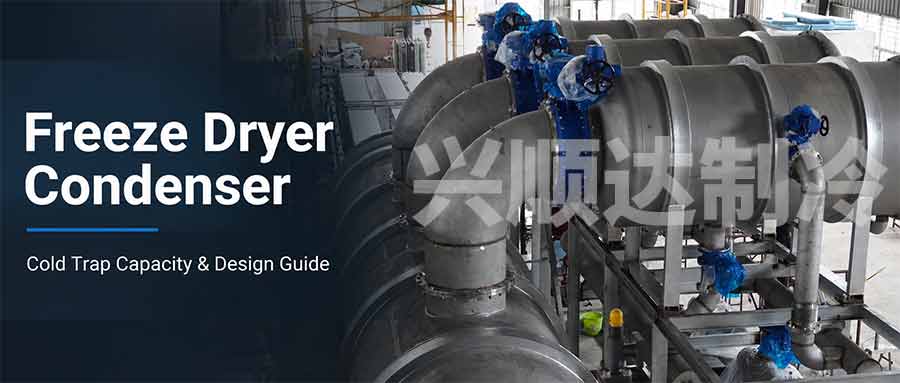
A freeze dryer condenser is one of the most important systems in a freeze dryer. It is also called a cold trap, ice condenser, or vapor condenser.
Its job is simple but critical. During freeze drying, frozen water in the product turns directly into vapor. The condenser captures this vapor and turns it back into ice on a cold surface.
However, in industrial food production, the condenser is not just a cold part inside the machine. It affects drying speed, vacuum stability, energy consumption, defrosting time, and real production output.
For this reason, food manufacturers should not choose a freeze dryer only by tray area or chamber size. They should also check whether the condenser capacity matches the product, moisture load, sublimation rate, and target drying cycle.
Planning a food freeze drying project? Contact our engineering team to calculate the right freeze dryer condenser capacity for your product and target output.
What Is a Freeze Dryer Condenser?
A freeze dryer condenser is the cold surface that collects water vapor during freeze drying. In many freeze dryer systems, it is also called a cold trap or ice condenser.
During primary drying, the product remains frozen. Heat is added carefully, and the ice inside the product sublimates into vapor. Then, under vacuum, this vapor moves toward the colder condenser surface.
Once the vapor reaches the condenser, it deposits as ice. This process removes moisture from the product while helping protect the vacuum pump from excessive water vapor.
A well-designed condenser also helps maintain stable chamber pressure and efficient drying performance.
For more technical background, readers can refer to this freeze drying explanation from Millrock Technology.
Freeze Dryer Condenser vs Refrigeration Condenser
The word “condenser” can cause confusion. In freeze drying, it may refer to two different parts.
| Term | Main Function | Where It Works |
|---|---|---|
| Freeze dryer condenser / cold trap | Captures water vapor from the product | Drying chamber or separate condenser chamber |
| Refrigeration condenser | Releases heat from the refrigeration system | Air-cooled, water-cooled, or evaporative cooling system |
A freeze dryer condenser captures sublimated vapor. A refrigeration condenser removes heat from the refrigeration cycle.
Both are important. However, this article focuses on the freeze dryer condenser, which directly affects vapor capture, vacuum stability, and drying speed.
How a Freeze Dryer Condenser Works
A freeze dryer condenser works by creating a cold surface with lower vapor pressure than the product area.
First, the frozen product receives heat from the shelf or heating system. Then, ice inside the product turns into water vapor. Because the system is under vacuum, the vapor moves from the product area toward the condenser.
When the vapor reaches the condenser, it deposits as ice. As a result, the system removes moisture without melting the product.
In industrial food freeze drying, this process must stay stable for many hours. Therefore, the condenser must match the shelf area, vapor load, refrigeration capacity, and expected drying time.
If the condenser cannot capture vapor fast enough, pressure may rise inside the chamber. Then, drying becomes slower and less stable.
Why Condenser Capacity Is More Than Ice Capacity
Many buyers only ask one question:
“How many kilograms of ice can the condenser hold?”
This question is useful, but it is not enough.
A freeze dryer condenser should be evaluated by two key indicators:
- Total ice capacity per batch
- Water capture rate per hour
Both are important. If one is weak, the freeze dryer may not reach its real production potential.
Total Ice Capacity Per Batch
Total ice capacity means how much water the condenser can collect during one full batch.
For example, if a batch contains a high-moisture product such as fruit, meat, seafood, or pet food, the condenser must hold all the water removed during drying.
If the total ice capacity is too small, the condenser may overload before the batch finishes. This can lead to unstable vacuum, slower drying, and more frequent defrosting.
Therefore, buyers should compare condenser capacity with:
- Fresh material weight per batch
- Initial moisture content
- Target final moisture
- Expected water removal per batch
- Safety margin for high-moisture products
For commercial food production, cold trap capacity is already one of the key points buyers should check before choosing a freeze dryer. This commercial freeze dryer guide also explains why cold trap capacity affects drying performance and energy use.
Water Capture Rate Per Hour
Water capture rate per hour is even more important for real drying speed.
During primary drying, water vapor does not come out at the same rate from beginning to end. In many products, there is a peak sublimation stage. During this stage, vapor load can rise quickly.
If the condenser cannot capture this vapor fast enough, the chamber pressure may increase. Then, the vacuum system may lose control, and drying speed may decrease.
This is why buyers should ask:
What is the maximum condensing rate during the drying cycle?
A large ice capacity does not always mean a strong condenser. A good freeze dryer condenser must also capture vapor quickly during peak sublimation.
For food freeze dryers, the maximum condensing rate should usually be ≥2 kg of water per m² of shelf area per hour. This helps the condenser match the peak sublimation load during primary drying.
What Happens If the Freeze Dryer Condenser Is Too Small?
An undersized condenser can limit the entire freeze dryer.
The machine may have a large chamber and many trays. However, if the cold trap is too small, the real drying speed will still be limited by vapor capture.
Common problems include:
- Longer drying cycles
- Unstable chamber pressure
- Reduced sublimation speed
- Higher energy consumption
- More moisture load on the vacuum pump
- More frequent defrosting
- Lower real daily output
- Uneven drying in some products
This problem is common in low-cost freeze dryers. Some machines look large from the outside, but the condenser surface area, refrigeration capacity, or vapor path design may not support the advertised batch capacity.
As a result, buyers may get a machine with large tray area but weak real production output.
How to Choose the Right Condenser Temperature
A lower condenser temperature is not always better.
The purpose of the condenser is to capture water vapor efficiently. Therefore, it must be cold enough to create a strong vapor pressure difference between the product and condenser.
However, lower temperature also increases refrigeration load. If the product does not require extremely low condenser temperature, chasing a colder number may only increase equipment cost and energy consumption.
For many food applications, the better question is not:
“How low can the condenser temperature reach?”
The better question is:
Can the condenser maintain stable vapor capture under real drying load?
For food manufacturers, the condenser temperature should be selected based on:
- Product type
- Freezing point or eutectic behavior
- Moisture content
- Loading thickness
- Sublimation rate
- Refrigeration capacity
- Energy cost
- Required drying cycle
In most projects, stable performance under load is more valuable than a very low no-load temperature.
Condenser Surface Area and Ice Thickness
Condenser surface area is a key design factor.
When water vapor reaches the condenser, it forms ice on the surface. If the condenser area is too small, the ice layer becomes thick quickly.
As the ice layer becomes thicker, heat transfer resistance increases. Then, the condenser surface becomes less effective at capturing vapor.
This can cause several problems:
- Lower vapor capture efficiency
- Higher condenser temperature under load
- Longer drying time
- More energy waste
- More frequent defrosting
A well-designed freeze dryer condenser should provide enough effective surface area. It should also control ice thickness during the main sublimation stage.
For industrial food freeze dryers, this is especially important because the water load is high. Fruits, meat, seafood, ready meals, and pet food can release large amounts of vapor during drying.
Therefore, buyers should not only ask about total condenser capacity. They should also ask about condenser surface area and vapor capture rate.
Internal vs External Freeze Dryer Condenser
According to the condenser installation position, freeze dryers can be divided into internal condenser freeze dryers and external condenser freeze dryers.
Internal condenser designs can be further divided into:
- Side-mounted condenser
- Bottom-mounted condenser
- Rear-mounted condenser
Each structure has different advantages and limitations. For food manufacturers, the right choice depends on machine size, chamber layout, cleaning requirements, condenser capacity, defrosting method, and transportation conditions.
Side-Mounted Internal Condenser
A side-mounted condenser is installed on the side of the drying chamber.
Its main advantage is that water vapor can contact the condenser surface quickly. The vapor path is short, and the contact area between vapor and condenser is relatively large. Therefore, vapor capture efficiency can be good.
This design also makes the machine compact.
However, the chamber space is limited. If the manufacturer increases the condenser size, the available drying area may be reduced. If the manufacturer keeps a large drying area, the condenser size may be limited.
To achieve both large tray area and large condenser capacity, the chamber body often needs to become larger. As a result, manufacturing cost, transportation difficulty, and installation requirements may increase.
Therefore, a side-mounted internal condenser is more suitable for compact systems or medium-capacity freeze dryers.
For large industrial food freeze dryers, buyers should carefully check whether the condenser capacity is enough for the target water removal load.
Bottom-Mounted Internal Condenser
A bottom-mounted condenser is installed under the drying area.
One advantage of this design is that operators can enter the drying chamber more easily. The heating plates and chamber interior are easier to clean, which is important for food hygiene.
Another advantage is that the bottom condenser can sometimes be divided into two independent condenser sections. These two cold traps can work alternately. When one condenser is collecting vapor, the other can defrost. This design can reduce waiting time between batches.
However, the alternate defrosting mechanism is more complex. It may require sliding plates or isolation structures. The manufacturing process is more difficult, and maintenance can also become harder.
In addition, the effective vapor capture area may be limited. During defrosting, frequent hot and cold cycling can increase energy consumption. It may also cause vacuum fluctuation inside the drying chamber if the isolation and control design is not stable.
Therefore, a bottom-mounted condenser can support better cleaning and possible alternate defrosting. However, buyers should pay close attention to mechanical reliability, sealing design, maintenance access, and vacuum stability.
Rear-Mounted Internal Condenser
A rear-mounted condenser is installed behind the drying area.
This design allows operators to enter the chamber for cleaning and inspection. The heating plates are also easier to clean. At the same time, the overall machine structure can remain compact.
For freeze dryers above 100 m², the drying chamber is usually much longer. In a rear-mounted condenser design, the material near the front end of the chamber is far away from the rear condenser.
As a result, vapor flow resistance increases, and the drying speed of the front-end material can become very slow. This may reduce the overall drying efficiency of the whole batch.
Another challenge is manufacturing and sealing. In many designs, the drying chamber and condenser section are fabricated separately and then connected during assembly.
The sealing between the drying chamber and the condenser section must be reliable. Otherwise, air leakage or vacuum instability may occur.
Therefore, rear-mounted condensers can be useful when compact structure and cleaning access are important. But for large food freeze dryers, buyers should check vapor flow distance, condenser capacity, vapor passage area, and sealing quality carefully.
External Condenser Freeze Dryer
An external condenser is installed in a separate condenser chamber outside the drying chamber.
This design is especially suitable for large food freeze dryers above 100 m².
Its main advantage is that operators can enter the drying chamber more easily. The heating plates, chamber walls, and product area are easier to clean and inspect. This is valuable for food processing plants that care about hygiene and long-term maintenance.
In addition, the drying chamber and condenser can be manufactured separately. This makes fabrication, transportation, and installation easier, especially for large industrial systems.
An external condenser design also allows more flexible configuration. One drying chamber can be matched with one or two condensers. When two condensers are used, the system can achieve stronger vapor capture capacity and better batch turnover.
For large-capacity food production, this design offers several advantages:
- Larger condenser surface area
- Stronger water capture capacity
- Easier chamber cleaning
- Easier condenser maintenance
- More flexible defrosting design
- Easier transportation and installation
- Better matching with large shelf area and high sublimation load
Therefore, for large industrial food freeze dryers, especially systems above 100 m², an external condenser is often the better choice.
How to Choose Between Internal and External Condensers
There is no single best condenser structure for every freeze dryer.
For small and medium systems, an internal condenser can make the machine compact and cost-effective. However, buyers must check whether the condenser size is sacrificed to keep a larger tray area.
For large food freeze dryers, an external condenser is usually more practical. It allows a larger cold trap, easier cleaning, better maintenance access, and stronger water capture capacity.
Before choosing a freeze dryer condenser structure, buyers should ask:
- Is the condenser side-mounted, bottom-mounted, rear-mounted, or external?
- Does the condenser size match the shelf area?
- What is the peak water capture rate per hour?
- Can operators enter the chamber for cleaning?
- How difficult is condenser maintenance?
- How long does defrosting take?
- Does alternate defrosting affect chamber vacuum?
- Is the chamber-condenser sealing structure reliable?
- Is the machine easy to transport and install?
- Is the design suitable for future production expansion?
For food manufacturers, the condenser installation form should not be judged only by appearance. It should be evaluated by real water capture capacity, cleaning convenience, defrosting efficiency, vacuum stability, and long-term maintenance cost.
Vapor Path Design Also Matters
The vapor path between the drying chamber and the condenser is often ignored. However, it can affect drying performance.
If the vapor port is too small, too long, or partly blocked, vapor flow becomes restricted. Then, vapor can accumulate in the product chamber.
This may cause pressure to rise and vacuum control to become unstable.
Therefore, a good freeze dryer condenser design should include:
- Enough vapor passage area
- Short and smooth vapor path
- Low flow resistance
- Proper isolation valve size
- Good matching between chamber, condenser, and refrigeration system
For large food freeze dryers, vapor flow design can be as important as condenser temperature.
Defrosting Design and Real Production Output
A freeze dryer condenser collects ice during every batch. After the batch ends, the ice must be removed.
This step is called defrosting.
Many buyers focus only on drying time. However, they also need to ask how long defrosting takes between batches.
For example, if one batch takes 12 hours but defrosting and preparation take another 30–60 minutes, the real daily output will be lower than expected.
In industrial food production, this downtime can become expensive.
A better condenser system may use:
- Faster hot gas defrosting
- Steam or water-assisted defrosting
- Multiple condensers
- Alternate defrosting
- Continuous ice removal design
This industrial freeze dryer manufacturer guide also explains why cold trap design affects drying efficiency and production continuity.
Therefore, buyers should always ask:
How long does condenser defrosting take between batches?
This question is simple, but it helps reveal the real production capacity of the machine.
Condenser Material: Stainless Steel, Aluminum, or Carbon Steel?
Condenser material affects corrosion resistance, hygiene, service life, and repair cost.
A freeze dryer condenser works in a harsh environment. It experiences low temperature, high humidity, ice formation, defrosting, and repeated thermal changes.
Therefore, material selection matters.
| Material | Advantage | Possible Risk |
|---|---|---|
| Stainless steel | Hygienic, corrosion-resistant, durable | Higher initial cost |
| Aluminum alloy | Lower cost than stainless steel | Corrosion risk if surface protection fails |
| Carbon steel | Lowest initial cost | Higher corrosion and leakage risk |
For industrial food freeze dryers, stainless steel is often preferred for long-term hygiene and corrosion resistance.
This is especially important in food production because the condenser may face repeated moisture exposure. Once corrosion starts near welds or weak points, repair can be costly.
A cheaper condenser may reduce initial purchase cost. However, if it leads to corrosion, refrigerant leakage, or long downtime, the total cost can become much higher.
How to Evaluate a Freeze Dryer Condenser Before Buying
Before buying an industrial food freeze dryer, buyers should ask detailed condenser questions.
Here is a practical checklist:
- What is the total ice capacity per batch?
- What is the peak water capture rate per hour?
- What is the condenser temperature under real load?
- What is the condenser surface area?
- How thick will the ice layer become during one batch?
- Is the condenser internal or external?
- How large is the vapor port between chamber and condenser?
- How long does defrosting take?
- Is alternate or continuous defrosting available?
- What material is used for the condenser?
- How is the condenser matched with shelf area?
- How is the condenser matched with the expected sublimation rate?
- How does the system prevent water vapor from entering the vacuum pump?
- What maintenance is required for the condenser and refrigeration system?
These questions help buyers compare machines by real performance, not only by brochure data.
For a broader machine selection checklist, buyers can also read this commercial freeze dryer guide.
Common Mistakes When Comparing Freeze Dryer Condensers
Many buyers make mistakes when comparing freeze dryer condensers.
The most common mistakes include:
- Only checking the lowest condenser temperature
- Only comparing total ice capacity
- Ignoring water capture rate per hour
- Ignoring condenser surface area
- Ignoring ice thickness during drying
- Ignoring vapor path design
- Ignoring defrosting time
- Ignoring condenser material
- Confusing the cold trap with the refrigeration condenser
- Comparing tray area without checking condenser capacity
These mistakes can lead to the wrong equipment choice.
A freeze dryer may look powerful because it has many trays. However, if the condenser cannot remove vapor fast enough, the machine will dry slowly.
Therefore, condenser design should always be part of the purchasing decision.
How a Well-Designed Condenser Improves Food Freeze Drying
A well-designed freeze dryer condenser improves the whole production process.
It can help food manufacturers achieve:
- More stable chamber pressure
- Faster vapor removal
- Shorter drying cycles
- Lower energy waste
- Better product consistency
- Less downtime between batches
- Lower vacuum pump risk
- Higher real daily output
- Longer equipment service life
For food manufacturers, the best freeze dryer is not always the machine with the largest chamber. It is the machine with balanced shelf area, heating capacity, condenser capacity, refrigeration power, vacuum performance, and defrosting design.
This is why a freeze dryer condenser should be evaluated as a production system, not as a simple accessory.
FAQ About Freeze Dryer Condensers
Is a freeze dryer condenser the same as a cold trap?
In many freeze dryer systems, yes. A freeze dryer condenser is often called a cold trap or ice condenser. It captures water vapor from the product and turns it into ice.
What does a freeze dryer condenser do?
It removes water vapor during freeze drying. This helps maintain vacuum stability, protects the vacuum pump, and supports efficient moisture removal.
What temperature should a freeze dryer condenser reach?
It depends on the product, vapor load, and process requirements. For food production, the condenser should be cold enough to capture vapor under real load. However, a lower temperature is not always better if it only increases energy consumption.
What is condenser ice capacity?
Condenser ice capacity is the total amount of water the condenser can collect as ice during one batch. It should be higher than the expected water removal from the product.
Why is water capture rate important?
Water capture rate shows how much vapor the condenser can remove per hour. It is important because the sublimation rate can be high during primary drying.
For food freeze dryers, the maximum condensing rate should usually be ≥2 kg of water per m² of shelf area per hour.
Can a small condenser make freeze drying slower?
Yes. A small condenser can limit vapor removal. As a result, chamber pressure may rise, drying may slow down, and energy consumption may increase.
Is a lower condenser temperature always better?
No. A lower temperature can improve vapor capture in some cases, but it also increases refrigeration load. For food freeze drying, stable condenser performance under real load is more important than the lowest no-load temperature.
What is the difference between an internal and external freeze dryer condenser?
An internal condenser is installed inside the drying chamber. It can make the machine compact, but chamber space may limit condenser size.
An external condenser is installed in a separate condenser chamber. It is more suitable for large food freeze dryers because it offers stronger water capture capacity, easier cleaning, and better maintenance access.
Which condenser structure is better for large food freeze dryers?
For large food freeze dryers above 100 m², an external condenser is usually more practical.
It allows the drying chamber and condenser to be manufactured separately. It also supports larger cold trap area, easier transportation, and stronger vapor capture capacity.
Why is a rear-mounted condenser not ideal for very large freeze dryers?
For freeze dryers above 100 m², the drying chamber is usually long. If the condenser is installed at the rear, the material near the front end of the chamber is far away from the cold trap.
This increases vapor flow resistance. As a result, the front-end material may dry much more slowly, which can reduce the overall drying speed of the batch.
Why does condenser defrosting affect production output?
The condenser must be defrosted after collecting ice. If defrosting takes too long, the machine cannot start the next batch quickly. This reduces real daily and yearly output.
Conclusion: Choose the Condenser Based on Real Production Needs
A freeze dryer condenser is a key part of freeze drying performance. It affects vapor capture, vacuum stability, drying speed, energy consumption, and batch turnover time.
Therefore, buyers should not only ask about tray area, chamber size, or the lowest condenser temperature.
Instead, they should evaluate:
- Total ice capacity
- Peak water capture rate
- Condenser surface area
- Ice thickness control
- Condenser temperature under load
- Condenser installation structure
- Vapor path design
- Defrosting method
- Condenser material
- Matching with shelf area and sublimation rate
For food manufacturers, a well-designed condenser can improve real output and reduce long-term operating cost.
Planning a freeze-dried food project? Contact our engineering team to calculate the right condenser capacity, water removal rate, refrigeration configuration, and defrosting method for your product.