
Equipment selection · Application review
Solvent Freeze Dryer: Compatibility Before Buying
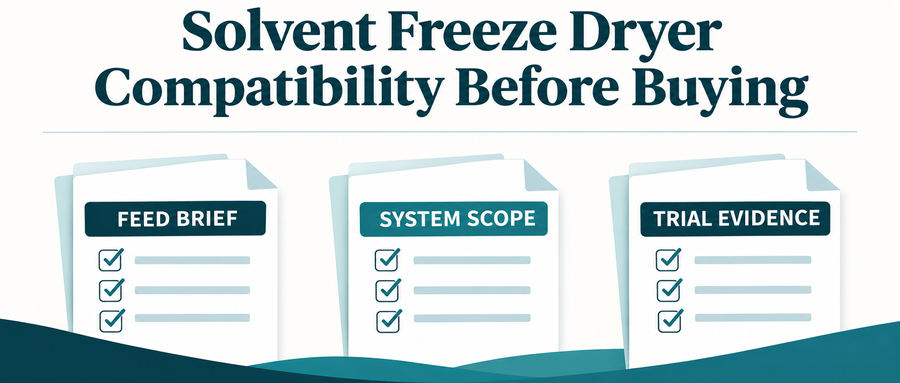
Before selecting a solvent freeze dryer, evaluate three separate buyer questions: what actual material will enter the machine, whether the quoted system was assessed for that material, and what evidence shows an acceptable product. A supplier’s answer to one question does not settle the other two.
A standard food-drying specification does not establish solvent compatibility. Suitability concerns the identified feed, equipment configuration and site together. This is a buyer’s guide to the evidence needed for an application decision, not approval to process a solvent or instructions for handling one.
APPLICATION DECISION
First decide whether the application can move forward
Start by identifying the actual material to be loaded into the drying chamber, rather than the extraction process that generated it. Here, feed means the exact material placed into the machine. Both the equipment supplier and responsible site reviewers need this identity and composition clear enough to evaluate project feasibility.
An extract described as mostly water still requires this review. Neither visual appearance nor an earlier extraction step serves as an equipment acceptance record.
On its solvent application page, Martin Christ distinguishes standard equipment from configurations intended for different solvent applications. The useful lesson for a buyer is to identify which equipment scope a statement covers. The manufacturer’s classification does not establish an allowable solvent percentage for another manufacturer’s food dryer.
- The feed is water-based food material: document its composition and intended product for food application review. State any uncertainty about solvent content or presence clearly.
- An organic solvent is known to be present: obtain the supplier’s written decision covering that named mixture and equipment configuration, along with a review by responsible site personnel.
- Composition or compatibility remains unknown: identify the missing information or assessment. Keep the application unresolved until those gaps are evaluated; an equipment quotation never closes an information gap.
Once you determine the appropriate review route, provide each prospective supplier with the same version-controlled description of the incoming feed.
THE BUYER’S INPUT
Give the supplier a feed it can identify
Distribute the same documented feed brief across initial enquiries, sample discussions, and supplier responses. Using one consistent version helps reduce repeated questions and exposes missing information early. Writing an assumption down, however, does not resolve an unknown.
The brief connects what the buyer knows about the material to the questions the supplier must answer. Use the following worksheet to link each piece of buyer information directly to the supplier’s response.
| Item | What the buyer sends | What the response should clarify |
|---|---|---|
| Material identity |
Name the product or material, outline its ingredient matrix, and describe any upstream extraction or preparation. |
Does the supplier identify this material and this brief version in the response? |
| Solvent information |
List every known solvent, its concentration range, the basis used to express that concentration, and the source of the information. |
Which uncertainty needs explanation or measurement before assessment? |
| Proposed load |
Specify the wet batch quantity, solids information, container or tray geometry, and expected batch-to-batch variation. |
Which batch quantity and loading arrangement does the written assessment cover? |
| Required product |
Identify the intended use, relevant quality attributes, and residual-solvent requirements, along with the party who approves those requirements. |
Who establishes the test method and criteria for product acceptance? |
| Installation context |
Specify available utilities, the proposed installation context, and the responsible parties for downstream interfaces. |
Where does equipment supply end, and which connections and reviews remain with the site? |
This is a procurement worksheet inferred from application and system-scope questions. It is not a solvent process specification. Mark unverified values as unknown rather than filling the gaps with assumed operating conditions.
Ask the supplier to state which proposed conditions it can assess, what missing information it still needs, and where specialist input is required. That written response will inform how you read the equipment offer.
THE SUPPLIER’S RESPONSE
Read the conditions before comparing the price
First look for the supplier’s written decision about the complete quoted system. An internal chamber coating, a component certificate, or an oil-free vacuum pump describes an isolated item; on its own, it does not establish acceptance for your actual feed and site.
The Epsilon 2-6D Solvent model description illustrates how a named solvent configuration brings together liquid- and vapour-contacting parts, valves, seals, the pump and refrigeration arrangement. It is evidence about that manufacturer’s identified configuration, not a specification to copy onto another machine. This guide prescribes no universal material, seal, pump type or collector temperature.
Review the proposal across four checks:
- Contact path: which chamber, product-contact parts, seals, valves, and sensors did the supplier include in its review?
- Collector and pump: which collector and vacuum pump arrangement was assessed, what assumptions were used in that assessment, and which duties are excluded?
- Downstream connections: where does the supply boundary end, who handles downstream connections, and which responsible reviewers must check them?
- Written decision: what source document, model and configuration version, feed boundary, written conditions, exclusions, and responsible sign-offs back the offer?
Next, compare each quote against the same feed revision and examine the conditions attached to the price, rather than assuming unstated features are covered.
| Question | Evidence to retain for each offer | Condition to keep visible |
|---|---|---|
| Same application? |
The named feed version alongside the written supplier application response. |
What is accepted, what is conditional, and what remains unanswered? |
| Same configuration? |
The quoted model, selected options, and complete equipment boundary linked to the response. |
Does the quoted hardware differ from the assessed configuration? |
| Who covers the site? |
The documented interfaces and the responsible party identified for each. |
Which work is excluded from the quote, and which site reviews remain outstanding? |
| What will the trial show? |
The proposed evidence, assigned trial responsibility, and agreed acceptance basis. |
What does the proposed evidence answer, and what does it leave open? |
| What does the price buy? |
The identified supply, documentation, trial, and handover scope attached to the price. |
Which scope elements remain unpriced or conditional, preventing a true like-for-like cost comparison? |
Labels such as documented, conditional and unresolved can help a buyer follow the responses; they are not certification grades. Retain the document behind each label. An isolated catalogue temperature, coating description or assumed capture percentage cannot replace an assessment of the application.
Return each unresolved point to whichever party is responsible for answering it. Keep these gaps visible in your comparison instead of substituting a lower price or component claims for a resolved application.
ACCEPTING THE APPLICATION
Agree what the trial must answer before commissioning it
This checklist neither authorizes a trial nor defines its operating procedure. Before commissioning a trial, the buyer, supplier and relevant site and quality reviewers should jointly identify the application question, representative feed and load, proposed configuration, review responsibilities, measurement plan and acceptance criteria.
Keep the equipment review separate from product acceptance. An equipment review evaluates whether the quoted configuration suits the stated application. Product acceptance also requires evidence of the result obtained from relevant product to show it meets your quality requirements.
Evidence about the equipment
Identify the application and configuration actually evaluated, along with the evidence and observations the responsible equipment and site reviewers must assess.
Evidence about the product
Identify the relevant quality attributes, residual moisture, and residual solvent to be measured, along with who owns the test methods, sampling plan, and applicable acceptance requirements.
A sample that looks dry answers only how it appears. Visual appearance, moisture, residual solvent, and other relevant quality attributes remain separate questions; looking dry does not measure remaining solvent.
Why product-specific evidence matters. In their 1998 study, Wittaya-areekul and Nail examined tert-butyl alcohol/water cosolvent systems with sucrose and glycine model formulations. Residual-solvent behaviour depended on formulation and physical state in those experiments. This supports asking for evidence about the relevant product. The pharmaceutical model study supplies no food or ethanol acceptance limit, drying recipe or proof that the buyer’s equipment is compatible.
Review trial findings against the actual feed, load, and configuration tested. Identify remaining technical questions before making the acceptance decision, and verify that report findings and limits trace back to that specific application.
Does a dry-looking sample prove solvent removal?
No. The relevant product needs the agreed residual-solvent analysis in its acceptance record. A visual check answers a different question.
Can a pharmaceutical paper set the limit for a food project?
The cited model study does not set that limit. The parties responsible for the intended product and market must identify the applicable requirements and acceptance basis.
DELIVERY AND LATER CHANGES
Keep the accepted application attached to the delivered system
During handover, assemble the project records so future reviewers can trace what was assessed, supplied, and accepted:
- Configuration and feed: retain the supplied equipment configuration alongside the approved feed version, conditions and exclusions.
- Interface responsibility: record the agreed division between equipment and site responsibilities, including the source of each required approval.
- Operating and cleaning documents: file the approved operating and cleaning instructions, noting who assessed cleaning-agent compatibility for the supplied system.
- Trial and acceptance records: compile the agreed trial and analytical reports, the formal acceptance decision, and any open actions.
- Reviewers for later changes: document the review route and identify the responsible application and site personnel for future modifications.
A change in solvent identity, composition range, load or relevant components must be returned to the responsible application and site reviewers before assuming the earlier decision still applies. These are procurement traceability recommendations based on configuration-specific equipment boundaries, not an operating procedure or universal legal qualification programme.
Check the project archive against four practical questions: what was assessed, what was supplied, who accepted it, and who reviews the next change? If earlier scope cannot be identified from the records, do not assume it covers the new proposal.
Choose the appropriate next project discussion
When discussing a water-based food freeze-drying system, prepare your product description, wet batch quantity, solids information, loading arrangement, product requirements, and available utilities. Declare any organic solvent or uncertainty about its presence at the start of discussions.
This article does not establish that the company supplies, modifies or validates solvent-rated equipment. A solvent-bearing application needs an appropriate equipment supplier’s assessment and competent site review.
References and evidence boundaries
- Martin Christ. Solvents. Manufacturer application information; statements apply to its identified equipment scope.
- Martin Christ. Epsilon 2-6D Solvent. Configuration-specific model information; cited as an evidence example, not a product recommendation.
- Wittaya-areekul S, Nail SL. Freeze-Drying of tert-Butyl Alcohol/Water Cosolvent Systems: Effects of Formulation and Process Variables on Residual Solvents. Journal of Pharmaceutical Sciences. 1998;87(4):491–495. DOI: 10.1021/js9702832. Pharmaceutical model-system findings; no food or ethanol acceptance limit is inferred.
About the Author: Zheng Wei
Founder & Freeze-Drying System Engineer
Fuzhou Xing Shun Da Refrigeration Facility Project Co., Ltd.
Zheng Wei participates in food freeze-drying trials, equipment selection, vacuum-system configuration, refrigeration planning, installation guidance, process optimization, and project handover. The project experience covers fruit, vegetables, cooked foods, seafood, meat, dairy products, herbs, and extracts.