
Food plant procurement · Safety documentation
Freeze Dryer Safety Precautions: A Food Plant Handover Checklist
Ask the supplier to show how the proposed freeze dryer will be reviewed, tested and handed over at your site before you place an order. Start by defining the food products you plan to process and the specific tasks your team will perform around the equipment. Then connect each safety question to its supporting document, a capable reviewer to evaluate it, and a recorded decision.
What machine and site are you asking someone to review?
Give both the supplier and your site safety reviewer the same description of the planned production operation. State the food product, prep steps, target wet batch weight, and daily workflow for loading, unloading, and cleaning. A reviewer must assess worker tasks alongside the machinery, since someone handling product trays may need different access from someone servicing a pump.
List all parts of the proposed machine scope, including the drying chamber, door or loading arrangement, pumps, refrigeration, heating and defrost, and auxiliaries. A bare model number does not specify these details. Whenever the equipment configuration changes, review immediately which drawings, documents, and review decisions are affected and must be updated with it.
A food freeze dryer combines a drying chamber, water-vapor capture, refrigeration, heating, vacuum and monitoring/control systems. The cited equipment-design paper describes that architecture; it does not establish a current machine’s safeguards or certification.[1]
Give the reviewer the actual installation conditions
- Utilities and surroundings: available services, access and maintenance space, wet areas, drainage, ventilation and nearby work activities.
- Product and cleaning conditions: food handling and any cleaning materials or methods that need compatibility review.
- Refrigeration details: ask the supplier to identify the actual refrigerant and charge (amount) and supply the relevant equipment documents.
- Local responsibilities: state the installation country and identify competent local people for electrical, mechanical, refrigeration and workplace-safety assessment.
Dust characteristics, pressure-boundary classification and special area requirements need assessment for the actual project. The words “food freeze dryer” do not settle those questions.
Track missing information directly on your project review record. If a loading arrangement or refrigerant choice remains unconfirmed, name a person to confirm it and identify each dependent decision waiting on that answer. This keeps attention on specific open questions rather than letting unverified quotation figures guide your choices.
Use approved layout and utility installation documents rather than preliminary quotation estimates. The commercial freeze dryer setup guide covers this wider plant preparation work. Preliminary figures in a sales proposal should never quietly become the final basis for site engineering review.
How will people be protected during operation and servicing?
Ask the supplier to show how workers are protected during each operational and maintenance task, rather than accepting a generic feature list. Confirm who may work around product loading areas, what restricted-access areas exist, and what instructions personnel need before cleaning, inspecting, or servicing equipment. The supplier’s explanation must match the proposed equipment configuration and reference the relevant manual or control documents.
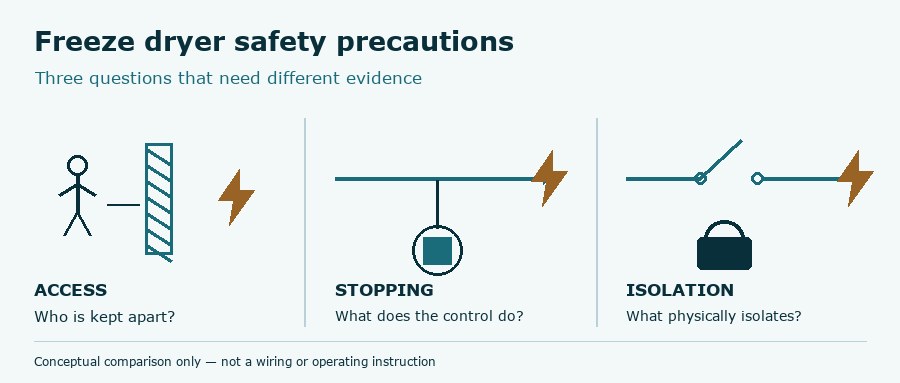
Keep three practical questions distinct: how guards keep someone away from a hazard during access, how machine controls stop the equipment, and how hazardous energy is physically isolated for servicing. One answer does not automatically establish the other two. For this reason, demonstrating an emergency stop cannot serve as a complete safety handover.
- Guards and access: request the approved description of guards, door/access functions and restricted areas. OSHA’s general machine-guarding provision addresses exposure of operators and nearby workers and requires that a guard not create a hazard itself.[3]
- Stopping and restart: request the documented differences between normal stop, emergency stop, reset and restart, including the intended response when relevant utilities are lost and restored.
- Energy and servicing: request identification of energy sources, isolation interfaces and stored-energy concerns. Competent site personnel need that information to prepare the appropriate machine-specific procedures.
- Permission to do the work: identify who may operate, clean, inspect, service or change controls, and which tasks require specialist involvement under the actual manual and site procedures.
Have a competent reviewer identify any unresolved guarding, access, or energy-isolation questions before agreeing on the equipment purchase specification. Note exactly which drawing, manual, or supplier explanation is still needed. Routine recipe and run procedures are covered in the commercial operating guide and manufacturer manuals; a procurement safety review should never attempt to draft replacement operating instructions.
Does the document cover the equipment and question in front of you?
Examine the document behind each vendor claim or approval marking to confirm what was actually evaluated. Check that the record identifies the proposed model and configuration, including the serial identity where available. Note the issuer, document number, and document revision. Then examine the evaluated equipment and functions, listed conditions, exclusions, and open actions.
Keep authenticity, document coverage, and local applicability separate. A valid document may cover only a specific subassembly or control enclosure rather than the complete freeze-drying machine. Simply having evidence for one function does not answer every site interface. Have a competent reviewer determine whether each document applies to your installation and answers your specific plant questions.
OSHA’s product list for Nationally Recognized Testing Laboratory (NRTL) approval notes that approval may be required only under particular circumstances or conditions of use. NSF separately describes electrical-safety testing/certification and commercial food-equipment sanitation services. These sources support checking the evaluated scope; they do not establish that the company’s machine holds any particular approval.[4][5][6]
Example: a quotation includes an electrical-panel document
Ask which panel, equipment and functions that document evaluates. Then ask what evidence remains for the supplied assembly and the connections to the site. Do not extend its scope to every machine function, sanitation outcome or production result.
A loaded drying test answers a different question: how the equipment performed for the defined load and conditions. A certificate and a drying result cannot replace each other.
Compare competing suppliers by checking how clearly their documentation matches your equipment scope. Record alongside each document what equipment it covers, who reviewed its applicability, and what unresolved questions remain. Comparing evaluated scope shows documentation gaps far more reliably than counting certificates. Refer to the food freeze dryer factory/site acceptance guide for organizing the wider performance verification plan.
What must the test show, and what evidence will you keep?
Agree in advance on what each check must demonstrate before witnessing any test. A general note stating “interlock checked” leaves out the specific function tested, the response expected under the approved design, and whether the observed result met the requirement. Without those details, you cannot make a sound acceptance decision.
To obtain usable records, propose that the buyer and supplier structure each agreed alarm, interlock, stop, restart, or utility-loss check around the five fields below. This outline defines the evidence to record without prescribing physical test methods or replacing approved site procedures.
- Identify the check: function, approved requirement, machine/configuration and protocol revision.
- Identify the people and method: competent test lead, witness and agreed method.
- Define the comparison: initial conditions and the response expected under the approved design.
- Keep the observation: actual behavior, timestamps and the original supporting record.
- Record the decision: deviations, corrective action, retest evidence and the designated acceptance decision.
Keep the original test record alongside the correction and retest evidence whenever an observation deviates from the approved requirement. Record who is responsible for the corrective action and who holds acceptance authority to approve closure. Retesting should document the resolution clearly without discarding earlier deviation records.
Tie witnessed safety records directly into the testing process described in the acceptance-testing guide, which covers factory and site acceptance trials. A drying trial demonstrates process performance under defined load and test conditions, but it does not close equipment safety reviews.
Who can do each task, and who decides that handover is complete?
Agree on both plant and supplier responsibilities for operation, service, and open actions before starting routine production. Provide operators, cleaners, and maintenance staff with current documents matching their assigned tasks. An informal demonstration does not clarify what tasks someone is permitted to carry out or when work must stop and be escalated to a specialist.
Separate training attendance records from task permission. A training record shows who attended, the subjects covered, the date, and the procedure or manual revision used. Permission to perform work remains a distinct plant decision, determined by actual manuals, worker competence, and local requirements.
- Training: person and role, subjects covered, current procedure or manual revision, trainer, date and the agreed assessment or demonstration.
- Task boundaries: permitted operator work, authorized site servicing and work requiring a specialist.
- Documents: relevant drawings, alarm/control information, manuals, approved settings, original test records and remaining actions.
- Changes and restart: approved equipment, software or setting changes, and decisions on which documents, training and tests must be updated before affected work or operation resumes.
OSHA’s energy-control tutorial distinguishes authorized, affected and other employees. It describes retraining when relevant assignments, equipment/processes or procedures change, or deficiencies are found. That does not establish a universal annual operator-recertification requirement.[2]
For U.S. refrigeration work, EPA Section 608 sets technician-certification requirements for specified activities/equipment and includes a supervised-apprentice exception. This supports a scoped U.S. service-competence check, not a worldwide rule for every task.[7]
Use a project register to track the five review questions alongside requested evidence and the people designated to close each action. The table below provides an example of how to organize evidence and responsibilities across the project. Adapt it to your plant’s setup, recording document receipt and acceptance of content as separate actions.
| Review item | Evidence to request | Responsibility to name | Open-item record |
|---|---|---|---|
| Product/site basis | Approved configuration, layout, utility interfaces and applicable risk-review inputs | Supplier document owner and competent site reviewer | Missing input, action owner and decision due |
| Safeguards and access | Guard/access description, control documents and energy-isolation interfaces | Equipment designer and site safety/engineering reviewer | Requirement, document revision and unresolved interface |
| Approval scope | Identified documents with issuer, evaluated model/function, conditions and exclusions | Supplier evidence owner and local applicability reviewer | Scope question and evidence still required |
| Witnessed checks | Approved protocol, original results, deviations and retests | Competent test lead, witness and acceptance authority | Result, correction, retest and closure decision |
| Operational handover | Current manuals, role training, authorized-service boundaries and revision records | Plant operation/service owners and agreed supplier contacts | Outstanding training, documents and release actions |
This example is a buyer-review aid proposed by this guide. It is not a completed machine risk assessment, an official certification or the plant’s formal authorization to operate. Open safety questions need a named owner and a recorded closure decision.
Consult the service and maintenance guide for model-specific support and maintenance records, and reference the food-plant cleaning guide for sanitation procedures. Confirm training duration, maintenance intervals, and service availability against your actual equipment, site requirements, and agreed supply scope. A general guide cannot replace machine manuals or establish fixed schedules for every facility.
Buyer questions about freeze dryer safety precautions
What should I ask for before accepting the freeze dryer?
Ask for the agreed product/site review basis, model-specific safeguard and energy-interface information, documents with a clearly evaluated scope, witnessed-check records and accountable training and service handover. Record who will answer each open question and who can accept its closure.
Is an emergency-stop demonstration enough?
No. It shows one function under particular conditions. Guard/access information, servicing-isolation interfaces, test records and training responsibilities still need review. Control stopping and physical energy isolation answer different questions.[2]
Does every food freeze dryer need the same certificate?
Requirements depend on the equipment, installation and jurisdiction. Check the model/function evaluated, conditions, exclusions and local applicability. One certificate name is not universal proof.[4]
Can a successful drying trial close the safety review?
A trial gives performance evidence for its defined load and conditions. It does not by itself establish safeguard coverage, approval scope, competent servicing procedures or completed training. Keep those decisions in the acceptance and handover records.
References and evidence boundaries
Sources support the specific attributed points. The checklist and register are buyer-review proposals; none of these references certifies the supplied machine.
- 赵鹤皋、林秀诚. 工业食品冷冻干燥机的设计[J]. 流体机械, 1996, 24(5):49–52. DOI: 未检出. Full four-page original reviewed; used only for system architecture, not historical design values or modern safety approval.
- U.S. Occupational Safety and Health Administration. Lockout/Tagout tutorial, printer-friendly version. Used for scope, energy-isolating devices, role training and change-related retraining. The tutorial is explanatory and is not a substitute for the standard.
- U.S. Occupational Safety and Health Administration. 29 CFR 1910.212: General requirements for all machines. Used for general guarding principles, not a freeze-dryer-specific control design.
- U.S. Occupational Safety and Health Administration. Type of products requiring NRTL approval. The source explicitly notes conditions affecting applicability.
- NSF. Food equipment electrical safety testing and certification for North America. Service-scope illustration, not supplier certification evidence.
- NSF. Commercial food equipment testing and certification. Used to distinguish sanitation evaluation from electrical and process-performance questions.
- U.S. Environmental Protection Agency. Section 608 technician certification requirements. Used only for the scoped U.S. refrigerant-service competence point.

About the Author: Zheng Wei
Founder & Freeze-Drying System Engineer
Fuzhou Xing Shun Da Refrigeration Facility Project Co., Ltd.
Zheng Wei participates in food freeze-drying trials, equipment selection, vacuum-system configuration, refrigeration planning, installation guidance, process optimization, and project handover. The project experience covers fruit, vegetables, cooked foods, seafood, meat, dairy products, herbs, and extracts.