
Food-project buying guide · Sri Lanka
Freeze Dryer Price in Sri Lanka: Food Project Cost Guide
Check the equipment, the cost of bringing it to your factory and the food it can produce before you choose an offer.
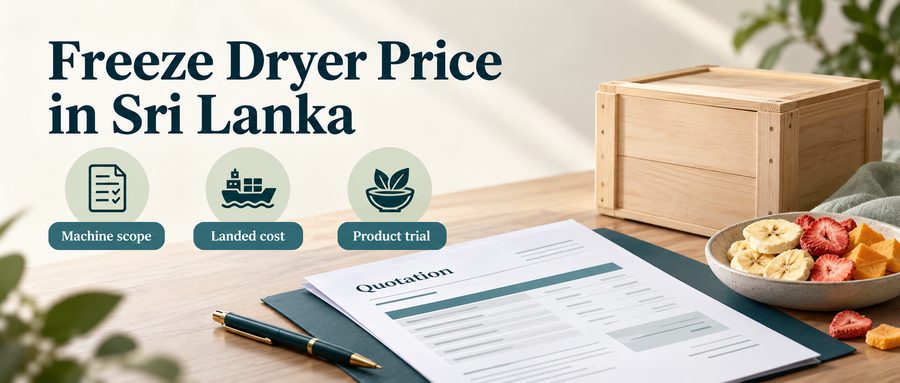
Ask for a written machine quotation, then build a separate landed and installation budget. A freeze dryer price in Sri Lanka is useful only when you know the model, what comes with it and where the supplier’s responsibility ends. Put freight, import charges, delivery to the factory and site work beside the equipment price.
This guide helps food businesses compare offers. It does not establish a current price range for the Sri Lankan market. The overseas listing below is a dated example; its price does not cover every configuration or prove what a working food-production project will cost.
Start with the equipment
Check what the quoted machine can do
Ask the seller which machine and accessories the price covers, and whether that configuration suits your food. A household machine, a laboratory lyophilizer and a food-production system may be offered for different tasks. Their labels alone do not tell you whether they can meet your load, cleaning or operating requirements.
In conventional vacuum freeze drying, the food is frozen and ice passes directly into vapor under vacuum: this step is called sublimation. A hot-air dehydrator uses a different drying process. Confirm which process the offer describes before comparing prices.[4]
Verify the process before using the price. Ask the seller to identify the freezing step, vacuum-rated drying chamber, vapor-capture system and included vacuum equipment. A fan-and-heater description does not demonstrate freeze drying. A laboratory label also does not establish a simple price or size ranking: laboratory systems can use different drying accessories and can be smaller or larger than home units. The intended food, loading arrangement and complete equipment scope still need to match.[6]
Read the headline price beside its scope
A dated price illustration, not a Sri Lankan quotation: on 31 October 2026, WM Machinery’s food freeze-dryer product page displayed US$2,900 and stated that shipping was calculated separately. The page offered several model variants. That headline figure does not establish the price of every configuration, an installed food-production line, Sri Lankan stock or a delivered-and-cleared purchase. It is a third-party listing, not a price offered by the company.[1]
Request the exact model and revision, included systems, quotation currency, validity period and named delivery destination. Ask which product and trial assumptions support the offer. If those details are missing, send the questions back to the supplier before treating the figure as a comparable project price.
| Offer | First question | Evidence still needed |
|---|---|---|
| Household or countertop unit | Does the proposed food, load and operating pattern fit the unit? | Actual product result, full cycle and included accessories. |
| Laboratory lyophilizer | Is it configured for the intended food format? | Loading, collection capacity and an appropriate food-trial protocol. |
| Food-production system | What accepted output does the quotation cover? | Product-specific capacity basis, utilities, interfaces and acceptance scope. |
Scroll this table horizontally on a narrow screen. The types of freeze dryers guide explains the broader equipment categories.
Give every bidder the same task
Send suppliers the same production requirements
- Product and preparation: identify the food or formulation, preparation and freezing route, measured starting moisture or solids, and piece thickness or liquid fill depth.
- Output and schedule: state prepared wet load, required accepted finished output, agreed quality criteria, operating hours and the time available between batches. Ask which values are measured, estimated or still awaiting a product trial.
- Configuration and utilities: request usable loading area, tray arrangement, included freezing, vacuum, refrigeration and controls, plus the selected model’s actual utility schedule. Provide available site services; do not substitute another machine’s electrical, water, air or steam figures.
Keep condenser figures separate. Ice-holding capacity describes how much ice can be retained before defrosting. A capture-performance figure expressed per 24 hours describes a different test basis; it does not by itself establish the time needed to dry the buyer’s product. Ask for both definitions, their test conditions and the proposed full product-cycle evidence.[7] Compare them with the expected water load, while retaining the product-specific trial and scale-up limits.
If suppliers use different meanings of capacity, ask them to restate their offers against the same input record. Keep any unresolved product-trial assumptions visible. A condenser figure by itself is not enough to promise a batch schedule.
Build the project budget
Add the costs of reaching and starting the factory
Choose one named delivery point for the comparison, then work from each machine price to that point. An offer ending at a port can leave the buyer with costs that another offer includes. Ask who arranges and pays for each remaining step through delivery, positioning and commissioning at the factory.
Enter the charges in a ledger rather than adding an unexplained allowance to the machine price. Keep the original currency and quotation date beside each amount. This lets you distinguish a changed exchange-rate assumption from a changed equipment offer.
| Cost line | Record before comparison |
|---|---|
| Equipment and packing | Exact configuration, included auxiliaries, export packing, currency and quotation validity. |
| Freight and insurance | Named delivery term and place, package dimensions and weights, route and written exclusions. |
| Import clearance | Confirmed classification, applicable charges, required documents and the party arranging declaration. |
| Port to factory | Handling, local transport, unloading, rigging and access preparation. |
| Site and commissioning | Electrical and utility work, installation labor, agreed travel, testing and training. |
| Currency and payment timing | The exchange-rate basis and date used in the budget, payment stages and relevant bank charges. |
Confirm import charges for the actual shipment
Use the current Sri Lanka Customs route. Its import guidance describes submitting a Customs Declaration through a Customs House Agent. It directs classification questions to the Tariff Guide and offers an advance-ruling route when classification is uncertain.[2] The published tariff portal also states that applicable laws and government gazettes govern its information.[3] Have the importer or appointed agent confirm the actual machine’s classification, valuation, controls, documents and charges before fixing a landed estimate.
Give the equipment specification and commercial documents to the importer or clearing agent before fixing the import-cost estimate. This guide assumes no HS code, duty percentage or exchange rate. A seller’s generic equipment code or a shopping-page currency conversion does not establish the charges for your shipment.
Then check each ledger line against the supplier’s written total. Leave included charges visible so their scope can be checked, but count them only once. Use the status record below to separate known prices from amounts still awaiting confirmation.
Give every cost line a status: included in the quoted total; separately quoted; excluded and priced by another party; or awaiting confirmation. Record the payer, currency, quote date and supporting document. An unpriced line is unknown, not zero. Keep supplier charges, importer estimates and site-contractor quotations distinct until their boundaries agree.
The equipment specification and commercial documents should accompany any classification enquiry. Sri Lanka Customs’ Commodity Classification Branch describes the advance-classification-ruling route; a generic equipment name or an AI-suggested code does not decide the shipment’s classification.[8]
Once the delivery and site-work boundaries agree, compare the totals and list the unresolved amounts alongside them. The total freeze-dryer cost guide extends the calculation to wider ownership costs; the ledger here makes the Sri Lankan destination and delivery responsibilities explicit.
Check what the food trial proves
Compare the food that passes the trial
Agree what counts as acceptable finished food before comparing suppliers’ output claims. Ask for a trial using a defined product and load, then examine how much finished food meets those requirements and how long the complete operation takes. Tray area and prepared wet kilograms describe parts of the task; they do not tell you how much saleable food you will obtain.
A quotation based on tray area or wet kilograms alone leaves important assumptions unresolved. Ratti’s food-powder chapter explains the heat- and mass-transfer constraints of freeze drying, including the effect of the dried layer and differences between laboratory and commercial equipment. Those principles support product-specific capacity review; they do not supply one production recipe for every food.[4]
Luo and Shu’s analysis treats freezing, sublimation, vapor capture and vacuum maintenance as parts of the energy boundary. Its theoretical discussion and illustrative curves are not a universal electricity guarantee.[5] For a purchase comparison, request measured consumption for a defined load and complete operating boundary, with any separate freezer or auxiliary utilities identified.
Use the following record to keep the food, load, process and acceptance checks together. Ask the supplier to identify which results were measured on the proposed equipment and which depend on a future trial. Do not turn an estimate into an output commitment without resolving its stated conditions.
- Fix the material: food type, formulation, preparation, initial moisture or solids, and piece thickness or fill depth.
- Fix the load: prepared wet mass, usable area, distribution and loading method.
- Keep the process record: freezing history, shelf and product temperatures, absolute pressure, condenser behavior and complete cycle.
- Define acceptance: final moisture by an agreed method, representative center checks, appearance, texture and intended rehydration or ingredient performance.
- Count saleable output: record rejected, broken or otherwise off-specification material, plus turnaround and packaging constraints.
Understand the water load before using a capacity figure
Illustrative water-load calculation: a hypothetical 100 kg prepared load at 80% initial moisture contains 20 kg dry solids. Assuming all solids remain and the final moisture is 2% on a wet basis, the finished mass is 20 ÷ 0.98 = 20.41 kg and estimated water removal is 79.59 kg. This arithmetic is not a tested food result, a release specification or a machine-capacity recommendation. Actual trimming, handling and quality losses change saleable yield.
Calculate against the finished food that passes acceptance
Carry the accepted trial into the cost comparison. Record the prepared wet input, total finished mass and the portion that meets the agreed saleable specification. Keep rejected or off-specification output separate; a different saleable grade should be identified rather than silently counted as the required product.
Metered energy per accepted kilogram = measured batch electricity (kWh) ÷ accepted finished mass (kg). Identify the meter, start and end points, included auxiliaries and any separate freezer. Report an omitted utility as excluded or unknown, not as zero consumption.
Allocated batch electricity cost per accepted kilogram = the electricity charge assigned to that measured boundary ÷ accepted finished mass. State the actual tariff and cost-allocation basis. This is not the complete electricity bill or total product cost unless all relevant charges and costs are included. If no finished product passes acceptance, neither ratio provides a valid cost per accepted kilogram.
Keep the full cycle and the separate loading, defrosting, cleaning and restart times beside the output record. A drying-only time cannot establish the production schedule. These ratios are accounting definitions for the agreed trial, not measured results, a universal energy benchmark or a factory-output guarantee.
Compare cost per accepted finished kilogram only when the trials use consistent acceptance and cost boundaries. A larger wet load can still give a poor result if the cycle takes longer, product breaks or part of the batch fails the agreed specification. Keep those outcomes beside the price rather than choosing on the largest loading claim.
Before placing the order, use the food freeze-dryer acceptance guide to separate checks on the machine, checks at the site and commitments about product performance. A successful result for a different food or loading arrangement does not settle your own trial requirements.
Make responsibility visible
Agree who installs, supports and repairs the system
Request the selected model’s layout and utility schedule before final site work. Check who will provide the electrical service, cooling, drainage and access needed to position the equipment. Delivery does not complete those tasks. Use the commercial installation guide to examine the physical interfaces, then assign them in the order.
| Interface | Clarify in the order |
|---|---|
| Process equipment | Chamber, condenser, refrigeration, vacuum, heating, controls and loading hardware; identify separately supplied freezing or packaging equipment. |
| Factory utilities | Actual voltage, phase and frequency; electrical starting/load requirements; cooling and drainage; steam only where the selected configuration requires it. |
| Delivery and positioning | Shipment boundary, route dimensions, lifting plan, assembly work and buyer-provided labor. |
| Testing and handover | Factory and site checks, product-trial commitments, manuals, records, operator training and sign-off. |
| Support and spares | Warranty start and exclusions, remote or on-site support, travel costs, critical spares and the responsible contact. |
Ask who does the work and who pays
Ask the supplier to price and assign installation, training, maintenance, spares and breakdown support separately. Include the work after the warranty ends. A broad support description leaves you unable to compare the cost or find out who will act when help is needed.
For installation, training, preventive maintenance, critical spares and breakdown work, record the responsible party, included work, separate price or charging basis, exclusions and evidence of availability. Identify who pays for travel, accommodation, extra site days, replacement-part freight and clearance, and post-warranty labor.
Keep an initial response, parts dispatch, technician arrival and repair completion as separate commitments. A warranty duration or “technical support” statement does not establish those times. Where local stock or engineers have not been verified, leave that status explicit and request the proposed alternative arrangement and its costs.
This guide does not establish stock held by the company, a local branch, resident engineers or a guaranteed response time in Sri Lanka. Equipment supply, installation guidance, travel, commissioning and support must be confirmed in the project-specific technical and commercial documents.
Review the written responsibilities with the freeze-dryer supplier checklist. Keep unverified availability or response arrangements open for confirmation. Separately, the operator should confirm the food business’s and premises’ applicable requirements with the relevant Sri Lankan authorities; purchasing the equipment does not establish readiness to operate.
Turn the comparison into an enquiry
Send a quotation brief the supplier can use
Send the food and its preparation, prepared wet kilograms per batch or day, required finished specification, thickness or fill depth, available trial results and planned operating hours. Add the factory location in Sri Lanka, delivery access, available utilities, packaging plan and the installation and support tasks you want included.
Identify missing or estimated inputs rather than filling them with another machine’s figures. Ask the supplier to state what can be quoted now and what needs a trial or further site information. That reply gives you a clearer basis for the next comparison.
The engineering team can use those inputs for a preliminary equipment and quotation-scope review, identifying missing capacity, utility and trial assumptions before a formal offer. Final prices, supply commitments and acceptance terms require the selected configuration’s written documents.
Questions when comparing Sri Lankan project offers
When can I treat an online price as the landed price?
When the written offer includes the delivery and clearance costs for your stated destination. Check packing, freight, insurance, import charges, inland transport and unloading. Keep site work separate unless the offer expressly includes it.
Can a laboratory machine meet a food-production requirement?
Check the proposed food, load, accessories, cycle and acceptance requirements against that configuration. A laboratory label or nominal collection capacity cannot answer the question alone. Ask for the appropriate food-trial evidence before treating its output as equivalent.
What should I provide for an import-cost check?
Provide the actual equipment specification and commercial documents to the importer or clearing agent, and follow the current Sri Lanka Customs classification procedure. The words “freeze dryer” alone do not determine a shipment-specific tariff code or duty rate in this guide.
What should I resolve before choosing the lower offer?
Check missing auxiliary equipment, delivery terms, site work, demonstrated accepted output and support responsibilities. Ask each supplier to show inclusions, exclusions and unknown amounts on the same basis. Choose only after you understand which costs and obligations the lower figure leaves with you.
Sources and evidence limits
- WM Machinery. Best Price Freeze Dryer Machine for Food. Observed 31 October 2026. A supplier’s displayed price and shipping statement; not a Sri Lankan market-price survey or a quotation from the company.
- Sri Lanka Customs. Importing Goods. Checked 31 October 2026. Procedural starting points; shipment-specific confirmation remains necessary.
- Sri Lanka Customs. Customs Import Tariff 2026. Checked 31 October 2026. Current classification, controls and gazettes must be confirmed for the actual shipment.
- Ratti C. Freeze drying for food powder production. In: Handbook of Food Powders. Woodhead Publishing; 2013:57–84. DOI: 10.1533/9780857098672.1.57. Used for qualitative process and scale-up constraints.
- Luo N, Shu H. Analysis of Energy Saving during Food Freeze Drying. Procedia Engineering. 2017;205:3763–3768. DOI: 10.1016/j.proeng.2017.10.330. Theoretical analysis and illustrative curves; no universal operating-energy value is adopted.
- Labconco. What’s the Difference Between a Home Freeze Dryer and a Lab Freeze Dryer? Checked 1 November 2026. Manufacturer explanation of intended applications, components and accessories; its numerical ranges are not adopted as food-project specifications.
- CryoDry. Understanding Condenser Specifications. Checked 1 November 2026. Used to distinguish ice-holding capacity from capture-performance test figures; no product-cycle or sizing guarantee is inferred.
- Sri Lanka Customs. Commodity Classification Branch. Checked 1 November 2026. Official classification and advance-ruling procedure; this guide assigns no machine-specific tariff code or rate.
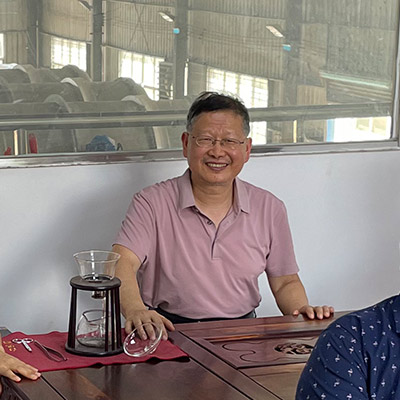
About the Author: Zheng Wei
Founder & Freeze-Drying System Engineer
Fuzhou Xing Shun Da Refrigeration Facility Project Co., Ltd.
Zheng Wei participates in food freeze-drying trials, equipment selection, vacuum-system configuration, refrigeration planning, installation guidance, process optimization, and project handover. The project experience covers fruit, vegetables, cooked foods, seafood, meat, dairy products, herbs, and extracts.