
Commercial Food Manufacturing Guide
How to Store Freeze Dried Food After Production
A practical release-to-warehouse guide for food manufacturers covering batch checks, exposure control, warehouse handling, transport, opened packs, returns, and storage troubleshooting.
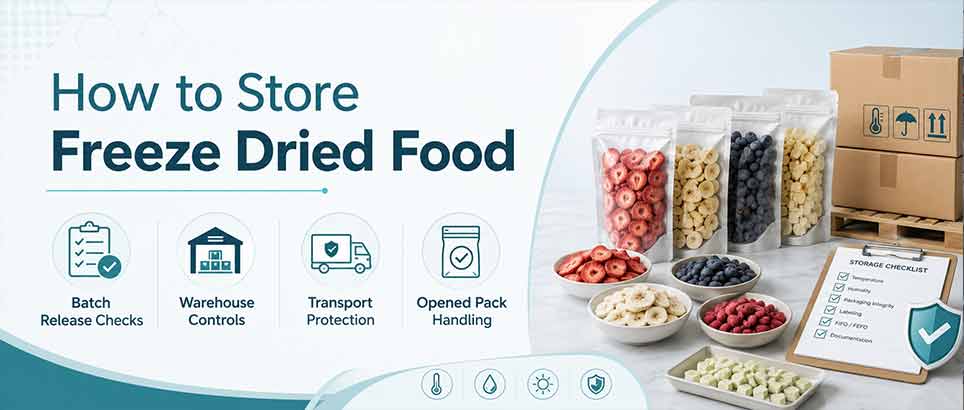
How to store freeze dried food commercially depends on the food, drying endpoint, package, distribution route, and destination market. In general, a factory should release only conforming batches, minimize exposure before sealing, protect cartons and pallets from moisture and damage, define controls for transport and opened packs, and review retained samples throughout the intended storage period.
Storage of Freeze Dried Food Is a Controlled System
Commercial storage begins before the freeze-dryer chamber opens. An incomplete cycle, a long transfer through humid air, a contaminated seal area, or a damaged pallet can affect the final product. Therefore, drying, unloading, packing, warehouse handling, and distribution should operate as one traceable process.
What the buyer needs
The buyer needs a product that remains within its agreed quality and safety specification through the stated route to market.
What the factory needs
The factory needs release criteria, exposure records, package checks, warehouse inspections, transport records, and retained-sample evidence.
The separate freeze-dried food packaging guide covers barrier materials, sealing, WVTR, OTR, oxygen control, and packaging-line decisions. This page focuses on what happens after drying and how storage performance is controlled. For new equipment projects, the food freeze-dryer validation guide explains FAT, SAT, and equipment acceptance planning.
Why One Storage Specification Cannot Cover Every Product
Remaining water, product composition, pore structure, fat content, sugar content, and piece geometry can influence physical stability. In a laboratory study of freeze-dried strawberry, apple, and pear, remaining water affected glass-transition behavior, while the three fruits responded differently to process conditions.[1] Consequently, the study supports product-specific limits rather than a universal final-moisture or storage target.
A separate atmospheric freeze-drying study of apple, turnip cabbage, and cod reported differences in product structure and sorption characteristics.[2] Atmospheric freeze-drying differs from conventional vacuum freeze-drying. Nevertheless, the research supports the broader point that composition and structure can influence storage behavior. Commercial package and storage decisions should therefore use the actual formulation and route to market.
A defensible claim should reflect the finished food, validated process, package, seal, storage profile, transport route, and test plan. High-fat, high-sugar, porous, powdered, and fragile foods can deteriorate in different ways.
Release the Batch Before It Becomes Finished Goods
A warehouse cannot correct an incomplete drying cycle. Therefore, the batch should meet defined release criteria before it enters finished-goods storage.
Use practical endpoint checks
The manufacturer’s standard in-house review generally includes final moisture, centre dryness, mass stability where appropriate, sensory condition, rehydration, and batch-to-batch consistency. A dry-looking surface alone does not confirm the centre of a thick piece.
Use additional testing when the product requires it
The manufacturer does not rely on water activity as its routine in-house endpoint check. However, product owners, accredited laboratories, buyers, or local authorities may require water activity, microbiological, chemical, nutritional, or other product-specific testing. Those requirements should be defined according to the food, claim, hazard analysis, and destination market.
Keep representative records
Release records should identify the batch, recipe, loading pattern, representative tray positions, final results, deviations, and disposition. In addition, doubtful trays or zones should be isolated instead of being mixed into a released lot.
Control Transfer Before Sealing
Freeze-dried food can absorb moisture from surrounding air. As a result, the packaging area, operators, materials, filler, sealer, labels, and inspection tools should be ready before unloading begins.
- Define the route: specify sampling, filling, sealing, coding, inspection, and case-packing steps.
- Reduce open handling: use clean, dry, closed intermediate containers when direct transfer is not possible.
- Record delays: document chamber-opening time, packaging start, line stops, and packaging completion.
- Protect the seal area: prevent powder, fragments, oil, or product pieces from entering the sealing surface.
- Plan for stoppages: define the disposition of exposed product when the filler, sealer, coder, or gas supply stops.
The package should then be checked as a protection system rather than as an isolated pouch. Barrier performance, closure integrity, headspace, puncture resistance, product shape, and distribution stress should work together. Detailed package selection remains the responsibility of the dedicated packaging page, which helps prevent this storage article from competing for packaging-intent keywords.
How to Store Freeze Dried Food in a Commercial Warehouse
A commercial warehouse should generally remain clean, dry, protected from direct light, and within the validated operating range for the finished product. For U.S. projects, FDA’s CGMP framework addresses sanitation, plant operations, production controls, and food holding activities.[3] Other markets may apply different rules.
Control cartons, pallets, and inventory
- Keep cartons away from water ingress, condensation, strong odors, chemicals, pests, and floor-level damage.
- Check pallet overhang, compression, stretch wrapping, sharp edges, and unstable stacking.
- Maintain readable lot codes and relevant date information on units, cartons, or pallets.
- Use FIFO or FEFO according to the business model and product specification.
- Record warehouse deviations and connect them to the affected lots.
Inspect finished goods at a defined frequency
Warehouse inspections may review room conditions, pest-control status, carton strength, package damage, seal condition, label readability, pallet stability, and signs of moisture exposure. The inspection frequency should reflect product risk, value, storage duration, and destination.
The National Center for Home Food Preservation advises that dried foods be packaged promptly and stored in cool, dry, dark conditions. It also notes that repeated package opening exposes dried food to air and moisture.[4] Because that guidance is written for home preservation, commercial manufacturers should use it only as general context and should validate the actual product and package.
Protect Transport, Opened Packs, Samples, and Returns
Transport and distribution
Transport may introduce heat swings, vibration, crushing, abrasion, puncture, or seal damage even when the warehouse is controlled. Consequently, the distribution plan should define the carton, pallet pattern, vehicle or container expectations, handover checks, and damaged-goods procedure.
Opened retail packs and bulk bags
The unopened shelf-life claim may no longer apply after a package is opened. The label or customer specification should therefore define reclosure, storage location, handling tools, maximum open time, and disposal conditions. For repeatedly opened bulk liners, smaller pack sizes may reduce exposure, although packaging cost may increase.
Retained samples
Retained samples should represent the released commercial product and package. They should remain traceable to the batch and storage condition so that complaint samples can be compared with normal product aging.
Damaged and returned product
Leaking, punctured, swollen, wet, heavily crushed, contaminated, or untraceable packages should be isolated for investigation. Simply resealing a returned pack may hide the original failure and may not restore the validated storage condition.
Quick Diagnosis of Common Storage Problems
| Observed problem | Priority checks | Relevant records |
|---|---|---|
| Fruit pieces lose crispness | Final moisture, centre dryness, packaging delay, moisture barrier, and seal integrity | Batch release, exposure log, material lot, and seal checks |
| Powder cakes or sticks | Product temperature, packaging-room humidity, exposure time, barrier performance, and closure | Room conditions, filling record, package specification, and retained samples |
| Meat, seafood, dairy, or pet food develops an unusual odor | Fat oxidation, residual oxygen strategy, package barrier, heat exposure, and formulation | Packaging record, warehouse history, transport record, and laboratory results where required |
| A package loses vacuum or inflates | Seal contamination, puncture, flex cracking, product shape, or a product-specific safety issue | Seal settings, inspection results, complaint sample, and food-safety review |
| Only some trays or cartons fail | Uneven loading, piece thickness, tray position, package handling, pallet pressure, or local damage | Tray map, process trend, carton location, and distribution history |
| Opened product softens quickly | Pack size, opening frequency, reclosure method, user environment, and after-opening instruction | Label, customer handling record, and returned sample |
A storage complaint should not be assigned to the freeze-dryer without evidence. First, the affected pack should be compared with a retained sample. Next, the investigation should trace the lot through final moisture, centre dryness, exposure, sealing, warehouse conditions, and transport. The freeze-dryer monitoring guide explains how process trends and alarm records can support this review.
Verify Storage Performance Instead of Assuming It
The useful question is not whether freeze-dried food can remain at room temperature in general. The useful question is whether the actual product, package, and route can remain acceptable through the intended storage and use period.
| Stage | Decision to document | Useful evidence |
|---|---|---|
| Batch release | Is the product ready for packaging? | Final moisture, centre dryness, representative sampling, sensory condition, and batch record |
| Packaging | Did the package achieve the intended protection? | Material lot, sealer settings, code, seal inspection, and integrity checks |
| Warehouse | Did the finished goods remain within the storage plan? | Condition log, pallet inspection, stock rotation, and lot traceability |
| Distribution | Could transport have damaged the product or package? | Dispatch record, route assumptions, receiving checks, and damage reports |
| Review | Does the product continue to support the claim? | Retained samples, texture, colour, aroma, rehydration, complaints, returns, and corrective actions |
The broader claim-development process is covered in the freeze-dried food shelf-life guide. In addition, published commercial food freeze-drying case studies show how different foods, loading conditions, drying cycles, and finished results can vary across projects.
- food name, formulation, piece size, slice thickness, or liquid loading depth;
- prepared wet material per batch and expected daily output;
- expected dry yield and target final moisture;
- retail or bulk package format and net weight;
- intended storage period and destination market;
- available unloading and packaging time;
- known softening, caking, oxidation, seal, warehouse, or transport problems.
Request a Freeze-Drying and Storage Review
If softening, caking, oxidation, or short storage performance appears after packaging, the cause may originate from drying, exposure, sealing, warehousing, or transport. Reviewing these stages together can help prevent changes to equipment or packaging before the actual failure point is identified.
Food manufacturers can submit the product type, wet load or daily output, package format, intended storage period, destination market, and current quality issue. The engineering team can review the information and provide a preliminary project checklist for further discussion.
Frequently Asked Questions
Can freeze-dried food be stored at room temperature?
Many commercial products are developed for ambient storage. However, the approved range should come from the finished product specification, package, validation evidence, and market requirements rather than from the drying method alone.
Does freeze-dried food need refrigeration?
Not automatically. An unopened product developed and validated as shelf stable may not require refrigeration. A specific formulation, opened package, buyer specification, or local requirement may need different controls.
How should opened freeze-dried food be stored?
The package should be closed promptly and protected from humidity, oxygen, contamination, heat, and light according to the approved after-opening instructions. The usable period after opening may be much shorter than the unopened storage period.
Should oxygen absorbers and desiccants be used together?
Not automatically. The decision depends on the product, residual moisture, headspace, package permeability, component capacity, compatibility, handling process, and food-safety plan.
How long can freeze-dried food be stored?
No single period applies to every product. The claim should be supported by the actual food, drying endpoint, package, seal, storage profile, intended use, distribution route, and validation evidence.
Does soft texture always mean that the freeze-drying cycle was incomplete?
No. Soft texture may result from incomplete drying, packaging delay, weak moisture barrier, seal leakage, puncture, condensation, opened-pack handling, or unsuitable storage. Batch and package records should be reviewed together.
References and External Resources
- Khalloufi S, Ratti C. Quality Deterioration of Freeze-dried Foods as Explained by Their Glass Transition Temperature and Internal Structure. Journal of Food Science. 2003;68(3):892–903. DOI: 10.1111/j.1365-2621.2003.tb08262.x.
- Claussen IC, Strømmen I, Hemmingsen AKT, Rustad T. Relationship of Product Structure, Sorption Characteristics, and Freezing Point of Atmospheric Freeze-Dried Foods. Drying Technology. 2007;25(5):853–865. DOI: 10.1080/07373930701370233.
- U.S. Food and Drug Administration. Current Good Manufacturing Practices for Food and Dietary Supplements.
- National Center for Home Food Preservation. Packaging and Storing Dried Foods.
Regulatory, labeling, laboratory, and test requirements vary by food and destination market. Food businesses should confirm current obligations with qualified food-safety, packaging, laboratory, and regulatory professionals.