
Spray Dryer vs Freeze Dryer for Food Production: Quality, Cost and Selection
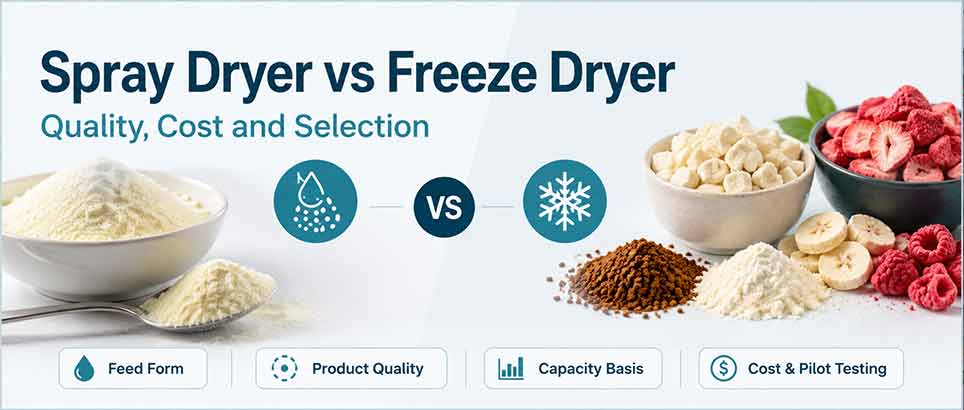
Spray dryer vs freeze dryer is not a contest between a low-quality process and a high-quality process. Instead, it is a production decision based on feed form, finished-product requirements, water-removal demand, market value and factory economics. In practice, spray drying is often a suitable route for large-volume, pumpable feeds intended to become uniform powder. By contrast, freeze drying is often considered when the product is heat-sensitive, high-value, structurally intact or expected to rehydrate with limited damage.
Decision in one minute: First, evaluate spray drying for pumpable feeds, high continuous throughput and standardized powder. By contrast, evaluate freeze drying when structure, aroma, rehydration or heat sensitivity supports a higher-value product. When both routes are feasible, complete a mass balance and representative trials before purchasing equipment.
Scope disclosure: The manufacturer supplies food freeze-drying systems rather than spray dryers. Freeze-dryer sizing and scale-up guidance in this article reflects the engineering team’s project work. Accordingly, spray-drying comparisons are based on published food-processing research and should be confirmed by a qualified spray-dryer supplier using the buyer’s actual formulation.
Quick Selection: Spray Dryer or Freeze Dryer?
Choose a Spray Dryer When
- The feed is a pumpable liquid, slurry or emulsion.
- The required product is a fine or agglomerated powder.
- High continuous throughput is the main production objective.
- The formula can tolerate brief thermal exposure.
- Unit production cost is more important than retaining the original food structure.
Choose a Freeze Dryer When
- The product is heat-sensitive or aroma-sensitive.
- The finished food is expected to retain pieces, layers or a porous structure.
- Rehydration performance supports the product’s market value.
- The product is sold as a premium ingredient, snack or prepared food.
- The feed is difficult to atomize into stable droplets.
Run Pilot Tests When
- Both processes appear technically possible.
- The feed is sticky, sugar-rich, fatty or highly concentrated.
- Carrier materials may be required.
- The acceptable aroma, color or solubility loss is not yet defined.
- The sales price and market quality threshold still require validation.
A food manufacturer should begin with the product specification, not the quotation. Therefore, a practical economic choice is the process that can consistently produce saleable product at the required capacity. For example, poor recovery, wall deposition or off-spec output can erase an apparent equipment-price advantage.
Spray Dryer vs Freeze Dryer: How the Processes Differ
How Spray Drying Works
A spray dryer pumps a liquid feed to an atomizer, forms small droplets and contacts them with heated air. As a result, moisture evaporates rapidly, and the particles are separated from the air stream. The process is effective for milk, coffee extract, protein solution, flavoring and other pumpable feeds, but viscosity, solids, sugar, fat, carriers and atomization all affect recovery and powder properties.
How Freeze Drying Works
A freeze dryer freezes the product, lowers chamber pressure and supplies controlled shelf heat so that ice leaves mainly by sublimation. Afterward, secondary drying removes additional moisture before unloading and protective packaging. In addition, the process can handle extracts and pastes while also preserving fruit pieces, meals, meat and seafood. Therefore, commercial evaluation should cover thickness, tray loading, vacuum stability, condenser load, center dryness, final moisture, mass stability, sensory quality, rehydration and batch consistency.
Engineering caution: Freeze drying may not be sufficiently gentle for some formulations. Sugar-rich extracts may soften, collapse or remain sticky when the formulation, freezing method, product depth or shelf-temperature program is unsuitable. Moreover, spray-drying performance is better assessed with more than inlet-air temperature because the feed’s thermal history is also influenced by droplet size, evaporation and residence time.
Why Feed Form Is the First Selection Filter
Ordinary spray drying generally works with feeds that can be pumped and atomized. For example, whole berries, meat pieces, shrimp, prepared meals and intact vegetable pieces are usually unsuitable for conventional spray drying unless they are converted into a pumpable form. Conversely, a liquid extract intended mainly as a low-cost standardized powder may not justify the longer batch cycle and higher capital intensity of freeze drying.
Commercial Comparison of Spray Drying and Freeze Drying
| Selection factor | Spray dryer | Freeze dryer | Buyer implication |
|---|---|---|---|
| Feed form | Pumpable liquid, slurry or emulsion | Liquid, paste, particles or structured food | Feed form can eliminate one route before cost analysis begins. |
| Production mode | Usually continuous | Usually batch | Annual output calculations should include cleaning, defrosting and turnaround time. |
| Finished form | Fine powder or agglomerated powder | Porous cake, flakes, granules or intact pieces | The required product form should be written into the specification. |
| Heat exposure | Higher-temperature air for a short residence time | Low-temperature dehydration under vacuum with controlled shelf heat | Actual quality is best confirmed with the real formula. |
| Throughput | Strong option for high-volume liquid-to-powder production | Better matched to batch production and higher-value products | Compare water removed and saleable output, not machine dimensions. |
| Particle control | Atomization and agglomeration can provide strong particle control | Dried cake may require crushing, milling or screening | Downstream equipment should be considered in the project scope. |
| Structure retention | Original food structure is not retained | Can retain the macrostructure of pieces and prepared foods | Important for snacks, meals, fruit, meat and seafood. |
| Product recovery risks | Wall deposition, cyclone losses and sticky powder | Incomplete drying, melt-back, tray adhesion and moisture pickup | Yield is more reliably estimated from trial measurements. |
| Factory economics | Often favorable for large-volume commodity powders | Often justified by premium quality or structured products | Use cost per saleable kilogram, not purchase price alone. |
Published comparisons report different advantages across products and quality metrics. For example, studies on pea processing water, smoke flavoring, plant extracts and fish-oil microcapsules reported different results for particle size, color, flow, encapsulation and compound retention. Therefore, outcomes depended on the feed, carrier system, formulation, target product and operating conditions.[1][2][3][4]
Product Quality: Aroma, Color, Structure and Rehydration
Heat-Sensitive and Aroma-Sensitive Ingredients
For example, freeze drying is commonly evaluated when volatile aroma, natural color or heat-sensitive functionality directly affects the selling price. Nevertheless, the engineering team should avoid assuming full retention of nutrients or aroma compounds. Freezing rate, oxygen exposure, cycle temperature, storage and packaging can still change the final product.
Spray drying can also protect sensitive compounds when residence time, carriers and outlet conditions are suitable. In liquid-smoke powder, both methods retained bioactive compounds, while spray drying produced smaller particles and freeze drying gave better flow in that formulation.[2] Dandelion-extract and fish-oil studies found higher encapsulation efficiency for the tested spray-dried systems, while freeze-dried particles were more irregular or porous.[3][4] Therefore, formulation and the target quality metric can matter more than a general assumption about process temperature.
Particle Size, Flow and Powder Handling
Spray drying normally creates particles during the drying step. Therefore, the atomizer, feed solids, viscosity, carrier and agglomeration strategy can be used to influence particle size, bulk density, dispersibility and flow.
Freeze-dried extracts normally leave the chamber as a cake, sheet or brittle mass. Consequently, the product may need crushing, milling and screening. As a result, these downstream steps can affect fines generation, powder density, dust control and packaging speed. In one food study, spray-dried samples had substantially smaller particles than freeze-dried samples, while the freeze-dried material showed better flow in that particular formulation.[2] The specification should therefore define the required powder behavior rather than assume it from the process.
Porous Structure and Rehydration
Freeze drying can create pores where ice crystals occupied space, but rehydration still depends on formulation, freezing, thickness, loading, endpoint and storage. Research on high-solid hydrocolloid and coffee systems shows that concentration, aeration and freezing conditions can change pore structure and reconstitution.[5] Rehydration should therefore be measured rather than treated as an inherent machine outcome.
However, structured products should be checked for appearance, breakage, sensory quality and rehydrated texture. Extracts and powders require solubility, dispersibility, caking and packaging checks.
Which Process Fits Different Food Products?
Coffee Extract
High-volume instant coffee powder is often evaluated through spray drying because concentrated extract can be atomized continuously. By contrast, freeze drying becomes more relevant when aroma, porous granules and premium positioning justify batch processing. In particular, key inputs include extract solids, viscosity, foaming, freezing behavior and aroma recovery.
For freeze-dried coffee process details, see the commercial coffee freeze dryer guide.
Milk, Whey and Protein Products
Milk and whey powders are classic spray-drying applications because factories need large, standardized output. However, freeze drying may be evaluated for smaller batches, sensitive cultures, premium ingredients or formulations that do not meet their functional target after the planned spray process.
For example, relevant process guides include freeze drying milk for commercial production and freeze-dried protein production.
Fruit, Vegetable and Herbal Extracts
Extract projects require more than a heat-sensitivity label. Therefore, the team should document solids concentration, sugar profile, viscosity, carrier requirement, target particle form, color standard, aroma requirement and expected sales price. Moreover, sticky, low-glass-transition feeds can create recovery problems in either process when formulation and operating conditions are not developed correctly.
The freeze dryer for liquid extracts guide explains the freeze-drying route for concentrated products. In addition, the SDG1600 instant tea powder case shows how an extract project connects loading, vapor handling, cycle control and final moisture. For encapsulated powder, suppliers should additionally test carrier type, recovery, particle size and redispersibility.
Whole Fruit, Meat, Seafood and Prepared Meals
Ordinary spray drying does not preserve intact food pieces. Therefore, when market value depends on recognizable fruit, meat, shrimp, vegetables or meals, freeze drying is the relevant route. However, thickness, tray loading, freezing, final moisture, center dryness and packaging still require validation.
Capacity Comparison: Do Not Compare Machine Size Alone
A practical spray dryer vs freeze dryer capacity comparison begins with water removal. However, spray dryers may be rated by feed rate, hourly evaporation or powder output, while freeze dryers may be rated by tray area, batch load, condenser capacity or daily wet-feed capacity.
Start With a Mass Balance
Assume a factory has 1,000 kg of liquid feed at 20% total solids:
Water to remove ≈ 1,000 kg − 200 kg = 800 kg
Although this simplified calculation excludes final product moisture and process losses, it establishes the correct scale of the drying duty. Therefore, the spray-dryer supplier should explain the expected evaporation rate while meeting powder specifications. Meanwhile, the freeze-dryer supplier should explain batch loading, condenser capture, cycle duration, defrosting and expected daily batch frequency.
Freeze-Dryer Capacity Should Reflect the Complete Cycle
A practical freeze-dryer capacity calculation should include:
- Wet material per tray and per square meter
- Product depth and exposed surface area
- Initial and target final moisture
- Freezing method and loading temperature
- Vacuum pull-down time
- Primary and secondary drying time
- Condenser water load and defrost time
- Unloading, cleaning and packaging time
- Expected good-product yield
Specification warning: Tray area, chamber volume and nominal feed weight do not prove daily output. For example, a large chamber with weak vapor handling, insufficient refrigeration or slow vacuum pull-down can produce a longer cycle and lower annual output than a properly balanced system.
Already know the feed solids and daily throughput?
A preliminary capacity review can begin with the product name, feed form, total solids, daily wet-feed target and factory country. The complete formulation is not required for the first discussion.
Cost Comparison: Calculate Cost per Saleable Kilogram
In a spray dryer vs freeze dryer cost analysis, equipment price is one input among several. The useful comparison is the annual cost required to produce saleable product that meets the specification.
In particular, the annual cost model should include:
- Raw material and concentration losses
- Carrier materials and formulation ingredients
- Electricity, steam, cooling water and compressed air
- Labor and quality-control time
- Cleaning, defrosting and changeover
- Wall deposition, fines, tray residue and rejected batches
- Milling, screening or agglomeration
- Moisture-barrier packaging and oxygen protection where required
- Maintenance, spare parts and vacuum-pump service
- Depreciation, financing and planned utilization
Spray drying is commonly attractive for high-volume powders because it can combine drying and particle formation in a continuous line. By contrast, freeze drying is more likely to be justified when the finished product earns a sufficient premium, preserves a structured form or addresses a quality requirement that the selected spray process may not meet adequately.
For a separate freeze-dryer utility model, see how much electricity a freeze dryer uses.
When a Food Manufacturer Should Not Choose Freeze Drying
However, an experienced freeze-dryer supplier should be willing to identify projects that do not justify freeze drying. Therefore, the process should not be selected merely because it appears more advanced.
- The product is a low-value commodity powder. A large continuous spray line may provide a more practical cost structure.
- Spray drying already meets the customer specification. Extra processing cost has no value when the market does not reward the difference.
- The market has not been validated. A large freeze-dryer purchase should not replace product and sales testing.
- Planned milling removes the structured-food advantage. Retained macrostructure may have little commercial value after the product is reduced to an ordinary powder.
- Packaging protection is unsuitable. A premium dried product can fail rapidly when moisture and oxygen protection are inadequate.
- The factory lacks utilities or trained operators. Vacuum, refrigeration, cooling, electrical supply and operating discipline are best planned together.
- Daily water-removal demand is too high for the product margin. The required freeze-drying capacity may not produce an acceptable return.
Pilot Testing Before Equipment Selection
When both processes are possible, the manufacturer should test the same representative feed and compare the results against one written product specification. In addition, samples should come from the intended production formula rather than a simplified laboratory substitute.
Spray-Drying Trial Records
- Total solids, viscosity and feed temperature
- Pump stability and atomization behavior
- Carrier type and addition level
- Powder recovery and wall deposition
- Particle size, bulk density and flow
- Solubility or dispersibility
- Color, aroma and sensory performance
- Final moisture and storage behavior
Freeze-Drying Trial Records
- Product depth, tray loading and batch weight
- Freezing condition and frozen structure
- Vacuum pull-down and pressure stability
- Condenser load and frost distribution
- Product-center dryness and final moisture
- Mass stability and batch consistency
- Sensory quality and rehydration performance
- Packaging and shelf-life verification
A laboratory or pilot unit should reproduce the heat-transfer, vapor-handling and monitoring logic planned for scale-up. First, the report should separate measured results from supplier interpretation. In particular, relevant outputs include powder recovery, final moisture, product-center dryness, mass stability, particle size, flowability, rehydration, sensory notes, batch consistency and saleable yield. Finally, the food freeze-dryer pilot testing guide explains how trial data supports equipment selection.
A Five-Step Decision Framework
- Define the feed. Record solids or moisture, viscosity, particles, fat, sugar, acidity and pumpability.
- Define the product. Specify powder, granules, flakes, pieces, porous cake or an intact meal.
- Set the quality threshold. Define color, aroma, solubility, rehydration, texture, final moisture and storage requirements.
- Calculate water removal and good output. Compare complete cycles and recovery rather than nominal size.
- Validate before purchase. Confirm the process in representative trials, then size production equipment from verified data.
Freeze-Dryer Scale-Up Path When Freeze Drying Is Selected
Therefore, once freeze drying is technically and commercially justified, equipment should be selected by verified wet-feed duty, water load, product thickness, cycle time and factory utilities.
| Production stage | Models | Typical 24-hour wet-feed planning range* | Primary use |
|---|---|---|---|
| Laboratory / pilot | SDG60 / SDG90 | 60–80 kg / 90–120 kg | Formula development, pilot production and scale-up data |
| Commercial | SDG350 / SDG700 / SDG1100 | 340–450 kg / 680–900 kg / 1.02–1.36 t | Small and medium food production |
| Industrial | SDG1600 / SDG3000 / SDG6000 | 1.2–2 t / 3–4 t / 6–8 t | Large food factories and multi-ton daily production |
*Planning ranges refer to typical wet feed at approximately 15% solids. However, actual capacity depends on product properties, loading density, thickness, drying endpoint, utilities and complete cycle time. A project-specific selection should be based on test data.
Afterward, buyers can review commercial freeze dryer models and industrial freeze dryer models after the process route has been confirmed.
Request a Drying Process Review Before Selecting Equipment
The final spray dryer vs freeze dryer decision is better supported by verified product and production data. Therefore, an initial review can begin with the product name, feed form, total solids or initial moisture, daily throughput, target product form and factory country. Afterward, the complete formulation can follow after the first capacity discussion.
In addition, when available, viscosity, final-moisture target, packaging method and trial results help the engineering team determine whether freeze drying is reasonable, what pilot work remains and which capacity range should be evaluated.
Frequently Asked Questions
Process and Product Questions
Is a spray dryer cheaper than a freeze dryer?
For large-volume liquid-to-powder production, spray drying often has a stronger cost structure. However, the buyer should compare total annual processing cost with annual saleable output. Therefore, product recovery, formulation, cleaning, downstream processing, packaging and market price can change the result.
Which process is better for heat-sensitive food ingredients?
Freeze drying is often evaluated first for highly heat-sensitive or aroma-sensitive products, but it may not be superior for some formulations. Properly designed spray drying can perform well because droplet residence time is short and protective carriers may be used. Therefore, comparative trials generally provide a more reliable basis for selection.
Is spray freeze drying the same as spray drying?
Spray freeze drying is generally treated as a different process. It combines atomization with rapid freezing before a freeze-drying stage and is therefore better distinguished from conventional spray drying and tray-based food freeze drying.
Which process is better for instant coffee?
Spray drying is commonly evaluated for high-volume, cost-sensitive instant coffee powder. By contrast, freeze drying is more relevant when aroma, porous granules and premium positioning justify the additional process complexity. Therefore, the decision should use the actual coffee extract and target product specification.
Capacity, Cost and Pilot Questions
How should spray-dryer and freeze-dryer capacity be compared?
Begin with total feed, dry solids and water to remove. Then compare the spray dryer’s evaporation and powder recovery with the freeze dryer’s batch loading, condenser duty, cycle time, defrost time and good-product yield. Therefore, nominal machine dimensions alone provide a limited basis for comparison.
Should a manufacturer run pilot tests before purchasing?
Yes, when product behavior or market requirements are uncertain. For example, pilot tests can reveal wall deposition, stickiness, incomplete drying, aroma loss, poor rehydration, low recovery or packaging problems before production equipment is ordered.
How does freeze drying affect nutrient retention?
Nutrient retention varies with the ingredient, formulation, oxygen exposure, process conditions, storage and analytical method. Accordingly, published comparisons report product-specific advantages for both spray drying and freeze drying.

About the Author
Zheng Wei is the Founder and Freeze-Drying System Engineer at Fuzhou Xing Shun Da Refrigeration Facility Project Co., Ltd.
He participates in the company’s food freeze-drying projects, including product trials, equipment selection, vacuum-system configuration, refrigeration planning, installation guidance and drying-process optimization. His project work covers fruit, vegetables, prepared meals, seafood, meat, herbs and liquid extracts.
References
- Chen, W., et al. “Effect of Spray-Drying and Freeze-Drying on the Composition, Physical Properties, and Sensory Quality of Pea Processing Water (Liluva).” Foods, 2021, 10(6), 1401. DOI: 10.3390/foods10061401.
- Xin, X., Essien, S., Dell, K., et al. “Effects of Spray-Drying and Freeze-Drying on Bioactive and Volatile Compounds of Smoke Powder Food Flavouring.” Food and Bioprocess Technology, 2022, 15, 785–794. DOI: 10.1007/s11947-022-02779-3.
- Ayaz, Q., Anjum, N., Mustafa, S., Rouf, A., Zargar, I. A., & Wani, S. M. “Optimization and Nanoencapsulation of Dandelion Leaf Extract for Herbal Tea: A Comparative Study of Spray and Freeze Drying.” Sustainable Food Technology, 2026, 4, 1996–2011. DOI: 10.1039/d5fb00693g.
- Cui, T., Chen, C., Jia, A., et al. “Characterization and Human Microfold Cell Assay of Fish Oil Microcapsules: Effect of Spray Drying and Freeze-Drying Using Konjac Glucomannan (KGM)-Soybean Protein Isolate (SPI) as Wall Materials.” Journal of Functional Foods, 2021, 83, 104542. DOI: 10.1016/j.jff.2021.104542.
- Malik, N., Gouseti, O., & Bakalis, S. “Effect of Freezing on Microstructure and Reconstitution of Freeze-Dried High Solid Hydrocolloid-Based Systems.” Food Hydrocolloids, 2018, 83, 473–484. DOI: 10.1016/j.foodhyd.2018.05.008.