
Food Factory Engineering Guide
Commercial Freeze Dryer Setup and Installation Requirements
These commercial freeze dryer installation requirements help food factories confirm site conditions, utilities, delivery access, supplier scope and acceptance tests before approving an order. This guide covers pilot, commercial and industrial food freeze dryers—not home-unit unboxing or first-use setup.
Preparing an installation plan? Compare the commercial freeze dryer models, then send your site and utility requirements for an engineering review.
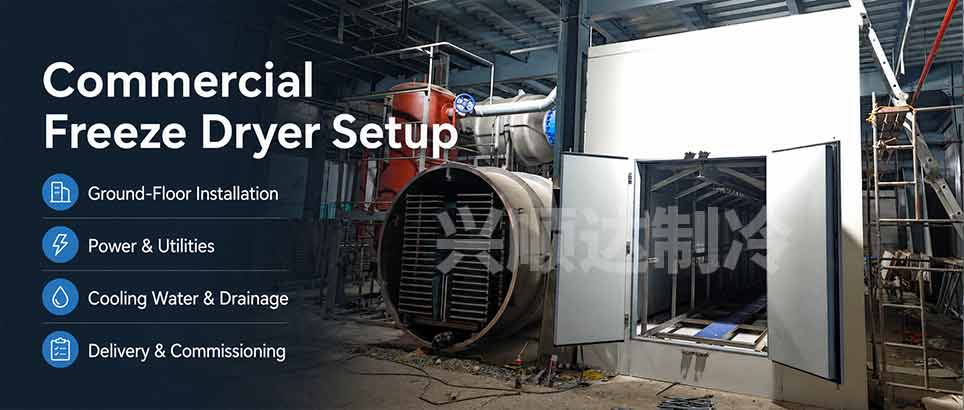
What does a commercial freeze dryer setup require?
Before ordering, confirm the product and prepared wet load, room dimensions, voltage and available transformer capacity, cooling-water temperature and flow, drainage, unloading route, service clearance and local compliance requirements. A verified steam supply is also required when the selected industrial configuration uses steam-supported heating or defrosting.
The supplier should issue a general arrangement drawing, equipment data, utility schedule, connection plan, shipping dimensions, installation scope and acceptance checklist. Final civil and utility work should follow approved project drawings—not a preliminary quotation table. For capacity-related purchase pricing and quotation factors, use the capacity-based equipment price guide.
Send the product, daily wet load and available utilities to receive a model recommendation, preliminary utility requirements and installation-planning feedback.
What must be confirmed before a freeze dryer is ordered?
Installation feasibility belongs in the purchasing decision. A machine can match the target output and still sit idle because the factory cannot provide the required power, cooling, drainage or access.
- Product and duty: Food type, initial moisture or solids, piece size or layer depth, prepared wet load, batches per day and target final moisture.
- Room and structure: Ground-floor installation area for large commercial and industrial systems, clear dimensions, floor condition, drainage slope, anchoring restrictions and maintenance access.
- Utilities: Voltage, phase, frequency, available transformer capacity, cooling-water conditions, drainage and steam when required by the selected configuration.
- Delivery route: Container position, lifting capacity, narrowest opening, corridor height, turning space and final positioning method.
- Commercial scope: Approved drawings, buyer and supplier responsibilities, commissioning tests, training, spare parts and handover records.
Start model selection with tested product data. Tray count alone does not prove capacity. The commercial freeze dryer tray guide explains how tray area, loading density and product depth work together.
Pilot, commercial and industrial freeze dryer setup differences
Setup complexity rises with scale. Pilot systems need less power and simpler access. Commercial systems require planned three-phase power, cooling water and defrost drainage. Industrial systems add steam, heavier support loads, larger refrigeration and vacuum packages, and multi-container delivery planning.
Pilot and commercial installation references
| Model | Machine size or preliminary installation area | Approx. equipment weight | Installed power | Defrost-water reference |
|---|---|---|---|---|
| SDG60 | 2100 × 2000 × 2400 mm; add service space | 750 kg | 11 kW | About 0.5 t hot water per defrost |
| SDG90 | 2300 × 2200 × 2500 mm; add service space | 950 kg | 15.8 kW | About 0.7 t hot water per defrost |
| SDG350 | About 20–30 m²; clear height >3.5 m | 5 t | 58.16 kW | About 1.2 t hot water per defrost |
| SDG700 | About 60–100 m²; clear height >3.5 m | 8.5 t | 111.6 kW | About 1.5 t hot water per defrost |
| SDG1100 | About 60–100 m²; clear height >3.5 m | 9.5 t | 155.9 kW | About 1.8 t hot water per defrost |
Industrial installation and steam references
| Model | Preliminary installation area | Approx. equipment weight | Installed power | Peak steam reference |
|---|---|---|---|---|
| SDG1600 | About 80–120 m²; clear height >5 m | 18 t | 148 kW | 150 kg/h at 0.5–0.7 MPa |
| SDG3000 | About 150–200 m²; clear height >5 m | 31 t | 279.7 kW | 300 kg/h at 0.5–0.7 MPa |
| SDG6000 | About 180–250 m²; clear height >5 m | 47 t | 510.2 kW | 600 kg/h at 0.5–0.7 MPa |
Pilot-model entries show machine dimensions. Commercial and industrial entries show preliminary installation area, including auxiliary equipment and service access. Shipping package weights, cable sizes and connection locations must come from the approved project drawings.
Compare the pilot models, commercial models and industrial models only after the product and site data are available.

Freeze dryer space requirements and food-factory layout
The machine outline is only the starting point
Include the chamber, condenser, refrigeration package, vacuum pumps, control cabinet, piping, loading zone and component-removal path. Door swing, tray-cart movement and pump or compressor replacement can make a room that fits the outline unusable in practice.
Plan the product flow, not only the equipment room
The freeze dryer is one part of a larger production line. Preparation, pre-freezing, loading, drying, unloading, inspection and packaging must work as one flow. Functional zoning and deliberate personnel and material routes reduce cross-traffic and keep wet operations away from dry inspection and packaging areas.1
- Keep the frozen-product route short to limit warming before vacuum is established.
- Separate wet cleaning and defrost activity from dry inspection and packaging where practical.
- Provide aisle width for tray carts, operators and maintenance—not just normal production.
- Protect control cabinets from washdown, condensate and drain splash.
- Reserve a realistic expansion route if another chamber may be added.
For U.S. food facilities, 21 CFR Part 117 Subpart B addresses plant space, sanitary operations, drainage, ventilation, equipment installation and process controls. Local rules and project-country requirements still govern the final design.

Ground-floor installation and equipment positioning
Blast-Freezing Integration
Coordinate the blast-freezing room, blast-freezer air cooler, and freeze-dryer loading interface in the approved project layout.


The listed large commercial and industrial freeze dryers should be installed on the ground floor. Upper-floor installation is generally not accepted because equipment weight, rigging difficulty, drainage, vibration, maintenance access and operational safety become harder to control.
Where a blast-freezing room is included, confirm the feed-track interfaces and installation sequence against the approved layout.

Before installation, the buyer should provide the floor condition, available area, clear height, floor level, anchoring restrictions and foundation information for review. Final civil work and equipment positioning should follow the manufacturer’s approved layout and equipment-weight data. A qualified local structural professional should confirm that the ground-floor installation area and any required foundation are suitable for the selected model.


Review the freeze dryer vacuum chamber design guide when evaluating chamber construction, sealing and long-term leakage risk.

Electrical power requirements
The standard reference supply for the listed food freeze dryers is three-phase 380 V / 50 Hz, with project-specific customization. Confirm voltage and frequency before electrical components are selected and the machine enters production.
Installed power is not transformer capacity
The electrical engineer must review simultaneous load, compressor and motor starting behavior, power factor, cable distance, voltage drop, protective devices and other factory loads. Do not choose a transformer by adding a casual percentage to nameplate power.
- Provide a dedicated distribution point, isolation device and protective grounding.
- Confirm the cable route and local electrical installation method.
- Define emergency-stop, interlock and restart behavior after power loss.
- Include the machine in the factory’s hazardous-energy control procedure.
U.S. facilities can consult OSHA’s electrical safety resources and lockout/tagout overview. For operating-cost estimates, use real cycle time and product load rather than installed kW alone; see the freeze dryer energy guide.
Cooling-water and heat-rejection planning
Cooling-water failure is a production risk, not a minor utility inconvenience. In engineering practice, shared or undersized water networks can cause pressure and temperature variation at the freeze dryer. Insufficient flow reduces condenser heat transfer and can raise compressor discharge pressure and temperature.

| Confirm | Why it matters | Project action |
|---|---|---|
| Maximum inlet temperature | Changes condensing pressure and available refrigeration capacity | Use the seasonal maximum, not today’s reading |
| Flow and pressure at the machine | Pipe loss and simultaneous users can starve the condenser | Verify the worst operating combination |
| Hardness and cleanliness | Scale and fouling reduce heat transfer | Define treatment, filtration and inspection |
| Tower and pump location | Affects head, pipe length, noise and service access | Coordinate before utility piping is installed |
| Cold-weather protection | Outdoor loops can freeze during shutdown | Use an approved drain, insulation or antifreeze strategy |
Refrigeration and condenser capacity must be evaluated as one water-removal system. Read the freeze dryer condenser guide before comparing cold-temperature claims.

Industrial freeze dryer utility requirements: steam
SDG1600, SDG3000 and SDG6000 use electric power plus steam for industrial heat delivery and defrosting. The planning reference is 0.5–0.7 MPa, with approximate peak demand of 150, 300 and 600 kg/h respectively.
Confirm available boiler capacity during the factory’s highest simultaneous demand. Peak demand is not average consumption. The steam design should cover pipe sizing, pressure regulation, isolation, condensate removal, insulation, drainage and safe valve access. Published food-equipment descriptions show that steam can heat the circulating heat-transfer fluid through a heat exchanger, with condensate leaving through a steam trap.3
Drainage, defrost water and ventilation
Ice captured on the condenser can produce a large volume of water over a short period during defrost. A food freeze-dryer operating description specifies opening the drain before the defrost-water inlet, draining the chamber completely, and confirming both valves are closed before vacuum operation.3 The final sequence must follow the ordered machine’s manual.
- Place the drain or channel near the approved outlet point.
- Confirm pipe size, slope, trap arrangement and backflow protection.
- Keep electrical cabinets and cable routes away from wet zones.
- Decide whether product residue, cleaning water and defrost water need separate handling.
- Check wastewater, sanitation and cold-weather requirements before discharge.
Also account for heat from compressors, pumps, motors and controls. Define the allowable room temperature, ventilation path, outdoor heat-rejection equipment, pump exhaust or oil-mist control, and noise management. A small sealed equipment room is not a production plan.
Delivery, unloading and installation access
Check the complete route from container position to the final support points. Door width alone is insufficient. Include unloading distance, crane or forklift capacity at the real load center, turning radius, ramps, pits, overhead services, corridor height and the final positioning method.
Include the blast-freezer air cooler in the delivery and unloading plan when it is part of the approved blast-freezing system.

- Compare shipping dimensions with the narrowest route point.
- Verify fork length and rated lifting capacity at the required reach.
- Review slopes, cable trenches and temporary steel-plate needs.
- Identify temporary wall, door or roof-panel removal.
- Reserve unpacking and shipped-section assembly space.
- Use only manufacturer-approved lifting points and procedures.


Large systems may arrive in several containers or frame containers. Coordinate the receiving plan with local riggers before shipment—not when the first truck reaches the gate.


Documents and responsibilities required before delivery
Ask for controlled project documents
- Approved general arrangement drawing and maintenance clearances
- Machine weight, support points and foundation-load information
- Electrical load schedule and connection requirements
- Cooling-water temperature, flow, pressure and connection data
- Industrial steam demand, pressure and connection data
- Drainage and defrost-water connection plan
- Shipping dimensions, package weights and lifting instructions
- Utility connection-point drawing, manuals and commissioning checklist
- Recommended consumables and critical spare-parts list
Define “installation included” in the contract
| Work item | Typical factory responsibility | Typical manufacturer responsibility |
|---|---|---|
| Civil and structural | Foundation, openings, local approvals and structural verification | Equipment weight, support loads and layout data |
| Utilities | Bring compliant services to agreed points | Issue utility requirements and machine-side connections |
| Unloading and positioning | Riggers, lifting equipment, route preparation and permits | Package data, lifting instructions and agreed supervision |
| Installation labor | Local electricians, pipefitters and general labor unless contracted | Assembly, technical supervision and system checks as agreed |
| Commissioning | Utilities, operators, product, test materials and site safety | Functional checks, loaded-test support and parameter guidance |
| Training and records | Nominate operators and maintenance staff | Provide agreed operation, maintenance and process training records |
Commercial freeze dryer installation services: what should be included?
Freeze dryer installation services should be defined as a deliverable, not a vague promise. Depending on the contract, the manufacturer may provide remote drawing review, on-site installation supervision, equipment positioning checks, machine-side connection verification, vacuum and refrigeration commissioning, a loaded product test, operator training and handover records. Civil work, plant utilities, unloading equipment, local labor and permits are normally supplied by the buyer unless the contract states otherwise.
Before shipment, the quotation or contract should name the service location, number of service days, travel and visa costs, local labor requirements, test product, acceptance criteria, training scope and the party responsible for delays caused by an unfinished site. This prevents “installation included” from being interpreted differently after the equipment arrives.
Freeze dryer installation, commissioning and acceptance
- Approve the layout. Freeze the final position, clearances, utility routes and product flow.
- Prepare the site—buyer responsibility. The buyer completes the required civil work, electrical supply, cooling water, steam where applicable, drainage, ventilation and equipment-access route according to the manufacturer’s approved drawings and utility requirements.
- Inspect the shipment. Record package condition, shipping-list results and visible damage.
- Position and connect. Level the machine and complete approved mechanical and electrical connections.
- Run dry functional checks. Verify phase sequence, grounding, valves, pumps, interlocks, alarms and emergency stops.
- Test vacuum and refrigeration. Record vacuum-down behavior, leakage, temperatures, pressures and stable condenser operation.
- Verify controls and data. Check sensors, HMI, trends, recipes, remote functions and safety logic.
- Run a documented loaded test. Fix product, thickness, loading density, cycle settings and endpoint criteria.
- Train and hand over. Sign the acceptance record and assign maintenance, spare-parts and process owners.
Turn acceptance into measurable evidence
Calibration research on freeze dryers treats temperature distribution, temperature deviation, working vacuum, ultimate vacuum and leakage as separate performance questions.2 Although that study concerns pharmaceutical equipment, the principle is useful for food projects: define each measurement, test condition, instrument and pass criterion before commissioning.
For projects with a blast-freezing room, coordinate its installation interfaces with freeze-dryer commissioning and acceptance checks.

| Acceptance record | What it should state |
|---|---|
| Electrical and safety | Supply, grounding, phase sequence, protection, emergency stop, alarms and isolation |
| Vacuum-down test | Starting condition, valve positions, instrument, target pressure and elapsed time |
| Leak test | Stabilization period, chamber condition, pressure-rise method and agreed limit |
| Condenser test | Temperature, refrigeration pressures, alarms and vapor-capture behavior |
| Heating and controls | Zone response, sensor agreement, records, recipes and interlocks |
| Defrost and drainage | Ice removal, discharge route, leakage, backup and final valve state |
| Loaded product test | Product, wet load, thickness, cycle, final moisture, quality and signatories |


Vacuum fault literature shows why a single “vacuum reached” result is weak: slow pump-down, poor ultimate vacuum and excessive leakage can have different causes and require different checks.4 For the listed commercial models, the manufacturer’s planning reference is less than 18 minutes to 133 Pa. The contract must still define whether the chamber is empty or loaded and how the test is performed. See the freeze dryer vacuum pump guide for pump configuration, pump-down time and vacuum-measurement considerations.
Pre-installation checklist for food manufacturers
Send this information before asking for a final model, price or factory layout.
- Product name, photographs and preparation method
- Piece size, slice thickness or liquid fill depth
- Initial moisture or solids and target final moisture
- Wet load per day, batches per day and operating calendar
- Ground-floor installation area, clear height and future expansion plan for large commercial or industrial systems
- Door, corridor, turning and container-unloading dimensions
- Voltage, phase, frequency and available transformer capacity
- Cooling-water maximum temperature, flow, pressure and quality
- Steam pressure and available peak capacity for industrial scale
- Drain position, capacity, wastewater route and wet-zone controls
- Project country, local codes and required documentation
- Target delivery, installation and production-start dates
Receive a recommended model, preliminary utility requirements and installation-planning feedback.
Commercial freeze dryer setup FAQ
How much space does a commercial freeze dryer need?
Commercial models in this range generally require approximately 20–100 m², depending on model size, auxiliary equipment and the required service access. The approved layout must define the final room size, equipment position and maintenance clearances.
Does a commercial freeze dryer require three-phase power?
The standard reference configuration is three-phase 380 V / 50 Hz. Project-country voltage and frequency can be customized, but must be confirmed before manufacture. A qualified electrical engineer should calculate distribution and transformer capacity.
Does an industrial freeze dryer need steam?
The listed SDG1600, SDG3000 and SDG6000 use electric power plus steam. Their planning reference is 0.5–0.7 MPa, with peak demand determined by model and final project design.
Does a commercial freeze dryer need cooling water?
The listed commercial and industrial configurations require reliable heat rejection. Confirm maximum inlet-water temperature, flow, pressure and water quality at the machine while other factory users are operating.
Who installs a commercial freeze dryer?
It depends on the contract. The manufacturer may provide full installation, on-site supervision or remote guidance. The buyer commonly provides civil work, utilities, unloading equipment and local labor. List every responsibility before shipment.
Can a large commercial or industrial freeze dryer be installed upstairs?
The listed large commercial and industrial freeze dryers are intended for ground-floor installation. Upper-floor installation is generally not accepted because of equipment weight, rigging, drainage, vibration, maintenance access and operational safety requirements.
How long does installation and commissioning take?
It depends on model size, shipping condition, site readiness, local labor and utility completion. A reliable schedule can be issued only after the layout, connection work, test plan and responsibilities are approved.
Technical review
Zheng Wei
Founder & Freeze-Drying System Engineer
Fuzhou Xing Shun Da Refrigeration Facility Project Co., Ltd.
Zheng Wei participates in the company’s food freeze-drying projects, including product tests, model selection, vacuum-system configuration, refrigeration planning, installation guidance and drying-process optimization for fruit, vegetables, prepared foods, seafood, meat, dairy, herbs and extracts.
Evidence and references
Numbered references support only the statements marked in the article. Pharmaceutical-equipment evidence is used as transferable engineering practice, not as a food-equipment legal requirement. Where no DOI could be confirmed in accessible journal records, the entry states this explicitly instead of publishing an unverified identifier. Model values are manufacturer planning data and must be confirmed in the ordered model’s approved documents.
- 赵鹤皋、林秀诚:《工业食品冷冻干燥机的设计》,《流体机械》,1996年第5期,第49–52页。DOI:未发现已分配 DOI。 Used for food freeze-dryer system configuration and production-line design considerations.
- 赵晶、张海锭、万正军、魏嵬、许澍、常稼强、王宇航、陈守彬:《药用真空冷冻干燥机校准方法研究》,《计量与测试技术》,2023年第50卷第10期,第80–83页。DOI:未发现已分配 DOI。 Used for the transferable acceptance framework: temperature, working vacuum, ultimate vacuum and leakage are separate performance questions.
- 石云波:《真空冷冻干燥技术及其在海产品加工中的应用》,《制冷与空调》,2012年第12卷第2期,第47–51页。DOI:未发现已分配 DOI。 Used for steam heat-exchanger description, defrost sequence and food freeze-dryer system operation.
- 程思远、董博:《冻干机真空异常诊断及排查方法》[EB/OL],PharmaTEC制药网,2023年3月2日。DOI:无。 Source page。 Used to distinguish pump-down, ultimate-vacuum and leakage problems during acceptance.