
Vacuum Pump for Freeze Dryer: How to Choose the Right System for Food Production
Choosing a vacuum pump for freeze dryer equipment requires more than comparing pump CFM or selecting the largest available motor. The vacuum pump, chamber, condenser, valves, piping and refrigeration system must operate as one balanced system. This guide explains the pressure, effective pumping speed, vapor handling, leak rate and maintenance factors food producers should evaluate before buying a food freeze dryer.
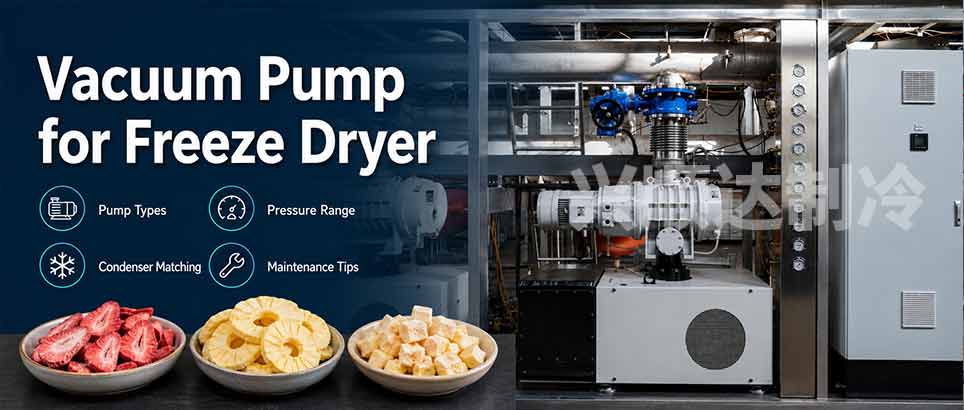
What Does a Vacuum Pump Do in a Freeze Dryer?
A freeze dryer vacuum pump removes air and other non-condensable gases from the chamber and maintains the low-pressure environment required for sublimation. Under suitable temperature and pressure conditions, ice inside the frozen product changes directly into water vapor.
The pump should not be treated as the primary water-removal device. At freeze-drying pressure, even a small mass of water vapor occupies a very large volume. For example, at approximately 133 Pa and around room temperature, 1 gram of water vapor occupies close to 1 cubic meter. Trying to remove the complete vapor load with an ordinary mechanical pump would therefore require an impractically large pumping capacity.
The freeze dryer condenser, also called the ice condenser or cold trap, captures most of the water vapor as ice. The mechanical vacuum system mainly removes:
- Air remaining in the chamber during initial evacuation
- Gas entering through seals, valves and pipe connections
- Non-condensable gases released by the product
- Residual water vapor not captured by the condenser
Separate These Three Vacuum Specifications
Buyers often compare vacuum systems using a single pressure number. This can be misleading because a freeze dryer has several different pressure specifications.
| Specification | What It Means | Why It Matters |
|---|---|---|
| Ultimate or empty-chamber pressure | The lowest pressure reached by a clean, dry and empty system after sufficient pumping time. | Shows the basic condition of the pump, seals and vacuum system, but does not represent production performance. |
| Operating pressure under load | The controlled chamber pressure while water vapor is being generated during drying. | This is the pressure that interacts with product temperature and the drying recipe. |
| Evacuation time | The time required to reduce chamber pressure from atmospheric pressure to a defined target pressure. | Shows whether the installed pump, piping and valves provide sufficient effective pumping speed. |
A pump may have an excellent ultimate pressure but still evacuate a large chamber too slowly. Conversely, a high-flow pump may evacuate the chamber quickly but fail to maintain pressure if the system has excessive leakage or water-vapor carryover.
Why Pump CFM Alone Is Not Enough
CFM or cubic meters per hour describes the nominal displacement of a pump under specified test conditions. The pumping speed available at the freeze dryer chamber can be much lower because gas must travel through valves, elbows, pipes and the condenser.
The capacity that matters is the effective pumping speed at the chamber, not only the rated speed printed on the pump nameplate.
Actual evacuation performance is affected by:
- Drying chamber volume
- Pump performance at the required pressure
- Vacuum pipe diameter and length
- Valve opening and internal flow area
- Number of elbows and restrictions
- Condenser structure and frost accumulation
- Door gasket, valve and pipe leakage
- Moisture remaining after cleaning or defrosting
Typical Vacuum Pump Configurations for Freeze Dryers
There is no pump configuration that is automatically best for every freeze dryer size. The selection should consider pressure range, chamber volume, evacuation time, water-vapor tolerance, utility availability, maintenance capability and total operating cost.


| Configuration | Typical Characteristics | Selection Conditions | Points to Check |
|---|---|---|---|
| Oil-sealed rotary vane pump | Compact, mature and relatively economical | Common for laboratory, pilot and selected small production systems | Oil contamination, gas ballast, vapor protection and service interval |
| Roots booster with oil-sealed backing pump | Higher pumping speed in the operating pressure range | Used when faster evacuation or greater effective pumping speed is required | Booster starting pressure, interlocks, oil condition and condenser performance |
| Roots booster with liquid-ring backing pump | Better tolerance of wet gas than many oil-sealed arrangements | Useful where suitable water supply and wastewater management are available | Water temperature, water quality, achievable pressure, corrosion and utility consumption |
| Dry vacuum pump | Avoids process-side pump oil and reduces oil-related maintenance | Selected when cleanliness, oil-free operation or a specific maintenance strategy justifies the cost | Purchase cost, vapor tolerance, cooling, service access and actual performance under load |
| Steam ejector system | Can directly handle large vapor loads without a conventional mechanical pump arrangement | Considered where stable steam and cooling-water utilities are available | Steam pressure stability, water use, energy cost, start-up procedure and backflow protection |

Pump type should therefore be presented as an engineering selection, not as a fixed rule based only on whether a freeze dryer is called laboratory, commercial or industrial.
What Vacuum Pressure Does a Food Freeze Dryer Need?
Food freeze drying does not require the lowest possible pressure at every stage. The operating pressure must support sublimation while keeping the product below its critical temperature.
Depending on product composition, the critical limit may be related to eutectic temperature, collapse temperature or glass-transition behavior. Product temperature, shelf temperature, condenser temperature and chamber pressure must therefore be considered together.
The operating pressure of freeze-drying equipment is typically controlled between 26 and 133 Pa.
Reliable measurement is as important as the target pressure. The gauge should have a suitable range, acceptable accuracy and stable behavior in the presence of water vapor. For additional technical background, buyers can review NIST pressure and vacuum calibration resources and vacuum measurement fundamentals from Pfeiffer Vacuum.
The sensor position must also be documented. Pressure at the chamber, condenser and pump inlet may differ because of gas-flow resistance. For a broader process explanation, read the related guide on freeze-drying temperature and pressure.
The Vacuum Pump Must Match the Condenser
The condenser captures water vapor and maintains the pressure difference that drives vapor from the product toward the cold surface. If the condenser is too warm, too small or overloaded, more vapor can reach the mechanical pump.
Excessive vapor carryover can contaminate pump oil, reduce pumping performance and increase maintenance. It can also cause unstable chamber pressure and longer drying cycles.
Confirm the maximum kilograms of ice the condenser can hold during one complete batch.
Confirm the kilograms of water vapor the condenser can capture per hour during peak sublimation.
Evaluate operating temperature and temperature uniformity under a real vapor load.
Check whether frost accumulation reduces the open flow area between chamber and pump.
Ensure the condenser is fully defrosted and dried before the next vacuum cycle.
Compare internal and external condenser layouts, vapor-path resistance and production workflow.
Total ice capacity and peak capture rate are different specifications. A condenser may hold enough ice for the batch but still fail to capture vapor fast enough during the highest sublimation period.
How to Size a Freeze Dryer Vacuum System
Preliminary evacuation calculations can relate chamber volume, effective pumping speed, starting pressure and target pressure. However, ideal calculations do not include leakage, desorption, moisture, pressure-dependent pump performance or restrictions inside the real machine.
In this simplified relationship, V is the evacuated volume, Seff is effective pumping speed at the chamber, P1 is starting pressure and P2 is target pressure.
The calculation is useful for comparison, but final selection should be confirmed through testing.
| Required Project Data | Why It Is Needed |
|---|---|
| Product type and composition | Different products have different critical temperatures, vapor loads and drying behavior. |
| Wet product weight per batch | Defines production scale and contributes to total water load. |
| Initial and final moisture targets | Allow the approximate mass of water to be removed to be calculated. |
| Slice thickness or tray loading depth | Affects internal mass-transfer resistance and drying time. |
| Chamber and connected-system volume | Determines the gas volume that must be evacuated. |
| Target operating pressure | Defines the relevant part of the pump-performance curve. |
| Required evacuation time | Helps determine effective pumping-speed requirements. |
| Condenser ice capacity | Confirms whether total batch water can be captured safely. |
| Peak condenser capture rate | Shows whether the condenser can handle maximum sublimation flow. |
| Pipe and valve dimensions | Required to evaluate system conductance and chamber-side pumping speed. |
| Estimated leak rate | Defines the continuous non-condensable gas load. |
| Factory utilities | Power, cooling water, ventilation, steam and drainage may limit pump selection. |
Example of a useful supplier proposal
A useful proposal should not simply state a pump model and nominal CFM. It should document the chamber volume, target pressure, predicted evacuation time, pump curve, pipe diameter, valve size, condenser performance and acceptance-test conditions.
Vacuum System Acceptance Tests
Request measurable acceptance criteria before ordering the equipment. Tests should define the machine condition, starting pressure, target pressure, condenser status and which pumps are operating.
Empty-Chamber Evacuation Test
Measure the time required to pump a clean, dry and empty chamber from atmospheric pressure to a specified pressure.
Pressure-Holding or Leak Test
Isolate the chamber at a defined pressure and measure the pressure rise over a defined period.
Production-Load Test
Confirm pressure stability, condenser temperature, pump behavior and cycle performance using an agreed product load.
Under the specified test method, the equipment typically achieves an empty-chamber evacuation time of less than 18 minutes.
Freeze Dryer Vacuum Pump Oil and Maintenance
In an oil-sealed pump, oil provides sealing, lubrication and cooling. Water, product vapor, particles and oxidation products can reduce oil performance.
Milky oil commonly indicates water contamination. Dark oil may indicate oxidation, overheating or process contamination. These symptoms should trigger inspection of the condenser, gas ballast, operating procedure and pump condition.

Maintenance points to include in the operating plan
- Use the oil grade specified by the pump manufacturer.
- Check oil level, color and contamination at documented intervals.
- Base oil-change frequency on operating hours, vapor exposure and pump condition.
- Use gas ballast according to the pump manufacturer’s instructions.
- Inspect inlet filters, exhaust filters, seals, flexible joints and valves.
- Check cooling-water or air-cooling performance where applicable.
- Trend evacuation time and operating pressure to identify gradual deterioration.
- Keep critical oil, filters, seals and service parts available.
An oil-free pump avoids process-side pump oil, but it is not maintenance-free. Bearings, seals, cooling systems and internal clearances still require inspection and service.
Common Vacuum Pump Selection Mistakes
- Comparing nominal CFM only. Nameplate flow does not show effective pumping speed at the chamber.
- Ignoring the pump curve. Pumping speed changes with inlet pressure and pump configuration.
- Using pipes that are too narrow. Poor conductance can prevent the chamber from receiving the benefit of a larger pump.
- Ignoring condenser peak load. Total ice capacity does not prove sufficient hourly capture performance.
- Mixing ultimate and operating pressure. Empty-chamber pressure does not represent loaded production conditions.
- Skipping leak-rate testing. Leaks add a continuous gas load and may prevent stable pressure control.
- Oversizing without an energy review. An unnecessarily large pump can increase power and maintenance costs.
- Choosing pump type by machine label alone. “Commercial” or “industrial” does not define vapor load, utilities or pressure requirements.
Questions to Ask a Freeze Dryer Supplier
Request the total evacuated volume, including connected condenser volume where relevant.
Separate empty-chamber pressure, operating pressure and test pressure.
Ask for starting pressure, target pressure and exact test conditions.
Do not rely only on the pump manufacturer’s nominal displacement.
Request the main pump, backing pump, booster and control sequence.
Check condenser performance, gas ballast and vapor-tolerant pump features.
Request both total ice capacity and peak capture rate.
Confirm the vapor path is not restricting effective pumping speed.
Ask for the test method, isolation period and permitted pressure rise.
Compare oil, filters, seals, cooling, service access and spare-part availability.
Confirm electrical load, cooling water, ventilation, steam and drainage.
Request performance data from a representative product or agreed test material.
Need Help Matching the Pump, Condenser and Freeze Dryer?
A reliable vacuum-system recommendation should begin with product type, wet batch weight, initial moisture, target final moisture, slice thickness, chamber volume, target pressure, cycle time and available factory utilities.
Send these project details to receive a configuration recommendation covering chamber size, condenser capacity, pump arrangement and utility requirements.
Request a Freeze Dryer Vacuum System RecommendationFAQ About Freeze Dryer Vacuum Pumps
What size vacuum pump do I need for a freeze dryer?
Pump size depends on chamber volume, target pressure, required evacuation time, pipe conductance, leak rate and condenser performance. Nominal CFM alone is not sufficient for final selection.
What vacuum pressure is required for food freeze drying?
Freeze-drying equipment typically operates between 26 and 133 Pa. The actual operating pressure must also consider product temperature, loading thickness, heat input and product-specific critical limits.
Does a larger vacuum pump make freeze drying faster?
Not necessarily. Once air and non-condensable gases are adequately controlled, drying rate is often limited by heat transfer, internal product resistance, condenser performance or vapor-path conductance. A larger pump cannot correct these limitations.
Why does freeze dryer vacuum pump oil turn milky?
Milky oil usually indicates water contamination. Possible causes include condenser overload, incomplete defrost drying, excessive vapor carryover, inappropriate gas-ballast operation or a product that partially melted.
Is an oil-free vacuum pump better for freeze drying?
An oil-free pump removes oil-related process concerns but may cost more and still requires scheduled maintenance. The decision should be based on vapor load, cleanliness requirements, pressure performance, energy use and service capability.
Can a refrigeration service pump be used on a food freeze dryer?
A service pump intended for evacuating refrigeration systems is generally not a direct replacement for a production freeze dryer vacuum system. Continuous operation, chamber size, water-vapor exposure, pressure range and maintenance requirements must all be evaluated.
Why does a freeze dryer take too long to reach vacuum?
Common causes include wet chamber surfaces, leaks, contaminated oil, blocked filters, worn pumps, narrow piping, restricted valves, an overloaded condenser or insufficient effective pumping speed.
Which is more important, the vacuum pump or the condenser?
They perform different but connected functions. The condenser captures most water vapor, while the pump removes air and non-condensable gases and maintains low pressure. Reliable freeze drying requires both systems to be correctly matched.
Conclusion
A vacuum pump for freeze dryer equipment should not be selected by CFM, motor power or ultimate pressure alone. The complete system must be evaluated using chamber volume, effective pumping speed, operating pressure, evacuation time, leak rate, pipe conductance, condenser capacity and vapor-handling capability.
The best vacuum system is not automatically the largest or most expensive option. It is the configuration that reaches the required pressure within the agreed time, remains stable under production load, protects the pump from excessive water vapor and supports consistent product quality at an acceptable operating cost.
Related resources: Freeze Dryer Condenser Guide | Freeze-Drying Temperature and Pressure | Commercial Freeze Dryer | Industrial Freeze Dryer | Customer Case Studies