
How to Choose a Food Freeze Dryer for Commercial Production
Do not select a commercial food freeze dryer only by tray quantity, chamber size, or purchase price. Correct sizing starts with prepared wet material, water removal per batch, usable shelf area, loading thickness, cold trap capacity, vacuum stability, full cycle time, factory utilities, and required product quality.
This engineering-based guide compares food freeze drying equipment for fruits, vegetables, meat, seafood, pet food, tea, coffee, extracts, and ready meals. It also connects model selection with real production data, so buyers can prepare a more accurate quotation and reduce scale-up risk.
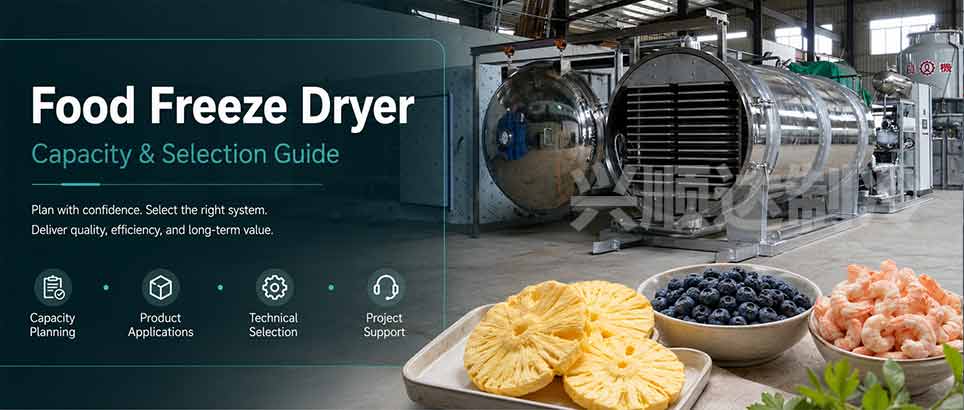
What Is a Food Freeze Dryer?
A food freeze dryer is a vacuum drying system that removes water from frozen food primarily through sublimation. During sublimation, ice changes directly into water vapor without first becoming liquid water.
When the freezing and drying process is properly developed, freeze-dried food can retain a porous structure, low weight, good shape, rapid rehydration, and more heat-sensitive qualities than food exposed to high-temperature drying.
In addition, a complete commercial system may include a drying chamber, trays or carts, heating plates, vapor condenser, refrigeration system, vacuum pumps, process controls, defrost system, pre-freezing equipment, loading equipment, and cleaning and drainage arrangements.
How Does Food Freeze-Drying Work?
In practice, food freeze-drying is not a single-temperature drying step. A complete process normally includes product preparation, pre-freezing, primary drying, secondary drying, unloading, and moisture-protective packaging.
Product Preparation
First, operators sort, wash, cut, cook, blanch, peel, mix, or mold the raw material as required. Slice thickness, liquid depth, surface skin, sugar, fat, and loading density can all affect drying time.
Pre-Freezing
Next, freeze the product to a validated temperature before vacuum drying. The product center temperature, freezing rate, and time should be considered instead of relying only on the air temperature of the freezer.
Primary Drying
Then, the system reduces chamber pressure and supplies controlled heat. Frozen water sublimates, and the resulting vapor moves to the colder condenser surface.
Secondary Drying
After most ice leaves the product, operators may raise its temperature within a safe limit to remove part of the remaining bound or adsorbed water.
Endpoint Verification
However, time alone is not a reliable drying endpoint. Product temperature, pressure behavior, moisture testing, water activity, or another validated method should be used.
Unloading and Packaging
Finally, freeze-dried products absorb moisture rapidly. They should be moved promptly into a controlled packaging area and sealed in suitable moisture- and oxygen-barrier packaging.
What Foods Can a Food Freeze Dryer Process?
In practice, many foods can be freeze-dried, but different materials require different preparation methods and drying recipes. A successful process for apple slices cannot automatically be used for shrimp, cooked rice, coffee extract, or raw pet food.
Fruits
For example, strawberry, blueberry, mango, pineapple, apple, pear, fig, and durian are common applications. Sugar concentration, skin structure, ripeness, pretreatment, and slice thickness affect product temperature and drying time.
Vegetables and Mushrooms
Likewise, carrot, radish, broccoli, leafy vegetables, mushroom, garlic, and soup ingredients may require blanching, color protection, controlled cutting, and consistent loading.
Meat, Seafood and Pet Food
By contrast, meat, shrimp, fish, and pet food require careful control of fat, thickness, microbial hazards, cooking or kill steps, sanitation, and post-drying contamination.
Rice and Ready Meals
Meanwhile, cooked rice, noodles, soup, complete meals, and instant ingredients require recipe testing because starch structure, oil, salt, and solids concentration influence drying and rehydration.
Tea, Coffee and Extracts
In addition, liquid extracts may need shallow tray loading, suitable molds, or specialized feeding methods. Their freezing behavior and collapse temperature can differ significantly from solid foods.
Functional Ingredients
For heat-sensitive applications, botanical ingredients, cultures, enzymes, and heat-sensitive materials may require tighter product-temperature control and more detailed process validation.
For additional product examples, see what foods can be freeze dried .
How to Calculate Food Freeze Dryer Capacity
Do not select a food freeze dryer from finished product weight alone. Capacity depends on prepared wet material, dry solids, removable water, usable tray area, loading density, cold trap load, full cycle time, and equipment utilization.
Step 1: Define the Prepared Wet Load
First, use the material that actually enters the freeze dryer after washing, peeling, cutting, cooking, draining, or concentration. This is often lower than the raw material purchased by the factory.
Step 2: Calculate the Water to Be Removed
For example, 1,000 kg of prepared fruit at 80% initial moisture contains 200 kg of dry solids. If the target final moisture is 3%, the estimated final product weight is 206.2 kg. Therefore, the system must remove about 793.8 kg of water during the batch.
However, this mass balance is a planning estimate. Actual production should also allow for sampling, tray residue, product rejection, and packaging loss.
Step 3: Determine the Required Usable Area
Next, calculate shelf area from a validated wet loading density rather than tray count alone. Many sliced or prepared food projects load approximately 10–13 kg/m², although the correct value depends on product structure, thickness, and the validated drying curve.
For example, if the project loads 1,000 kg at 12 kg/m², it needs about 83.3 m² of usable tray area. The quoted area should exclude surfaces that cannot actually hold product.
Step 4: Match the Cold Trap to the Water Load
However, chamber area alone does not guarantee output. The cold trap must capture the released vapor while maintaining stable pressure during the highest sublimation load. Buyers should compare total capture capacity, capture rate, frost distribution, vapor path, and defrost time.
Step 5: Calculate Real Daily Throughput
Finally, daily production includes loading, vacuum pull-down, primary drying, secondary drying, pressure release, unloading, defrosting, cleaning, and preparation for the next batch. Therefore, advertised batch capacity should not be treated as guaranteed daily output.
Food Freeze Dryer Model and Production Path
In practice, the safest equipment path follows the production stage. Pilot equipment develops the recipe and scale-up data. Commercial models support regular batch production, while industrial systems require plant-level utility, layout, handling, and installation planning.
| Production Stage | Model Range | Typical 24-Hour Wet Material Capacity | Best Use |
|---|---|---|---|
| Lab and pilot testing | SDG60 / SDG90 | Approximately 60–80 kg / 90–120 kg | Recipe development, sample production, loading tests and scale-up records. |
| Commercial production | SDG350 / SDG700 / SDG1100 | Approximately 340–450 kg / 680–900 kg / 1.02–1.36 t | Regular batches for fruit, vegetables, prepared meals, meat, seafood, pet food and ingredients. |
| Industrial production | SDG1600 / SDG3000 / SDG6000 | Approximately 1.2–2 t / 3–4 t / 6–8 t | Large food factories with planned utilities, loading logistics, installation and multi-batch production. |
However, confirm these typical wet-food capacity ranges against product moisture, thickness, loading density, cycle time and final quality. They are not universal guarantees for every recipe.
Technical Specifications Buyers Should Compare
A reliable quotation should provide more than model name, tray number, chamber dimensions, and installed power. The following specifications have a direct influence on process stability, throughput, product uniformity, and operating cost.
1. Usable Shelf Area
First, confirm the actual tray area available for product, tray dimensions, shelf spacing, number of carts, and recommended loading density. Exclude surfaces that cannot hold product from the nominal area.
2. Loading Uniformity
In addition, uneven tray depth and inconsistent heat transfer can produce different final moisture levels within the same batch. Ask how temperature and heat distribution are controlled across shelves.
3. Condenser Capacity
Next, compare total ice capacity, operating temperature, surface temperature uniformity, vapor path, defrost method, and expected capture performance during peak sublimation.
4. Vacuum System
Also, ask for working pressure range, pull-down time, leak-rate test, vacuum pump arrangement, water-vapor protection, maintenance requirements, and pressure control method. Food projects commonly operate within a controlled range such as 26–100 Pa, rather than at the lowest pressure the pump can reach in an empty chamber.
5. Heating System
Meanwhile, heating must be controllable and uniform. Compare electric, steam, hot-water, or heat-transfer-fluid designs according to factory utilities and required production scale.
6. Product Temperature Monitoring
However, shelf or heating-plate temperature is not the same as product temperature. The control system should support suitable product sensors and downloadable batch records.
7. Frozen-Product Transfer
Before primary drying, complete frozen-product transfer and vacuum pull-down quickly enough to prevent surface thawing, structural damage, or process instability.
8. Drying Endpoint
In addition, ask whether the system uses product-temperature response, pressure-rise testing, comparative pressure measurement, moisture testing, or another validated endpoint method.
9. Sanitary Construction
For sanitation, review product-contact materials, weld finish, tray design, drainage, access for cleaning, dead spaces, door seals, cleaning procedures, and compatibility with the intended food.
10. Controls and Records
Moreover, the system should record time, product temperature, shelf temperature, chamber pressure, condenser temperature, alarms, and recipe changes for each production batch.
11. Defrost and Turnaround
As a result, defrosting can reduce daily throughput. Compare defrost time, water removal, drainage, cleaning time, and preparation time between batches.
12. Service and Spare Parts
Finally, check commissioning, operator training, process assistance, remote support, spare-part availability, refrigeration service, vacuum-pump maintenance, and warranty scope.
For more information about vapor capture, read the freeze dryer condenser guide . Buyers who need traceable pressure measurement can also review NIST pressure and vacuum calibration information .
How Long Does Food Freeze-Drying Take?
There is no reliable universal drying time for all foods. In many commercial food projects, drying may take about 8–15 hours, while liquid, thick, dense, or high-solids products may require up to about 20 hours. The actual cycle depends on the product and process conditions, including:
- Product shape, slice thickness and liquid depth.
- Initial moisture, solids, sugar, salt and fat content.
- Skin, wax layer, fiber structure and pretreatment.
- Loading density and tray arrangement.
- Freezing rate, freezing temperature and ice-crystal structure.
- Allowable product temperature during primary drying.
- Chamber pressure, heat input and vapor-flow resistance.
- Condenser temperature and vapor capture performance.
- Target final moisture and water activity.
- Method used to determine the drying endpoint.
For example, thin, porous products may dry faster than thick, dense, sugary, fatty, or liquid products. The cycle should therefore be developed for the actual product, loading pattern, equipment scale, and required quality.
Therefore, the most reliable method is to complete sample testing, identify the drying endpoint, repeat the test, and then apply a justified scale-up factor for the production machine.
Product Quality and Drying Endpoint
In practice, a product can look dry on the surface while still containing frozen or concentrated moisture inside. Extending every batch for an arbitrary safety period can reduce throughput and waste energy, while ending too early can cause unstable product and packaging failure.
Quality Indicators to Define Before Equipment Selection
- Target final moisture content.
- Target water activity.
- Color and acceptable color change.
- Shape retention, shrinkage and structural collapse.
- Texture, crispness or required hardness.
- Rehydration time and rehydration ratio.
- Aroma and flavor retention.
- Batch uniformity between trays and shelf positions.
- Microbiological and chemical specifications.
- Expected shelf life in the selected packaging.
Possible Endpoint Methods
Depending on the machine and product, endpoint evaluation may include product-temperature stabilization, pressure-rise testing, comparison of pressure measurements, mass change, vapor measurement, or laboratory testing of moisture and water activity.
However, do not assume that one sensor represents every tray. Endpoint procedures and sample locations should be validated for the actual loading pattern. For shelf-stability planning, buyers can also review the FDA technical guidance on water activity in foods .
Food Safety, Sanitation and Packaging
Freeze-drying removes water, but food businesses should not treat it as a validated microbial kill step without supporting evidence. Microorganisms may survive freezing and low-moisture processing. Food safety controls must be designed for the specific product, process, facility, and sales market.
However, this is especially important for raw meat, raw pet food, seafood, dairy-containing products, ready-to-eat meals, powders, and products consumed without additional cooking.
Food Safety Questions for the Project
- Does the process include a validated cooking, pasteurization or other kill step?
- Are raw and ready-to-eat areas separated?
- Which cleaning procedure applies to trays, carts, chamber surfaces and tools?
- Which environmental controls protect the product after drying?
- How quickly is the product packaged after unloading?
- What moisture, water-activity and microbiological limits apply?
- How are batch records, traceability and corrective actions managed?
Therefore, food businesses should develop a hazard analysis and appropriate preventive controls for their products. Refer to official FDA HACCP resources and FSMA preventive controls information where applicable.
Packaging Requirements
After drying, freeze-dried foods are often porous and hygroscopic. Exposure to humid air can quickly damage texture and increase moisture. Packaging should be selected according to the product’s sensitivity, expected shelf life, distribution conditions, and target market.
- Use suitable moisture-barrier packaging.
- Consider oxygen-barrier performance for oxidation-sensitive foods.
- Evaluate nitrogen flushing, vacuum packing or oxygen absorbers.
- Verify seal strength and package integrity.
- Control humidity and exposure time in the packaging room.
- Confirm shelf life through product and packaging tests.
How Much Does a Commercial Food Freeze Dryer Cost?
In practice, the price depends on usable drying area, chamber volume, condenser design, refrigeration system, vacuum equipment, heating method, controls, materials, automation, utilities, installation, and service scope.
Equipment Cost
First, equipment cost covers the drying chamber, condenser, refrigeration system, vacuum pumps, heating system, control cabinet, trays, carts, sensors, defrost equipment, and standard accessories.
Factory Project Cost
In addition, project cost includes freight, foundation, installation, electrical work, cooling water, steam, compressed air, drainage, pre-freezing, packaging rooms, ventilation, and building modifications.
Operating Cost
Meanwhile, operating cost includes electricity, steam, cooling water, labor, packaging, cleaning, vacuum-pump service, refrigeration maintenance, spare parts, defrosting, downtime, and rejected batches.
Therefore, two machines with similar tray counts can have very different usable areas, water-removal capacity, drying uniformity, cycle times, and operating costs. Purchase price should therefore be compared together with expected annual production and total cost of ownership.
See the commercial freeze dryer price guide for additional budget factors.
Energy Consumption and Operating Cost
In practice, installed electrical power is not the same as actual energy consumption. A large connected load does not mean that every component runs at full power throughout the complete cycle.
Therefore, a useful comparison should define the product, wet load, removed water, drying endpoint, full cycle time, and all included utilities.
In addition, compare energy per kilogram of wet material or saleable finished product, but state the calculation basis clearly.
Energy Consumers May Include
- Pre-freezing equipment.
- Condenser and refrigeration compressors.
- Vacuum pumps.
- Electric heaters or circulating heat-transfer systems.
- Cooling-water pumps and cooling towers.
- Steam generation where steam heating is used.
- Defrosting, cleaning and auxiliary equipment.
- Packaging-room humidity and temperature control.
Meanwhile, industrial systems may use steam or another thermal source when this matches available factory utilities. The best heating method depends on equipment scale, local energy prices, temperature control, maintenance, and plant infrastructure.
Read more about freeze dryer electricity consumption .
Real Food Freeze-Drying Project Data
Compared with general specifications, real project data gives buyers a stronger reference than chamber area or marketing capacity alone. However, these results should still be used as engineering references because product thickness, moisture, formulation, loading, utilities and final quality can change the result.
| Project | Equipment and Batch Load | Drying Result | Why It Helps Buyers |
|---|---|---|---|
| Cooked fried rice, India | SDG350, 10 m², approximately 125 kg per batch at 12.5 kg/m² | 6 hours, 1.28% final moisture, approximately 1.67 kWh/kg wet material | Shows how a compact commercial system can process prepared meals with a short validated cycle. |
| Pineapple slices, Indonesia | SDG700, 20 m², approximately 244 kg per batch at 12.2 kg/m² | 12 hours, 2.31% final moisture, approximately 1.73 kWh/kg wet material | Connects slicing direction, loading density, cold trap capacity and real fruit output. |
| Pear slices, Oregon, USA | SDG3000, 100 m², approximately 1,200 kg per batch at 12 kg/m² | 12 hours, 2.21% final moisture, about 1.1 kWh electricity plus 1.5 kg steam/kg wet material | Provides an industrial fruit reference for loading, utilities, final moisture and batch planning. |
| Shrimp, Kochi, India | SDG6000, 200 m², approximately 2,320 kg per batch at 11.6 kg/m² | 8 hours, 1.68% final moisture, about 1.02 kWh electricity plus 1.41 kg steam/kg wet material | Shows large-scale seafood throughput, fast rehydration use and defined utility consumption. |
How to Use Case Data Correctly
- Compare products with similar structure, moisture and thickness.
- Check wet load, usable area and loading density together.
- Confirm whether energy figures include pre-freezing and auxiliary equipment.
- Review vacuum range, cold trap basis, full cycle and final moisture.
- Run pilot testing before applying a reference directly to a new recipe.
How to Judge a Food Freeze Dryer Supplier
A supplier should reduce uncertainty before the purchase. Therefore, buyers should look for transparent assumptions, real food project data, product testing support, utility planning, installation capability and first-batch production assistance.
Evidence to Request
- Similar food cases with wet load, area, cycle and final moisture.
- Cold trap capture basis and loaded vacuum range.
- Factory test records and agreed acceptance conditions.
- Utility list, equipment boundary and layout requirements.
- Training, commissioning, spare parts and remote service scope.
Questions That Reveal Engineering Depth
- What water load and loading thickness were assumed?
- How was the cold trap matched to peak sublimation?
- How quickly does the loaded system reach stable vacuum?
- Which process data can be transferred from pilot to production?
- What support is included during the first production batches?
Common Mistakes When Buying a Food Freeze Dryer
- Selecting a machine only by its lowest purchase price.
- Comparing tray quantity without checking actual usable shelf area.
- Using finished dry weight as the only capacity specification.
- Ignoring the quantity of water that must be removed per batch.
- Accepting a drying-time promise without product testing.
- Ignoring slice thickness, loading density, sugar, fat and skin structure.
- Checking condenser temperature but not ice capacity or vapor load.
- Assuming that the lowest possible vacuum creates the fastest drying.
- Failing to define final moisture, water activity and drying endpoint.
- Using small home-machine results as direct industrial scale-up data.
- Ignoring loading, unloading, defrosting, cleaning and packaging time.
- Forgetting power, steam, cooling water, drainage and ventilation requirements.
- Treating freeze-drying as a replacement for food safety controls.
- Purchasing without training, commissioning and first-batch support.
Information Required for an Accurate Quotation
Therefore, base a useful quotation on the product and production target. Sending only a required machine size or finished product weight can result in an unsuitable recommendation.
Product Information
- Food name, ingredients and product photographs.
- Raw, cooked, concentrated or otherwise pretreated condition.
- Initial moisture or solids content.
- Target final moisture and water activity.
- Slice thickness, cube size or liquid depth.
- Sugar, salt and fat content where relevant.
- Required color, texture, shape and rehydration.
- Packaging method and expected shelf life.
Production Information
- Prepared wet material per batch and per day.
- Operating days and shifts per year.
- Expected number of batches per day.
- Available workshop area and ceiling height.
- Power supply, voltage and frequency.
- Cooling-water temperature and flow.
- Steam pressure and capacity if available.
- Drainage, ventilation and environmental conditions.
Need Help Selecting a Food Freeze Dryer?
First, send the product name, photographs, prepared wet load, initial moisture, target final moisture, loading thickness, available utilities and factory location. The engineering review can return a practical model range, estimated usable area, cold trap basis, utility checklist and recommended pilot-testing path.
In addition, project support may also include sample-test planning, capacity calculation, layout discussion, installation guidance, operator training, and first-batch production assistance.
Frequently Asked Questions
What is a food freeze dryer?
A food freeze dryer is a vacuum drying system that removes water from frozen food mainly by sublimation. A production system normally includes a drying chamber, heating system, cold trap, refrigeration system, vacuum system and process controls.
How should food freeze dryer capacity be selected?
Select capacity from prepared wet load, dry solids, water removal, usable shelf area, loading density, cold trap load, full cycle time and expected utilization. Tray count alone is not enough.
How long does food freeze-drying take?
Many food projects dry in roughly 8–15 hours, while liquid, thick or high-solids products may require up to about 20 hours. Product testing is necessary because thickness, moisture, pressure, heat input and endpoint can change the cycle.
Why is cold trap capacity important?
In practice, the cold trap captures water vapor released during sublimation. It must handle the total water load and peak vapor flow while supporting stable chamber pressure.
Does a lower vacuum always dry food faster?
No. Drying depends on the balance between pressure, heat transfer, product temperature, vapor-flow resistance and cold trap performance.
Can one freeze dryer process fruit, meat, seafood and prepared meals?
The same equipment family can process different foods, but each product needs its own preparation, loading thickness, temperature and pressure profile, endpoint and food-safety controls.
Does freeze-drying kill bacteria?
Do not treat freeze-drying as a microbial kill step without supporting evidence. The food business may still need validated cooking, sanitation, environmental controls and protection against contamination after drying.
Should samples be tested before buying a production machine?
Yes. Pilot testing helps define loading density, freezing conditions, drying profiles, endpoint, cycle time and product quality before the business commits to commercial or industrial scale.
About the Author

Zheng Wei
Founder & Freeze-Drying System Engineer
In practice, Zheng Wei participates in the food freeze-drying projects published on this website. His work includes product testing, equipment selection, vacuum-system configuration, refrigeration planning, installation guidance and drying-process optimization for fruit, vegetables, prepared food, seafood, meat, pet food, tea, extracts and other food applications.
Therefore, this guide uses engineering calculations, equipment specifications and real project records to help food businesses make safer, better-informed equipment decisions.