
Freeze Dryer Commercial Use Guide for Food Businesses
A freeze dryer commercial project should be evaluated by production capacity, product type, operating cost, factory conditions, and real drying data. For food manufacturers, the right machine is not simply the largest model or the lowest-priced offer. Instead, it should match the daily wet material load, drying time, final moisture target, condenser capacity, power supply, water use, and operator training plan.
What Does “Freeze Dryer Commercial” Mean?
A freeze dryer for commercial use is designed for business food production. It is different from a home freeze dryer because it must support larger wet material loads, stronger refrigeration, stable vacuum control, larger condenser capacity, repeatable batch results, and easier process monitoring.
In food production, freeze-drying removes water after the product is frozen. The ice changes directly into vapor under vacuum, which is called sublimation. The University of Minnesota Extension explains that freeze-drying works through sublimation under controlled conditions. Therefore, commercial projects need more than a simple drying chamber.
Food safety also depends on moisture control. The FDA water activity guide explains how water activity affects microbial growth and food stability. As a result, commercial freeze-dried food producers should review final moisture, water activity, packaging, and storage conditions together.
Who Should Consider a Commercial Freeze Dryer?
A commercial food freeze dryer is suitable when a company needs stable daily production instead of small sample testing. It is especially useful for businesses that already know their target product and want to enter commercial sales.
- Freeze-dried fruit and vegetable producers
- Prepared meal and instant food manufacturers
- Pet food brands
- Seafood and meat processors
- Food ingredient suppliers
- OEM freeze-dried food factories
- Companies moving from pilot testing to stable batch production
However, if the buyer only needs recipe development or very small batches, a small commercial freeze dryer may be enough. If the buyer needs more than 1.2 tons of wet material per 24 hours, an industrial freeze dryer may be a better choice.
Commercial Freeze Dryer Model Comparison
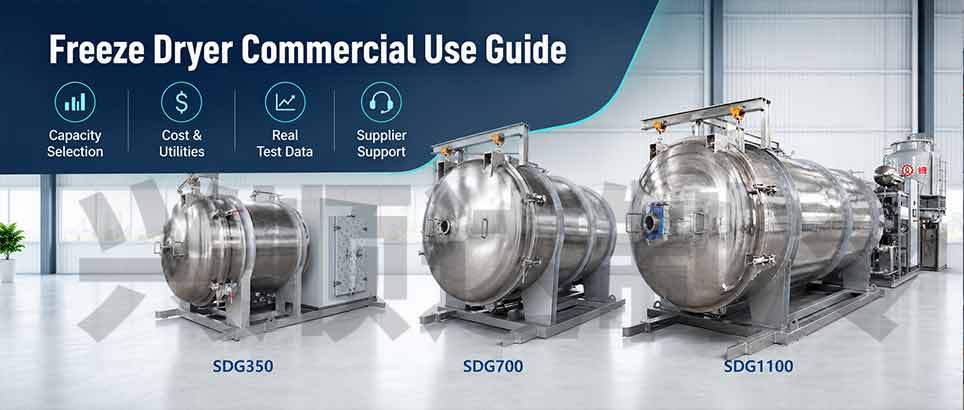
Goodfreezedryer.com offers SDG350, SDG700, and SDG1100 commercial freeze dryer models for food production. These models are positioned between pilot-scale equipment and industrial freeze dryers.

340–450 kg / 24h
For smaller commercial food production projects and early stable batch sales.

680–900 kg / 24h
For medium commercial output and growing food production plans.
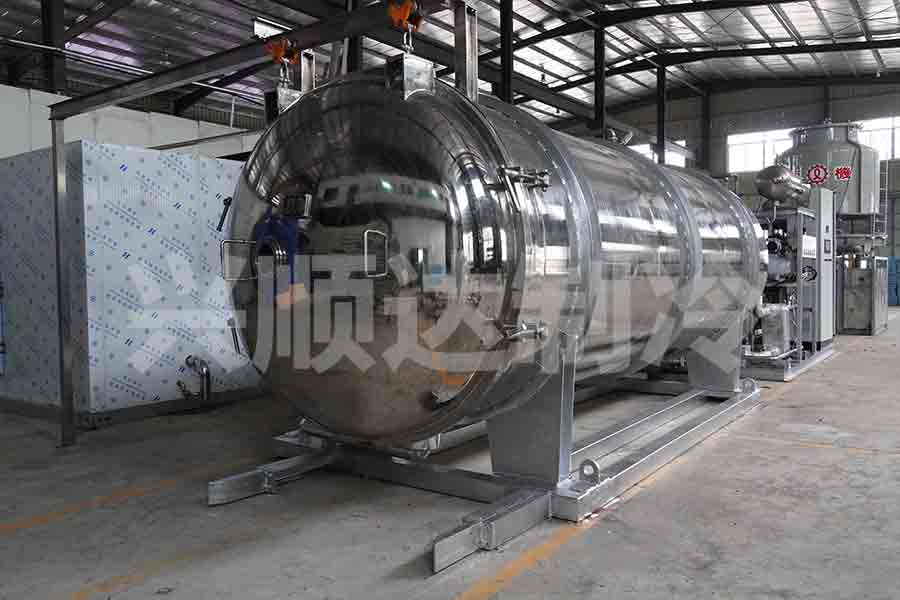
1.02–1.36 tons / 24h
For larger commercial food production before moving to industrial scale.
| Model | Wet Material Capacity / 24h | Total Power | Site Space | Defrost Water | Best For |
|---|---|---|---|---|---|
| SDG350 | 340–450 kg | 58.16 kW | 20–30 m² | 1.2 tons/time | Small commercial food production |
| SDG700 | 680–900 kg | 111.6 kW | 60–100 m² | 1.5 tons/time | Medium commercial production |
| SDG1100 | 1.02–1.36 tons | 155.9 kW | 60–100 m² | 1.8 tons/time | Larger commercial production |
All three models are designed for 8–15 hours of typical food drying time, final moisture below 3%, and vacuum-down speed below 18 minutes to 133 Pa. They also use radiation heating, stainless steel chamber and condenser structure, touchscreen HMI control, mobile remote monitoring, and hot water defrosting.
For full model specifications, buyers can review the commercial freeze dryer product page.
How to Choose Between SDG350, SDG700, and SDG1100
The first selection rule is simple: start with daily wet material capacity. Then, confirm drying time, factory space, power supply, water supply, drainage, and expected finished product output.
Choose SDG350 If
SDG350 is suitable for smaller commercial food producers. It is a practical choice when the factory needs 340–450 kg of wet material capacity per 24 hours.
It may fit companies that are moving from pilot testing to real sales. In addition, it requires less installation space than larger commercial models, which makes it easier for factories with limited floor area.
Choose SDG700 If
SDG700 is suitable for medium commercial production. It can process 680–900 kg of wet material per 24 hours.
This model is often a better option for fruit snack producers, vegetable processors, pet food brands, and factories with stable commercial orders. Moreover, it provides more capacity without entering full industrial scale.
Choose SDG1100 If
SDG1100 is suitable for larger commercial food production. It can process 1.02–1.36 tons of wet material per 24 hours.
This model is useful when the buyer already has stable demand and wants higher output before investing in a steam-supported industrial system. Therefore, it is often selected by factories that want stronger batch capacity while still staying within the commercial equipment category.
How Much Does a Commercial Freeze Dryer Cost?
A commercial freeze dryer usually requires a project-based quotation. Based on the reference range for SDG350, SDG700, and SDG1100, the typical commercial project range is about USD 80,000–191,000.
Final pricing depends on tray area, condenser capacity, vacuum system configuration, control system, stainless steel material grade, automation level, installation support, commissioning, operator training, spare parts package, shipping, and site conditions.
Therefore, buyers should not compare suppliers by price alone. A lower initial quotation may exclude important items such as installation guidance, training, commissioning, spare parts, or real production support.
For a more detailed cost discussion, buyers can read the commercial freeze dryer price guide.
Energy and Water Use in Commercial Freeze-Drying
Energy use is a major part of operating cost. For SDG350, SDG700, and SDG1100 commercial freeze dryers, the average energy consumption reference is about 1.7 kWh per kg of wet material.
However, actual energy use can change. It depends on product moisture content, slice thickness, loading density, drying profile, freezing condition, and target final moisture.
Water use should also be included in the project plan. The commercial series uses hot water defrosting:
- SDG350: about 1.2 tons per defrost
- SDG700: about 1.5 tons per defrost
- SDG1100: about 1.8 tons per defrost
Because of this, buyers should confirm water supply, drainage, floor loading, and equipment room conditions before placing an order.
How Much Finished Product Comes from Fresh Material?
Many buyers ask how much freeze-dried product they can get from 1 kg of fresh material. The answer depends mainly on moisture content and target final moisture.
Basic calculation: Estimated freeze-dried weight = dry solids weight ÷ (1 − final moisture content)
For example, if fresh apple contains about 85% moisture, then 1 kg of fresh apple contains about 150 g of dry solids. If the target final moisture is about 3%, the estimated freeze-dried apple weight is about 154.6 g.
| Fresh Material | Estimated Freeze-Dried Weight from 1 kg Fresh Material |
|---|---|
| Apple | About 154.6 g |
| Pineapple | About 151.5 g |
| Banana | About 257.7 g |
| Prawns | About 216.5 g |
| Fresh fish | About 278.4 g |
| Beef | About 381.4 g |
These figures help factories estimate fresh material demand, batch output, packaging quantity, and possible sales volume. However, the final result can change due to product variety, pretreatment, loading thickness, drying process, and target final moisture.
For more food yield examples, see this guide: What Foods Can Be Freeze Dried?
Real Commercial Freeze-Drying Test Data
Real production data is more useful than general marketing claims. It helps buyers understand how batch load, drying time, vacuum range, condenser capacity, final moisture, and energy use affect commercial production.
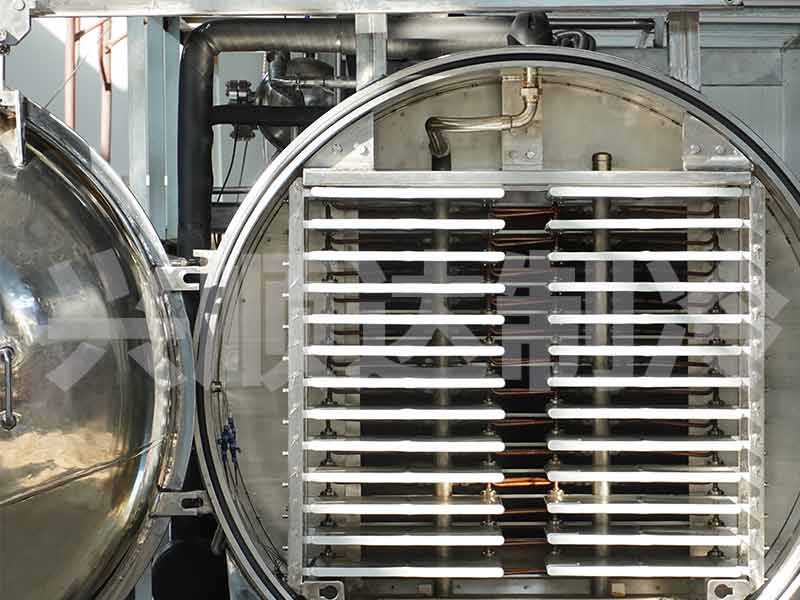
Freeze-Dried Rice
About 125 kg per batch, 6 h drying time, 1.28% final moisture, and 1.67 kWh/kg energy use.
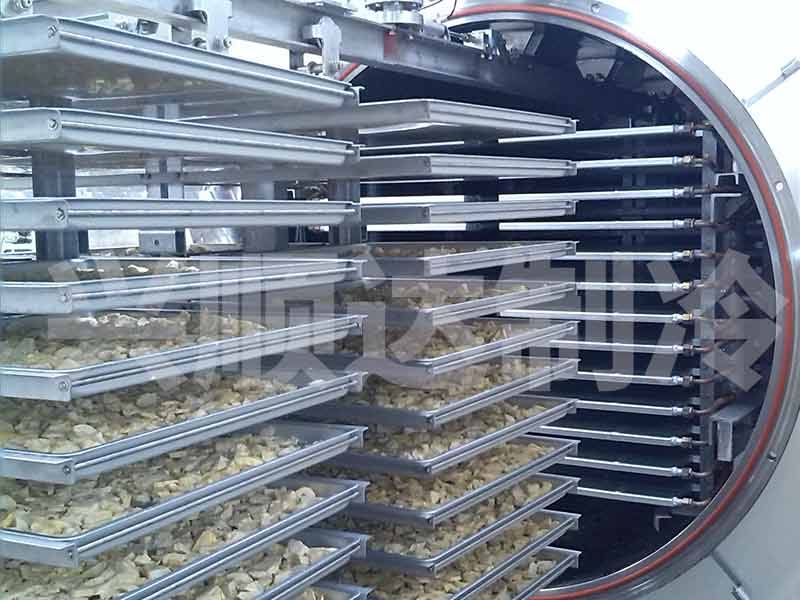
Freeze-Dried Pineapple
About 244 kg per batch, 12 h drying time, 2.31% final moisture, and 1.73 kWh/kg energy use.
Freeze-Dried Blueberries
About 360 kg per batch, 13 h drying time, 1.97% final moisture, and 1.8 kWh/kg energy use.
SDG350 Case: Freeze-Dried Rice in India
An Indian food processor used an SDG350 10 m² freeze dryer for cooked fried rice. The batch load was about 125 kg, and the drying cycle was completed in 6 hours. The final moisture reached 1.28%, and the energy use was about 1.67 kWh per kg of fresh material.
This case is useful for prepared food manufacturers because cooked rice and instant meals require stable drying, low final moisture, and good rehydration performance. Read the full case: Freeze-Dried Rice Case Study.
SDG700 Case: Freeze-Dried Pineapple in Indonesia
An Indonesian food processor used an SDG700 20 m² freeze dryer for pineapple slices. The batch load was about 244 kg, and the drying cycle took 12 hours. The final moisture reached 2.31%, while energy use was about 1.73 kWh per kg of fresh material.
This case shows why slicing method matters. Proper pineapple slicing improves moisture movement and helps support stable commercial drying. Read the full case: Freeze-Dried Pineapple Case Study.
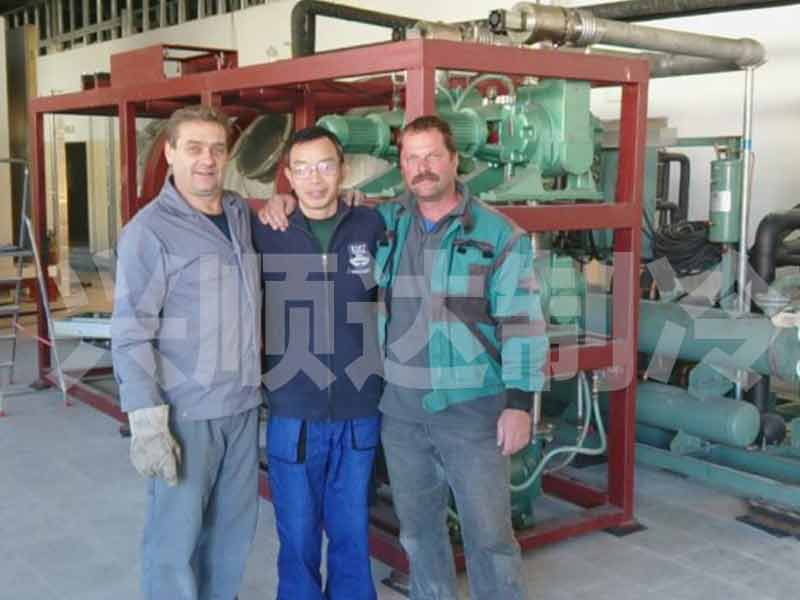
SDG1100 Case: Freeze-Dried Blueberries
A Czech food processor used an SDG1100 30 m² freeze dryer for fresh blueberries. The batch load was about 360 kg, and the drying cycle took 13 hours. The final moisture reached 1.97%, and energy use was about 1.8 kWh per kg of fresh material.
Blueberries need pretreatment because the skin can slow moisture release. In this project, perforation pretreatment helped improve drying performance. Read the full case: Freeze-Dried Blueberries Case Study.
Why Product Testing Matters Before Model Selection
A commercial freeze drying machine should not be selected only by catalog capacity. Two products with the same wet weight may require different drying time and energy use.
For example, cooked rice finished drying in 6 hours in the SDG350 case. However, pineapple slices took 12 hours in the SDG700 case, while blueberries took 13 hours in the SDG1100 case. Therefore, product structure, moisture content, sugar level, thickness, and pretreatment can change the final production plan.
Before asking for a commercial freeze dryer quotation, buyers should prepare:
- Product name and raw material condition
- Fresh material moisture content if available
- Slice thickness or piece size
- Expected daily wet material load
- Target final moisture
- Packaging method
- Factory power supply
- Water supply and drainage conditions
- Available installation space
- Budget range
- Need for sample testing
With this information, engineers can recommend a more suitable model and help avoid oversizing or undersizing the equipment.
Factory Requirements Before Buying
A commercial freeze dryer project needs proper site preparation. Buyers should check the factory conditions before confirming the model.
Power Supply
The commercial models use three-phase power. Standard configuration is 3P 380V / 50Hz, but voltage and frequency can be customized for different countries.
Installation Space
The SDG350 usually needs about 20–30 m². The SDG700 and SDG1100 usually need about 60–100 m². In addition, the factory height should be more than 3.5 m.
Water and Drainage
Since the commercial series uses hot water defrosting, buyers should prepare enough water supply and drainage capacity. This is especially important for factories that run frequent batches.
Shipping and Unloading
SDG350 usually ships in 1 × 40HQ container. SDG700 and SDG1100 usually require 1 × 40HQ + 1 × 20GP. Therefore, the buyer should confirm unloading equipment, access width, floor loading, and installation route.
Common Mistakes When Buying a Commercial Freeze Dryer
Mistake 1: Choosing Only by the Lowest Price
A low price may look attractive. However, it may reduce condenser capacity, vacuum stability, material quality, control functions, training, or after-sales support. As a result, the buyer may pay more later through downtime, poor drying results, or higher operating cost.
Mistake 2: Comparing Only Batch Capacity
Batch capacity does not equal daily output. A larger load may need longer drying time. Therefore, buyers should compare wet material capacity, cycle time, energy use, and finished product yield together.
Mistake 3: Ignoring Product Thickness
Thicker products usually need more time. In addition, uneven thickness can cause wet cores or inconsistent texture. Therefore, buyers should confirm slicing thickness before model selection.
Mistake 4: Buying Without Real Test Data
General machine descriptions cannot replace product testing. Real drying data helps confirm loading density, vacuum range, condenser load, drying time, final moisture, and energy use.
Mistake 5: Ignoring Training
Commercial freeze-drying is not only machine operation. Operators also need to understand loading, drying endpoint judgment, cleaning, maintenance, alarms, and batch records.
How Goodfreezedryer.com Supports Commercial Freeze Dryer Projects
A commercial freeze dryer project should not stop at machine delivery. Food processors also need product evaluation, model selection, factory testing, installation, commissioning, operator training, and support during the first real production batches.
- Customer provides raw material and capacity requirements.
- Engineers evaluate product characteristics.
- The team provides sample testing or process suggestions.
- A suitable model is recommended.
- Equipment manufacturing begins.
- Factory testing is completed before delivery.
- The equipment is shipped and installed.
- Engineers provide commissioning and operator training.
- The team supports the first 1–2 real production batches.
- Remote support and spare parts supply continue after production starts.
This process helps buyers reduce project risk. Moreover, it helps operators understand how to control slice thickness, loading density, drying time, final moisture, and routine maintenance.
When Should Buyers Move from Commercial to Industrial Freeze Dryers?
A commercial freeze dryer is suitable for many food companies. However, some factories need larger production from the beginning.
- Daily wet material demand is above 1.2 tons.
- The project needs steam-supported production.
- The factory already has stable large-volume orders.
- The product line needs multiple batches every day.
- Utility conditions support larger equipment.
- The business needs long-term expansion capacity.
In this situation, buyers can review the industrial freeze dryer models instead of selecting a commercial model first.
FAQ About Freeze Dryer Commercial Projects
What is a freeze dryer commercial system?
A freeze dryer commercial system is a freeze-drying machine used for business food production. It supports higher wet material capacity, stronger condenser performance, stable vacuum control, repeatable drying results, and process monitoring.
How much food can a commercial freeze dryer process per day?
The SDG350 can process about 340–450 kg of wet material per 24 hours. The SDG700 can process about 680–900 kg. The SDG1100 can process about 1.02–1.36 tons.
How much does a commercial freeze dryer cost?
A typical SDG350, SDG700, or SDG1100 commercial project reference range is about USD 80,000–191,000. Final cost depends on tray area, condenser capacity, vacuum system, control system, automation level, material grade, installation, training, commissioning, spare parts, and shipping conditions.
How much electricity does a commercial freeze dryer use?
The commercial series uses about 1.7 kWh per kg of wet material as a reference. However, real energy use depends on product moisture, slice thickness, loading density, drying cycle, and target final moisture.
Can one commercial freeze dryer process different foods?
Yes, one machine can process different products. However, each product may need a different loading density, thickness, drying profile, and drying time. Therefore, factories should test key products before mass production.
What final moisture is suitable for commercial freeze-dried food?
Many commercial freeze-dried foods are controlled below 3% final moisture. However, final specifications should be confirmed according to product type, packaging, water activity, storage conditions, and local food safety requirements.
What information should buyers provide before asking for a quote?
Buyers should provide product type, daily wet material capacity, slice thickness, target final moisture, factory power supply, water and drainage conditions, installation space, budget range, and whether sample testing is needed.
Request a Commercial Freeze Dryer Recommendation
Choosing the right commercial freeze dryer is easier when the buyer starts with real production data. Product type, wet material capacity, slice thickness, final moisture target, energy conditions, and factory space should all be reviewed before confirming the model.
For food businesses planning commercial freeze-dried production, Goodfreezedryer.com can help evaluate SDG350, SDG700, SDG1100, or industrial freeze dryer options.
Contact Goodfreezedryer.com for a Commercial Freeze Dryer Recommendation