
Food Freeze Drying Guide
What Foods Can Be Freeze Dried? Freeze-Dried Food Yield Chart
What foods can be freeze dried? Food processors can freeze dry most fruits, vegetables, meat, seafood, eggs, dairy products, herbs, and prepared meals. However, moisture content, fat content, sugar level, slice thickness, loading density, and freeze dryer design all influence final quality.
In practice, food factories ask this question for more than product development. They also need to estimate finished yield, water removal load, condenser capacity, drying time, packaging volume, and the right machine size.
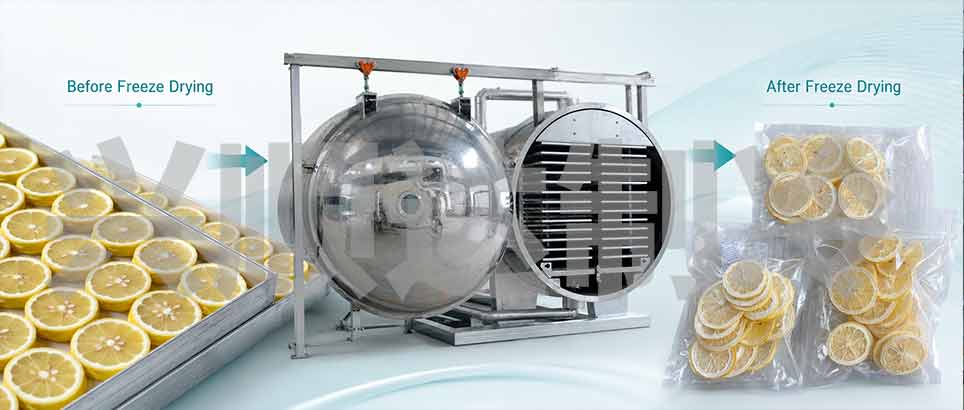
What Foods Can Be Freeze Dried?
Freeze drying removes water at low temperature under vacuum. Therefore, food processors use it for fruit snacks, vegetable ingredients, instant meals, seafood, meat products, pet food, dairy ingredients, and powder materials.
Fruits
Food processors often freeze dry apples, bananas, apricots, cherries, grapes, lemons, oranges, peaches, pears, pineapples, plums, melons, and watermelons.
Because fruits usually keep strong color and aroma, they work well for snacks, cereal toppings, beverage ingredients, and bakery inclusions. However, high-moisture fruits create low finished yield from the same fresh weight.
Vegetables
Factories commonly freeze dry cabbage, carrot, celery, cucumber, corn, onion, potato, pumpkin, radish, spinach, tomato, asparagus, and mushroom.
For example, instant noodle, soup, seasoning, ready-meal, vegetable powder, and pet food producers often choose freeze-dried vegetables for fast rehydration and better shape retention.
Meat, Seafood, Eggs, and Dairy
Food processors also freeze dry beef, pork, mutton, poultry, fish, prawns, oysters, eggs, milk, and cheese.
However, high-fat materials need careful testing. Freeze drying removes water, not fat. In addition, excessive oil can block the internal channels that water vapor uses to escape from the product.
Prepared Meals and Specialty Foods
Factories can freeze dry cooked rice, pasta meals, soups, fruit powders, vegetable powders, meat cubes, seafood ingredients, and pet food products.
Still, prepared meals need recipe testing before scale-up. Salt, oil, starch, sauce thickness, and sugar content can change drying speed, texture, and final moisture.
What Foods Should Not Be Freeze Dried?
High-Oil Products
Pure oil, high-oil sauces, and very high-fat foods usually perform poorly in standard freeze drying. The reason is simple: the process removes water, but it does not remove oil.
Why oil matters: excessive oil can coat the material structure and block the vapor escape path inside the product. As a result, internal moisture moves out more slowly during sublimation and desorption.
Commercial Testing Requirement
Because of this, high-fat products may dry unevenly, remain soft or greasy, develop wet cores, or show poor storage stability after packaging. However, a factory should not reject every high-fat formula immediately.
Instead, the factory should test formula adjustment, pretreatment, loading thickness, and packaging before it invests in a commercial or industrial freeze dryer.
Freeze-Dried Food Yield Chart: Fresh Weight vs Finished Weight
How to Read the Chart
The following freeze-dried food yield chart helps estimate finished freeze-dried weight from 1 kg of fresh material. The calculation uses raw material moisture content and assumes about 3% final moisture.
Important note: material variety, pretreatment, loading thickness, drying process, and target final moisture can change actual results. Therefore, use this chart for preliminary production estimation, not as a final process guarantee.
Fresh Material to Freeze-Dried Weight Table
| Food | Category | Moisture Content | Estimated Freeze-Dried Weight from 1 kg Fresh Material |
|---|---|---|---|
| Apple | Fruit | 85% | 154.6 g |
| Apricot | Fruit | 85.4% | 150.5 g |
| Gracilaria | Sea vegetable | 94% | 61.9 g |
| Banana | Fruit | 75% | 257.7 g |
| Lentils | Legume | 89% | 113.4 g |
| Beet | Vegetable | 72% | 288.7 g |
| Cabbage | Vegetable | 85% | 154.6 g |
| Cabbage heart | Vegetable | 91% | 92.8 g |
| Carrot | Vegetable | 83% | 175.3 g |
| Celery | Vegetable | 94% | 61.9 g |
| Cottage cheese | Dairy | 46–53% | 484.5–556.7 g |
| Cherry | Fruit | 82% | 185.6 g |
| Cucumber | Vegetable | 96.4% | 37.1 g |
| Fresh eggs | Egg product | 70% | 309.3 g |
| Fresh fish | Seafood | 73% | 278.4 g |
| Grape | Fruit | 82% | 185.6 g |
| Oyster | Seafood | 80% | 206.2 g |
| Lemon | Fruit | 89% | 113.4 g |
| Lettuce | Vegetable | 94.3% | 58.8 g |
| Prawns | Seafood | 79% | 216.5 g |
| Corn | Vegetable | 73.9% | 269.1 g |
| Citrus | Fruit | 86% | 144.3 g |
| Melon | Fruit | 92.7% | 75.3 g |
| Milk | Dairy | 87% | 134.0 g |
| Mutton | Meat | 60–70% | 309.3–412.4 g |
| Onion | Vegetable | 87.5% | 128.9 g |
| Orange | Fruit | 90% | 103.1 g |
| Peach | Fruit | 86.9% | 135.1 g |
| Pear | Fruit | 83% | 175.3 g |
| Pineapple | Fruit | 85.3% | 151.5 g |
| Plum | Fruit | 86% | 144.3 g |
| Pork | Meat | 35–42% | 597.9–670.1 g |
| Potato | Vegetable | 77.8% | 228.9 g |
| Fresh poultry | Meat | 74% | 268.0 g |
| Pumpkin | Vegetable | 90.5% | 97.9 g |
| Rabbit | Meat | 60% | 412.4 g |
| Radish | Vegetable | 93.6% | 66.0 g |
| Spinach | Vegetable | 92.7% | 75.3 g |
| Bayberry | Fruit | 90% | 103.1 g |
| Tomato | Vegetable / Fruit | 94% | 61.9 g |
| Kohlrabi | Vegetable | 90.9% | 93.8 g |
| Watermelon | Fruit | 92.1% | 81.4 g |
| Beef | Meat | 63% | 381.4 g |
| Date | Fruit | 83% | 175.3 g |
| Asparagus | Vegetable | 94% | 61.9 g |
| Mushroom | Vegetable / Fungus | 91.1% | 91.8 g |
Before commercial scale-up, the factory should run each product in a real freeze dryer. Cutting thickness, recipe, pretreatment, and loading weight can all change drying behavior.
How to Calculate Freeze-Dried Yield from Fresh Material
Basic Formula
You can estimate freeze-dried yield from the dry solids in the fresh material. This calculation helps factories avoid machine selection mistakes based only on finished product weight.
Apple Example
For example, fresh apple contains about 85% moisture. Therefore, 1 kg of fresh apple contains about 150 g of dry solids. If the target final moisture is about 3%, the estimated finished weight is:
After this calculation, the factory can estimate fresh material demand per batch or per day. Then it can evaluate tray area, condenser load, utility demand, and machine size more accurately.
Examples: How Much Freeze-Dried Product Comes from 1 kg of Fresh Food?
The following examples show why moisture content matters in commercial freeze drying.
High-Moisture Fruits and Vegetables
- 1 kg of fresh apple may produce about 154.6 g of freeze-dried apple.
- 1 kg of cucumber may produce only about 37.1 g of freeze-dried cucumber.
- 1 kg of orange may produce about 103.1 g of freeze-dried orange.
- 1 kg of radish may produce about 66.0 g of freeze-dried radish.
Higher-Solid Foods
- 1 kg of banana may produce about 257.7 g of freeze-dried banana.
- 1 kg of fresh fish may produce about 278.4 g of freeze-dried fish.
- 1 kg of beef may produce about 381.4 g of freeze-dried beef.
- 1 kg of milk may produce about 134.0 g of freeze-dried milk powder base.
As a result, two products with the same fresh material weight can have very different finished output. This affects raw material purchase, packaging volume, labor arrangement, cold storage planning, and freeze dryer capacity selection.
Why Moisture Content Matters When Choosing a Freeze Dryer
Water Removal Load
Moisture content affects more than finished product weight. It also determines how much water the condenser must capture during each batch.
High-moisture foods, such as cucumber, tomato, lettuce, radish, melon, and watermelon, create low finished yield but high water removal load. Therefore, these materials may require stronger condenser capacity than the finished weight suggests.
Fat Content and Vapor Movement
Fat content also changes drying behavior. During freeze drying, water vapor must escape through pores and channels inside the frozen product.
If oil coats the material surface or fills part of the internal structure, it can slow vapor movement and cause uneven drying. Therefore, high-fat formulas often need smaller loading thickness, longer drying validation, and stricter packaging tests.
Machine Selection Factors
For this reason, food processors should evaluate several technical factors before buying a food freeze dryer.
For small and medium food factories, a commercial freeze dryer for food production often supports pilot production, product launch, and medium-scale output. For factories that process several tons of fresh material per day, an industrial freeze dryer for large-scale food production usually makes more sense.
Can Different Foods Run in One Freeze-Drying Batch?
Process Matching
A factory can sometimes run different foods in the same batch. However, commercial production should avoid random mixed loading.
Different moisture content, slice thickness, sugar level, fat content, and product structure can create different drying speeds. As a result, one product may finish earlier while another product still contains too much moisture.
Flavor Control
In addition, strong-smell materials can affect mild-flavor products. For example, onion, seafood, and certain herbs should not run with fruit snacks unless the factory has already validated the process.
For stable commercial results, production teams should group similar materials by moisture content, thickness, product form, and target final moisture.
Commercial Freeze-Dried Food Applications
Freeze-Dried Fruits and Vegetables
Food companies use freeze-dried fruits and vegetables in snack foods, breakfast cereals, bakery ingredients, instant soup, seasoning powders, beverage powders, and pet food. Compared with traditional hot-air drying, freeze drying better protects shape, color, aroma, and rehydration performance.
However, each material needs a different process. Apple slices, banana slices, carrot cubes, tomato pieces, and leafy vegetables all require different loading thicknesses, heating curves, and drying endpoints.
Freeze-Dried Meat, Seafood, Eggs, and Dairy
Food factories use freeze-dried meat, seafood, eggs, and dairy products in instant meals, camping food, emergency food, pet treats, soup ingredients, and high-protein products.
Meanwhile, lean meat and cooked seafood usually stabilize more easily than high-fat materials. Dairy and egg products also need checks for foaming, stickiness, fat oxidation, powder behavior, and final packaging requirements.
Food processors can also compare freeze drying with dehydration before choosing a process: freeze dryer vs dehydrator.
How to Use This Chart for Freeze Dryer Capacity Planning
Start with Finished Product Target
The yield chart helps factories estimate fresh material demand before machine selection. This step prevents underestimating tray area, condenser load, batch quantity, and energy demand.
Example: Freeze-Dried Apple Production
A factory wants to produce 100 kg of freeze-dried apple per day. According to the chart, 1 kg of fresh apple may produce about 154.6 g of freeze-dried apple. Therefore, the factory may need about 647 kg of fresh apples per day.
After this step, the factory can compare batch capacity, drying time, condenser load, and factory utility conditions. For cost and utility estimation, food processors can read the freeze drying cost analysis. In addition, buyers can compare wet material capacity on the freeze dryer products page before requesting a quotation.
What Information Should Be Provided Before Choosing a Freeze Dryer?
Material and Production Data
Before recommending a machine model, GoodFreezeDryer evaluates both the food material and the production target. This approach helps customers avoid oversized equipment, undersized condenser capacity, and unrealistic finished product expectations.
| Information | Why It Matters |
|---|---|
| Raw material name | Different foods have different moisture content, structure, and drying behavior. |
| Daily fresh material capacity | This determines the required tray area, batch size, and machine category. |
| Target finished product weight | This helps calculate the required fresh material input and avoids planning mistakes. |
| Target final moisture | Lower final moisture may increase drying time and energy demand. |
| Slice thickness or product size | Thicker products usually need longer drying cycles. |
| Loading weight per tray | This affects drying uniformity, batch output, and drying time. |
| Energy type | Electric heating, steam heating, or hybrid systems affect operating cost and factory utilities. |
| Factory space and utilities | Large freeze dryer systems require enough space, power, cooling water, drainage, and installation access. |
| Packaging method | Moisture-proof and oxygen-controlled packaging affects shelf life. |
Need Help Testing Your Food Material?
GoodFreezeDryer helps food processors test raw materials, estimate freeze-dried yield, and select suitable commercial or industrial freeze dryer models. For a practical recommendation, customers can send the material name, daily fresh material capacity, target final moisture, product thickness, and product photos.
FAQ About Foods That Can Be Freeze Dried
What foods can be freeze dried?
Food processors can freeze dry most fruits, vegetables, meat, seafood, eggs, dairy products, herbs, and prepared meals. However, product quality and drying efficiency depend on moisture content, sugar level, fat content, thickness, loading density, and process control.
Can meat be freeze dried?
Yes. Food processors can freeze dry meat, poultry, and seafood. For commercial production, lean materials usually stabilize more easily than high-fat cuts. In addition, the factory should control sanitation, packaging, and shelf-life testing carefully.
Can milk and eggs be freeze dried?
Yes. Food processors can freeze dry milk and eggs. However, dairy and egg products need testing for foaming, stickiness, fat oxidation, powder behavior, and final packaging requirements.
Which foods are not suitable for freeze drying?
Pure oil, high-oil sauces, and very high-fat foods usually perform poorly in standard freeze drying. Excessive oil can also block the vapor escape path inside the product, which may cause uneven drying or poor storage stability.
How much weight is lost during freeze drying?
Weight loss depends mainly on original moisture content. For example, 1 kg of fresh apple may produce about 154.6 g of freeze-dried apple, while 1 kg of cucumber may produce only about 37.1 g of freeze-dried cucumber.
Does moisture content affect freeze dryer size?
Yes. Higher moisture content creates more water load for the condenser. Therefore, moisture content affects condenser capacity, drying time, energy consumption, and machine size selection.
Does fat content affect freeze drying?
Yes. High fat content can reduce drying uniformity because oil may coat the material structure and block water vapor movement. As a result, the product may show wet cores, greasy surfaces, longer drying validation, and unstable shelf life.
Can fruits and vegetables run together in one freeze dryer?
They can run together only when thickness, moisture content, flavor, and drying behavior match. For commercial production, production teams should group similar materials to improve drying uniformity and product consistency.