
Grading Berry Lots for Industrial Freeze Drying: Whole-Fruit Yield, Piece Outlets, and Batch Trial Planning
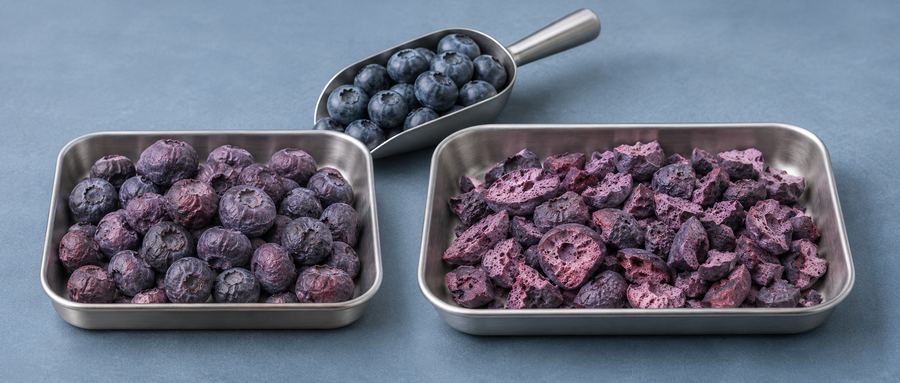
A berry can leave the freeze dryer completely intact and still shatter before the customer opens the pack. For a Ukrainian berry ingredient processor evaluating a batch vacuum freeze dryer alongside existing frozen operations, the operational choice is deciding which raw frozen lots should stay in frozen sales, which are worth drying for whole berries versus cut pieces, and how much finished product actually survives screening and packing. Making these allocations early requires connecting intake grades, handling losses, and realistic finished specifications rather than relying on chamber vacuum performance alone.
1. Defining Product Formats Before Grading the Raw Crop
Commercial freeze-dried fruit is graded against the specific end use that defines the sale. A buyer may require recognizable whole berries as visual toppings, a calibrated particle band for breakfast cereal inclusions, or uniform powder for bakery blends, as shown in commercial format offerings (CryoVit). Each intended application establishes its own mechanical sensitivity and acceptable breakage thresholds, shaping the grading decision before raw fruit enters the drying room.
In Ukraine, an established grower and processor such as Eco Berry already runs size calibration, optical or laser sorting, and freezing in an individually quick frozen (IQF) tunnel for strawberries, blueberries, raspberries, blackberries, and red currants (Eco Berry). This operational example shows that incoming fruit is already mechanically graded and frozen on site. However, a lot that meets an acceptable IQF standard for frozen bulk distribution does not automatically yield an acceptable whole-berry pack after freeze drying.
Food safety release is a separate prerequisite before any berry lot can be routed to a production line. A lot failing microbiological thresholds, pesticide limits, foreign-matter checks, or internal release criteria must be held or rejected. A physically sound appearance alone does not confer food safety. Once a batch is released and otherwise suitable, it can be graded for a buyer’s use even if it has cosmetic or sizing defects. Depending on confirmed buyer specifications, such lots can follow three distinct commercial paths: remaining in existing frozen distribution if that outlet is confirmed and accepts the specification, drying for a whole-berry pack if the fruit meets the buyer’s whole criteria, or routing to sized pieces or powder if an approved buyer specification exists for those dried formats.
Before assigning incoming lots to a drying slot, production managers should obtain the customer’s precise definition of acceptable product. An ingredient buyer’s specification guide (Frosse Specification Guide) typically defines particle size distribution, allowable broken pieces, and maximum fines percentages across the target format. Crucially, a standard sieve opening alone cannot distinguish an intact whole berry from a berry halved along its equator; visual calibration references, defect counts, and gravimetric sieve tests must be combined to define true contract grade.
2. Skin Resistance, Cutting, and the Sublimation Drying Path
During primary drying—the stage where ice sublimes directly into water vapor—heat applied from the shelves promotes sublimation inside the fruit. The resulting water vapor escapes through the outer berry skin and developing dry porous layer, or moves directly through exposed cut tissue, before traveling through the chamber to be captured as ice on a colder condenser surface. An intact waxy berry skin resists vapor flow, and as sublimation advances, the ice interface recedes and the thicker porous dry layer grows, adding further resistance. Cutting the berry bypasses this skin barrier and creates an exposed vapor path through internal flesh, rather than guaranteeing a shorter cycle for every berry. Overall sublimation kinetics depend on the combined balance of supplied shelf heat, vapor escape paths, and ice capture at the colder condenser surface.
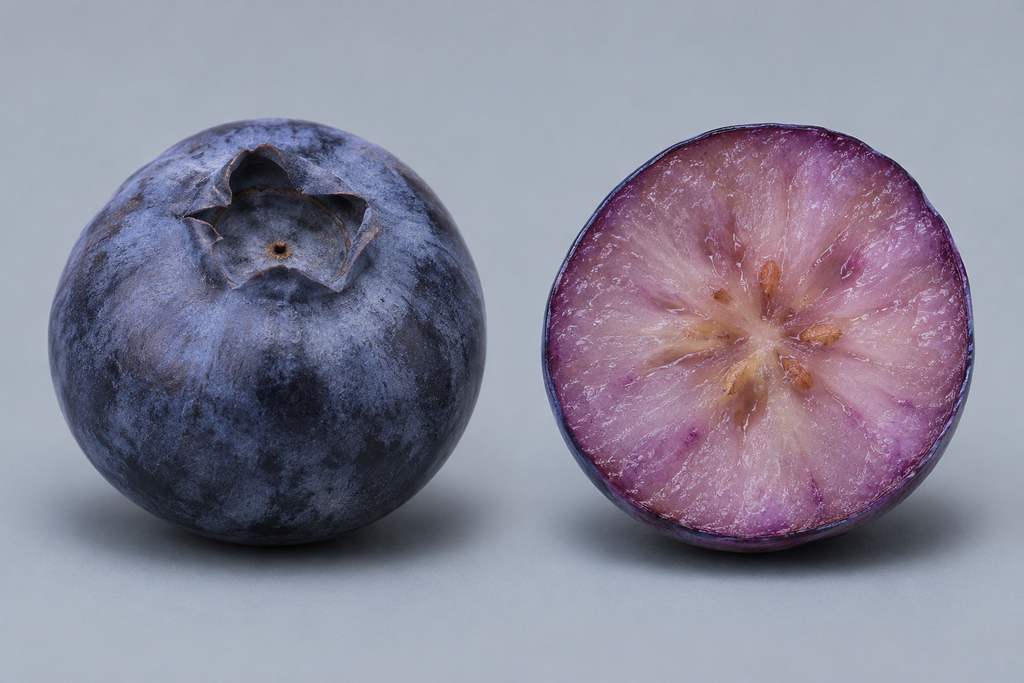
In a laboratory study evaluating mass-transfer resistance and primary drying kinetics, Munzenmayer, Ulloa, Pinto, Ramirez, Valencia, Simpson, and Almonacid (Foods 2020, 9(2), 211) tested retail Chilean highbush blueberries sized to 14–15 mm in a Martin Christ Alpha 2-4 LSCplus laboratory freeze dryer. Working with three 0.021 m² shelves, a total load of 60 berry units across the shelves, a 20 °C shelf setting, 13 Pa chamber pressure, and a −85 °C condenser, the authors reported primary drying times estimated by pressure increase tests (PIT) and mass-transfer resistance analysis derived from manometric temperature measurements (MTM) under identical settings without inferring full-cycle durations:
- Untreated whole blueberries: primary drying time was 17.0 ± 0.9 hours (mean ± standard deviation).
- Blueberries cut into halves: primary drying time fell to 6.7 ± 1.2 hours.
- Laser-perforated blueberries (experimental arm): berries treated with nine CO₂ laser microperforations required 13.0 ± 2.0 hours.
While halving a berry shortens primary drying time in the laboratory, cutting permanently removes that fruit from the whole-berry category. That cut fruit can only enter a sized piece format if a buyer grants an approved contract grade for pieces. Furthermore, the 14–15 mm retail blueberry data and primary-stage durations observed under these laboratory conditions cannot be taken as commercial cycle recipes for other cultivars or industrial production lines.
3. Where the Grade Gets Lost: Chamber Discharge vs. Final Packaging
Freeze-dried berries leave the vacuum chamber as delicate, highly porous structures that are vulnerable to mechanical breakage. Surface splits observed immediately at chamber discharge already existed before downstream transfer began, but their specific origin or process station has not been determined. Comparing matched grading checks on the same measurement basis at chamber discharge and at final packaging reveals how many kilograms stopped meeting the target grade between those two points, without identifying which specific transfer step or upstream setting caused the loss or serving as a causal test.
Consequently, a single grading check at dryer discharge conceals post-drying product degradation. Production teams must establish a two-point grading protocol:
- Discharge screening: Assess physical grade immediately after unload using the exact sampling and grading method specified for final packaging, confirm product moisture or water activity against the applicable acceptance specification, and verify loaded product temperature through separate documented measurements (with additional berry workflow context available in Blueberry Commercial Production).
- Finished-pack grading: Re-grade the lot after it has passed through vibrating conveyors, optical sorters, size screens, and final packaging machinery into moisture-barrier bags or cartons.
Vibratory transfer conveyors, inspection drops, and packaging funnels apply mechanical shear and impact that fracture delicate dried berries into undersized pieces and fines. While fines are left unallocated in this whole-fruit evaluation, they may have a distinct confirmed use under an approved specification. Because whole berries can shatter during sorting and bagging, pre-packing weight alone does not establish the amount of contracted packed output, and the total weighed kilograms of dried product at discharge do not equal the kilograms of accepted whole fruit after packing.
4. Accepted Output by Grade: Two Lots with Equal Discharge Weight
To illustrate how physical handling impacts finished fractions, consider two hypothetical dried berry lots (Lot A and Lot B). In this illustrative comparison, both lots yield an identical net weight of dried product at discharge of 20.0 kg each, evaluated against a matched moisture specification under the assumption that ambient moisture pickup during handling is excluded.
| Lot Designation | Net Weight of Dried Product at Discharge (kg) | Buyer-Approved Whole Fruit (kg) | Independently Approved Pieces (kg) | Unallocated Fines / Waste (kg) | Whole-Fruit Pack-Out (%) |
|---|---|---|---|---|---|
| Lot A | 20.0 | 13.6 | 5.0 | 1.4 | 68.0% |
| Lot B | 20.0 | 12.5 | 6.8 | 0.7 | 62.5% |
Contract whole-fruit pack-out is defined as buyer-accepted packed whole mass divided by the net weight of all dried product at discharge, multiplied by 100%. In this comparison, Lot A achieves 68.0% (13.6 kg / 20.0 kg), delivering 1.1 kg more buyer-accepted whole fruit than Lot B at 62.5% (12.5 kg / 20.0 kg). When producing exclusively for a single whole-fruit contract, Lot A yields the superior outcome.
When a separate confirmed outlet and approved specification exist for piece fractions, Lot B delivers 6.8 kg of approved pieces—1.8 kg more than Lot A (5.0 kg)—while leaving half as many unallocated fines (0.7 kg versus 1.4 kg), resulting in 19.3 kg of total saleable fruit compared to 18.6 kg for Lot A. Unallocated fines carry no assumed outlet. However, total accepted kilograms cannot by itself establish profitability, because different product grades command distinct contract prices and handling costs.
5. Preparing a Defensible Pilot Trial Brief for Equipment Evaluation
When an ingredient processor prepares to evaluate commercial batch vacuum freeze dryers—whether testing client fruit at an external pilot facility (GEA RAY® Pilot Plant Documentation) or validating an industrial installation (Food Freeze Dryer Validation)—the trial brief must reflect real finished product grades rather than theoretical chamber drying rates.
To ensure trial results can be accurately compared across different equipment configurations, the production manager should structure the trial brief around five documented requirements:
- Representative raw lot documentation: Define incoming fruit cultivar, sizing distribution, Brix variation, and IQF freezing history rather than hand-picking atypical premium samples.
- Target format acceptance criteria: Provide exact written specifications for acceptable whole berries, allowed piece size screens, and acceptable breakage thresholds.
- Validated loading conditions: Record wet tray load per area in kg/m², layer thickness or fruit depth in mm, tray loading pattern, berry orientation, and pre-freezing conditions, supported by loaded trial evidence for heating uniformity.
- Complete cycle accounting: State a single comparable loading-to-next-ready interval that includes tray loading, chamber evacuation, separate drying stages, tray unloading, condenser defrost, and required turnaround, specifying clearly which stages the trial measured or proposed.
- Two-point yield verification: Require that both discharge dry mass and post-screening packed fractions (whole, pieces, fines) are weighed and recorded.
When evaluating equipment options, processors should base technical comparisons on complete loading-to-next-ready cycles and realistic plant utility conditions. What total usable condenser ice capacity and verified water vapor capture rate are documented under that load and the actual depth of the fruit layer in the tray? Furthermore, reviewing evidence of temperature, dryness, and grades across representative loaded tray positions helps assess consistency, without claiming these prove uniform heat transfer during either stage.
Processors evaluating an industrial batch freeze-drying installation are invited to share their usable product specification, representative fruit grades, and existing grading results to review application requirements through the Project Consultation portal.
References
- Munzenmayer P, Ulloa J, Pinto M, Ramirez C, Valencia P, Simpson R, Almonacid S. Freeze-Drying of Blueberries: Effects of Carbon Dioxide (CO2) Laser Perforation as Skin Pretreatment to Improve Mass Transfer, Primary Drying Time, and Quality. Foods. 2020;9(2):211.
- Eco Berry. Company and processing operations.
- CryoVit. Freeze-dried product formats.
- Frosse. Freeze-dried product specification guide.
- GEA. RAY® Pilot Plant Freeze Dryer.
About the Author: Zheng Wei
Founder & Freeze-Drying System Engineer
Fuzhou Xing Shun Da Refrigeration Facility Project Co., Ltd.
Zheng Wei participates in food freeze-drying trials, equipment selection, vacuum-system configuration, refrigeration planning, installation guidance, process optimization, and project handover. The project experience covers fruit, vegetables, cooked foods, seafood, meat, dairy products, herbs, and extracts.