
Rehydration Ratio in Freeze-Dried Food: Measurement Methods, Physical Mechanisms, and Factory Trial Evaluation
In industrial food processing, rehydration is the process of restoring water to dehydrated food before consumption or downstream manufacturing. For foods intended to be reconstituted before eating or incorporation into recipes, rehydration behavior provides a practical measure of product preparation. However, rehydration values are useful only when test conditions, sample definitions, and physical context are clearly declared. Understanding how these metrics are calculated, what mass transfers occur during soaking, and how to control testing variables allows food manufacturers and procurement teams to evaluate trial lots with consistent baselines.
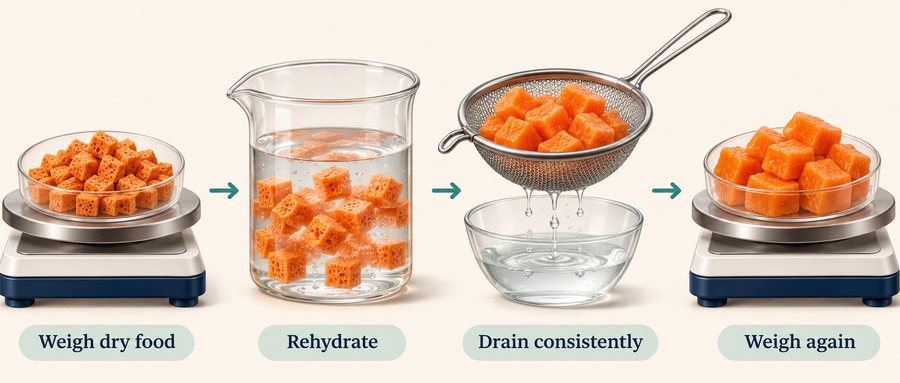
Formulas and Baselines: How Rehydration Ratio Is Calculated
Rehydration measures how a dried food portion changes in mass after immersion under defined contact conditions. One common mass ratio used in drying research is the gross ratio, often denoted as RR. For example, in an experimental study on sun-, solar-, and cabinet-dried tomato samples, Hameed et al. (Hameed et al., 2016 [R1]) defined the rehydration ratio as the weight of the rehydrated sample divided by the weight of the sample taken for rehydration:
Gross Rehydration Ratio (Dimensionless):
RR = M_r / M_d
M_d: Initial mass of the dried food sample prior to immersion (excluding container).M_r: Final mass of the same sample after immersion for a defined duration and completion of a standardized draining procedure (excluding container).
Both values must be measured in identical mass units (typically grams). Because RR is a pure ratio, it is dimensionless.
Absolute and Normalized Mass Gain
A testing protocol may also report mass uptake as absolute net mass gain or normalized net mass gain rather than a gross multiplier:
- Absolute Net Mass Gain:
ΔM = M_r - M_d(expressed in grams). - Normalized Net Gain:
(M_r - M_d) / M_d(expressed as a fraction or multiplied by 100 to yield a percentage).
In a hypothetical calculation with a 5.0 g initial dried food portion yielding 20.0 g of drained product after soaking, the gross rehydration ratio RR is 20.0 / 5.0 = 4.0. The absolute net mass gain is 20.0 g - 5.0 g = 15.0 g, and the normalized net gain is (20.0 - 5.0) / 5.0 = 3.0 (or 300%). These numbers are arithmetic illustrations, not product specifications, test standards, or equipment performance targets.
Distinguishing As-Tested Product Mass from a Dry-Solids Basis
In typical plant measurements, M_d is the initial as-tested mass of the dried product, which may include residual moisture. Research studies sometimes express rehydration capacity on a dry-solids basis. For example, Assis et al. (Assis et al., 2018 [R2]) tested osmotically pre-treated dried apple cubes at 80°C using a sample:water mass ratio of 1:100 with blotting before weighing, reporting rehydration capacity as moisture content on a dry basis in kg water/kg dry matter.
Determining dry solids requires an independent, suitable moisture determination method matched to the product. A gross mass ratio based on as-tested dried product (M_r / M_d) and a dry-basis ratio (kg water/kg dry matter) report fundamentally different quantities. Trial documentation should always explicitly identify whether the initial mass represents as-tested dried product or determined dry solids.
The Fresh-Baseline Recovery Coefficient
A third distinct metric evaluates how closely a reconstituted product returns to its original, fresh pre-drying mass. Meda and Ratti (Meda & Ratti, 2005 [R3]) defined a recovery coefficient (Equation 3 in their study on freeze-dried strawberries) as:
Recovery Coefficient (%) = [(W_r - W_fd) / (W_0 - W_fd)] × 100
W_r: Rehydrated sample mass.W_fd: Initial freeze-dried sample mass.W_0: Original fresh fruit mass prior to freezing and drying.
This recovery coefficient evaluates the mass difference between the rehydrated sample and the freeze-dried piece relative to the initial mass loss between fresh fruit and freeze-dried material (W_0 - W_fd). Because it incorporates original fresh mass, it reflects a different relationship than the gross mass ratio RR. Because soluble solids can also leach during immersion, the recovery coefficient should not be interpreted as pure water uptake alone.
Physical Mechanisms: Porosity, Capillary Action, and Solute Leaching
In freeze-drying, frozen ice crystals sublimate directly into vapor under vacuum without passing through a liquid stage. As water vapor leaves the food, it leaves open pore spaces within the surrounding tissue matrix that liquid can subsequently enter during rehydration. The extent to which these pore spaces remain accessible depends on the surrounding food material and processing history.
When dried food is placed in liquid, water enters the matrix through pore spaces, with capillary transport discussed by Meda and Ratti (Meda & Ratti, 2005 [R3]) as a relevant mechanism in highly porous freeze-dried structures. Water movement into the food is influenced by pore dimensions, connectivity, and the surrounding solid matrix:
- Freezing History and Matrix Structure: Freezing conditions influence the size and distribution of ice crystals formed in the food, which in turn affects the pores remaining after sublimation, the rate of liquid uptake, and the resulting rehydrated texture.
- Tissue Structure and Pre-treatments: Intrinsic tissue characteristics and preparatory steps such as blanching or osmotic treatment alter matrix permeability, affecting how liquid enters the structure and how firm the rehydrated piece remains.
Simultaneous Water Uptake and Solid Loss
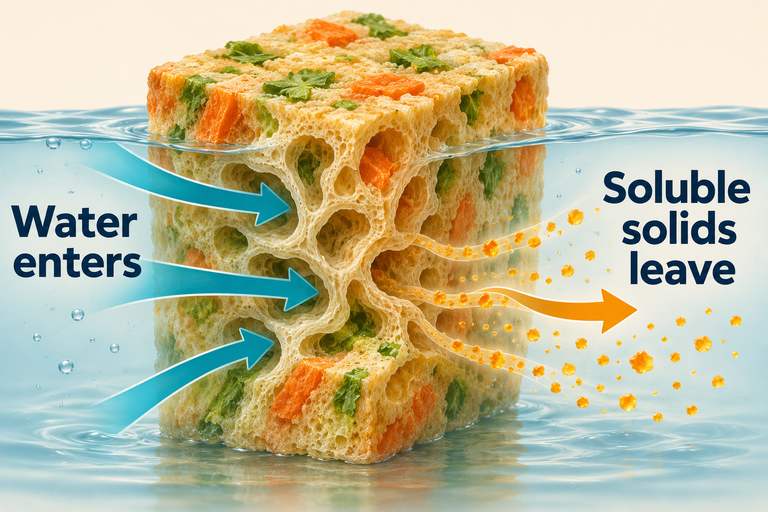
A critical limitation of gross weighing is the assumption that mass change represents solely water uptake. When a dried porous food contacts water, two counter-directional mass transfer phenomena occur simultaneously (Assis et al., 2018 [R2]):
- Water molecules diffuse and flow by capillarity into the porous matrix, increasing product weight.
- Soluble dry solids, such as sugars or other soluble materials, dissolve and leach into the soaking liquid, decreasing the dry matter of the piece.
Assuming no other material enters or exits, the overall measured mass change is:
ΔM_measured = ΔM_water_absorbed - M_solids_lost
Routine weighings before and after soaking capture this combined net mass change. Because water gain and solids loss occur at the same time, the mass of absorbed water is not identical to the net mass gain. Separating water uptake from solids loss requires additional information, such as independently determined dry-solids content and suitable mass balances.
Temperature Dependence and Structural Integrity
Water temperature influences rehydration behavior. In freeze-dried strawberries tested at 0°C, 20°C, 40°C, and 80°C, Meda and Ratti (Meda & Ratti, 2005 [R3]) measured a higher recovery coefficient near 0°C than at the warmer temperatures. The authors proposed structural changes or pore collapse at elevated temperatures as an explanation for the lower recovery observed in those samples.
This observation is specific to the strawberry samples, experimental protocol, and recovery metric in that study. Appropriate rehydration temperatures in industrial practice depend on the specific food material, intended preparation method, and product trial goals.
In addition, Meda and Ratti observed that rehydrated strawberries were substantially less firm than fresh fruit (Meda & Ratti, 2005 [R3]). Because a high mass recovery does not ensure original fruit firmness, product evaluation protocols should assess physical texture and mass recovery as separate quality parameters.
Laboratory Test Design vs. Culinary Food Function
A factory test should match how the product will actually be prepared and used. Depending on the food, an assessment may require examining drained piece mass, the surrounding liquid, or the complete prepared serving.
Drained Components vs. Whole-Dish Products
The chosen test method should correspond to the functional role of the food in its intended application:
- Discrete Ingredient Pieces (e.g., vegetable pieces, fruit dice, meat cubes): For ingredients intended for dry mixes, noodle garnishes, or bakery inclusions, pieces are often evaluated as distinct solids using a defined draining and weighing procedure to record the rehydrated piece mass.
- Instant Dispersible Blocks (e.g., instant soups): In instant soup blocks, solids hydrate and disperse into liquid to form a finished broth. In a commercial case study on freeze-dried instant tremella soup (Tremella Soup Case Study, 2017 [R4]), trial adjustments of liquid-to-solid ratio and boiling time balanced block strength, crispness, packaging convenience, and rehydration performance. Evaluating such foods requires testing the whole prepared soup rather than relying only on drained ingredient pieces.
Key Variables in Standardizing a Rehydration Protocol
Because measured mass values depend directly on testing conditions, comparisons across trials require documented, controlled test parameters. When testing the effect of a specific trial variable, other factors must be held constant. Table 1 outlines practical variables to specify when planning comparison procedures.
| Variable Category | Parameters to Document and Control | Technical Consequence if Uncontrolled |
|---|---|---|
| Sample Material | Raw material lot, formulation, pre-treatment (such as blanching), piece geometry, and dimensions. | Differences in initial tissue structure or piece size alter liquid absorption and mass changes across lots. |
| Moisture Baseline | As-tested sample weight (M_d), residual moisture content, or independently determined dry-solids basis. |
Unrecorded moisture baselines prevent direct comparison of calculated mass ratios. |
| Liquid Medium | Liquid composition, volume, and sample:water ratio (for example, sample:water mass ratio of 1:100 as in Assis et al. [R2]). | Differing liquid quantities and compositions alter contact conditions during immersion. |
| Thermal Profile | Starting liquid temperature, vessel insulation, and temperature control during soaking. | Uncontrolled cooling or temperature drift during the test alters hydration behavior. |
| Contact Dynamics | Static immersion or defined stirring; total contact time. | Variations in liquid movement or contact duration alter measured mass changes across samples. |
| Separation Method | Drain time (for example, draining 5 minutes followed by blotting as in Meda & Ratti [R3]), drainage pressure, and weighing delay. | Variations in draining time, pressure, or surface blotting change the amount of liquid retained on the sample. |
| Sampling Scale | Portion size, number of repeated portions, and evaluation of piece-to-piece variation. | Limited sample sizes or unrecorded variation make comparisons between trial lots uncertain. |
Single-Time Tests, Hydration Curves, and Mass Plateaus
Factory evaluations may measure rehydration at a single defined time, across a series of time intervals to establish a hydration curve, or continue until the sample reaches a measured mass plateau where drained mass stops changing under the test conditions. The appropriate choice depends on the specific product question and whether interest centers on initial reconstitution speed or maximum mass uptake.
A measured mass plateau indicates that the drained sample mass has stabilized under the stated test conditions; it does not independently demonstrate that chemical moisture equilibrium has been reached. When product quality depends on rapid preparation, inspection of the piece center and sensory texture at the intended serving time confirms whether the core has adequately rehydrated.
Evaluating Industrial Batch Freeze Dryers Through Rehydration Trials
Commercial food freeze-drying is carried out in production-scale batch freeze dryers. During pilot runs and equipment trial evaluations, rehydration behavior of finished food samples provides one practical metric for comparing trial batches.
Distinguishing Chamber Uniformity from Processing Variations
Before attributing differences in rehydration results to dryer performance, process teams should systematically examine traceable raw material, preparation, and operational factors:
- Tray Loading: Differences in tray loading depth or distribution across trays can alter local drying conditions and should be recorded during trial comparisons.
- Freezing Conditions: Variations in freezing history affect ice formation and dried matrix structure, which can influence subsequent rehydration.
- Chamber Position: Differences across shelf positions and tray locations should be tracked using representative sampling to document variation across the chamber.
- Raw Material and Pre-treatment: Variations in raw material lot, ripeness, sugar content, or pre-treatments influence tissue permeability and mass change during testing.
Meaningful comparisons require documented raw material formulation, sample geometry, tray loading, freezing method, drying conditions, and rehydration testing protocols. Explicitly identifying which factors are intentionally varied and holding other parameters constant allows clear evaluation of trial results.
Connecting Finished-Food Quality to Production Scale
Trial evaluations must consider finished-food quality alongside cycle duration, tray loading, and equipment operating parameters. Rehydration performance is one aspect of finished product quality that should be evaluated in conjunction with overall production cycle time and equipment duty.
Fuzhou Xing Shun Da Refrigeration Facility Project Co., Ltd. manufactures industrial and commercial batch food freeze dryers. For further technical details on cycle development, see our food freeze-drying cycle development page, and review equipment validation topics on our food freeze-dryer validation page. Information about our company is available on our about us page, and technical inquiries can be submitted via our contact page.
References and source context
- Hameed OB, Ahsan H, Rather AH, Hussain SZ, Naik HR. Influence of Pretreatments and Drying Methods on Water Activity, Dehydration and Rehydration Ratio of Dried Tomato. Biosciences Biotechnology Research Asia. 2016;13(4). DOI record · 10.13005/bbra/2391. Scope used: mass-ratio definition and method context from sun-, solar- or cabinet-dried tomatoes.
- Assis FR, Morais RMSC, Morais AMMB. Rehydration of osmotically pre-treated apple cubes dried by hot air, microwave, and freeze-drying. Acta Alimentaria. 2018;47(3):315–323. Full paper · doi:10.1556/066.2018.47.3.7. Scope used: food-specific definitions, methods and interpretation.
- Meda L, Ratti C. Rehydration of freeze‐dried strawberries at varying temperatures. Journal of Food Process Engineering. 2005;28:233–246. DOI record · 10.1111/j.1745-4530.2005.00404.x. Scope used: the study’s recovery coefficient, temperature response and firmness results.
- Freeze-Dried Instant Tremella Soup Case Study. First-party project record, China, 2017. Qualitative example of the formulation and handling tradeoff.
Use the research findings to understand the measurements, the company case to see a production tradeoff, and the hypothetical example to follow the arithmetic. Set product targets from the intended food and a defined test method.

About the Author: Zheng Wei
Founder & Freeze-Drying System Engineer
Fuzhou Xing Shun Da Refrigeration Facility Project Co., Ltd.
Zheng Wei participates in food freeze-drying trials, equipment selection, vacuum-system configuration, refrigeration planning, installation guidance, process optimization, and project handover. The project experience covers fruit, vegetables, cooked foods, seafood, meat, dairy products, herbs, and extracts.