
Food processing · Buying an LN2-dependent system
Liquid Nitrogen Freeze Dryer: Check the Function Before Comparing Quotes
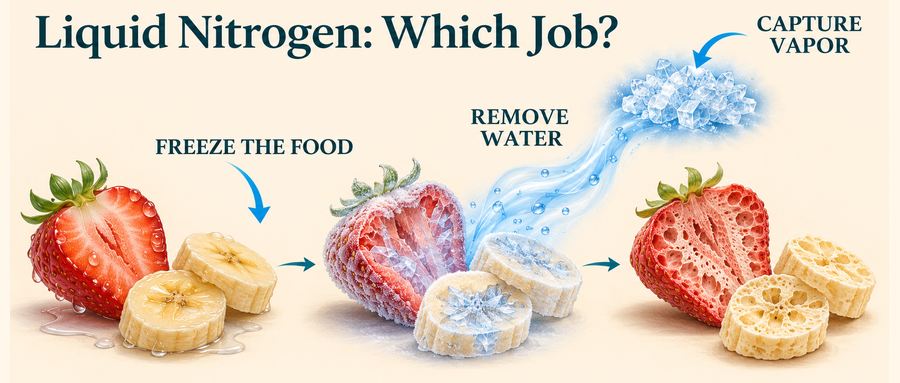
Find where nitrogen is used, check what the proposed system can do with your food, then compare its complete cost and supply needs.
Before comparing quotations for a liquid nitrogen freeze dryer, ask each supplier to identify exactly which equipment uses nitrogen. The term alone does not explain whether the quote covers an upstream freezer, refrigeration for a specific dryer circuit or component, an auxiliary solvent trap, or dry nitrogen gas backfill. Each arrangement serves a completely different technical purpose.
For a food processing project in India, evaluate your specific product and manufacturing route first. Confirm which equipment is included in the quoted price, what loaded test data the supplier has on similar products, and which gas supply connections or site works you must arrange. The five checkpoints below show how to turn an initial supplier conversation into a proposal you can verify.
Ask the supplier to show where nitrogen is used
Request an itemized equipment list and a clear process flow description showing how food moves through the line and where nitrogen is applied. For each nitrogen connection, confirm whether it uses liquid or gas, which component consumes it, and whether that hardware is included in the quotation. Clarify the transfer scope between separate upstream or downstream units and the vacuum drying chamber.
This clarification prevents misunderstandings about scope: quoting a separate cryogenic pre-freezer does not imply that the subsequent vacuum drying chamber is included. Likewise, providing an inert gas connection does not mean the freeze dryer uses liquid nitrogen for refrigeration.
Freezing and freeze drying do different work
Freezing prepares the product for drying. During primary drying, ice leaves the product as vapor under vacuum; this change from solid to vapor is sublimation. The condenser captures that vapor, while later secondary drying removes additional water held by the dried material. Cooling, heat supplied to the product, and vacuum control therefore have different jobs in the drying process. The SP technical note explains these stages; its laboratory and pharmaceutical examples are not operating recipes for a food product.[3]
| Function | What it means | What the buyer should confirm |
|---|---|---|
| External LN2 pre-freezing | A separate cryogenic unit freezes prepared material before transfer to a freeze dryer. | The upstream unit, frozen-product transfer and subsequent vacuum-drying equipment included in the scope. |
| Cryogenic dryer cooling | LN2 provides refrigeration for the specified dryer circuit or component. | Whether it cools shelves, the condenser, or another circuit; the duty and control arrangement supplied. |
| Specialist solvent trap | A separate low-temperature trap may be required for particular solvents. | The actual vapor/application requirement and the qualified compatibility and safety review. |
| Nitrogen gas backfill | Dry nitrogen can be admitted before sealing or unloading, where appropriate to the process. | The gas specification and supply interface, separately from any liquid-nitrogen refrigeration. |
GEA describes a liquid-nitrogen freezer that produces frozen material for transfer to a freeze dryer. Millrock describes LN2 cooling as an alternative to mechanical refrigeration within a dryer. These examples establish two different uses of nitrogen; neither brochure is a matched performance test for the food and load in your project.[1] [2]
The SP note separately discusses external freezing, traps for particular solvents, and inert-gas backfill. A solvent-trap requirement must not be transferred to an ordinary food-water application without checking the actual vapor and equipment requirements. A nitrogen-gas backfill connection also does not establish a need for liquid-nitrogen refrigeration.[3]
Record the supplier’s written equipment scope and explicit exclusions. Focus on verifying what hardware and functions are included in the quote, rather than assuming your food facility needs every mechanism listed in the table. Once the physical scope is clear, examine what cooling work the system can deliver under load.
The food freeze-dryer selection guide explains the overall preparation, tray loading, and drying sequence. Review that broader equipment framework to identify any required items that lie outside the equipment supplier's quote.
Compare cooling during the proposed production work
Send identical product and load specifications to each supplier and request test records under comparable conditions. Specify the raw food, cut dimensions, preparation methods, tray loading arrangement, initial temperature and state, and total water load. State clearly whether the product will be frozen before loading or frozen directly on shelves inside the dryer. Without these details, suppliers will base their figures on differing operating assumptions.
Distinguish evidence for shelf cooling or freezing from evidence for vapor capture at the condenser. Ask which specific refrigeration circuit uses liquid nitrogen and what operating conditions the system maintains across each stage. Reaching a low temperature in an empty chamber does not show how the equipment performs with a full production load.
Cooling temperature and cooling power are separate parts of the specification. The technical discussion in Lyophilization World identifies the load profile over time, peak cooling demand and turndown as selection inputs. Here, turndown means the ability to operate at the lower demand as the load changes. This supports asking for evidence across the proposed process; the source's broader claims about cost, reliability and environmental performance are not adopted as results for this food project.[4]
Ask each supplier what test records and explanations they can provide across four areas:
- What material was tested? Confirm the food material, preparation, piece dimensions, and batch water load in the test, noting differences from your intended product.
- What was measured and controlled? Check shelf, product, and condenser temperatures, chamber pressure, measurement locations, and control methods across the drying stages.
- What operating conditions applied? Check ambient room conditions, required plant utilities, and manufacturer operating limitations linked to the run.
- What acceptance criteria applied? Establish agreed project acceptance standards before treating competing equipment quotes as equivalent.
Do not substitute generic empty-chamber temperatures, standard tolerance bands, or borrowed shelf uniformity figures for loaded test records on your food and batch size.
The SP note cautions that there is no universal safe freeze-drying recipe. A colder component specification therefore cannot replace product-specific operating and acceptance conditions.[3]
These test logs show how the equipment operates under load. A dedicated product trial answers the next question: will this equipment and processing route deliver the speed or quality claimed for your food?
Define what the food trial is meant to prove
Clarify the vendor's exact commercial claim before scheduling pilot trials. Faster freezing, shorter drying time, and reduced complete production time are separate outcomes. Define which result the trial evaluates, then establish the food preparation, piece dimensions, tray loading, and finished quality criteria needed to test it.
Record both the freezing conditions over time and the vacuum drying process that follows. Without detailed records for both stages, any observed difference in speed or quality cannot be attributed to liquid nitrogen rather than to other run variables.
What the food studies support
Bera and colleagues studied small banana samples with cryogenic pre-freezing and infrared-assisted freeze drying. Their results belong to that combined laboratory treatment and sample geometry. They do not establish a commercial drying cycle or an advantage caused by liquid nitrogen alone.[5]
Levin and colleagues studied concentrated coffee particles. Freezing conditions changed pore structure and drying kinetics, and total drying time also involved secondary drying. That finding gives a reason to examine the complete route for the actual product; it is not a rule that faster or slower freezing must give the same drying result for every food.[6]
Choose the comparison that answers the claim
To evaluate freezing history, keep other relevant processing conditions comparable and disclose any changes. Maintain consistent product dimensions, tray loading, and drying targets while recording the drying cycle. This shows how the freezing method influences drying behavior and product quality.
To compare complete production routes, allow each system to follow its own developed cycle, disclose all operating differences, and compare the agreed total production time, metered utility inputs, and accepted dry output. This supports route selection between different equipment arrangements, but it does not isolate freezing alone.
Agree in writing before running trials on what parameters will be tested, the measurement methods and records to use, and how results outside agreed targets will be handled. Depending on the product, criteria may include residual moisture, water activity, texture, appearance, rehydration ratio, packaging integrity, or sensory quality. Define explicit test methods for your food rather than relying on a single moisture value.
Record measured results alongside the preparation details, batch load, and operating conditions used in the run. For questions on frozen handling and product release, consult the pre-freezing requirements guide. Clear quality and output data provide a sound basis for the subsequent cost comparison.
Compare the complete route per accepted kilogram
Agree with suppliers on a consistent boundary and accounting period for calculating production costs. Define which steps—preparation, freezing, material transfer, vacuum drying, defrosting, and turnaround—are included across the complete route. Use accepted dry output that meets agreed quality standards as the cost denominator, rather than comparing costs per wet input kilogram or per freezing hour.
GEA flags nitrogen consumption as an operating-cost consideration for its upstream freezer. Millrock makes a cost-parity claim for its own LN2 dryer-cooling option. Those statements concern different equipment and are not comparative cost data for another food factory. Freezer-only nitrogen consumption must not be presented as the consumption of a complete freeze-drying line.[1] [2]
A comparable cost worksheet
First agree the boundary and accounting period. Include the relevant preparation/freezing, transfer, vacuum drying, defrost and other route operations on the same basis for both proposals. Define accepted dry output by the same product-quality requirements.
Comparable cost per accepted kg =
(agreed capital allocation + nitrogen cost + electricity + other agreed route costs) ÷ accepted dry output
This is an accounting framework, not a measured saving. Capital allocation requires an explicit life, utilization and financing basis. Other route costs may include labor, maintenance, utilities, storage or delivery charges, and agreed installation-related costs. Costs already included in a supplier’s charge should not be added again.
- Use the delivered nitrogen basis. Obtain the actual quote, unit of sale, delivery/minimum-order terms, rental or service charges, and measurement boundary.
- Match inventory and consumption. When opening and closing stock differ, reconcile them before allocating nitrogen to the comparison period. Record storage, transfer, startup and standby losses within that boundary.
- Count each loss once. If the chosen purchased/consumed nitrogen total already includes those losses, do not add their estimated cost a second time.
- Normalize by accepted output. Use comparable accepted dry kilograms and the complete production period, including the agreed turnaround. A freezing-only time or raw wet load is a different denominator.
For a food processing facility in India, obtain actual delivered nitrogen quotations from local gas suppliers and current industrial power tariffs from the local utility. Verify applicable delivery terms, minimum order quantities, and rental or service fees for your project. Do not substitute generic nitrogen prices, assumed boil-off allowances, or standard payback estimates for project-specific quotes. The industrial freeze-dryer cost guide provides an accounting structure to help verify route costs.
Confirm supply and site responsibilities before ordering
Require the equipment supplier, gas vendor, and plant contractor to define their physical supply scopes, interface connections, and contractual exclusions in writing before placing orders. A freeze-dryer quotation does not guarantee reliable nitrogen supply to your plant or ensure that onsite storage and distribution meet safety standards.
- Confirm the supply. Verify regional delivery availability, lead times, and reliability with gas suppliers against your projected usage. Define backup supply arrangements and response plans for delivery disruptions based on your plant location and operating schedule.
- Define any consumption guarantee. Require suppliers to state the measurement methods, rated load, utility boundaries, covered losses, test conditions, and remedies if agreed consumption targets are not met. Separate liquid nitrogen for pre-freezing or dryer cooling from nitrogen gas backfill.
- Assign interface responsibilities. Agree on which party provides storage, transfer lines, utility connections, control interfaces, commissioning, documentation, and service support. Identify and list all scope exclusions explicitly.
- Obtain qualified reviews and written conclusions. Commission a qualified project-specific cryogenic, safety, and applicable regulatory review, and obtain the responsible parties' written conclusions and remaining actions. Do not rely on informal sales statements in place of professional technical review and documented handoffs.
GEA's description includes ventilation as a plant interface for its cryogenic freezer. That illustrates why the equipment boundary must be checked against the site work. It does not establish ventilation quantities or regulatory requirements for a different facility.[1]
Consult the commercial freeze-dryer setup guide to align space, utilities, and commissioning plans across all responsible suppliers. Resolve nitrogen-related scope boundaries and exclusions directly with each supplier before issuing purchase orders.
Start with the food and the quoted nitrogen function
For a food freeze-drying equipment discussion, send the product, prepared wet load, intended location and the supplier's description of where nitrogen is used. Include the equipment list, exclusions and any trial or consumption records already available.
These details help identify the drying scope and the questions still to resolve. Nitrogen supply, cryogenic site engineering and approval responsibilities must be confirmed separately. No particular cooling option or performance outcome is promised.
References and evidence boundaries
- GEA. Liquid Nitrogen Freezer. Manufacturer description of a separate upstream freezer; its model/consumption data are not whole-dryer results.
- Millrock Technology. Liquid Nitrogen (LN2) Cooling for Freeze Drying. Manufacturer architecture and marketing claims, not a measured comparison for this food project.
- Barley J. Basic Principles of Freeze Drying. SP technical note, Rev. 001, March 2022. Laboratory/pharmaceutical examples and numerical settings are not adopted as food recipes.
- Lyophilization World. Freeze-drying with liquid nitrogen. Technical/vendor-context discussion of refrigeration-load profile; broad economic and environmental claims are not adopted.
- Bera M, Chakraborty R, Bhattacharya P. Optimization of Intensification of Freeze-Drying Rate of Banana: Combined Applications of IR Radiation and Cryogenic Freezing. Separation Science and Technology. 2012;48(2):346–358. doi:10.1080/01496395.2012.688785. Small banana samples, LN2 pre-freezing and IR-assisted drying; no commercial cycle or isolated LN2 guarantee is inferred.
- Levin P, Meunier V, Kessler U, Heinrich S. Influence of Freezing Parameters on the Formation of Internal Porous Structure and Its Impact on Freeze-Drying Kinetics. Processes. 2021;9(8):1273. doi:10.3390/pr9081273. Concentrated coffee particles; no universal food or LN2 process setting is inferred.
About the Author: Zheng Wei
Founder & Freeze-Drying System Engineer
Fuzhou Xing Shun Da Refrigeration Facility Project Co., Ltd.
Zheng Wei participates in food freeze-drying trials, equipment selection, vacuum-system configuration, refrigeration planning, installation guidance, process optimization, and project handover. The project experience covers fruit, vegetables, cooked foods, seafood, meat, dairy products, herbs, and extracts.