
Freeze Drying Pineapple: Crisp Snack Pieces or Food Ingredients?
When evaluating a freeze-dried pineapple line, an established fruit processor must first resolve whether the planned product is a crisp, ready-to-eat snack piece or an ingredient destined for dry mixes and prepared foods. An attractive, airy snack slice and an ingredient piece formulated to hydrate in cereal serve entirely different functional purposes, meaning a sample that looks appealing on a laboratory tray does not answer commercial product suitability. Because pineapple combines high natural sugars with directional vascular tissues, deciding this finished-use specification upfront determines how you structure trial comparisons, assess cut geometry and freezing, and translate accepted dried yield into equipment capacity.
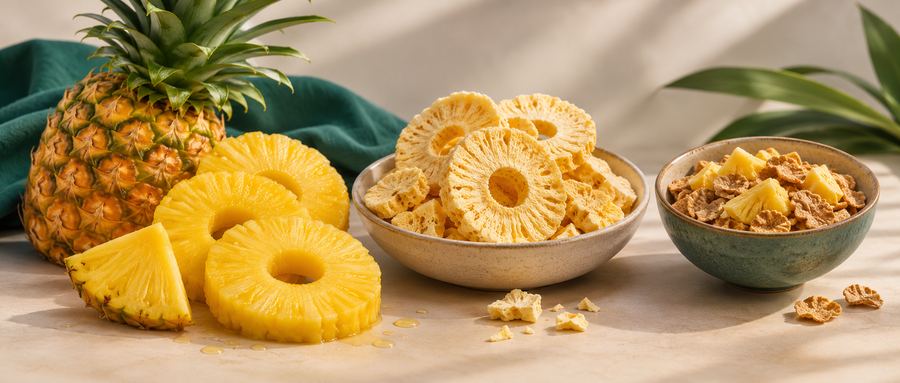
Choosing Finished Product Behavior: Snack Slices or Ingredients
Before committing tray surface area in a commercial batch freeze dryer, define the measurable finished-product criteria you intend to verify in drying trials. For ready-to-eat snack pieces, such as sliced rings or segments, target specifications generally center on a crisp, airy bite, a dry non-tacky surface, and preserved slice geometry rather than a dense or collapsed matrix. However, acceptable edge retention, color uniformity, and mechanical breakage remain specific to buyer agreements; slight chipping or cosmetic broken pieces may be fully acceptable to one customer or diverted into secondary uses, which directly determines what percentage of a dried tray qualifies as prime saleable output.
When processing pineapple as a food ingredient, functional evaluation shifts to how pieces behave when hydrated in the finished formulation. Diced pineapple destined for cold breakfast cereals, instant hot oatmeal, or baking mixes must be judged on its rate of liquid uptake, chew, and structural integrity under the preparation temperature and liquid of that actual food, rather than inferred from dry crispness alone. Furthermore, pineapple powder represents a completely distinct product specification requiring dedicated milling and protective environmental control against sugar-driven caking; processing fines and broken slices from snack runs cannot simply be designated as functional ingredient pieces without verifying their specific moisture limits and particle size distribution.
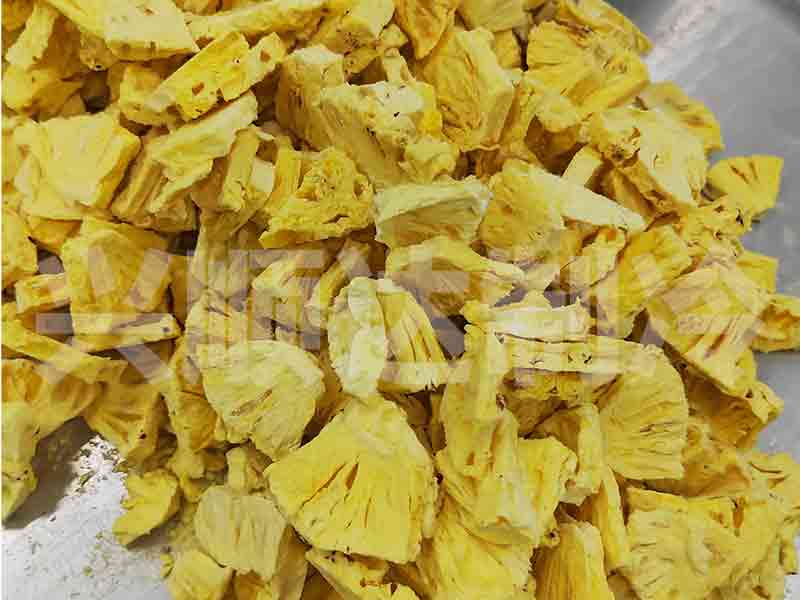
Establishing this finished product definition early provides the benchmark needed during food freeze-drying cycle development. Porosity targets, permissible residual moisture, and acceptable piece integrity can differ depending on whether fruit is eaten dry or reconstituted in liquid, helping determine what trial comparisons to test. In turn, whatever crisp matrix or residual moisture profile is achieved in the drying chamber must be preserved during handling and storage through validated moisture-barrier packaging.
Evaluating Cut Geometry, Core Retention, and Freezing State
The internal structure of pineapple flesh is naturally anisotropic, meaning its cellular tissue and physical properties differ according to direction. Vascular bundles and tubular fluid-transport channels run primarily along the fruit’s longitudinal axis from root to crown. In an early freeze-drying study using laboratory (0.18 m²) and pilot (1.5 m²) systems, Wen, Li, Lan, and Mei (1998) examined 10 mm pineapple samples that were cut axially along this length, using scanning electron microscopy to observe the tissue microstructure. Their qualitative imaging showed that cutting radially across the axis exposes open capillary channel cross-sections, whereas longitudinal cutting leaves these tubular channels running parallel along the slice surface.
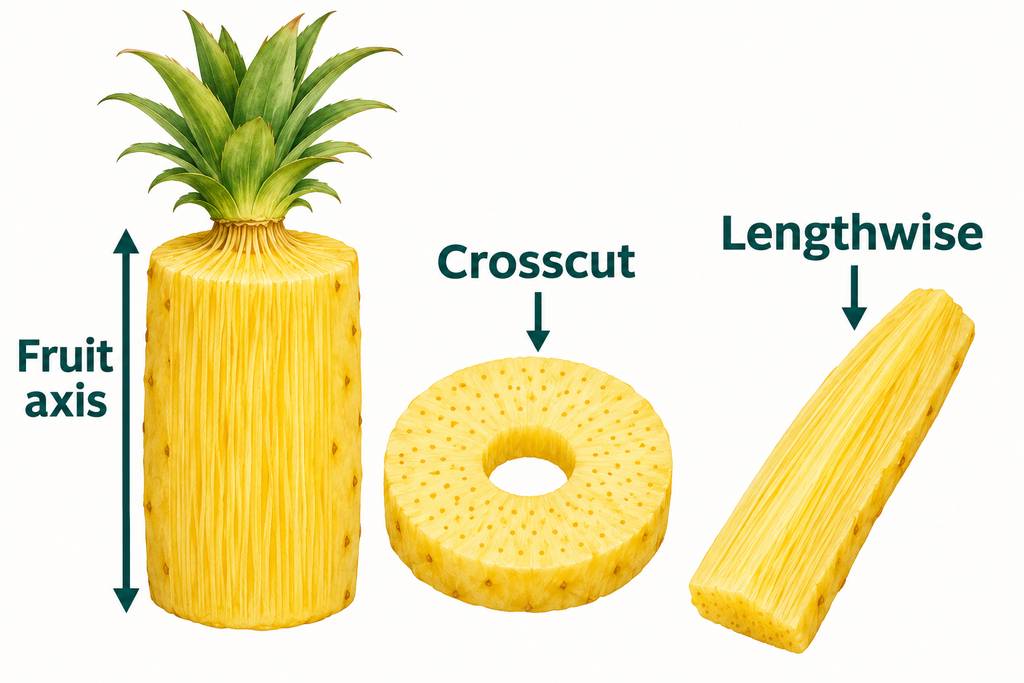
This anatomical alignment provides a physical rationale for comparing cut directions during process development, but it does not justify assuming an unverified cycle advantage. Slicing radially across the central axis exposes open capillary channel cross-sections at the cut face, whereas cutting lengthwise leaves vascular channels oriented along the slice. Because the 1998 study examined axially cut fruit without testing crosscut and longitudinal slices against each other under a matched drying cycle, the comparative rate difference between orientations remains unquantified. Processors should test cut orientation under controlled trials using their specific piece geometry to observe actual sublimation behavior, shrinkage, and slice appearance rather than relying on assumed cycle reductions.
Whether to core the fruit or retain the fibrous center core tissue is another deliberate product and process comparison. The core differs physically in its fibrous structure from outer fruit flesh, and including it alters prepared slice mass, finished texture, and sensory bite. Rather than assuming that retained core causes an automatic sublimation delay or delivers an unverified yield benefit, processors can run controlled comparative trials between cored rings and core-intact slices to evaluate actual drying endpoints, dimensional stability, and customer acceptance against their intended snack or ingredient specification.
Piece thickness, cut orientation, retained core, fruit maturity, and pre-freezing temperature and history collectively define the physical boundary for heat and mass transfer. Thicker pieces lengthen the conductive path for heat to penetrate to the receding ice front and the escape path for sublimated water vapor, while differences in ripeness, soluble solids, and freezing conditions alter the frozen piece. When faced with batch variations in raw fruit or altered cutting formats, operators should systematically compare slice dimensions, maturity, pre-freezing state, tray loading, and representative drying endpoints before attributing discrepancies to dryer programming, following the foundational principles outlined in how to freeze dry fruit.
Controlling Sublimation, Heat Input, and Vapor Capture
Connecting cut geometry and pre-freezing to actual cycle performance requires understanding the two physical drying stages: primary drying, where frozen ice sublimes directly into water vapor under vacuum and is captured on a refrigerated condenser, and secondary drying, where remaining unfrozen moisture desorbs from the fruit matrix. Operating these stages successfully requires maintaining dynamic balance among heat input, chamber vacuum, and vapor capture capacity so that the delicate sugar-rich structure of pineapple does not collapse.
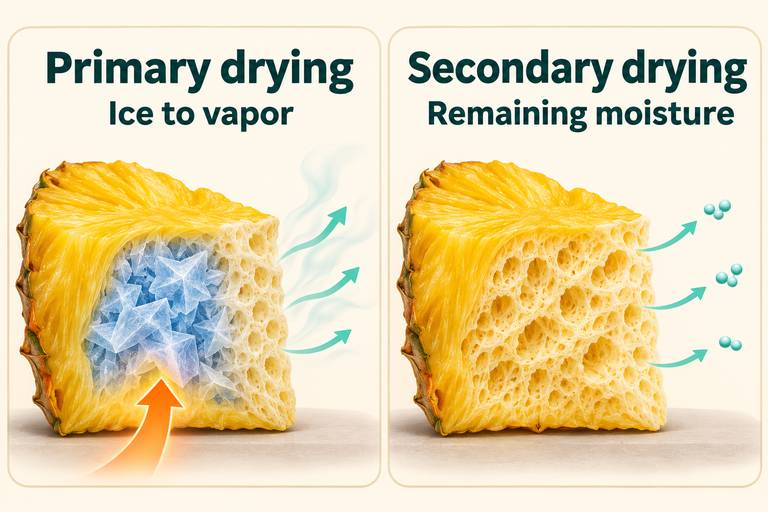
During primary drying, thermal energy is supplied to the frozen pineapple to sublime ice directly into vapor without passing through a liquid state. This heat transfers from heated surfaces through trays and into the fruit. As ice sublimes, a receding internal ice boundary forms while an outer dried layer develops, requiring heat to continue reaching the sublimation zone while water vapor migrates outward into the vacuum chamber.
Chamber pressure and heat input interact continuously with product temperature and drying kinetics. Operating at lower chamber pressure (deeper vacuum) alters both the vapor flow regime and gas-mediated heat transfer between heating shelves, trays, and product surfaces; deeper vacuum does not automatically accelerate drying and can reduce heat transfer. Conversely, supplying shelf heat faster than vapor can sublime and escape raises local product temperature, risking matrix collapse or localized melting that can impede remaining vapor escape. Evaluating drying trials therefore requires measuring product temperature and sublimation progress directly rather than relying on nominal pressure setpoints as proof of an acceptable cycle.
The vacuum environment depends on a refrigerated condenser (cold trap) that continuously captures sublimated water vapor by freezing it onto refrigerated surfaces. If the sublimation rate of a full tray load exceeds the refrigeration and condensation capacity of the cold trap, chamber pressure will rise, which can disturb sublimation and alter coupled drying conditions. Furthermore, discovering a crisp, dry surface on an accessible edge piece provides only local surface evidence and does not demonstrate that ice sublimation is finished at the core of thicker pieces or across all tray positions throughout the chamber.
After primary ice sublimation is completed, secondary drying removes remaining unfrozen moisture from the fruit matrix. The temperatures, pressures, and durations used during this stage depend on the specific product format and equipment capabilities. Secondary drying continues until representative measurements across different tray positions confirm that the batch meets the targeted residual moisture specification, rather than relying on visual surface inspection or an unverified average reading.
Judging Product Quality: Moisture, Water Activity, and Application Behavior
Managing finished fruit quality requires distinguishing between total moisture content and water activity (aw). Moisture content measures the total percentage of water by weight (expressed on a wet basis), whereas water activity reflects the energy status and availability of that water. As detailed in the official FDA Technical Guide on Water Activity in Foods, water activity is the ratio of the vapor pressure of water in the food to the vapor pressure of pure water under identical equilibrium conditions. Because food composition and temperature determine how strongly water is bound, materials with identical total moisture content can exhibit different water activity levels.
Accurate water activity measurement requires allowing a representative sample to reach equilibrium in a sealed chamber at a controlled, calibrated temperature. Total moisture content alone does not provide a universal one-to-one conversion to water activity. Moreover, neither a low moisture measurement nor an individual water activity reading constitutes a validated microbial kill step or an unconditional guarantee of product shelf life; commercial stability depends on defining rigorous release specifications and confirming stability under intended packaging and storage conditions.
Preserved cellular porosity is closely linked to how freeze-dried pineapple rehydrates. In an experimental investigation published by Tiliwa, Boateng, Zhou, and Xu (2023), researchers tested fully ripe MD2 pineapple rings (80 mm outer diameter, 30 mm center hole, 5 ± 1 mm thickness) in a total batch of 300 g (12 slices), measuring weight reduction in triplicate groups of 4 slices during drying under several methods. Their freeze-drying protocol used fruit pre-frozen at −20°C, dried at a 25°C apparatus setting and 0.518 mbar with a −95°C cold trap. Scanning electron micrographs showed that freeze drying preserved an open, porous cellular network with less apparent structural shrinkage than hot-air drying methods.
Under their standardized rehydration test—soaking 2.5 g of dried slices in 25°C distilled water for 30 minutes and blotting surface water before periodic weighing—the freeze-dried group absorbed water most rapidly and achieved the highest rehydration ratio among tested methods. Rehydration ratio is defined strictly as the mass of the rehydrated wet sample divided by the dry sample mass, representing physical water uptake rather than a return to fresh fruit texture or zero shrinkage. When developing an ingredient specification, processors should extend beyond distilled water tests to evaluate rehydration in the actual liquid, temperature, and residence time of the intended food matrix, using the testing principles discussed in rehydration ratio in freeze-dried food.
Visual color and aroma profile must likewise be judged against the intended product application. In the 2023 study by Tiliwa et al., freeze-dried pineapple exhibited the lowest browning index among tested drying methods, preserving a pale, bright color; however, this significant lightness shift produced the largest total color difference (ΔE) relative to fresh pineapple. In volatile analysis, a 10-sensor electronic nose analyzing headspace at 40°C demonstrated that drying techniques create distinct volatile response patterns. While these sensor responses confirm that drying alters aroma profiles, the electronic nose does not quantify specific chemical aroma compounds (as with gas chromatography–mass spectrometry) or measure sensory preference by a human tasting panel. Whether pale brightness, preserved porosity, or specific aromatic qualities represent desirable attributes depends on customer acceptance criteria for a given snack or blended food, which processors should verify through representative sensory and application testing rather than assuming freeze drying is universally preferred.
Once dried, the open porous matrix and high natural sugar content make pineapple hygroscopic. If exposed to ambient moisture during handling or storage, dried pieces absorb atmospheric water vapor, which can soften crisp snack structures and alter surface texture depending on environmental conditions and exposure duration. Protecting finished product quality between dryer unloading and final consumption requires minimizing moisture exposure, using validated moisture-barrier packaging, and ensuring intact seals, as detailed in freeze-dried food packaging.
Connecting Mass Balance, Accepted Yield, and Facility Throughput
Accurately sizing freeze-drying equipment requires distinguishing between purchased raw pineapple mass and the prepared wet input mass loaded onto dryer trays. Peeling, coring if specified, trimming peel blemishes, and draining free surface juice occur entirely upstream of the drying chamber. Equipment loading figures and mass balances must therefore be based strictly on prepared wet input mass (M), weighed after all preparation and drainage operations are complete, rather than calculated directly from raw whole fruit purchase invoices.
Assuming dry solids are conserved across the drying process with no unaccounted additions or physical losses, let Xi represent the initial wet-basis moisture content (expressed as a decimal fraction) and Xf represent the final dried moisture content. The mass of dry solids (S) is defined as:
S = M × (1 − Xi)
Because the finished product retains a small fraction of residual moisture (Xf), the ideal total dried mass (D) is calculated by dividing conserved solids by the non-water fraction:
D = S / (1 − Xf)
The total mass of water removed by the freeze dryer (W), comprising both sublimated ice and desorbed bound moisture, is the difference between wet input and dry output:
W = M − D
To illustrate these principles with an explicit hypothetical calculation (not a commercial yield guarantee or machine trial), consider a prepared batch of M = 100.00 kg of drained pineapple chunks with an initial moisture content of Xi = 85.0% (0.85) and an intended final moisture content of Xf = 3.0% (0.03):
- Conserved dry solids: S = 100.00 × (1 − 0.85) = 15.000 kg
- Ideal dried product mass: D = 15.000 / (1 − 0.03) = 15.464 kg
- Total water removed: W = 100.00 − 15.464 = 84.536 kg
- Hypothetical accepted-piece fraction at 90%: 15.464 × 0.90 = 13.918 kg of prime pieces
This worked example highlights a vital distinction for capacity planning: while total dried mass is 15.464 kg, prime saleable product accounts for only 13.918 kg. The remaining 1.546 kg represents an unaccepted fraction whose physical condition and market disposition remain unspecified; it cannot simply be counted toward prime snack delivery commitments or written off as zero value without testing alternative product specifications, such as milling into powder or grading for ingredient blends. For a processor evaluating project feasibility, pairing measured preparation yield with accepted piece recovery defines the true whole-fruit requirement needed to support delivery commitments and cost models.
Swipe horizontally to read the complete hypothetical calculation.
| Process Parameter | Symbol / Basis | Hypothetical Value | Operational Meaning |
|---|---|---|---|
| Prepared Wet Input | M | 100.00 kg | Weighed after peeling, coring, trimming, and draining |
| Initial Moisture Content | Xi | 85.0% (0.85) | Wet-basis moisture of prepared fruit |
| Conserved Dry Solids | S | 15.000 kg | Invariable fruit solids across drying process |
| Target Final Moisture | Xf | 3.0% (0.03) | Target residual moisture in finished product |
| Ideal Dried Mass | D | 15.464 kg | Total dry product containing residual moisture |
| Total Water Removed | W | 84.536 kg | Total ice sublimated and vapor desorbed |
| Accepted Pieces (90%) | — | 13.918 kg | Hypothetical whole pieces meeting visual/size spec |
When projecting facility throughput, processors must distinguish between active drying cycle time and total batch turnaround time. An actual first-party case study from a 2014 Indonesian food processing project using a 20 m² freeze dryer (model SDG700) documented a prepared wet loading of 12.2 kg/m² (approximately 244 kg total load) of crosscut rounds dried over a 12-hour cycle to achieve a 2.31% final moisture content. This historical record demonstrates specific operating parameters, but does not provide starting moisture, total dried mass, or accepted yield for that run.
A 12-hour active drying run does not mean an operating facility completes two commercial batches every 24 hours. Full chamber occupation time encompasses tray loading, vacuum pull-down, sublimation and desorption, chamber venting, tray unloading, and turnaround steps such as condenser defrosting and cleaning where required by the facility schedule. While external pre-freezing can conditionally run in parallel with active drying, executing overlapping batches requires that pre-freezing capacity, tray handling, labor shifts, and staging areas actively support that schedule. Period delivery projections should be based on accepted prime mass per batch multiplied by actually completed batches over time, rather than theoretical equipment loading rates.
What to Verify Before Choosing Equipment Capacity
Successfully scaling a freeze-dried pineapple operation requires establishing your target product specification and validating accepted output before finalizing commercial dryer capacity. Rather than assuming nominal drying times or wet tray loading figures translate directly into saleable inventory, processors should conduct controlled trials to verify cut behavior, sublimation dynamics across full trays, and accepted piece recovery under realistic batch turnaround schedules.
If you are establishing project parameters for industrial pineapple freeze drying, you can share your planned cut format, prepared wet batch mass, finished quality criteria, and intended operating schedule: Discuss your pineapple freeze-drying project.
References
- Wen Xinrong, Li Xiaoying, Lan Renhua, Mei Ciyun. 草菇、菠萝的冷冻干燥过程及影响因素分析. Guangzhou Chemical Industry.1998;26(2):1–4.
- Tiliwa ES, Boateng ID, Zhou C, Xu B. Role of Drying Technologies on the Drying Kinetics, Physical Quality, Aroma, and Enzymatic Activity of Pineapple Slices. Sustainability.2023;15(22):15906. DOI:10.3390/su152215906.
- U.S. Food and Drug Administration. Water Activity (aw) in Foods. Technicalguide1984; cited for definitions and measurement conditions.
- Company project report. 2014 Indonesian pineapple freeze-drying project. First-party historical loading, drying-time and moisture observations.

About the Author: Zheng Wei
Founder & Freeze-Drying System Engineer
Fuzhou Xing Shun Da Refrigeration Facility Project Co., Ltd.
Zheng Wei participates in food freeze-drying trials, equipment selection, vacuum-system configuration, refrigeration planning, installation guidance, process optimization, and project handover. The project experience covers fruit, vegetables, cooked foods, seafood, meat, dairy products, herbs, and extracts.