
Freeze Drying Broccoli for Food Ingredients
Choosing Broccoli Ingredient Form and Food Function
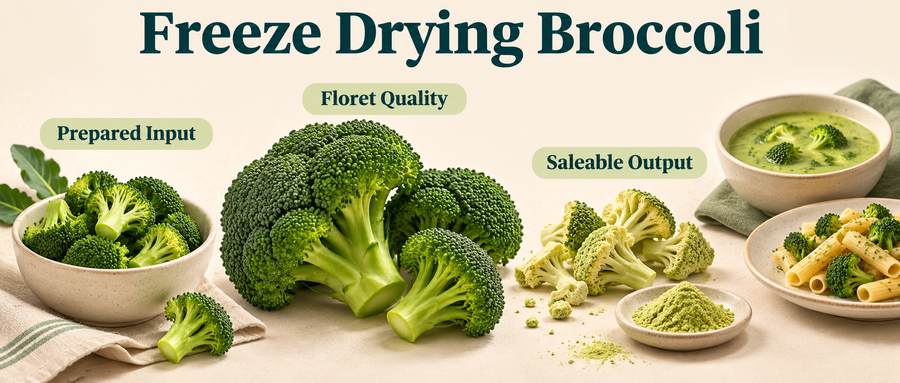
When formulating dry soups or ready meals with visible broccoli pieces (Seawind Foods), food processors must decide whether whole florets will rehydrate with the natural bite, color, and visual integrity consumers expect. Freeze drying removes moisture by freezing the vegetable and sublimating solid ice directly into water vapor under vacuum.
That functional evaluation differs across finished product forms. Where dry soup mixes and prepared meals require intact florets that maintain piece geometry, rehydrated bite, and characteristic flavor, seasoned vegetable snacks require a crisp dry chew, piece durability against handling breakage, and characteristic flavor. In powder applications, intact floret structure is unnecessary, shifting the focus to milling efficiency, particle dispersion, color stability, and whether drying costs match the value in the formulated blend.
Handling and packaging dried florets produces a mix of intact heads, detached branches, and small fragments. Production accounting tracks these streams against explicit acceptance criteria: pieces meeting the visual and size requirements constitute accepted floret yield, while broken fragments and fines are recorded separately. When fines satisfy designated particle, moisture, and color specifications, they can be directed into secondary products such as seasonings or dry soup bases; otherwise, they are recorded as rework, reject material, or unrecovered yield loss. Sizing a commercial freeze dryer for vegetables therefore depends on measuring the real yield of accepted pieces and defining the planned commercial disposition for off-spec fractions.
Fresh Preparation, Blanching, and Frozen Infeed State
Raw vegetable pretreatment directly influences how broccoli behaves during subsequent freezing and vacuum drying. As outlined in general vegetable processing principles from the National Center for Home Food Preservation, heating raw pieces briefly in steam or boiling water inactivates native enzymes responsible for progressive flavor, color, and structural breakdown in frozen storage. Because heating softens vegetable tissue, prompt cooling is necessary to arrest the cooking process before surface water is drained ahead of freezing. Documenting and matching these preparation steps in trial runs helps processors accurately interpret drying performance and product texture.
Setting the thermal exposure involves balancing competing quality requirements. Under-blanching leaves enzymes active, leading to progressive off-flavors, pigment degradation, and structural breakdown over storage. Conversely, over-blanching degrades quality through tissue softening and loss of natural flavor, color, vitamins, and minerals. Because heat penetration varies with floret diameter and stem thickness, processors establish heating durations, rapid cooling protocols, and draining stages tailored to their specific cut sizes and piece geometry rather than relying on a generic heating time.
Processors compare preparing fresh raw broccoli on-site with sourcing pre-cut frozen florets. On-site fresh preparation allows trimming, floret-to-stem ratios, blanching times, and draining to be observed and managed directly on the processing floor. Purchasing frozen broccoli relies instead on upstream preparation, requiring documented blanching thermal history, freezing conditions, and cold-chain temperature records to establish a valid baseline. Setting up a controlled commercial evaluation requires aligning piece dimensions, thermal pretreatment, and frozen temperature history before trays enter the vacuum chamber.
Piece Size, Tray Loading, and Drying Uniformity
Industrial batch freeze drying operates across two physical stages under vacuum. In primary drying, heat transferred into the frozen vegetable drives ice sublimation directly into water vapor, which moves through the structure of the bed and is collected by the condenser. After free ice crystals have sublimated, secondary drying desorbs remaining bound moisture from the solid vegetable matrix. The progress of sublimation and vapor removal depends on the balance between heat input, vacuum level, vapor pathways through the vegetable layer, and the rate of condenser vapor capture.
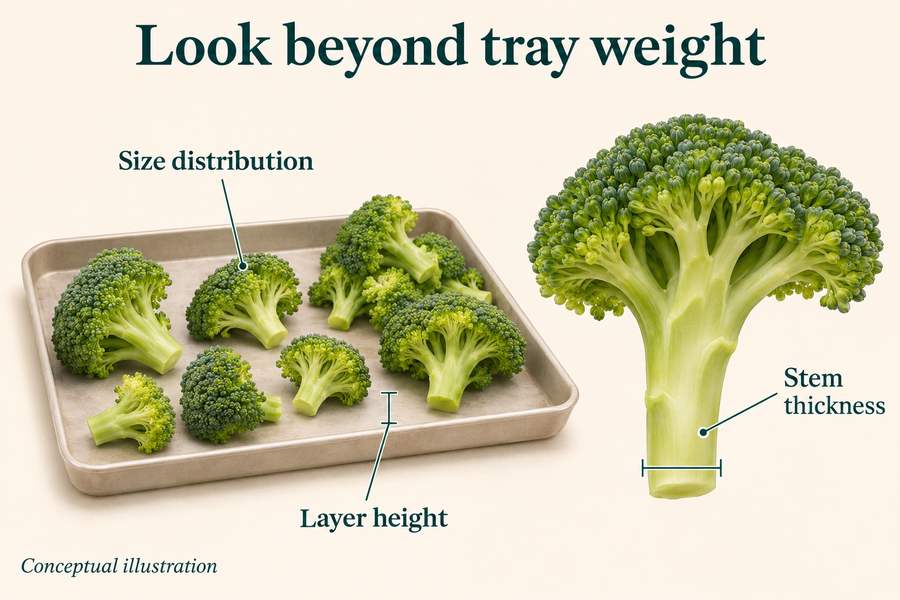
A broccoli floret pairs an open, high-surface-area flower cluster with a thicker, fibrous attached stem. In mixed florets, differences in piece thickness and local tissue density can alter heat entry and water vapor pathways during sublimation. Observing a dry surface on outer flower buds reflects only local surface condition, not the drying progress throughout the piece. Evaluating drying across a batch involves testing representative thick stems alongside open florets across various tray positions to monitor moisture levels and verify when primary ice removal is complete.
Achieving consistent drying times and uniform residual moisture requires balancing piece dimensions with tray loading density:
Swipe horizontally to read the comparison table.
| Geometry and Loading Variable | What the Parameter Records | Comparison and Evaluation Focus |
|---|---|---|
| Floret and Stem Dimensions | Measures floret diameter, attached-stem thickness, and piece size distribution across the batch. | Provides geometric data to compare open floret heads and thicker stem regions during trial drying evaluations. |
| Prepared Net Mass and Usable Area | Records total wet broccoli weight loaded across available tray surface area. | Calculates average loading density to evaluate alongside piece arrangement, layer thickness, and local tray distribution. |
| Layer Height and Tray Placement | Documents bed thickness, piece overlap, and physical contact with the tray surface. | Assesses heat entry, bed depth, and vapor escape pathways across representative tray locations. |
Trays loaded with identical total mass can exhibit different drying behavior if one carries a single layer of uniform florets while another holds deep piles with overlapping thick stems. Developing an efficient cycle relies on controlled pilot trials that adjust one parameter at a time. Systematically recording floret dimensions, net tray loading, layer arrangement, tray locations, and stem core moisture provides the measurable data needed to optimize batch drying, as detailed in guides on food freeze drying cycle development.
Finished Moisture, Sensory Quality, and Food Safety
Establishing finished product specifications requires defining both moisture content and water activity (aw). On a wet basis, moisture content expresses the mass of water as a fraction of total product weight; on a dry basis, it measures water mass relative to dry vegetable solids. Water activity reflects the energy state and availability of that water to support microorganisms or participate in chemical degradation. While dried vegetables typically display lower water activity as moisture is removed, moisture content and water activity represent distinct physical properties. Processors establish individual targets and test methods for both parameters to govern product stability.
In laboratory research evaluating vegetable dehydration methods, Mohammadi et al. (2020) examined conventional freeze drying using a 320 g laboratory batch of fresh broccoli florets steam-blanched for 5 minutes, frozen at −24°C, and dried in a laboratory freeze dryer. Under those specific experimental trial conditions, the dried florets reached an observed moisture content of 3.70 ± 0.56% (w/w) and a water activity of 0.12 ± 0.01. These findings illustrate the moisture and water activity levels achievable under controlled small-scale conditions, serving as experimental reference data rather than uniform industrial release specifications.
In laboratory testing of 1 to 2 g dried broccoli samples immersed in 30°C water for up to 10 minutes, freeze-dried pieces exhibited faster and higher water uptake on a dry basis than air-dried or microwave-vacuum samples. In sensory evaluations by eight trained panelists, freeze-dried broccoli received favorable texture scores, while microwave-vacuum samples scored higher for overall preference. These findings illustrate that water absorption, finished mouthfeel, and flavor perception reflect different quality attributes, requiring food processors to test rehydration rate, chew, and aroma under the actual preparation and serving conditions of their finished food.
Food safety planning must reflect the distinction between dehydration and microbial lethality: freeze drying is not a validated microbial kill step. As explained by the University of Minnesota Extension, illness-causing organisms can survive vacuum dehydration at low temperatures and resume growth when moisture becomes available. Maintaining finished product safety depends on each facility establishing appropriate hazard controls and strict hygienic handling procedures suited to its raw materials, processing lines, and packaging operations, as discussed in the review on whether freeze drying kills bacteria and viruses.
The porous internal structure of freeze-dried broccoli that facilitates water uptake also makes the material hygroscopic (Johnston, 2025). Exposure to ambient air leads to moisture absorption that softens dried tissue and reduces crispness. Preserving finished quality involves minimizing exposure time between chamber unloading and sealing, combined with selecting moisture-barrier packaging with verified seal integrity, as detailed in the analysis of freeze-dried food packaging.
Wet Input, Dry Output, and Batch Capacity Balance
Evaluating batch freeze-drying equipment begins with a mass balance over the batch cycle. Prepared, drained wet broccoli enters the vacuum chamber at an initial water mass fraction, and dried product leaves at a specified target moisture level. Assuming dry vegetable solids are conserved across the chamber boundary—measuring wet mass after upstream trimming, blanching, and draining, with no added ingredients or unmeasured losses during the cycle—the dry solids govern the mathematical relationship between incoming wet mass, dried output, and total water removed.
Let M represent the mass of prepared, drained wet broccoli loaded into the dryer in kilograms. Let Xi represent the initial water mass fraction on a wet basis, expressed as a decimal value between 0 and 1. Let Xf represent the final water mass fraction on a wet basis, also expressed as a decimal value between 0 and 1. The conserved dry solids mass S, the ideal finished dry mass D, and the total water removed W (including primary ice sublimation and desorbed secondary moisture) follow standard mass conservation:
S = M × (1 − Xi)
D = S / (1 − Xf)
W = M − D
In calculating ideal finished dry mass D, dividing conserved solids S by (1 − Xf) accounts for the fact that commercial dried broccoli retains a small, specified fraction of residual water Xf. Dividing by the final dry solid fraction correctly scales the finished output mass to reflect this target moisture content.
To illustrate how incoming moisture determines final output, consider an explicitly hypothetical baseline batch using assumed reference values:
- Incoming prepared wet broccoli mass (M): 100.00 kg
- Assumed initial water mass fraction (Xi): 90.00% (0.90)
- Assumed final water mass fraction (Xf): 2.00% (0.02)
Applying these mass balance relationships produces the following baseline calculations:
- Conserved dry solids: S = 100.00 kg × (1 − 0.90) = 10.00 kg
- Ideal finished dry mass: D = 10.00 kg / (1 − 0.02) = 10.20408 kg (approximately 10.20 kg)
- Total water removed: W = 100.00 kg − 10.20408 kg = 89.79592 kg (approximately 89.80 kg)
These calculations reflect an illustrative baseline where the 2.00% final moisture serves as an arithmetic modeling assumption. In commercial manufacturing, total dried mass divides into whole florets, broken pieces, and fines. If we further assume, as an explicit modeling scenario, that 90.00% of the dried mass satisfies buyer visual and size specifications for intact whole florets, the accepted floret output is:
Accepted Floret Output = 10.20408 kg × 0.90 = 9.18367 kg (approximately 9.18 kg)
The remaining mass—approximately 1.02 kg per 100 kg of wet infeed in this hypothetical model—must have its actual disposition determined by material quality. If screened fines and bud fragments satisfy independent specifications for seasoning powders or blended ingredients, they can be accounted for as usable product; otherwise, they are recorded as rework, off-spec reject, or net yield loss. The 90.00% recovery factor serves solely as an arithmetic illustration for yield accounting rather than a standard commercial specification.
Calculating total water removed (W) indicates the total batch water load released during drying. In evaluating a commercial batch freeze dryer, condenser performance involves two distinct engineering parameters: peak vapor condensation rate (kg/h), which must handle the maximum sublimation flux during primary drying, and total ice-holding capacity (kg), which defines how much ice can accumulate on the condenser surface before defrosting is required. Sizing discussions evaluate both peak vapor flux and cumulative batch water mass against these equipment capabilities.
Actual plant productivity over a scheduled operating week or month links batch yield with turnaround frequency:
Accepted Production = Actual Accepted Mass per Batch × Realistically Completed Batches
Total cycle duration extends beyond active primary sublimation and secondary desorption. A complete batch turnaround includes tray loading, chamber evacuation, in-chamber freezing when applied, drying stages, vacuum release, tray unloading, and condenser defrosting, cleaning, and system reset. External freezing can run concurrently with drying cycles when plant freezing capacity, transfer handling, cold-chain maintenance, and labor scheduling permit. Downstream packaging line throughput, maintenance windows, and equipment availability determine total operating time, with output for any period reflecting the number of batches fully completed within that timeframe.
Specifying Equipment from Your Production Requirements
Evaluating an industrial freeze-drying system connects equipment capacity to the intended food application and production schedule. Incoming prepared wet mass, floret intactness criteria, finished moisture specifications, and complete batch turnaround times establish the starting technical basis for evaluating tray area, refrigeration, and vacuum equipment through representative trial data.
To review your broccoli product specifications, incoming preparation volumes, and batch equipment requirements:
Discuss your broccoli processing requirements and batch equipment specifications
Sources
- Mohammadi X, Deng Y, Matinfar G, Singh A, Mandal R, Pratap-Singh A. (2020). Impact of Three Different Dehydration Methods on Nutritional Values and Sensory Quality of Dried Broccoli, Oranges, and Carrots. Foods 9(10),1464.
- National Center for Home Food Preservation, University of Georgia. Blanching Vegetables.
- University of Minnesota Extension. Amy Johnston. Preserving food at home: Freeze-drying. Reviewed 2025.
- Seawind Foods. Broccoli, Freeze Dried. Ingredient-application context only.

About the Author: Zheng Wei
Founder & Freeze-Drying System Engineer
Fuzhou Xing Shun Da Refrigeration Facility Project Co., Ltd.
Zheng Wei participates in food freeze-drying trials, equipment selection, vacuum-system configuration, refrigeration planning, installation guidance, process optimization, and project handover. The project experience covers fruit, vegetables, cooked foods, seafood, meat, dairy products, herbs, and extracts.