
Freeze Dryer Molds for Food Blocks: Choosing Process Routes and Tooling for Accepted Output
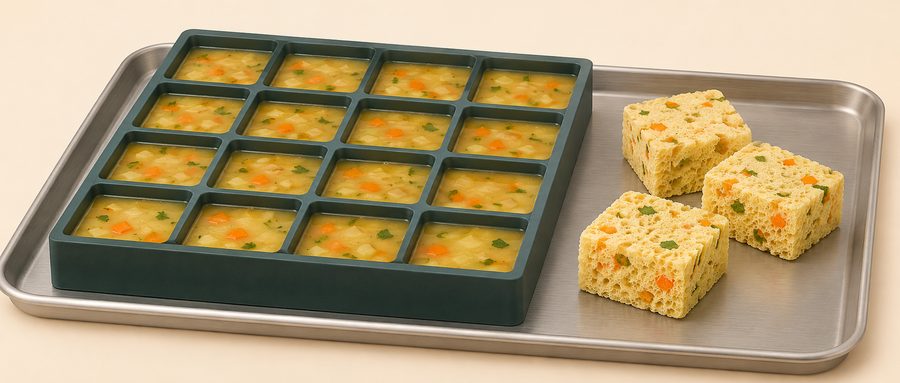
Conceptual illustration of a liquid-filled portion mold and porous dried soup blocks on a freeze-dryer loading tray, not actual plant photography or equipment specifications.
When a food plant considers a different portion mold for instant soup or food blocks, production managers need to know what makes the comparison meaningful. Commercial food processors portion prepared mixtures into individual servings before freezing and drying, as shown in Amano Foods’ manufacturing flow where cooked soup is poured into single-serving trays. However, switching a mold cavity does not automatically alter every processing outcome in a single predictable way. A meaningful evaluation compares the actual process route, heat and vapor pathways, handling losses, and the number of blocks that pass all plant release criteria.
For a production manager evaluating tooling options, nominal cavity count per tray is an incomplete guide to throughput. Cavity dimensions, mold materials, and demolding choices change how food is supported, how heat enters the frozen mass, how vapor leaves the product, and how many blocks survive handling intact. This guide explains how to compare retained-mold drying with frozen demolding, evaluate material documentation and dimensional stability, account for mass balance and defect disposition, and run representative loaded trials on batch production equipment.
Process Routes: Retained-Mold Drying Versus Frozen Demolding
A plant evaluating portion tooling can compare two operational configurations. In the retained-mold route, prepared food is poured into mold cavities, frozen, and kept inside those same cavities throughout vacuum drying, releasing only as finished dry blocks. In the frozen-demolding route, food is filled and frozen in molds, extracted from the cavities while still frozen, and then transferred onto flat drying trays. Under vacuum drying, ice leaves the food as vapor, followed by the removal of remaining bound moisture; in frozen demolding, this occurs without mold side walls.
In the retained-mold configuration, the mold provides physical containment and support from pre-freezing through the end of dehydration. This containment helps hold the portion shape of fragile or liquid mixtures before drying begins. However, retaining the mold during drying introduces the mold’s construction, support interface, and additional thermal mass into the drying chamber. The mold body also occupies tray footprint and vertical space, representing trial variables that plant engineers must measure against drying performance rather than assuming vertical clearance would otherwise hold more food.
In the frozen-demolding configuration, molds serve only as forming tools during pre-freezing. After the ice structure solidifies, portions are released from cavities and supported directly on drying trays for sublimation. Removing the mold eliminates mold mass from the chamber and alters physical support and contact, but this change does not automatically shorten cycle time. Plant teams must measure actual release and transfer handling damage, as well as the risk of partial surface thawing during transfer, against their facility’s specific ability to handle frozen portions without chipping edges or melting.
Cavity Geometry, Tray Clearance, and Heat Transfer Pathways

Schematic comparison of portion geometry and heat support: food retained within an open-top cavity mold versus a demolded frozen block supported directly on a flat drying tray. This compares structural configuration and support interface without representing measured drying rates.
Freeze-drying requires heat to reach the internal sublimation front where ice transforms into vapor, while allowing that vapor to escape from the exposed food surface into the chamber. Cavity dimensions establish filled food depth, net mass per portion, and physical support. However, geometry alone does not directly determine heat transfer or drying rates; heat must travel through available paths while water vapor escapes through open porous surfaces into the vacuum environment.
Laboratory research illustrates how product thickness and production rate per area and time depend on heating arrangements. In a freeze-drying study on laboratory yoghurt by N. K. Sharma and C. P. Arora (International Journal of Refrigeration, 1995), researchers tested samples in a small circular holder with nylon side walls, an aluminium bottom, and special steel pins to constrain lifting. Under radiant heating from above, production rate per area and time changed little with sample thickness; under contact heating through the frozen bottom, thinner tested samples achieved higher production rates; and a combined heating arrangement produced an intermediate maximum. Crucially, the shortest drying time and the highest production rate per area and time proved to be distinct outcomes. Because this research evaluated yoghurt in a specialized laboratory holder, its findings represent qualitative heat-mode principles rather than a soup-mold or silicone-versus-metal comparison, and its numerical results cannot be transferred as operating settings or optimal depths for industrial food plants.
When evaluating cavity dimensions for industrial batch equipment, engineers must assess heat supply and vapor escape for their specific machine configuration. In an open-top mold, the upper surface remains open for vapor escape, while heat reaches the food according to the mold’s construction, tray contact, and whether the receiving equipment supplies radiant or contact heat. When portions are demolded onto a flat tray, released lateral sides become exposed to the chamber vacuum, but this additional surface area does not prove drying will be faster. Mold dimensions must also be evaluated against tray footprint, physical support, and vertical clearance between tray tiers to ensure vapor can exit freely into the chamber. For broader liquid handling principles, see the discussion on freeze-drying liquid foods.
Evaluating Mold Materials: Documentation, Mechanical Handling, and Process Fit
When specifying or replacing portion molds, production managers frequently compare rigid metal trays, coated aluminum, and flexible polymers like silicone. Selecting an appropriate material requires separating three distinct engineering judgments that are too often conflated: regulatory food-contact documentation, mechanical durability under thermal cycling, and in-chamber process compatibility.
The first judgment addresses regulatory compliance for food contact. As an example from US regulation, guidance from the US Food and Drug Administration (FDA) on food-contact materials explains that authorization review considers chemical identity, technical specifications, and specific conditions of intended use, and a commercial buyer may ask the mold manufacturer for a letter of guaranty. However, holding a regulatory letter or showing compliance for intended contact conditions does not establish whether a mold will maintain its dimensions under repeated vacuum freeze-drying cycles or support efficient sublimation.
The second judgment evaluates mechanical handling and durability during actual use. Rather than relying on generic assumptions about materials, plant teams should examine documented and observed evidence: filled support under wet food mass, release damage, dimensional and surface condition, and behavior through repeated freezing, vacuum drying, and heating cycles. A flexible design’s actual shape under food load can be observed during filling and handling rather than predicted by formula, while tooling condition and part release can be verified directly. Documenting surface wear, cracking, and dimensional retention over repeated intended temperature and vacuum cycles helps the plant judge portion consistency, without assuming a limited set of observations establishes entire service life.
The third judgment evaluates in-chamber process performance in the plant’s actual freeze dryer. Instead of assuming universal thermal rankings, engineers must evaluate the specific mold material, its wall and base construction, and how it contacts the receiving machine’s shelves or receives radiant heat. An open-top mold cavity does not form a sealed vapor barrier, and exposing lateral block sides by frozen demolding does not alone establish a shorter cycle. Running an actual filled trial on the production equipment provides the necessary process judgment, independent of regulatory paperwork and empty handling tests.
Mass Balance and Yield Bookkeeping: From Wet Fill to Accepted Units
A common operational mistake during mold redesign is projecting finished output based solely on nominal cavity volume and water density. Prepared food mixtures, broths, and purees contain dissolved solids and suspended inclusions that alter density and viscosity, making direct volumetric assumptions inaccurate. Plant accounting must track mass balance rigorously from measured wet fill to final dry solids.
To illustrate the necessary bookkeeping, consider a purely hypothetical batch calculation with fictional operating values. Assume a plant operates 50 usable trays, with each tray holding 2 cavity molds, and each mold containing 40 individual cavities. This yields a nominal batch capacity of 4,000 portion cavities:
| Parameter | Hypothetical Value | Unit / Note |
|---|---|---|
| Total Cavities per Batch | 4,000 | 50 trays × 2 molds × 40 cavities |
| Measured Wet Fill per Cavity | 25 | Grams of prepared mixture |
| Total Net Wet Food Mass | 100 | Kilograms (excluding mold tare) |
| Formulation Total Solids | 15% | Yields 15.00 kg dry solids |
| Theoretical Final Dry Mass | 15.46 | kg, assuming 3% wet-basis final moisture |
| Accepted Unit Count | 3,700 | Passing all agreed plant release criteria (shape, portion weight, moisture, rehydration) |
In this hypothetical scenario, 100 kg of wet food contains 15 kg of bone-dry solids. Assuming 3% final moisture on a wet basis—treated strictly as an arithmetic assumption for this calculation, not a quality or safety target—the theoretical finished dry mass without operational losses equals 15 / (1 − 0.03) ≈ 15.46 kg. If quality inspection confirms that 3,700 blocks satisfy all agreed plant release requirements, including portion weight, intact geometry, moisture limits, and rehydration checks, the accepted count is 3,700 units rather than the nominal 4,000. The remaining 300 non-conforming units await approved plant disposition; their count cannot simply be counted as commercial saleable product or assumed to be reusable.
True production efficiency must also account for chamber occupancy time. The effective production rate is defined as accepted units divided by total chamber-occupied hours (3,700 / T, where T represents total chamber residence including loading, cycle execution, and unloading). If pre-freezing and demolding occur outside the main vacuum chamber in a blast freezer, those operations require separate labor, floor space, and refrigeration energy, which should be tracked alongside chamber metrics rather than silently conflated with drying time.
Executing Loaded Trials and Evaluating Block Quality
Before committing capital to full sets of replacement tooling, facility managers should conduct representative full-load trials on the receiving production equipment. Empty or partially loaded tests cannot establish whether a mold layout performs under commercial vapor and refrigeration loads. A valid comparison holds product formulation, total solids (both dissolved and suspended), food inclusions, measured net wet fill mass and filled geometry where the route permits, freezing history, and agreed final-product requirements comparable, while documenting intentional route differences. Engineers should record filled tray layout, support interface, total chamber occupied time, representative product observations, and representative final-product checks rather than relying on unverified cycle predictions.
Yield evaluation should record observable defect counts at the specific stage they occur rather than grouping losses into an end-of-line total. In both process routes, demolding loss should be recorded at the actual demolding stage—whether portions are demolded frozen before drying or dry after drying—covering release breakage, edge chipping, or material remaining in cavities. Subsequent losses during tray transfer, in-chamber drying, and packaging handling must be logged separately. Observing cracking or broken edges does not automatically identify a single cause; stage-specific counts help engineers investigate whether mechanical shock, handling forces, or process conditions contributed to the defect.
Beyond mechanical recovery count, trial blocks must satisfy agreed preparation and rehydration standards. In a commercial tremella soup case reported from an industrial project in China in 2017 (published on goodfreezedryer.com), formulation liquid-to-solid ratio and boiling preparation time influenced dried block physical strength and rehydration behavior. When evaluating trial blocks, quality teams should test rehydration using specified water volumes, water temperatures, holding times, and stirring. Simple water mass uptake alone does not confirm quality; intact portion count and functional preparation behavior must be judged together to verify that ingredients reconstitute uniformly, broths disperse without clumping, and blocks meet agreed texture and appearance.
Planning Your Batch Equipment and Tooling Configuration
Determining an effective portion mold configuration requires aligning cavity dimensions, tray support, and handling methods with your equipment’s specific shelf spacing, heating arrangement, and condensing capacity. Plant operators planning tooling changes for batch food freeze dryers can discuss equipment configurations by sharing their food composition, total solids, measured net wet fill mass and depth, mold or tray layout drawings, target accepted portion count, and preparation criteria through the contact page on goodfreezedryer.com.
Referenced Sources and Technical Literature
The engineering context and operational principles in this guide draw on verified technical references and manufacturer documentation:
- Amano Foods Official Manufacturing Flow: Documentation of commercial portioned soup processing, detailing liquid portioning into individual trays prior to freezing and freeze-drying.
- Published 2017 Commercial Tremella Soup Case on goodfreezedryer.com: Report describing the operational relationship between formulation liquid-to-solid ratio, boiling preparation, dried block physical strength, and finished rehydration behavior.
- Sharma, N. K., & Arora, C. P. (1995). Influence of product thickness, chamber pressure and heating conditions on production rate of freeze-dried yoghurt: International Journal of Refrigeration, 18(5), 297–307. Experimental evaluation of radiant, conductive, and combined heating modes and product thickness effects.
- US FDA Regulatory Framework for Food Contact Materials: Administrative guidance outlining substance identity, technical specifications, conditions of use, and manufacturer letters of guaranty for food-contact compliance.
About the Author: Zheng Wei
Founder & Freeze-Drying System Engineer
Fuzhou Xing Shun Da Refrigeration Facility Project Co., Ltd.
Zheng Wei participates in food freeze-drying trials, equipment selection, vacuum-system configuration, refrigeration planning, installation guidance, process optimization, and project handover. The project experience covers fruit, vegetables, cooked foods, seafood, meat, dairy products, herbs, and extracts.