
Freeze-Drying Prepared Meals: Co-Drying or Separate Ingredients?
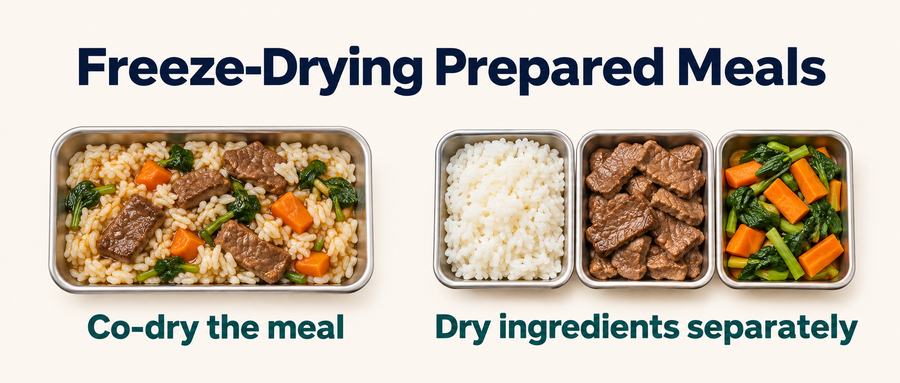
When developing a just-add-hot-water version of a cooked dish such as braised beef rice with vegetables, should you freeze-dry the completed meal together or dry ingredients separately and combine them at packaging? Drying the shared load simplifies dosing when the assembled meal meets target quality and fits your packaging line. If a specific ingredient such as a dense beef chunk creates a stubborn drying bottleneck, compare splitting out only that component, balancing the drying improvement against extra staging, multiple batches, and packaging steps.
Deciding Between a Shared Drying Load and Separate Ingredient Streams
Commercial processors use both production routes. Prepared-meal manufacturer Naanke reports cooking batches of food, spreading the cooked meals onto trays, freeze-drying them in industrial vacuum chambers, and inspecting and sealing the finished product. Conversely, outdoor meal maker Back Country Cuisine reports producing meal ingredients separately and combining distinct dry items directly in the pouch, without stating that every ingredient is freeze-dried.
In a shared load, common shelf and chamber settings can produce different cooling or drying behavior across the diverse ingredients of the meal. Operators must judge when the load is ready using representative slow-drying spots; one dense or thick ingredient is a possible limit, though not invariably the sole determinant of cycle completion. Running one dried stream can simplify pack-line dosing and reduce the need for separate ingredient stocks. With separate streams, pre-treatment and tray loading can be adjusted for each individual food, but this adds extra batches, intermediate handling, and multiple dosing steps to weigh.
A practical trial may split only one ingredient rather than separating the entire recipe. For instance, grains, vegetables, and sauce can be co-dried while peeling off only a dense protein for an independent cycle. Splitting is a trade-off to test rather than an automatic improvement; evaluate whether any gains in texture justify the additional staging, batch scheduling, and packaging handling on your line.
How Layer Depth and Sauce Shape Drying
Industrial freeze-drying begins with freezing, followed by ice sublimation during primary drying where water vapor moves through the porous dried layer toward a cold condenser. Secondary drying then removes further associated water under vacuum, with shelf heating applied according to the temperature program. How moisture escapes depends directly on the physical arrangement and depth of the food on the tray.
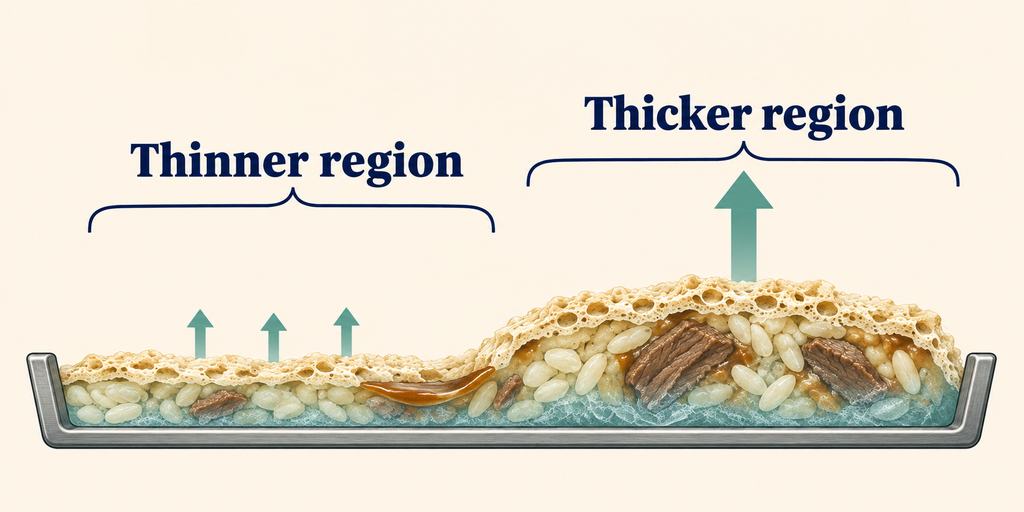
When food is spread across a tray, observable differences in local sauce pooling and inclusion thickness occur naturally. A deep pocket can lengthen the local vapor path. At a fixed filled tray area and recipe, increasing fill depth usually also increases wet mass, raising the total amount of water to remove from the chamber. These are two distinct physical effects. Uneven distribution means localized drying rates can diverge across the tray even under identical shelf temperatures and chamber pressures.
Pilot research on formulated dishes illustrates the practical effect of loading depth. In a pilot study using a 10 m² integrated pre-freezing and freeze-drying chamber with a formulated instant mushroom soup containing egg, vegetables, seasonings, and dextrin, Shi et al. (Transactions of the CSAE 2021) compared tray fill depths of 10, 15, 20, and 25 mm. Thicker fills cooled more slowly during freezing, creating a trade-off between freezing performance and tray loading mass that led the authors to select 15 mm for their specific recipe and equipment.
The same mushroom soup study evaluated secondary desorption profiles to distinguish cycle duration from finished product quality. Comparing two different heating regimes, Profile A ran a 280-minute secondary phase and achieved a 94.5% conforming finished-block mass fraction (defined as conforming dried block mass relative to total dried block mass) with a sensory score of 6.88 ± 0.31 (evaluating color, shape, taste, and dispersibility) at 1.64 kWh per kg of water removed. Profile D used a 354-minute secondary phase under a different temperature profile, reaching a 99.2% conforming mass fraction and a sensory score of 8.37 ± 0.52 at 1.75 kWh per kg of water removed. Because distinct heating programs and different times were tested, the comparison cannot isolate elapsed time alone, highlighting the practical importance of evaluating actual block quality and energy alongside duration.
Liquid-rich recipes require balancing cooking preparation against dry block handling. In a published instant soup case study with instant tremella soup, operators adjusted cooking time and the liquid-to-solid ratio, evaluating dry block strength for packaging handling alongside hot-water reconstitution.
Testing Rehydration on the Finished Serving
A freeze-dried meal that meets average final moisture targets can still fail in consumer preparation. Evaluating whether to co-dry or separate components requires testing the finished serving under identical preparation instructions: record the exact volume and initial temperature of added hot water, the serving container, the order of water addition and stirring, and the standing time. If a separate-component pouch requires different preparation instructions from an assembled meal, evaluate both side-by-side as distinct, clearly labeled serving conditions.
Observe sauce dispersal and inclusion texture separately after rehydration. In co-dried portions, observe whether the center of a dense piece remains firm and whether the sauce disperses smoothly or leaves pooled sediment. A firm center is an observable texture result rather than direct proof of water penetration depth or a specific drying failure. Adjusting tray fill, ingredient pre-cooking, or running a separate batch is a comparison to test rather than a guaranteed fix, since target texture is defined by the processor.
Acceptance standards must match your specific product format. A soft texture is intentional in a porridge, whereas distinct grain firmness and tender vegetable bite define quality in a savory rice dish. Distinguish dry block moisture and handling durability from final sauce dispersal and bite; whole-meal quality cannot be judged solely by a drained-mass metric, as discussed in the site’s guide to freeze-dried rehydration ratios.
Packaging Balances and Moisture Exposure
Separating ingredients upstream shifts scheduling and inventory complexity to the packaging area. A multi-component pouch requires synchronized dry stocks, which can introduce packaging bottlenecks if component yields or freeze-dryer cycle completions fall out of balance. Having components available in storage does not automatically translate to continuous line throughput or predictable chamber occupancy.
Consider a hypothetical packaging run for a three-component meal dosed at 25 g dried rice, 15 g dried vegetables, and 15 g dried sauce per pouch. If you have released stocks of 25 kg rice, 12 kg vegetables, and 15 kg sauce available simultaneously, those quantities support 1,000, 800, and 1,000 portion equivalents respectively. This inventory caps the packaging run at 800 complete pouches before accounting for measured filling losses or incomplete packs. The remaining 5 kg of rice and 3 kg of sauce can be allocated to future scheduled production or other approved products under your plant inventory strategy, rather than sitting idle waiting for a specific batch.
Handling separate dried streams also increases product exposure to ambient air. As noted by the University of Minnesota Extension, freeze-dried food readily adsorbs moisture during open handling, making moisture uptake an operational reason to protect transfers. Furthermore, freeze-drying removes water and is not a validated microbial kill step. Maintaining product safety and shelf stability relies on your plant’s validated food safety plan, including cooking, cooling, hygienic handling, and prompt moisture-barrier packaging.
Setting Up a Representative Pilot Trial
Before committing production schedules or capital, run trials using a stable recipe and a representative tray loading arrangement. Measure actual fill depth, sauce pooling, inclusion dimensions, and usable shelf area to establish the true drying duty. Document the complete cycle, including loading, primary sublimation, secondary desorption, and turnaround steps such as unloading, defrosting, and chamber cleaning where applicable. Evaluate moisture content and dried quality at both representative and slow-drying tray locations alongside hot-water rehydration tests of the finished serving.
During trials, observe shelf and product temperatures, chamber pressure under load, and condenser conditions to help interpret product drying behavior, though these readings alone do not confirm peak capacity, absence of melt-back, or safe operation. Structured freeze-drying cycle development protocols help evaluate operating boundaries. For separate streams, assess component-specific loading densities, distinct drying schedules, accepted dry outputs, pouch filling performance, and the same serving check.
Bring the decision back to the prepared dish. If the co-dried braised beef rice dries acceptably across the tray and rehydrates to target quality within your serving guidelines, the shared load is the simpler operating route. When the shared route misses acceptance due to one confirmed limiting ingredient such as tough meat chunks, test splitting only that ingredient, judging the measured improvement in finished bite against the extra chamber time, staging vessels, and packaging work.
If you are planning trial runs to evaluate a shared load against separate ingredient streams, share your food format, ingredient sizes and ratios, target output, and the open comparison through our contact page to discuss representative pilot equipment parameters.
References
- Shi D, Fan X, Yin C, et al. Pilot-plant test of mushroom instant soup by vacuum freeze drying based on energy consumption analysis. Transactions of the CSAE. 2021;37(10):253–260.
- Naanke. Quality: How Naanke meals are made.
- Back Country Cuisine. The Making of a Back Country Cuisine Meal.
- Freeze-Dried Instant Tremella Soup Case Study.
- University of Minnesota Extension. Preserving food at home: Freeze-drying.
About the Author: Zheng Wei
Founder & Freeze-Drying System Engineer
Fuzhou Xing Shun Da Refrigeration Facility Project Co., Ltd.
Zheng Wei participates in food freeze-drying trials, equipment selection, vacuum-system configuration, refrigeration planning, installation guidance, process optimization, and project handover. The project experience covers fruit, vegetables, cooked foods, seafood, meat, dairy products, herbs, and extracts.