
Comparing Nepal Food Freeze-Dryer Quotations: From Compact Machine Prices to Production Line Reality
For a Nepal fruit or specialty food processor evaluating equipment, comparing freeze-dryer numbers can easily mislead. One local distributor catalog displays compact freeze dryers priced between Rs 320,000 and Rs 580,000, while an industrial vendor presents the 300 kg/day IFD-300 via request for quotation with no public price tag. Deciding between them means determining whether these offers describe the same usable food duty, what factory utilities and interfaces are included, and what work remains before the line turns raw harvest into saleable dried food.
1. Unpacking the Price Tag: Local Display Listings vs. Industrial Quotations
Published pricing in Nepal provides an accessible entry point, but it represents a very specific machinery tier. For example, published catalog data from local distributor Changing Nepal (retrieved 19 November 2026) lists a compact family of freeze dryers with 4, 6, and 8 trays at Rs 320,000 to Rs 580,000 [1]. This published range applies to a compact machine family specified at 220 V, 50 Hz and 1.5–2.2 kW. Furthermore, its commercial terms state “Ex-Bhaktapur. Delivery, installation and training quoted with the machine” [1]. Because this displayed wording does not establish whether those services are included in the price or billed separately, a written quotation must explicitly define the agreed handover location and clarify the exact scope of delivery, installation, and training.
By comparison, the observed listing for the ICE MAKE IFD-300 from RM Agrotech in Nepal quotes no public price, directing buyers to an RFQ process [2]. Comparing documented offers requires examining the conditional scope behind each figure rather than contrasting a compact catalog display against an unpriced industrial proposal. Before evaluating capital outlay, buyers must establish whether each proposal covers only the bare machine, or extends to factory integration, freight, and technical handover. For broader guidance on evaluating comprehensive capital and operating expenditures, see how to calculate the real cost of an industrial freeze dryer.
2. Defining the Usable Food Duty: Aligning Capacity, Water Removal, and Yield
Brochure figures often leave the physical capacity boundary undefined. Changing Nepal cites fresh-food capacities of 5–6 kg, 8–10 kg, and 10–15 kg per batch across its compact models [1], while RM Agrotech lists 300 kg/day for the IFD-300 [2]. However, the listed 300 kg/day is a catalog rating rather than a validated duty for a specific food buyer. Sizing an operation requires distinguishing between incoming raw fruit from the orchard, prepared wet food loaded onto trays after trimming and peeling, and accepted dry output meeting customer specifications. Preparation losses depend entirely on the specific fruit variety and processing steps.
To verify whether a machine matches production requirements, calculate theoretical mass balance by assuming conserved dry solids, with no added inputs and no solids or handling losses, expressing all moisture fractions on a wet basis:
- Dry Solids Mass:
Dry Solids = Prepared Wet Mass × (1 − Initial Moisture) - Theoretical Final Mass:
Final Dried Mass = Dry Solids ÷ (1 − Final Moisture) - Total Water Removed:
Water Removed = Prepared Wet Mass − Final Dried Mass
Consider an explicitly hypothetical calculation: 200 kg of prepared wet fruit pieces at an assumed 85% initial wet-basis moisture dried to an assumed 3% final wet-basis moisture, conserving solids without losses. Dry solids equal 200 × (1 − 0.85) = 30 kg. The theoretical final dried mass is 30 ÷ (1 − 0.03) = 30.93 kg (rounded), and total water removed across primary sublimation and secondary desorption is 200 − 30.93 = 169.07 kg. These figures represent theoretical mass balances rather than guaranteed commercial yields or direct ice condenser holding capacity. The 3% figure is an illustrative calculation assumption, not an established standard for food or mangoes; actual condenser ice duty and final accepted product mass require separate verification and product trials.
Operating cycles also dictate the relationship between batch size and daily output. In a simplified, explicitly hypothetical schedule separate from the IFD-300 rating, processing a 200 kg prepared wet batch with an assumed 16-hour repeating interval until the next load can start yields a long-run mathematical average throughput of 200 × (24 ÷ 16) = 300 kg/day of prepared wet input. In this model starting at hour 0, hour 16 and hour 32 mark completed turnaround milestones; only one batch finishes within the first 24 hours. Actual product drying completion, unload-ready time, and quality release are distinct factory times that should not be inferred from this turnaround interval. For detailed methodologies on sizing batch systems, review batch freeze dryer capacity calculations.
3. The Factory Boundary: Utilities, Integration, and Energy Scope
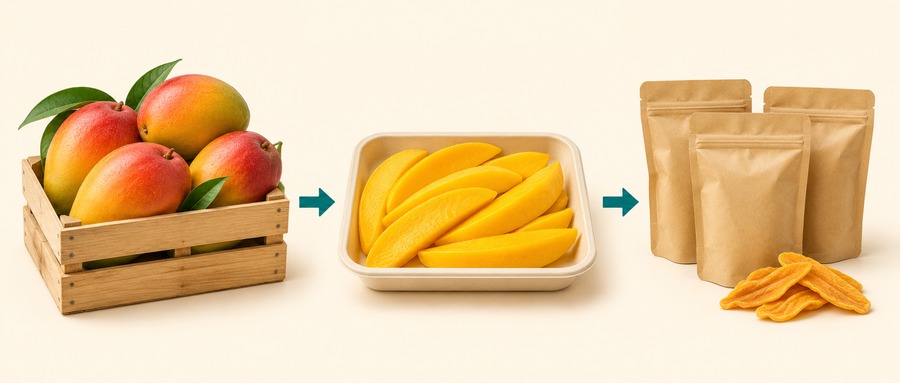
A freeze dryer operates within an integrated processing facility. In a qualitative engineering discussion of freeze-drying equipment selection and production line design, Zhao Guochen emphasized that a functional facility requires balanced upstream and downstream areas: raw material storage, preparation and slicing, freezing and drying, tray unloading, holding, sorting, and packaging [4]. Real-world seasonal processing in Nepal reflects these operational demands. For instance, Khetipati Organics sources mangoes from Sarlahi and handles sorting, slicing, and freeze-drying at its Dhankuta facility, reporting that rapid seasonal harvest volumes intensify pressure on physical workspace, workflow coordination, workforce training, and working capital [3]. Preparation, freezing, holding, and packaging interfaces must be evaluated for the chosen process rather than assuming standalone equipment operates without supporting room and handling investments.
Utility requirements form another major cost boundary. Changing Nepal lists its compact models at 220 V, 50 Hz and 1.5–2.2 kW [1], whereas the observed RM Agrotech page for the IFD-300 specifies 415 V, three phase, 50 Hz with a maximum installed power of 50 kW [2]. A published installed kW rating is an equipment nameplate specification, not a measured running draw. Facility electrical design cannot be derived from installed kW alone; an actual site assessment must verify line capacity, cable and transformer sizing, starting currents, simultaneous loads, protection, and backup generation requirements.
Energy evaluations similarly require clarifying the measurement boundary between installed kW and metered full-cycle energy consumption (kWh) for a defined food and time window. A proposal must specify whether energy figures include or exclude external prefreezing, condenser defrosting, cleaning, and packaging operations. Because actual electrical draw changes across operational stages, running consumption cannot be determined by multiplying nameplate kW by cycle hours, but must be measured over the agreed food, time, and system boundary. Confirming these physical and utility interfaces early is essential for facility budgeting; see commercial freeze dryer setup planning for detailed floor and utility considerations.
4. Ready-to-Run Handover: Commissioning, Food Trials, and Local Support
A quotation that covers equipment delivery is fundamentally different from a contract for a functionally validated production line. When evaluating competing bids, distinguish between three distinct project milestones:
- Delivered Machinery: Equipment reaches an agreed handover location, such as the supplier warehouse or the buyer’s factory site. The written contract scope must explicitly specify the handover location and define which party arranges and pays for freight, unloading, rigging, positioning, and mechanical connections [1].
- Functional Commissioning: The vendor and buyer agree on utility connections and functional checks, such as empty-chamber testing of vacuum pull-down and refrigeration operation. These initial checks confirm basic equipment assembly, but no-load performance does not demonstrate drying behaviour or moisture capture under actual food loading.
- Product-Qualified Handover: The parties agree in advance on a representative production trial with actual food, defining loading density, test methods, cycle duration, and residual moisture criteria. Equipment and process acceptance validates machine performance against agreed parameters, leaving commercial food safety and product release to the processor’s standard operating responsibilities.
After-sales support must also be confirmed in writing. For its ICE MAKE vacuum freeze dryers, RM Agrotech advertises installation and after-sales service across Nepal [2]. Buyers should confirm in the written contract whether support includes on-site visits or only remote guidance, which spare parts are supplied, when warranty coverage begins, and how travel and labor costs are allocated during maintenance. For rigorous testing protocols, explore food freeze dryer validation and acceptance testing.
Aligning Your Project Scope Before You Buy
Comparing freeze-dryer quotations requires examining usable food duty, factory utility interfaces, and handover criteria rather than comparing surface figures. For a Nepal food business balancing seasonal harvest surges against capital constraints, defining prepared wet batch capacity, scope boundaries, and written acceptance terms provides the technical clarity needed to evaluate competing proposals.
If you are preparing a commercial freeze-drying project, discussing your production requirements helps clarify equipment boundaries. Share your target food type, expected prepared wet load per batch, daily throughput target, available site utilities, and intended scope of supply to contact our engineering specialists for an equipment discussion.
References
- Changing Nepal. Freeze Dryer. Retrieved 19 November 2026.
- RM Agrotech. Vacuum Freeze Dryer (IFD-300). Retrieved 19 November 2026.
- Limbu S. Aligning Growth with Values. Khetipati Organics. 9 June 2025.
- Zhao Guochen (赵国臣). 冻干机的选择及冻干食品生产线的设计. 甘肃科技纵横. 2003;32(4):42.
About the Author: Zheng Wei
Founder & Freeze-Drying System Engineer
Fuzhou Xing Shun Da Refrigeration Facility Project Co., Ltd.
Zheng Wei participates in food freeze-drying trials, equipment selection, vacuum-system configuration, refrigeration planning, installation guidance, process optimization, and project handover. The project experience covers fruit, vegetables, cooked foods, seafood, meat, dairy products, herbs, and extracts.