
Food ingredient process decisions
Vacuum Drying vs Freeze Drying for Yeast: Viability and Process Choice
A useful comparison starts with what the yeast must do after drying, rehydration, and storage.
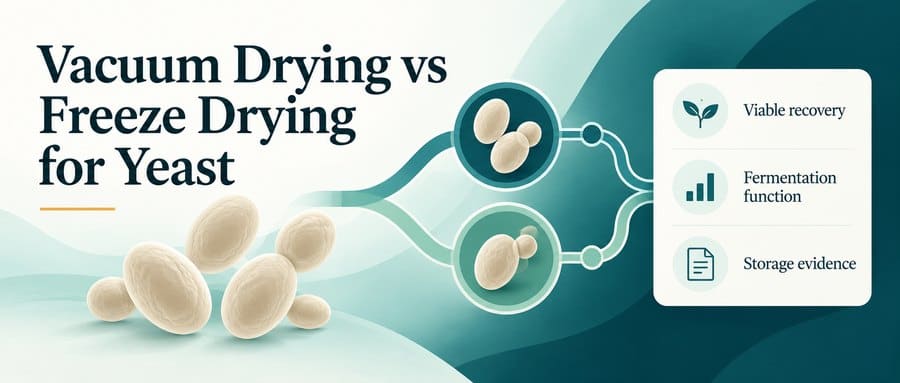
The difference between vacuum drying and freeze drying for yeast is the water-removal route and the stresses the culture experiences. Conventional vacuum drying removes liquid water by evaporation under reduced pressure. Freeze drying removes ice from a frozen preparation by sublimation, followed by further moisture removal. For a live yeast product, neither route should be selected from temperature or dryness alone: the decision requires strain-specific recovery, intended fermentation performance, and storage evidence.[1]
Define the yeast result before comparing dryers
A starter culture must remain functional in its intended fermentation. An inactive yeast ingredient may instead be sold for flavor, composition, or another material property. Because these represent different acceptance targets, a dryer that produces a satisfactory inactive ingredient has not demonstrated that it can preserve an active starter.
Low pressure is common to both processes; it does not make them equivalent. The yeast-preservation literature distinguishes freeze drying from liquid-drying, or L-drying, which removes water without first freezing the preparation.[1] A laboratory L-drying method, a conventional vacuum oven and a microwave-vacuum dryer also differ in heat transfer, preparation and exposure. A comparison should name the actual method used.
| Decision | Conventional vacuum drying | Freeze drying |
|---|---|---|
| Water-removal route | Evaporation from a liquid-containing preparation under reduced pressure. | Sublimation from a frozen preparation, followed by secondary drying. |
| What must be tested | Response to the actual temperature history, dehydration and formulation. | Response to freezing, dehydration, formulation and subsequent recovery. |
| Evidence for a live product | A defined strain, a comparable starting basis, recovered viable units, intended function and stability in the proposed package. | |
| What a dry sample cannot prove | Retained fermentation performance, a commercial shelf life or validated production capacity. | |
On a narrow screen, scroll the comparison horizontally. These are evaluation questions, not universal operating settings.
For the broader food-equipment comparison, see vacuum oven versus freeze dryer. The remaining discussion focuses on the additional evidence required when yeast function matters.
Read yeast studies within their actual boundaries
Laboratory survival is conditional
Miyamoto-Shinohara and colleagues compared freeze-dried and L-dried yeast preparations in sealed ampoules. Immediate survival varied between strains, and storage behavior depended on the preparation and sealing conditions. Importantly, the two routes used different suspension media; the L-drying preparation also included a cotton plug. The results compare those complete preservation methods, rather than isolating drying mechanism as the only variable.[1]
For a buyer, the implication is to test the intended strain and formulation. The ampoule results do not establish a tray-dryer pressure setting, a guaranteed survival percentage or a commercial room-temperature shelf life.
Cell recovery and useful fermentation are separate checks
A food-fermentation study by Houngbédji and colleagues evaluated freeze-dried cultures containing yeasts and lactic acid bacteria with maize flour as a carrier. Alongside microbial counts, the researchers tested fermentation of maize dough after refrigerated storage at 4°C for up to 45 days. Older stored cultures showed slower early acidification, even though later fermentation results were broadly similar under the tested conditions.[2]
This was a defined mixed culture, not a demonstration that yeast alone caused the acidification result. It supports checking intended function as well as survival. It does not establish the same behavior for another strain, carrier, package or storage temperature.
These studies address different questions. Neither justifies a blanket claim that freeze drying always preserves yeast better than vacuum drying. Likewise, favorable L-drying results in a culture collection do not establish the performance of a production vacuum oven.
Compare recovered function in a matched trial
The producer and a suitable microbiology or fermentation laboratory should agree on the comparison protocol before samples are dried. The trial should separate the drying route from variations in strain, formulation, or measurement.
- Define the starting material. Record the food-grade strain or culture designation, intended use, starting biomass or cell basis, feed solids and carrier composition. Use comparable starting material for each route.
- Declare what is being compared. An identical formulation helps examine the effect of the process. Separately optimized formulations compare complete process options. Report that difference rather than attributing the whole outcome to the dryer.
- Record the exposure. Retain actual product temperature, pressure, phase time, layer depth and loading records. A shelf setting or the pump’s ultimate vacuum does not describe the culture’s complete history.
- Measure recovered viable units on a consistent basis. Water removal and added carrier change product mass. A higher count per gram of dried material does not by itself demonstrate better survival; account for recovered mass and the original batch or biomass basis.
- Use a defined recovery and function test. State the rehydration method used by the testing laboratory, then assess the intended application, such as fermentation start, gas production or the relevant product outcome. Do not substitute cake appearance for that result.
- Repeat the checks during storage. Evaluate the actual formulation and package under the proposed conditions. Define acceptable viable recovery and function at release and at the intended end of storage.
The strain-dependent survival and storage findings in the ampoule study, together with the separate fermentation checks in the cereal-culture study, provide the basis for this evaluation framework.[1][2] The checklist is an engineering synthesis; it is not a validated recipe for a specific yeast.
Final moisture and water activity remain useful measurements, but they address different questions than viable recovery or fermentation performance. Target values should come from specific formulation and stability testing, not a generic claim that every live yeast must reach the same moisture value.
Carry the accepted process into capacity and cost
Only a process that meets the yeast specification provides a useful sizing basis. The equipment discussion can then connect wet feed, water removal, usable shelf area, and complete batch time to the quantity of acceptable product.
Keep three production measures separate
- Physical duty: feed solids, water to remove, layer depth, required product-temperature control and condenser load.
- Accepted output: recovered product that passes the agreed viable-count and function specifications, including any required dose basis.
- Complete production time: preparation, freezing where used, drying, unloading, defrosting, cleaning, testing and packaging constraints.
A nominal food capacity in kilograms per day does not establish validated yeast output. Compare total process cost against accepted output under the same specification; include rejected material, testing and storage requirements rather than comparing purchase price alone.
GoodFreezeDryer’s published milk pilot record illustrates the documentation of loading, drying time, finished yield, and residual moisture in a related food application. It is not a yeast viability trial. A yeast project still requires its own biological acceptance evidence and equipment-fit assessment.
The food pilot-testing guide and condenser sizing guide explain the related equipment questions. Before recommending a model, the equipment supplier should confirm whether the required product-temperature control, hygienic handling, and batch configuration suit the proposed process.
Prepare a yeast project brief
An effective preliminary enquiry describes the required result and available evidence without needing to disclose a proprietary culture formulation.
- Food-grade yeast product, intended use and whether viability is required.
- Nonconfidential strain or culture designation and the testing partner’s role.
- Feed form, solids, carrier constraints and wet mass per batch.
- Release and storage targets for viable recovery and intended function.
- Existing drying, rehydration, storage and packaging trial results.
- Required batch schedule, handling conditions and available utilities.
Discuss the food-equipment fit
Send the nonconfidential brief for a preliminary discussion of equipment fit and missing process inputs. Biological performance and stability must be established with the producer’s qualified testing team; an equipment quotation does not validate a culture or guarantee survival.
Frequently asked questions
Is freeze drying always better for live yeast?
No. The actual outcome depends on the strain, preparation, process, and storage conditions. Published yeast comparisons do not establish a universal winner. A matched trial should measure the required recovery and function.[1]
Does freeze drying leave every yeast cell alive?
No. Published yeast studies report cell losses during processing. Survival must be measured for the specific preparation; preservation is not a guarantee of complete recovery.[1][2]
Can a vacuum oven replace a yeast freeze dryer?
It is a distinct process option to evaluate, rather than a direct replacement established by low pressure alone. The comparison must specify the vacuum technique and confirm that it meets the required yeast product specification.
Can a laboratory storage result support a commercial shelf-life claim?
Only within its demonstrated scope. Ampoule preservation or refrigerated mixed-culture results do not validate another package, formulation, temperature, or distribution period. The intended commercial product requires its own stability evidence.
Technical references
- Miyamoto-Shinohara Y, Nozawa F, Sukenobe J, Imaizumi T. Survival of yeasts stored after freeze-drying or liquid-drying. Journal of General and Applied Microbiology. 2010;56(2):107–119. DOI: 10.2323/jgam.56.107.
- Houngbédji M, Compaoré CS, Madodé YE, Padonou SW, Hounhouigan DJ. Maize flour is a promising and low-cost carrier material for producing freeze-dried starter cultures adapted to cereal fermentation in West Africa. Cogent Food & Agriculture. 2020;6(1):1858532. DOI: 10.1080/23311932.2020.1858532.
The cited studies concern specific laboratory preparations. The equipment checklist is a scoped engineering interpretation and does not convert those methods into a commercial yeast-production recipe.

About the Author: Zheng Wei
Founder & Freeze-Drying System Engineer
Fuzhou Xing Shun Da Refrigeration Facility Project Co., Ltd.
Zheng Wei participates in food freeze-drying trials, equipment selection, vacuum-system configuration, refrigeration planning, installation guidance, process optimization, and project handover. The project experience covers fruit, vegetables, cooked foods, seafood, meat, dairy products, herbs, and extracts.