
Commercial Freeze Drier Guide
Commercial Freeze Drier for Food Business: Capacity Planning Guide
Article Summary
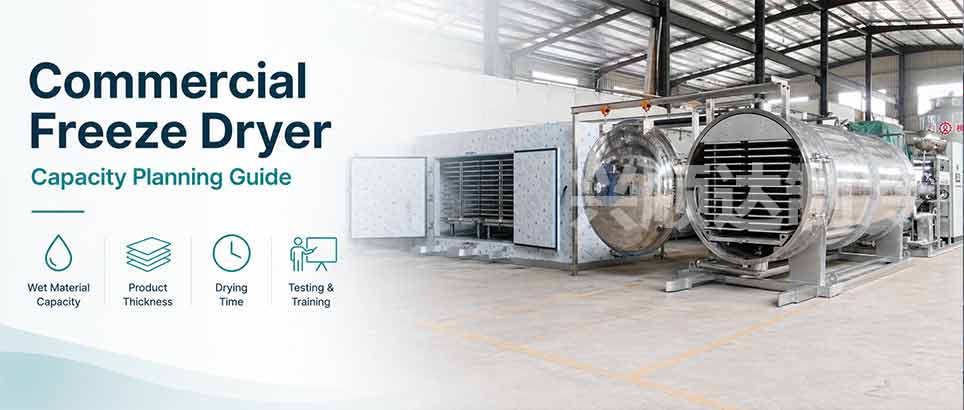
A commercial freeze drier is not only a machine with trays and a vacuum chamber. Instead, for a food business, it is a production system that must match product moisture, slice thickness, daily wet material capacity, drying time, cold trap load, energy use, and factory conditions.
Many buyers search for commercial freeze drier, while the more common industry spelling is commercial freeze dryer. In most equipment searches, both terms refer to the same type of freeze-drying machine for commercial food production.
However, the spelling is not the main issue. More importantly, the machine must support stable production, consistent final moisture, reasonable operating cost, and future scale-up.
What Is a Commercial Freeze Drier?
In practice, a commercial freeze drier removes moisture from frozen food under vacuum. During the process, ice inside the product turns into vapor through sublimation. After that, the cold trap captures this vapor as ice, while the heating system controls the drying speed.
Compared with a home freeze dryer, a commercial freeze drier is designed for higher wet material capacity, stronger vacuum performance, larger cold trap load, better process control, and more stable batch production.
By contrast, an industrial freeze dryer is usually selected for larger production lines. Therefore, a commercial model often fits small and medium food factories that need commercial output but do not yet require large steam systems, oversized factory space, or multi-container industrial installation.
In practical food production, a commercial freeze drier is often used for fruit snacks, vegetables, pet food, meat, seafood, instant meals, soup blocks, herbs, tea, coffee, and food ingredients.
Who Needs a Commercial Freeze Drier?
A commercial freeze drier is suitable for food businesses that have moved beyond small test batches and need repeatable production.
Food startups may use it when home freeze dryers no longer provide enough daily output. Meanwhile, farms may use it to turn seasonal fruit into higher-value shelf-stable products. Pet food brands may use it for meat, organs, and nutrition-focused snacks. In addition, food factories may use it for instant meals, soup ingredients, seafood, or vegetable products.
Beyond capacity, commercial freeze drying is useful when a company needs better process records, stable final moisture, controlled product appearance, and more efficient labor use.
Therefore, a buyer should consider a commercial freeze drier when the project needs hundreds of kilograms of wet material capacity per day, but the factory is not yet ready for a full industrial freeze-drying system.
Commercial Freeze Drier vs Home Freeze Dryer vs Industrial Freeze Dryer
In most projects, the right machine level depends on production scale, not only on budget.
| Machine Level | Best For | Buyer Concern | Recommended Page |
|---|---|---|---|
| Home freeze dryer | Family use, hobby production, very small testing | Low investment and small batches | Not the main focus for food factory production |
| Pilot freeze dryer | Product testing and process development | Color, shape, texture, loading density, final moisture | Pilot Lab Freeze Dryer |
| Commercial freeze drier | Small and medium food production | Daily batch output, stable drying cycles, process control | Commercial Freeze Dryer |
| Industrial freeze dryer | Ton-level factory production | Steam, utilities, factory layout, long-term scale-up | Industrial Freeze Dryer |
For early-stage process testing, buyers can review Pilot Lab Freeze Dryer models. For larger factory projects, the Industrial Freeze Dryer page is more relevant.
Commercial Freeze Drier Capacity: Start with Wet Material, Not Dried Weight
The most common mistake is choosing a freeze dryer by final dried product weight. In real projects, equipment selection should start with wet material capacity.
For example, fresh fruit, vegetables, meat, seafood, and cooked meals all contain different amounts of water. As a result, two products with the same tray area may have very different final output, drying time, and energy use.
For example, fruit slices may dry within a common food drying cycle when thickness and loading are suitable. However, soup blocks or high-load prepared meals may require a longer drying cycle. Therefore, daily production should be calculated by wet material weight, drying time, and number of batches per day.
Key Capacity Questions Before Model Selection
Before comparing models, the buyer should clarify the following production data. As a result, the supplier can estimate the required drying area, cold trap load, drying cycle, and daily output more accurately.
- What product will be processed?
- Required wet material per day
- Raw moisture content
- Target final moisture
- Product thickness or piece size
- Loading density per square meter
- Estimated drying time per batch
- Daily batch count
Once these details are clear, a buyer can compare SDG350, SDG700, and SDG1100 models more correctly.
Commercial Freeze Drier Model Range
For food businesses, SDG350, SDG700, and SDG1100 cover different commercial production levels. Therefore, the buyer should compare them by daily wet material capacity and drying cycle rather than by appearance.
Model Positioning by Production Level
SDG350
First, SDG350 is suitable for small commercial food production. It is often considered when a buyer wants to move from pilot testing to regular production, but the daily wet material target is still moderate.
SDG700
Next, SDG700 is suitable for medium commercial production. It provides more drying area and higher wet material capacity, so it fits growing food brands and factories with stable orders.
SDG1100
Finally, SDG1100 is suitable for larger commercial production. It is useful when the buyer wants higher daily output but does not yet need a full industrial freeze-drying system.
Overall, commercial models cover approximately 340 kg to 1.36 tons of wet material per 24 hours, depending on model, product type, loading density, and drying time.
Then, buyers can compare the model details on the Commercial Freeze Dryer product page.
How Product Thickness Affects Commercial Freeze Drier Capacity
In addition, product thickness has a direct effect on drying time. A thicker product may look better before drying, but it can slow moisture migration and reduce daily output.
Therefore, thickness testing should be completed before choosing a model. The goal is not only to make the product look good. Instead, the target is to balance appearance, texture, drying time, final moisture, and production capacity.
| Product | Recommended Thickness or Preparation | Why It Matters |
|---|---|---|
| Apple slices | 6–10 mm | Provides better crispness while maintaining practical drying efficiency. |
| Pear slices | 3–5 mm | Thicker slices can extend drying time and reduce daily output. |
| Pineapple slices | 6–8 mm | Affects product shape, texture, and crispness after freeze drying. |
| Durian | Pre-freeze before cutting or portioning | Helps maintain a cleaner shape and better product appearance. |
| Meat cubes | 8–10 mm | Maintains shape while keeping the drying cycle under control. |
| Blueberries | Puncturing is recommended | Improves moisture migration and supports more even drying. |
For this reason, a reliable supplier should not recommend a machine only by tray area. The supplier should first understand the product structure, thickness, loading method, and target final moisture.
Real Drying Examples from Food Projects
Moreover, real project data is more useful than general equipment claims. Different products can perform very differently, even when processed in similar commercial or industrial freeze-drying systems.
For example, blueberry projects may require puncturing to improve moisture release and reduce quality problems. Durian projects may need product handling that protects shape and appearance. Meanwhile, meat chunks require thickness testing to balance shape and drying time. Cooked rice or instant meal products may need different drying profiles because the structure is different from fruit slices.
In commercial food production, these differences affect drying time, energy use, final moisture, texture, and daily capacity. Therefore, buyers should review similar cases before making a decision.
For reference, the Customer Success Story page includes real freeze-drying projects for fruit, vegetables, meat, seafood, instant meals, and other food products. It can help buyers understand how drying time, batch load, final moisture, and energy use vary by product.
Key Systems to Check Before Buying a Commercial Freeze Drier
In addition, a commercial freeze drier should be evaluated as a complete system. Although chamber size is important, it is not enough.
Cold Trap Capacity
During sublimation, the cold trap captures water vapor. If the cold trap capacity is too small, the vacuum may become unstable and drying efficiency may fall.
Therefore, buyers should check cold trap load, condenser design, defrost method, and water capture rate. A low cold trap temperature alone does not guarantee strong drying performance.
Vacuum System
Meanwhile, the vacuum system creates the pressure condition required for sublimation. A good system should reach the target vacuum efficiently and maintain stable pressure during drying.
As a result, buyers should check vacuum pump configuration, time to reach 133 Pa, maintenance requirements, and long-term reliability.
Heating System
Similarly, the heating system provides controlled energy for sublimation. If heating is too weak, drying time increases. If heating is poorly controlled, product quality may suffer.
In many cases, commercial models use electric heating. Larger industrial systems may use steam heating when factory conditions support it.
Control and Data Recording
Besides mechanical performance, food production needs repeatable process control. A commercial freeze drier should support recipe management, temperature monitoring, vacuum monitoring, process recording, and operator-friendly control.
As a result, these functions help the factory repeat successful batches and train operators more easily.
Food Safety and Cleaning Design
Meanwhile, material, chamber structure, tray design, drainage, and cleaning access all affect long-term production. For food businesses, easy cleaning and stable hygienic operation are important parts of equipment selection.
In addition, food manufacturers should consider local food safety rules. For the U.S. market, buyers can review the FDA resource on Water Activity in Foods. They can also review FDA information on sanitation programs for low-moisture ready-to-eat foods.
For this reason, the equipment decision should include both production capacity and cleanability. A machine that is difficult to clean may increase operating risk even if the purchase price looks attractive.
Commercial Freeze Drier Cost: What Buyers Should Understand
However, the purchase price is only one part of the real cost. A low-priced machine may still create higher production cost if the drying cycle is longer, the cold trap is undersized, the vacuum system is weak, or the machine needs frequent maintenance.
Cost Questions Before Comparing Quotes
- How many kilograms of wet material can the machine process per day?
- How long does one batch take?
- What is the average electricity use per kilogram of wet material?
- Does the cold trap match the water load?
- How much labor is needed for loading, unloading, cleaning, and operation?
- Is training included?
- Are spare parts and remote support available?
For a deeper operating cost estimate, buyers can also read the Freeze Drying Cost Analysis guide.
Commercial Freeze Drier or Industrial Freeze Dryer?
In some projects, buyers are between commercial and industrial levels. This is especially common when the target capacity is around one ton of wet material per day.
In this situation, a commercial freeze drier may be suitable when the factory wants electric heating, moderate installation complexity, and commercial batch production. SDG1100 can support larger commercial output when the product and drying cycle are suitable.
However, an industrial freeze dryer may be a better choice when the factory plans to process more than 1.2 tons of wet material per day, has steam available, needs larger production lines, or expects future expansion to several tons per day.
Therefore, the boundary should not be judged by one number alone. Instead, the decision should consider product type, daily wet material target, drying cycle, factory utilities, floor space, labor plan, and expansion goals.
To compare production levels, buyers can review the Freeze Dryer Products page.
Why Product Testing Should Come Before Buying
For this reason, product testing is one of the most important steps before purchasing a commercial freeze drier.
A proper testing process helps confirm whether the product can reach the desired color, shape, texture, final moisture, and rehydration performance. Moreover, it helps the engineering team estimate loading density, drying time, and daily production capacity.
A practical testing and training process usually includes:
- The customer provides product samples.
- Engineers test slice thickness, loading density, and drying profile.
- The team confirms freeze-dried appearance, rehydration, texture, taste, and final moisture.
- The manufacturer recommends a model based on test results and production targets.
- After installation, the customer receives on-site or remote training.
- Engineers support the first production batches.
- After the process becomes stable, the customer receives standard process records for future operation.
This approach reduces risk because the buyer does not rely only on brochure data. Instead, the machine recommendation is based on product behavior, test results, and production goals.
Commercial Freeze Drier Project Planning Checklist
Before requesting a quote, a buyer should prepare the following information. Consequently, the supplier can respond with a more realistic model recommendation rather than a rough price only.
Product and Process Data
- Product name
- Fresh material weight per day
- Raw moisture content
- Target final moisture
- Slice thickness or product size
- Loading density per square meter
- Expected drying time
- Required final product form
Factory and Project Data
- Local voltage and frequency
- Factory space and ceiling height
- Steam availability
- Cooling water or ambient conditions
- Packaging method
- Target market and food safety requirements
- Future expansion plan
With this information, the supplier can recommend a more suitable model and avoid under-sizing or over-sizing the system.
Common Mistakes When Choosing a Commercial Freeze Drier
Choosing by Tray Area Only
First, tray area matters, but it does not equal real production capacity. Product thickness, moisture content, loading density, and drying time also matter.
Ignoring Product Thickness
Second, thicker products can extend drying time. This reduces daily batches and lowers output.
Comparing Only Machine Price
Third, a cheaper machine may cost more in long-term operation if it dries slowly or consumes more energy per kilogram of product.
Not Checking Cold Trap Capacity
Also, the cold trap must match the water load. Otherwise, drying speed and vacuum stability may suffer.
Using a Home Freeze Dryer for Stable Commercial Production
In addition, a home freeze dryer may help with early testing, but commercial food production needs stronger capacity, process control, cleaning design, and support.
Skipping Product Testing
Without testing, however, the buyer may choose the wrong model, loading plan, or drying profile.
Ignoring Training and After-Sales Support
Finally, freeze drying is a production process, not only an equipment purchase. Training helps operators control product quality and reduce mistakes.
When to Contact a Manufacturer
At this stage, a buyer should contact a manufacturer when the product, target capacity, and factory conditions are clear enough for project evaluation.
Instead of asking only for a general price, the buyer should send product details, daily wet material target, product thickness, final moisture requirement, factory space, power condition, and expansion plan.
With this information, the engineering team can evaluate drying area, cold trap load, vacuum system, heating method, drying cycle, energy use, and installation requirements.
Request a Commercial Freeze Drier ConfigurationFAQ About Commercial Freeze Drier
Basic Terminology
Is “commercial freeze drier” the same as “commercial freeze dryer”?
Yes. In most buyer searches, both terms refer to the same type of commercial freeze-drying equipment. However, “freeze dryer” is the more common industry spelling, while “freeze drier” is a common search variation.
Capacity and Drying Time
How much food can a commercial freeze drier process per day?
It depends on the model, product moisture, slice thickness, loading density, drying time, and number of batches per day. Therefore, commercial models may cover hundreds of kilograms to more than one ton of wet material per 24 hours.
How long does commercial freeze drying take?
Many food products can dry within 8–15 hours when thickness and loading are suitable. However, high-load products, thick pieces, liquid products, or soup blocks may take longer.
Products and Applications
Which products can be processed in a commercial freeze drier?
Common products include fruit slices, vegetables, meat, seafood, pet food, instant meals, soup ingredients, herbs, tea, coffee, and food ingredients. However, each product still needs thickness and loading tests before production.
How is a commercial freeze drier different from a home freeze dryer?
A home freeze dryer is suitable for small batches and early testing. By contrast, a commercial freeze drier is designed for higher capacity, better process control, stronger vacuum and cold trap systems, and more stable business production.
Model Selection and Quote Data
Should a buyer choose a commercial or industrial freeze dryer?
A commercial freeze drier is suitable for small and medium food production. However, an industrial freeze dryer is more suitable when the factory needs ton-level daily output, steam heating, larger installation space, and long-term expansion capacity.
Which data should a buyer provide before requesting a quote?
The buyer should provide product type, wet material per day, raw moisture, target final moisture, thickness, loading density, local power, steam condition, factory space, and target production plan. As a result, the supplier can make a more accurate recommendation.
Can product testing change the model recommendation?
Yes. Product testing can change the recommended model because actual drying time, loading density, final moisture, and product structure may differ from the buyer’s first estimate. Therefore, testing can reduce selection risk.
Conclusion
In conclusion, a commercial freeze drier should not be selected only by price, tray number, or machine size. For food businesses, the correct choice depends on wet material capacity, product thickness, drying time, cold trap load, vacuum performance, energy use, factory conditions, and real product testing.
A reliable equipment decision should begin with product data and end with a production plan. Therefore, buyers should compare models, review similar case studies, test the product when possible, and confirm installation and training support before purchasing.
To compare models, visit the Commercial Freeze Dryer page. Real food project data is available on the Customer Success Story page. For a custom recommendation, send product and capacity details through the Contact page.