
Freeze Dryer Electricity Use Guide
How Much Electricity Does a Freeze Dryer Use?
In practice, a freeze dryer can use very different amounts of electricity depending on machine size, product moisture, batch load, drying time, and heating method. For food production, the better question is not only “How many watts does it use?” A better question is: “How many kWh are needed per batch or per kilogram of wet material?”
Therefore, this guide explains how much electricity a freeze dryer uses for home, pilot, commercial, and industrial food freeze-drying projects. It also shows how buyers can estimate electricity use before choosing a machine.
For business buyers, total installed power does not equal real electricity consumption. In other words, the nameplate kW is only a planning reference. Product testing and batch data give a more reliable estimate than equipment power alone.
Quick Answer: How Much Electricity Does a Freeze Dryer Use?
First, a small home freeze dryer is often described by watts, daily running cost, or cycle cost. However, a commercial or industrial food freeze dryer should be measured by kWh per batch, kWh per kilogram of wet material, or kWh per kilogram of water removed.
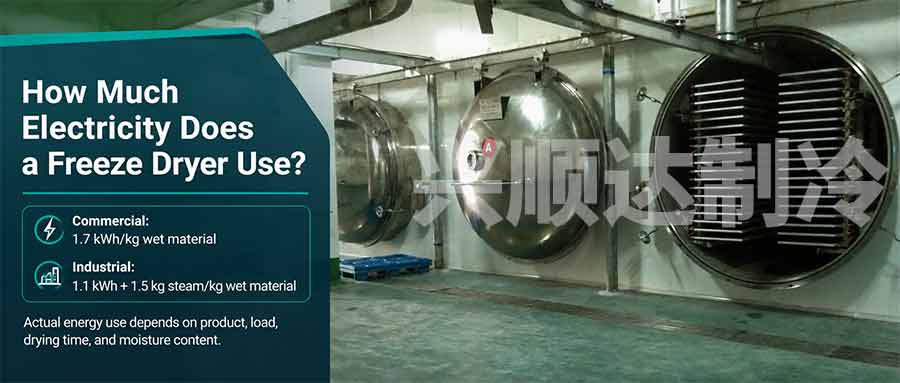
For example, in commercial food production, a practical planning reference is about 1.7 kWh per kilogram of wet material. In larger industrial production, the system may use about 1.1 kWh of electricity plus 1.5 kg of steam per kilogram of wet material.
However, these values are references, not fixed guarantees. Actual electricity use depends on product type, moisture content, slice thickness, loading density, freezing condition, drying curve, condenser capacity, and target final moisture.
Power Rating Is Not the Same as Real Electricity Use
At first, many buyers ask for the installed power of a freeze dryer. This number matters for factory power planning. However, it does not show the real electricity cost of each batch.
In addition, power rating is measured in kW. Electricity use is measured in kWh. For example, a machine with 100 kW installed power does not always consume 100 kWh every hour. During a freeze-drying cycle, refrigeration, vacuum, heating, control, and defrosting loads change by stage.
Why installed power can mislead buyers
- Refrigeration load changes during freezing and vapor capture.
- Vacuum pumps do not always run under the same load.
- Heating demand changes during primary and secondary drying.
- Thicker products can extend drying time.
- Overloading trays can increase total electricity use per batch.
Therefore, food manufacturers should not compare freeze dryers only by installed power. They should ask for estimated kWh per batch and energy use per kilogram of wet material.

How to Calculate Freeze Dryer Electricity Use per Batch
Next, the simplest calculation starts with wet material weight and reference energy use. As a result, this method connects energy cost with real production output.
For example, if a commercial freeze dryer processes 125 kg of cooked food per batch and the measured electricity use is 1.67 kWh/kg, the calculation is simple.
Therefore, this calculation gives a better business estimate than checking equipment power alone. For a full operating cost analysis that includes steam, labor, packaging, maintenance, and depreciation, buyers can read the full operating cost calculation.
Home, Pilot, and Production-Scale Freeze Dryer Electricity Use
In addition, different freeze dryer types need different energy metrics. For example, home users often care about household electricity bills. Food manufacturers need batch cost, daily output, and cost per kilogram.
| Freeze Dryer Type | Best Energy Metric | Main Buyer Concern | Best Use |
|---|---|---|---|
| Home freeze dryer | Watts, kWh/day, or cycle cost | Household electricity bill | Home food storage and small batches |
| Pilot freeze dryer | kW and kWh per test batch | Product testing and process validation | Trial production before investment |
| Commercial freeze dryer | kWh/kg wet material | Batch cost and daily output | Food business production |
| Industrial freeze dryer | kWh + steam/kg wet material | Factory-scale operating cost | Large food processing plants |
Because of this difference, a food factory should not use home freeze dryer electricity data for commercial investment planning. Instead, the factory should estimate electricity use from product testing, loading weight, drying time, and machine configuration.
Electricity Use for Commercial-Scale Food Production
However, a production-scale freeze dryer is not just a larger home unit. Instead, it is designed for higher wet material capacity, stronger refrigeration, better vapor capture, stable vacuum control, and repeatable batch production.
For Goodfreezedryer.com commercial-scale food production equipment, the average energy consumption reference is about 1.7 kWh per kilogram of wet material. Therefore, this reference helps buyers estimate electricity use before sample testing confirms final data.
| Model | Wet Material Capacity / 24h | Total Power | Reference Energy Use |
|---|---|---|---|
| SDG350 | 340–450 kg | 58.16 kW | About 1.7 kWh/kg wet material |
| SDG700 | 680–900 kg | 111.6 kW | About 1.7 kWh/kg wet material |
| SDG1100 | 1.02–1.36 tons | 155.9 kW | About 1.7 kWh/kg wet material |
However, actual energy use still depends on the product. Fruit, seafood, meat, pet food, cooked meals, and extracts may need different drying curves. Therefore, buyers should use product testing data before final model selection.
Buyers planning business production can compare suitable machine capacity by wet material load, drying time, power, site space, and energy use.

Electricity and Steam Use for Industrial-Scale Food Production
Meanwhile, large-scale freeze dryer energy use should not be calculated by electricity alone. For example, large food freeze-drying systems often use steam for heating support or defrosting. As a result, operating cost should include both electricity and steam.
For Goodfreezedryer.com industrial-scale food production equipment, a practical energy reference is about 1.1 kWh of electricity plus 1.5 kg of steam per kilogram of wet material.
| Model | Wet Material Capacity / 24h | Electric Power + Steam | Reference Energy Use |
|---|---|---|---|
| SDG1600 | 1.2–2 tons | 148 kW + steam | About 1.1 kWh + 1.5 kg steam/kg |
| SDG3000 | 3–4 tons | 279.7 kW + steam | About 1.1 kWh + 1.5 kg steam/kg |
| SDG6000 | 6–8 tons | 510.2 kW + steam | About 1.1 kWh + 1.5 kg steam/kg |
Therefore, industrial buyers should not ask only, “How much electricity does a freeze dryer use?” They should also ask about steam demand, defrosting method, condenser capacity, site utilities, and expected daily output.
For large projects, buyers can review production-scale equipment for 1.2–8 tons of wet material per 24 hours.
Real Case Examples of Freeze Dryer Electricity Use
In addition, real project data gives buyers a more practical view than general power claims. For example, the projects below show how product type, batch load, drying time, and utility method affect energy use.
| Product | Machine | Batch Load | Drying Time | Final Moisture | Energy Use | Estimated Batch Electricity |
|---|---|---|---|---|---|---|
| Cooked fried rice | SDG350 | 125 kg | 6 h | 1.28% | 1.67 kWh/kg | About 208.75 kWh |
| Blueberries | SDG1100 | 360 kg | 13 h | 1.97% | 1.8 kWh/kg | About 648 kWh |
| Durian | SDG1100 | 390 kg | 13 h | 2.09% | 1.73 kWh/kg | About 674.7 kWh |
| Meat chunks | SDG350 | 121 kg | 12 h | 1.49% | 1.77 kWh/kg | About 214.17 kWh |
| Shrimp | SDG6000 | 2,320 kg | 8 h | 1.68% | 1.02 kWh + 1.41 kg steam/kg | Electricity plus steam |
| Pear slices | SDG3000 | 1,200 kg | 12 h | 2.21% | 1.1 kWh + 1.5 kg steam/kg | Electricity plus steam |
Therefore, these examples show a key point: electricity use changes with product structure and process settings. A sliced fruit, a whole berry, a cooked meal, meat, and seafood do not dry in the same way.
Buyers can review more freeze dryer case studies to compare product type, drying time, vacuum range, final moisture, and energy use.
Simple Electricity-Only Cost Estimate
Finally, electricity cost depends on local power rates. Therefore, a simple formula can help buyers estimate batch cost.
For example, if a batch uses 208.75 kWh and the local commercial electricity price is 0.1392 USD/kWh, the calculation is:
However, this calculation only covers electricity. It does not include raw material, labor, packaging, maintenance, cooling water, steam, rent, or depreciation.
In March 2026, the U.S. Energy Information Administration reported average electricity revenue of 13.92 cents/kWh for the commercial sector and 8.58 cents/kWh for the industrial sector. Therefore, buyers in other regions should replace this value with their local tariff. See the U.S. Energy Information Administration electricity data for a public reference.
What Affects Freeze Dryer Electricity Consumption?
In addition, freeze dryer electricity use is not fixed. As a result, several production factors can increase or reduce the total kWh per batch.
Product moisture content
For example, high-moisture products usually need more energy because the machine must remove more water.
Slice thickness
Thicker pieces slow internal moisture movement. Therefore, they often need longer drying time.
Loading density
However, higher loading can improve capacity, but overloading can block vapor flow and increase batch time.
Drying time
Longer cycles keep refrigeration, vacuum, heating, and controls running for more hours.
Condenser capacity
Also, the condenser must capture vapor fast enough. Otherwise, a weak condenser can slow drying and raise cost.
Vacuum stability
Stable vacuum helps water sublimate efficiently and supports consistent product quality.
Heating method
In addition, commercial machines may use electric heating or a heat-transfer medium. Larger industrial systems may use steam-supported heating. Therefore, the best choice depends on factory utilities, energy prices, and production scale.

How to Reduce Freeze Dryer Electricity Use
However, reducing electricity use does not mean buying the cheapest freeze dryer. Instead, it means improving drying efficiency, batch stability, and product consistency.
- Control slice thickness: Avoid unnecessarily thick pieces.
- Use suitable loading density: Keep vapor movement clear inside the chamber.
- Confirm the drying curve: Use product testing before mass production.
- Choose enough condenser capacity: Strong vapor capture can support shorter cycles.
- Keep vacuum stable: Check sealing, pumps, valves, and sensors.
- Avoid blind oversizing: Match machine size to real daily output.
- Plan defrosting and cleaning: Less downtime improves daily production efficiency.
In other words, the best energy-saving step is not one single component. It is the combination of product testing, correct loading, suitable condenser capacity, stable vacuum, and trained operators.

When Should Buyers Ask for a Custom Energy Estimate?
Finally, a custom estimate is necessary when the buyer plans commercial or industrial food production. For example, this is especially important for fruit snacks, pet food, seafood ingredients, instant meals, herbs, extracts, and high-moisture products.
Therefore, before requesting a freeze dryer electricity estimate, buyers should prepare the following information:
Need a Freeze Dryer Electricity Use Estimate?
For example, send product details, daily capacity target, slice thickness, moisture information, and local utility conditions. Then, our engineers can help estimate suitable machine size, expected energy use, project layout, and quotation direction.
FAQ About Freeze Dryer Electricity Use
How much electricity does a freeze dryer use?
It depends on machine size, product load, moisture content, drying time, and heating method. For example, home units are often measured by daily kWh. However, commercial food freeze dryers are better measured by kWh per kilogram of wet material.
Does a freeze dryer use a lot of electricity?
A freeze dryer uses more energy than many simple drying machines because it combines freezing, vacuum, vapor capture, and controlled heating. However, commercial value can justify the energy cost when the finished product has a premium selling price.
How much electricity does a commercial freeze dryer use?
A practical reference for many commercial food freeze-drying projects is about 1.7 kWh per kilogram of wet material. However, actual use depends on product type, thickness, loading density, drying curve, and final moisture target.
How much electricity does an industrial freeze dryer use?
Industrial systems may use electricity plus steam. Therefore, a practical reference is about 1.1 kWh of electricity plus 1.5 kg of steam per kilogram of wet material.
Is installed power the same as electricity consumption?
No. Installed power shows the maximum electrical capacity. Instead, real electricity consumption depends on operating stage, load level, drying time, and product condition.
How do buyers calculate kWh per batch?
First, multiply wet material load by the measured or estimated kWh per kilogram. For example, 125 kg × 1.67 kWh/kg = 208.75 kWh per batch.
Why does fruit use different electricity than meat or seafood?
Because each product has different moisture content, structure, thickness, sugar level, fat content, and drying curve, drying time will change. As a result, energy use also changes.
Can a larger freeze dryer reduce electricity cost per kilogram?
It can reduce cost per kilogram when the machine is properly loaded and matched to factory utilities. However, oversizing can waste investment and reduce efficiency if the load is too small.
Should buyers choose electric heating or steam-supported heating?
The choice depends on production scale, local electricity price, steam supply, factory utilities, and daily output. For example, commercial projects often use electric or heat-transfer-medium systems. Meanwhile, larger industrial projects may benefit from steam-supported systems.
What is the best way to estimate freeze dryer electricity use?
The best method is to test the product, confirm drying time, measure energy use per kilogram, and then multiply kWh per batch by the local electricity price. Therefore, sample testing gives a safer estimate than power rating alone.
Data Sources and Planning Notes
In addition, the commercial and industrial energy references in this guide are based on Goodfreezedryer.com product data and customer case data. Meanwhile, public electricity price examples use U.S. Energy Information Administration data. Therefore, actual energy use may change with product moisture, cutting size, loading density, drying profile, site utility conditions, and target final moisture.